You’re probably looking at the same pattern a lot of Shopify brands are dealing with right now. Paid traffic is expensive, first-order conversion is stubborn, and the default answer keeps being another discount. So teams turn to bundles because they seem safer than sitewide markdowns.
That instinct is mostly right. Bundling can lift cart size without broadcasting that everything on your store is cheaper now. But the part most articles skip is the dangerous part. A bundle can raise AOV and still hurt the business if it eats margin, trains customers to wait, or inadvertently replaces full-price single-item purchases with lower-profit combinations.
That’s the essential job when you’re figuring out how to bundle products to increase AOV. You’re not just trying to make baskets bigger. You’re trying to make them bigger without weakening pricing power.
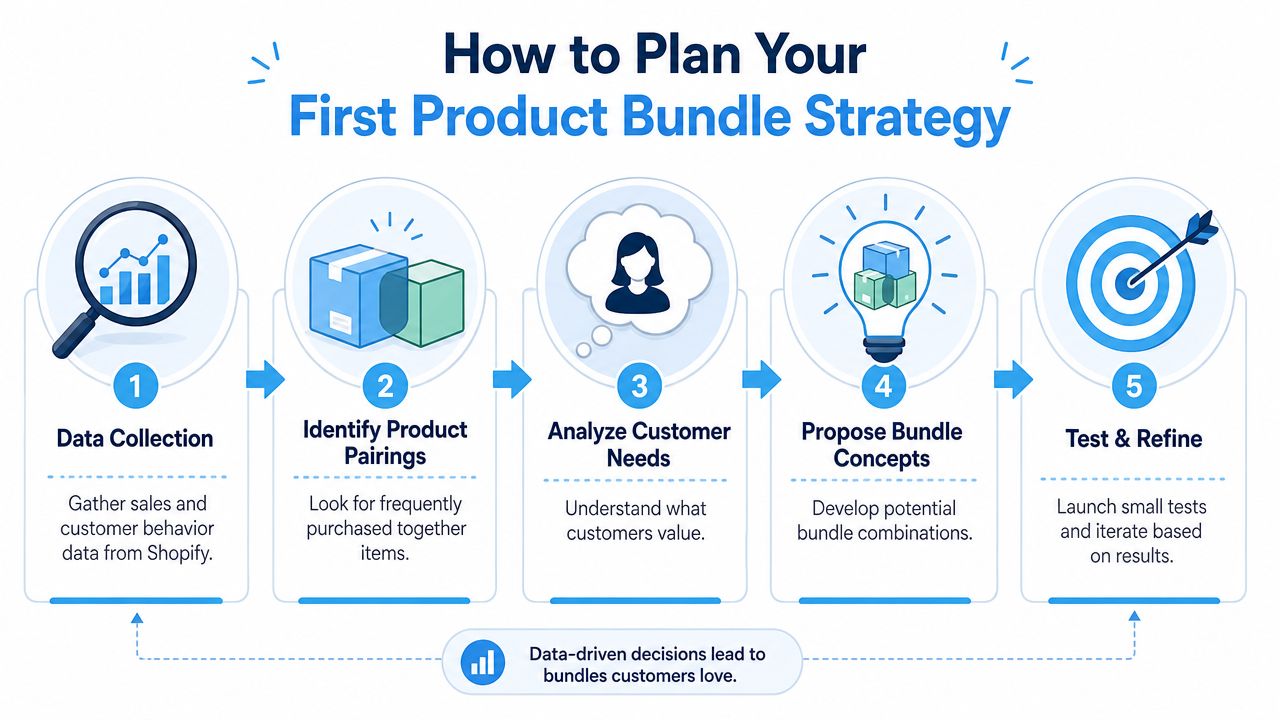
How to Plan Your First Product Bundle Strategy
Most weak bundles start the same way. Someone on the team picks three products that seem related, adds a small discount, and calls it a day. That’s not strategy. That’s packaging.
The better starting point is your own Shopify order history. If customers already buy certain products together, they’re showing you where the bundle opportunity is. When bundling is built on co-purchase behavior, it performs far better. Effective product bundling increases Average Order Value by 20–40% when grounded in market basket analysis that identifies co-purchase affinities, with best-in-class implementations achieving up to a 55% AOV lift and an 86% revenue-per-user increase according to Rework’s product bundling research.
Start with what customers already buy together
In Shopify, pull order data and look for repeat combinations. You don’t need a complicated BI setup to do this first pass. Start with:
- Top-selling SKUs that bring consistent product page traffic
- Orders containing two or more line items
- Pairs or trios that appear together repeatedly
- Products bought by first-time customers versus repeat buyers
If you use Shopify analytics alone, this can be a manual review. If you have a reporting app or a data tool connected to Shopify, use that to spot frequently bought together patterns faster.
A simple rule works well here. Pick one driver product, the item that earns traffic or initiates purchase intent, then pair it with a rider product, the item that completes the use case and often carries healthier margin.
For example, a cleanser rarely belongs in a bundle with a random sale item. It makes sense with a moisturizer, a serum, or a travel pouch if those products complete the routine the shopper already wants.
Build around a complete job, not a random discount
The strongest bundles solve a problem in one click. That’s why starter kits, replenishment packs, and routine builders keep showing up across categories.
Use this quick filter before you create anything:
- Would a customer naturally use these items together
- Does the bundle reduce decision friction
- Does the rider improve the economics of the order
- Would the bundle still make sense without a steep discount
If the answer to the fourth question is no, the offer probably isn’t strong enough yet.
Practical rule: If a customer needs the bundle explained, the bundle isn’t ready.
One useful outside perspective on this is SelfServe’s piece on leveraging product bundles for AOV, especially if you want examples of how bundle structure changes buying behavior.
Keep the first test narrow
Don’t launch six bundles at once. Start with one clear concept on one high-intent product family. Fixed sets are usually easier to read and easier to measure than a sprawling build-your-own experience.
A good first test has these traits:
| Element | What to choose |
|---|---|
| Traffic source | A product that already gets reliable PDP visits |
| Bundle logic | Complementary items with obvious use together |
| Margin profile | At least one included item with room to protect profit |
| Audience | Either first-time shoppers or repeat replenishment buyers, not both at once |
That focus matters because early bundle testing isn’t about proving bundling works in theory. It’s about finding where it works in your catalog.
Choosing the Right Bundle Type and Pricing Model
Once you know what belongs together, the next decision is structural. Many Shopify stores often get sloppy here. They pick a bundle type that creates friction, then blame pricing when it underperforms.
The right format depends on the product, the catalog depth, and how much flexibility your customer wants.
Match the bundle type to the buying behavior
Here’s the simplest way to think about the main formats:
| Bundle type | Best for | Risk |
|---|---|---|
| Pure bundle | Starter kits, routines, gift sets | Too rigid if customers want choice |
| Mix-and-match | Apparel, snacks, beauty shades, variety packs | Too many options can slow decisions |
| Add-on bundle | Accessories, care items, complements on the PDP or cart | Feels weak if the add-on looks irrelevant |
| Volume bundle | Consumables, supplements, refills | Can look like bulk discounting if overused |
If you sell consumables, volume bundles are often the cleanest entry point. Bundling complementary products is a primary tactic for lifting cart size, with specific success metrics tied to tiered volume discounts like “buy two save 10%, buy three save 20%” according to this breakdown of tiered volume discounts and cart growth.
That structure works because it gives the shopper a reason to buy ahead without forcing a flat markdown across the entire store.
Price the bundle from the margin up
Don’t start with “what discount sounds attractive.” Start with unit economics.
Use this order:
- Add up your true product costs
- Calculate your minimum acceptable gross profit for the bundled order
- Set the bundle price above that floor
- Only then decide how to frame the savings
That last step matters because presentation changes conversion. If the savings are real, make them obvious by showing the sum of individual prices next to the bundle price. That anchor effect is a big part of why bundling works.
When discounting does make sense, keep it controlled. Brands should generally target discount levels of 10% to 20% when margins stay above 50%, and use tighter 5% to 10% discounts for lower-margin categories based on the Swell bundling statistics overview.
Show the math clearly
A shopper shouldn’t need to calculate whether your bundle is worthwhile. Show:
- What’s included
- The individual item total
- The bundle price
- The exact savings
“Save $15” is often easier to process than “15% off” because it feels concrete and verifiable at a glance.
The strongest pricing pages make the shopper feel smart for buying the bundle, not suspicious that they’re being steered into a trick.
Bundles can also do useful work around shipping thresholds. A curated set that gets a shopper close to free shipping often performs better than a weak standalone cross-sell, because it closes the gap with a more coherent offer. If you want a deeper pricing framework for that balance, Quikly’s article on bundle pricing strategy is a practical reference.
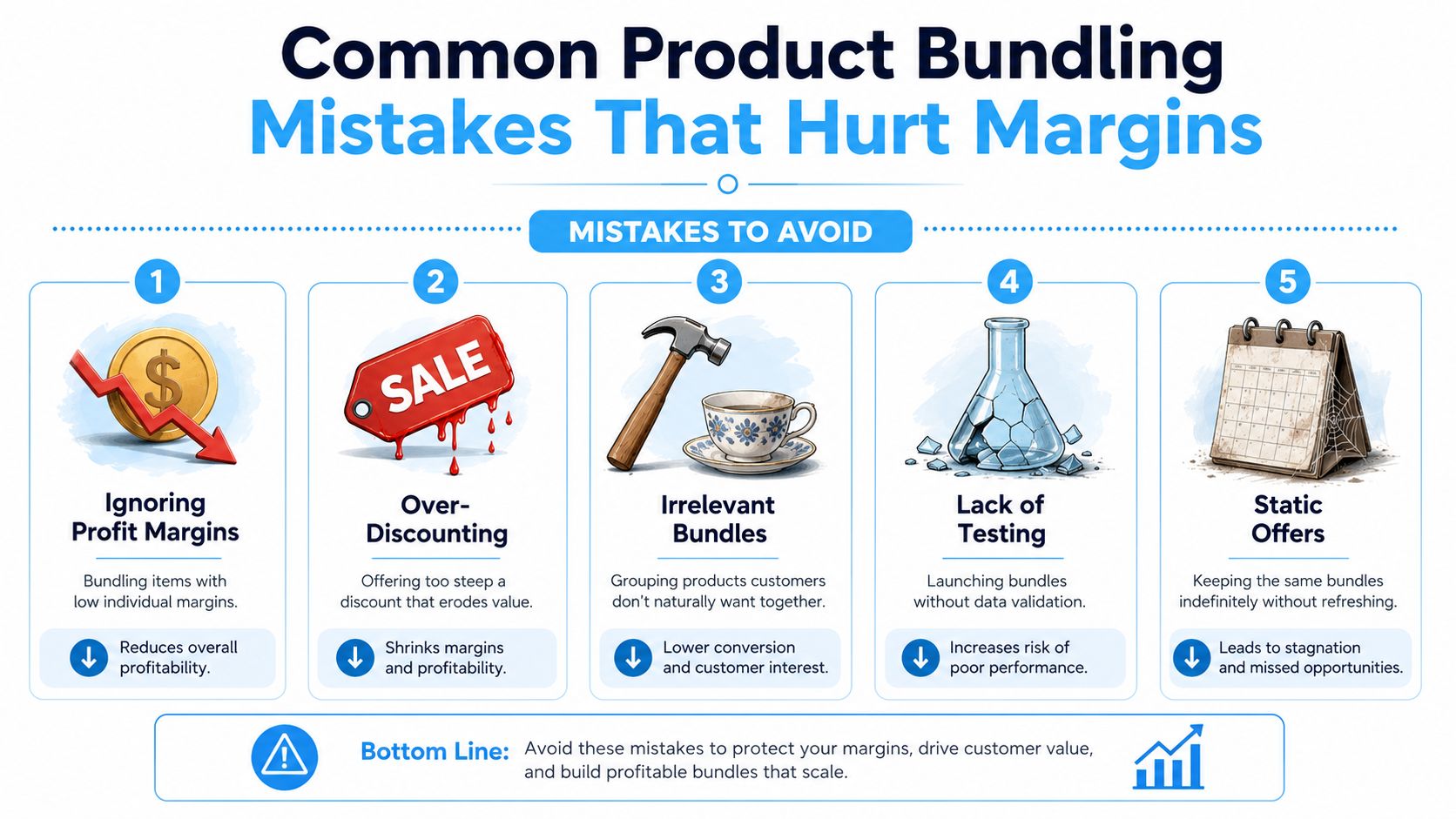
Common Product Bundling Mistakes That Hurt Margins
A store launches a bundle, AOV jumps, and the team calls it a win. Two months later, profit per order is flat, the hero SKU is no longer selling at full price, and repeat customers have learned to wait for the set instead of buying now.
That pattern is common because bundles can hide bad economics. Shopify reporting will show a larger cart. It will not warn you when the bundle is replacing a healthier purchase path or shrinking contribution margin on products that used to sell well on their own.
Cannibalization is usually the first margin leak
Many bundle strategies fail because they shift demand instead of creating new value. Voucherify’s bundling analysis notes that some bundle programs do not increase net revenue because shoppers move from higher-margin single products into discounted combinations.
The risk is easy to miss until you look at order mix:
- A hero SKU that used to sell at full price starts moving mainly through the discounted set
- An accessory gets added for “value” but lowers the perceived quality of the core product
- A bundle stays live too long and becomes the price customers expect
Once that behavior sets in, margin recovery gets harder. You are no longer testing a merchandising offer. You are retraining demand.
Run the breakeven math before the bundle goes live
A practical bundle check starts with one question. Does this offer produce more profit per visitor, or does it just make the cart look bigger?
Use a simple worksheet with three inputs:
| Check | What to compare |
|---|---|
| Standalone profit | Profit on the hero SKU sold alone |
| Bundle profit | Profit on the full bundle after discount |
| Required behavior change | How often the bundle must be accepted to beat the standalone baseline |
This catches weak ideas early. If a bundle lowers profit on the order, it needs to increase attachment rate, conversion rate, or new-customer take rate enough to justify the trade. If it cannot do that on paper, it rarely does it in market.
Margin check: A bundle that raises AOV while lowering contribution per visitor is not growth. It is a pricing mistake with better optics.
The operational mistakes that keep showing up
The most expensive bundle problems are usually simple.
Overbuilt offers slow people down. If shoppers have to decode choice rules, exclusions, tiered pricing, or variant logic, many will skip the bundle entirely. Keep the first version narrow and obvious.
Bad product pairing hurts brand perception. Premium products need matching companions. Pairing a high-consideration item with a weak add-on can make the entire offer feel cheaper, even if the math works.
Permanent bundles create pricing expectations you may not want. I have seen brands train loyal customers to hold off until the set returns, especially when the same combination stays available year-round. A better approach is to rotate bundles around specific use cases, seasons, or customer moments. These Shopify bundle ideas by customer intent and merchandising goal are a good model for that.
Promotion can create its own margin problem too. If paid traffic leads with the discount instead of the use case, shoppers compare price first and value second. Creative should show why the set belongs together, not just that it is cheaper. The same principle applies in paid social, where bundle ads need product context and clear use-case storytelling. This guide to Shopify video ad applications is useful if you are building creative around bundles without turning them into generic sale ads.
The safest bundles are easy to understand, hard to substitute, and easy to remove if they start eating into full-price demand.
Implementing and Promoting Bundles on Your Shopify Store
A bundle usually wins or loses at the point of presentation.
I have seen strong bundle logic underperform because the offer showed up in the wrong place, asked for too many decisions, or interrupted the buying flow. Implementation matters because margin risk begins to surface. A bundle that converts in the cart but pulls shoppers away from a higher-margin single-item purchase is not a win.
On Shopify, the goal is simple. Put the bundle in the few places where it feels like the next logical step, then remove every bit of friction you can.
Match the bundle to the surface
Placement should follow buying intent.
Product pages are the best fit for routine sets, starter kits, and obvious product pairings. The shopper is still evaluating the main item, so the bundle needs to strengthen that decision. If the bundle explains how to use the product better, complete the routine, or avoid a second purchase later, it belongs here.
Cart drawers and cart pages serve a different job. Use them for simple completion offers with low decision weight. Keep the copy short, the visuals clear, and the accept action easy. If the shopper needs to compare multiple versions, the offer is too complex for cart placement.
Collection pages and dedicated bundle PDPs work better for bundles built around a use case, season, or gift moment. That format gives you room to explain why the products belong together without crowding the core PDP experience.
Keep the setup tight
Bundle apps create a lot of self-inflicted problems. Teams add selectors, conditions, and variant options because they can, then wonder why attach rate stalls.
The cleaner path is usually the better one:
- Show one primary bundle on each PDP so the shopper has a clear default path.
- Preload sensible choices for mix-and-match bundles instead of forcing configuration from scratch.
- State the contents and savings early so the customer does not have to hunt for the value.
- Set inventory rules carefully so one out-of-stock item does not break the entire offer.
- Review contribution margin before launch because a bundle can raise AOV while lowering order profit.
That last point gets missed a lot. A bundle can look successful in Shopify reports while effectively discounting items customers would have bought anyway at full price.
If you need examples by category and shopping intent, this roundup of product bundle ideas for Shopify is useful for mapping the offer to the page type.
Promote the bundle like a solution, not a markdown
Off-site promotion should carry the same discipline as onsite merchandising. Lead with the use case, the outcome, or the convenience of getting the full setup in one purchase. Lead with price alone and you start teaching customers to evaluate the bundle like a sale item.
Email and SMS usually work well for replenishment sets, seasonal kits, and gift bundles because you can segment by purchase history. Paid social works when the creative shows the bundle in use and makes the pairing feel intentional. If your team is building those assets, this guide to Shopify video ad applications is a helpful reference for turning bundle value into ad creative that still feels product-led.
Good implementation protects both conversion and pricing power. The bundle should feel easy to buy, easy to understand, and specific to the moment the shopper is in.
Turn Bundles Into an Event Not a Permanent Discount
The fastest way to ruin a decent bundling strategy is to make it permanent.
If the same bundle is always available, customers stop reading it as a special offer. They read it as the new normal. That’s where brands get in trouble. The bundle no longer creates action. It creates hesitation because shoppers assume it will still be there later, or worse, that a better version is coming.
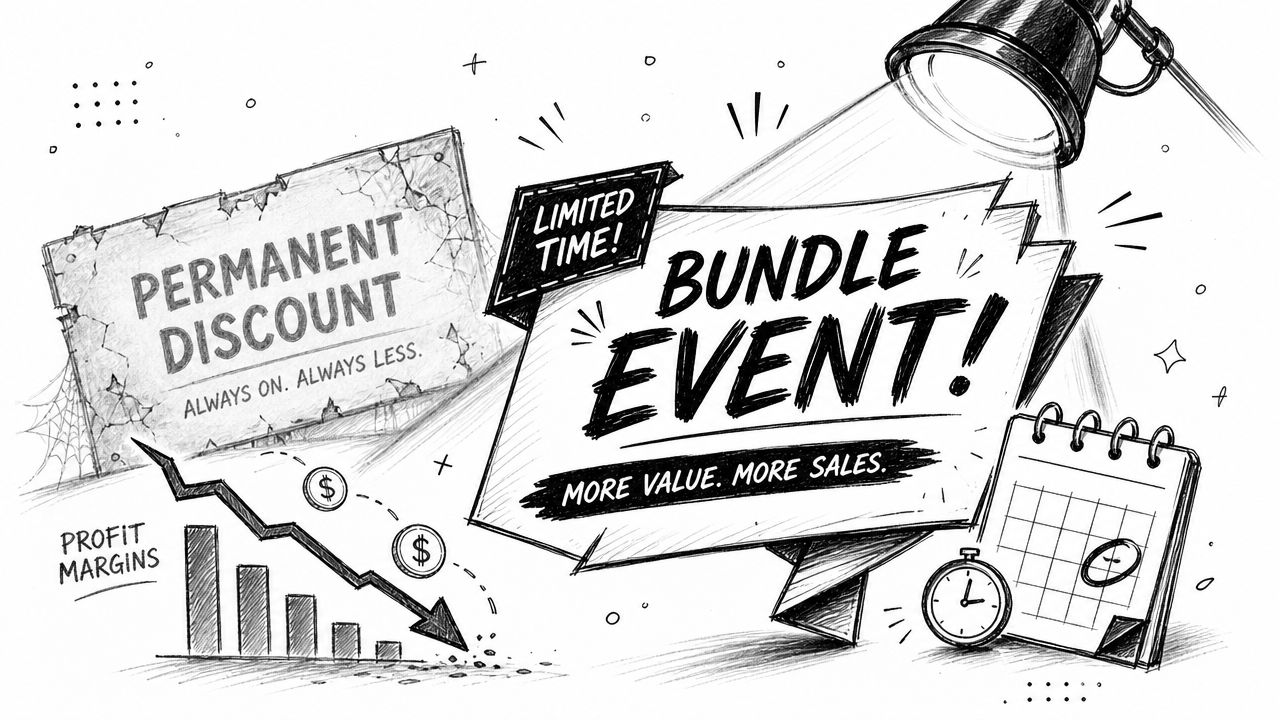
Predictable bundles train customers to wait
This is the hidden behavioral cost of bundling. The promotion may still convert some orders, but it changes customer expectations in ways that hurt future conversion and pricing power.
That problem is no longer theoretical. Recent DTC data indicates that 62% of shoppers delay purchases when they anticipate a bundle offer, mirroring the wait-for-markdown behavior seen with sitewide sales. Emerging best practices now emphasize descending-tier or capped-claim bundles to break this cycle, according to Recharge’s discussion of bundle timing and shopper behavior.
That should change how you think about bundles. The goal isn’t just “offer a package deal.” The goal is to create a reason to act now.
Use real scarcity, not decorative urgency
There’s a difference between pressure and clarity. A bundle event works when the customer understands that acting early matters because the offer is limited by time, quantity, or both.
That taps into a few well-known buying dynamics:
- Loss aversion, because people weigh missing a strong offer more heavily than they weigh saving the decision for later
- Scarcity bias, because limited access changes perceived value
- Commitment and consistency, because once a shopper starts engaging with a claimable offer, they’re more likely to complete it
The key is that the scarcity has to be real. If every “limited” bundle returns next week, shoppers learn the pattern.
What a healthier bundle cadence looks like
Instead of leaving bundles on all the time, use them in bursts tied to specific merchandising moments:
| Approach | Why it protects the brand |
|---|---|
| Quantity-capped bundle | The offer ends when the claim limit is reached |
| Time-bound bundle drop | Customers know exactly when the window closes |
| Descending-tier bundle | Early claimers get the strongest version, later claimers still get value but not the same deal |
| Seasonal curated set | Feels timely instead of permanently discounted |
This is the smarter way to preserve both urgency and pricing integrity. The customer experiences the bundle as an event, not as a standing markdown that conditions them to stall.
Measuring and Testing Your Bundles for Better Results
Once a bundle is live, don’t judge it on AOV alone. That’s the headline metric, not the diagnostic one.
A bundle program gets better when you track the full commercial picture and test the few variables that change behavior.
Measure the bundle like an operator, not a marketer
At minimum, watch these metrics each week:
- Bundle uptake rate, meaning how often eligible shoppers choose the bundle
- Margin per order, not just order value
- Standalone item sales, especially for hero SKUs that might be getting cannibalized
- Cart completion by placement, so you can tell whether the PDP, cart, or landing page is doing the work
If the bundle lifts AOV but drags down order profitability or weakens your strongest standalone product, that’s a sign to revise the offer.
A clean dashboard doesn’t need to be fancy. It needs to separate “bigger carts” from “better orders.”
Run a short testing cycle
The easiest tests are usually the most useful:
-
Pricing frame test
Keep the same bundle contents, but compare exact-dollar savings messaging against percentage-off framing. -
Composition test
Swap one rider product for another and see whether attachment improves without damaging margin. -
Placement test
Compare a PDP bundle module against a cart-drawer offer for the same product family.
A bundle shouldn’t be treated like set-and-forget merchandising. It’s a live offer that earns its place or loses it.
Keep those tests isolated. Change one thing at a time. If you want more ideas for expanding AOV systematically across Shopify, Quikly’s guide on increase AOV on Shopify is worth a read.
If you want bundling to drive action without turning into another permanent discount, Quikly is built for that. It lets Shopify brands run quantity-capped and time-bound promotional experiences that feel on-brand, create real urgency, and reward shoppers who act instead of training them to wait. That’s a better fit for teams trying to grow AOV while protecting margin and brand perception.
Topics: how to bundle products to increase aov, product bundling, shopify aov, ecommerce strategy, increase average order value