A Shopify store can report a healthy sales increase year over year and still leave the operator with less cash, weaker repeat demand, and customers waiting for the next discount. The percentage gets celebrated before anyone asks what produced it.
That question matters more now because online retail is growing faster than retail overall. U.S. ecommerce sales reached $340.2 billion in Q2 2026, up 12.2% year over year, while total retail sales rose 6.7%, according to the U.S. Census Bureau’s ecommerce data. Growth is available, but Shopify brands still need to separate durable demand from inflation, timing, channel mix, and promotional volume.
The practical standard is simple: grow comparable sales through profitable orders, stronger conversion, higher basket value, and more returning customers. Discounts can help, but they shouldn’t become the business model.
The Number That Lies to You
A year-over-year percentage is an answer to a narrow question: how did sales compare with the same period last year? It isn’t an explanation of why they changed.
A store can post a strong headline gain because a promotion created a temporary spike, a one-time wholesale order landed in the period, or a price increase lifted revenue while units stayed flat. A weak comparison base can make ordinary performance look exceptional. A few strong weeks can also conceal soft demand across the rest of the year.
That distinction matters for Shopify operators because the dashboard usually puts revenue first. The margin statement arrives later.
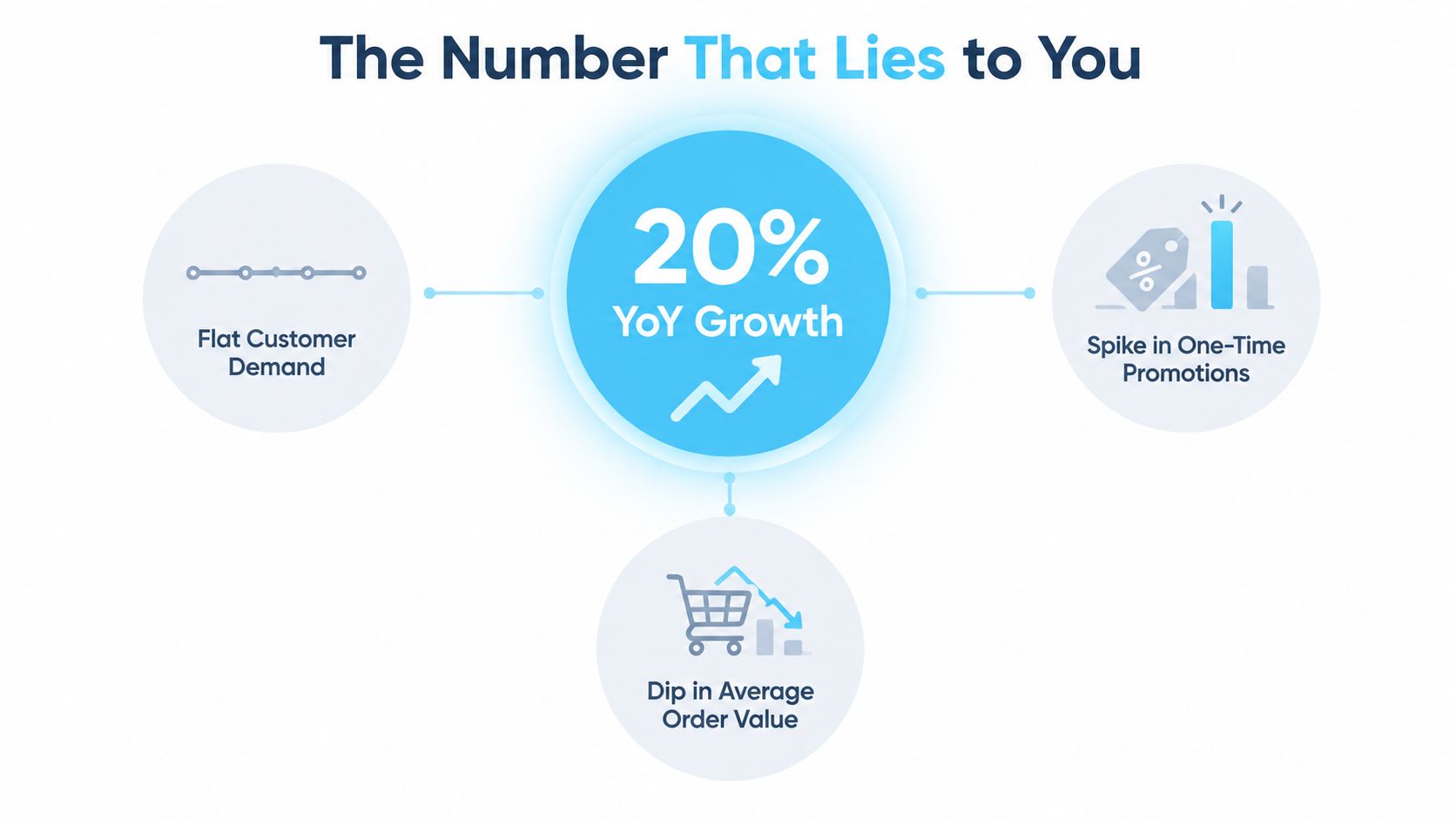
Why promotional volume can look like demand
The discount treadmill starts innocently. A brand offers a markdown, sees orders rise, and repeats the offer when the next period looks slower. Customers learn that waiting has value, so full-price intent weakens. The team then needs a more visible offer, a broader audience, or a deeper cut to create the same urgency.
This can increase reported sales while reducing gross margin and pulling future purchases into the current period. It can also change the customer mix, bringing in buyers who respond to price but don’t return without another incentive.
Practical rule: A sales increase is worth celebrating only when the incremental orders leave enough margin to support acquisition, fulfillment, service, and future retention.
Treat incrementality as a discipline, not a reporting label. A useful primer on incrementality testing for marketing campaigns can help teams distinguish sales that happened because of a campaign from sales that would’ve happened anyway.
The working definition for this article is therefore stricter than “revenue is higher than last year.” A meaningful YoY gain comes from a comparable base, survives margin review, and improves the customer economics that keep the next period healthy.
Build a Clean Baseline Before You Chase Growth
Before changing your theme, launching a campaign, or increasing paid spend, create a comparable-sales view. Same-store sales should use a fixed like-for-like base, including only stores or selling units open in both periods, excluding new openings and closures, and calculating growth as:
(Current comparable sales − prior comparable sales) ÷ prior comparable sales × 100
That standard applies naturally to physical retail, but Shopify brands need an equivalent discipline across products, channels, and customer cohorts. Total sales can rise because the store added a marketplace, expanded wholesale, launched a new collection, or acquired a different type of customer. Those changes may be valuable, but they shouldn’t be confused with organic growth from the existing business.
Clean the comparison period
Review the prior-year window line by line. Remove or separately label wholesale drops, unusual return activity, pricing tests, one-off launches, and campaigns that won’t repeat. Normalize calendar differences, including an extra weekend, a promotional event landing in a different week, or a major shopping period moving across reporting periods.
Practitioners also adjust comparable-sales analysis for remodels, relocations, seasonality, and calendar shifts, as outlined in this guide to comp sales calculations. For ecommerce, the same principle means comparing equivalent trading conditions rather than blindly matching dates.
Use a baseline table like this before setting the target:
| Adjustment | Why It Matters | How to Apply |
|---|---|---|
| New products or channels | Expansion can masquerade as organic demand | Report the new source separately, then compare the established base |
| Returns and cancellations | One period may contain an unusual reversal of prior orders | Use net sales consistently and flag abnormal return behavior |
| Pricing changes | Revenue can rise while unit demand weakens | Review units, realized price, and gross margin together |
| Promotional calendar | Timing can move demand between periods | Match comparable campaign windows and document the difference |
| Wholesale or B2B orders | A single account can distort DTC performance | Separate wholesale revenue from Shopify direct sales |
| Product availability | Stockouts suppress the prior or current period | Annotate unavailable SKUs and avoid treating lost demand as conversion weakness |
Put the right measures beside revenue
A clean scorecard should include contribution margin, repeat purchase rate, and net new customer share. Add units, refunds, discount cost, and fulfillment expense where those figures are available. The ecommerce performance metrics guide is a useful reference for building that wider view.
The baseline isn’t paperwork. It tells you whether the next lift came from more shoppers, better merchandising, larger baskets, or customers returning by choice. Without it, the team can optimize the easiest number to move, usually revenue, while missing the economics that determine whether growth lasts.
The Four Levers That Actually Move Year Over Year
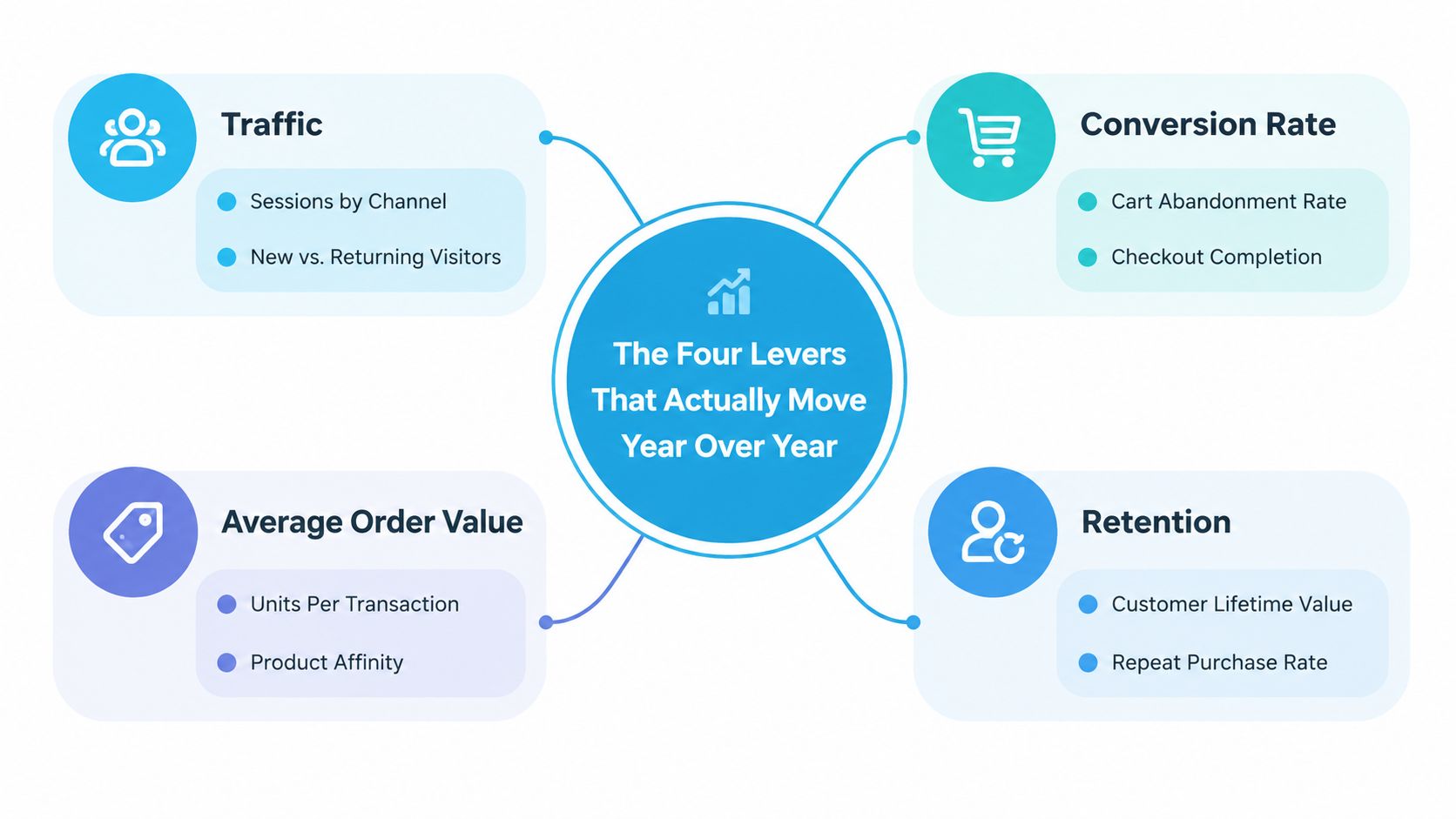
Revenue growth comes from four operating levers: traffic, conversion rate, average order value, and retention. They interact, so improving one while neglecting the others often produces a temporary result rather than a stronger annual business.
Traffic brings opportunity, not necessarily customers
Start with sessions by source, then separate new and returning visitors. Paid social can produce a large audience while bringing weak purchase intent. Branded search may convert efficiently but capture demand created elsewhere. The useful question is not “did sessions rise?” It’s “did qualified sessions create profitable first orders?”
Traffic growth works best when the landing page, offer, and product availability match the promise that earned the click. Otherwise, the acquisition budget grows while the customer base barely changes.
Conversion captures existing intent
Conversion rate depends on the path from product page to checkout. Review add-to-cart rate, checkout completion, mobile behavior, payment failures, and customer questions. A store with strong traffic but weak checkout completion doesn’t need more visitors first. It needs fewer points of hesitation.
Theme customization, faster mobile rendering, clearer delivery information, better product education, and trustworthy reviews can improve the path without lowering price. Standard popups often add another interruption without resolving the objection that stopped the purchase.
AOV increases the value of each order
Average order value grows through units per transaction, attach rate, product affinity, bundles, and thresholds that make a larger basket feel rational. A complementary product shown at the right point can outperform a blanket discount because it increases utility rather than reducing price.
Be careful with forced bundles. If the second item feels irrelevant, the store may lift nominal AOV while increasing returns or lowering customer satisfaction. Merchandising should make the larger basket easier to understand, not harder to accept.
Retention determines whether growth compounds
Repeat purchase rate and customer lifetime value tell you whether the first order created a relationship. AOV gains without retention reset the problem each January. Traffic gains without retention buy customers repeatedly instead of building an owned base.
Post-purchase education, replenishment reminders, product-specific email and SMS flows, loyalty benefits, and useful customer service all contribute. The ecommerce growth strategies resource offers additional context for connecting acquisition, conversion, and retention work.
For broader planning, a practical overview of actionable 2026 marketing strategies can help teams evaluate channel and creative priorities without treating traffic as the whole growth plan.
The multiplier framing is the important part. YoY sales improve when more qualified people arrive, more of them buy, each order carries useful value, and a meaningful share returns. Promotions should support those movements while staying inside the margin constraint.
Promotions That Lift Sales Without Training Customers to Wait
A promotion should reward early commitment, not hesitation. The distinction changes how you structure the offer, who sees it, and what you measure after the campaign ends.
Flat percentage discounts tell every shopper the same thing: the price is lower, and there’s no meaningful cost to waiting. Behavior-driven promotions create a reason to act now without making the regular price look artificial.
Use commitment-based mechanics
Tiered early access gives loyal customers or subscribers the first opportunity to claim an incentive. The reward can become less generous as the campaign progresses, provided the change is disclosed clearly. This uses scarcity bias and temporal discounting, shoppers value an opportunity more when the window is limited and delay has a visible cost.
Bundle anchors protect AOV by making the value of a multi-item purchase clear. Pair products with a real use case, such as a core item and its replenishment or accessory, then make the bundle benefit smaller than the cost of buying unnecessary inventory.
Free-shipping thresholds should sit above a contribution-margin floor. The threshold needs to encourage an additional item without turning shipping into an invisible subsidy on low-value orders.
Loyalty-exclusive discounts give existing customers recognition without teaching the entire audience to wait. Loyalty can also be expressed through early access, a bonus product, or an improved service promise rather than a deeper markdown.
Create urgency without manufacturing it
Scarcity works when the limit is real. Use capped quantities per SKU or a defined campaign window, and don’t fabricate inventory counts. Loss aversion can support a vanishing bonus, such as free shipping or an accessory available only during the active period, if the condition is clear and honored.
A time-boxed offer can close within 48 hours, but the exact window matters less than consistency and credibility. If every campaign extends, resets, or appears immediately after the last one, customers learn that the deadline has no meaning.
Audit every campaign against four questions:
- Incremental margin: What margin remains after the incentive, shipping, fulfillment, returns, and campaign cost?
- Redemption ceiling: How much exposure or inventory can the business support before the offer damages economics?
- Attribution window: How long after exposure will an order count as influenced, and what control group will challenge that assumption?
- Post-promo return rate: Did the offer bring customers who return products or return to purchase, or did it only pull forward existing demand?
Research on promotions and margin erosion emphasizes measuring sales and gross margin impact together, including promoted versus non-promoted sales and gross margin dollars. Revenue alone can’t tell you whether a promotion worked.
A promotion that pulls sales forward creates new timing, urgency, or basket value. One that pulls sales from next month borrows demand and leaves the following period exposed. The difference shows up in repeat behavior, non-promoted sales, and margin, not in the launch-day dashboard.
A Measurement and Testing Framework That Catches Real Lift
Campaign reporting should answer two separate questions: how many orders were associated with the promotion, and how many additional orders did the promotion cause. Shopify attribution often answers the first question more easily than the second.
Use a holdout wherever the audience and channel allow it. For example, reserve 10% of email subscribers or geographic regions as a control group, keep the campaign out of that group, and compare outcomes against the exposed audience. The holdout doesn’t need to be perfect to be useful, but it needs consistent selection and no conflicting offer.
Set attribution windows before launch
Write the window into the campaign brief before results arrive. A practical starting framework is below:
| Channel | Attribution Window | Test Duration | Primary KPI |
|---|---|---|---|
| Paid social | 1 day | Two weeks or longer | Incremental contribution margin per order |
| Email and SMS | 7 days | Two weeks or longer | Incremental orders and gross margin |
| Organic search | 14 days | Two weeks or longer | New customer contribution margin |
The windows above are operating assumptions for testing, not universal truths. Adjust them when the buying cycle, product category, or repeat interval makes a different period more credible.
Score the economics after the sale
Revenue belongs on the scorecard, but it shouldn’t lead it. Track gross margin per order, repeat purchase rate within 60 days, discount dependency ratio, and incremental customer acquisition cost.
The discount dependency ratio should show how much sales activity requires an offer. A rising ratio means the store may be increasing revenue while weakening full-price demand. Compare promoted and non-promoted customers separately, because averages can hide a deterioration in the core customer base.
For experiments, change one meaningful variable at a time. Keep the test running for a two-week minimum where volume and buying cycles permit, and use a 95% confidence threshold before shipping a permanent change. The point isn’t to make testing ceremonial. It’s to stop the team from converting a noisy weekend into a permanent pricing or merchandising decision.
A margin-aware scorecard gives finance a clear approval path. Growth owns the hypothesis, creative owns the message, operations confirms inventory and fulfillment capacity, and finance reviews the contribution economics before launch.
For a deeper treatment of control groups and causal measurement, use this guide to incrementality testing for ecommerce.
A 90-Day Execution Plan to Compound the Gains
A 90-day plan works when the team sequences the levers instead of launching every idea at once. Each phase should produce a cleaner input for the next one.
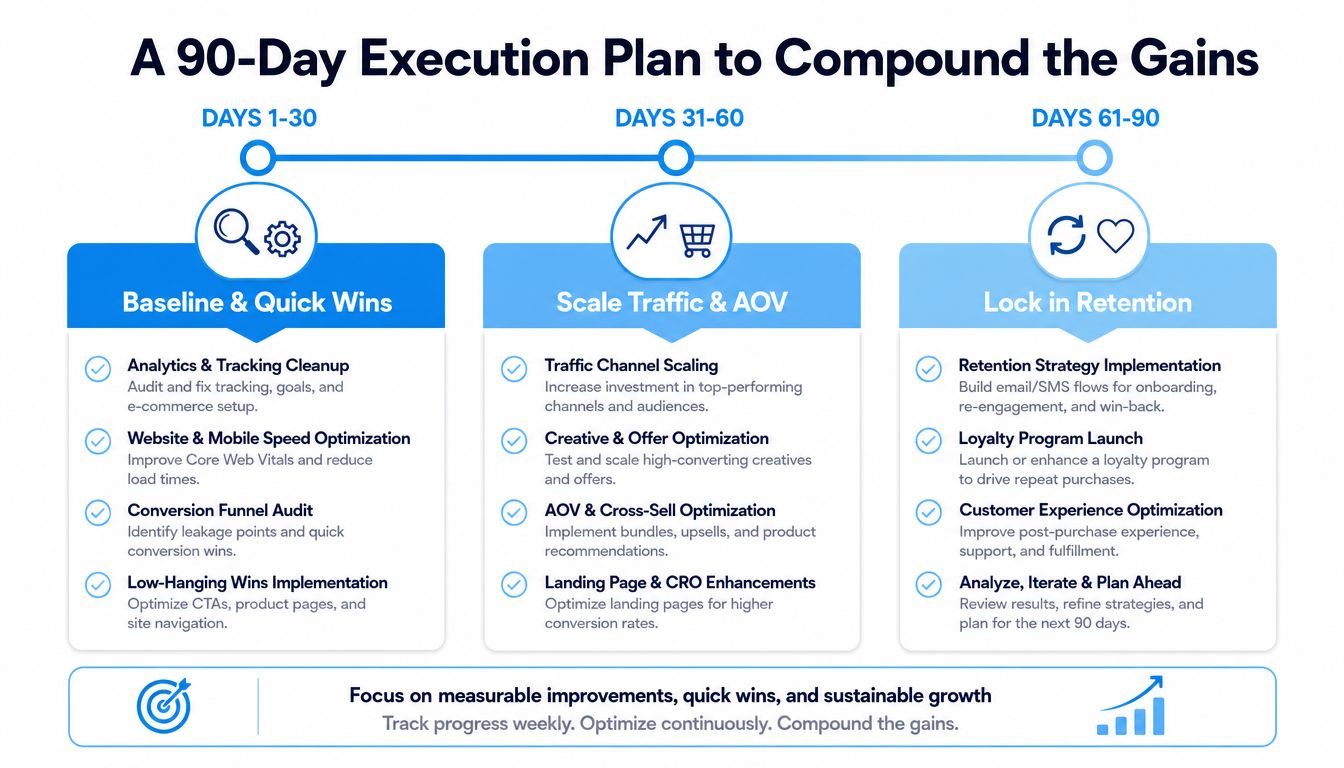
Days 1 to 30 establish the baseline
Audit analytics, product availability, returns, discount codes, channel tracking, and calendar comparisons. Confirm that Shopify reports, ad platforms, Klaviyo, SMS tools, and finance are using compatible definitions for orders, net sales, refunds, and attribution.
Then fix the obvious conversion leaks. Review mobile speed, product-page clarity, shipping information, payment failures, checkout friction, and merchandising for high-intent products. Don’t scale traffic into a path that still loses ready-to-buy visitors.
Days 31 to 60 improve basket value and retention
Test bundles built around product affinity, then review units per transaction, attach rate, gross margin, and returns. Set free-shipping or gift thresholds only after confirming that the incremental basket covers the cost.
Build post-purchase flows by product and customer intent. A first-time buyer should receive useful setup or usage guidance, while a replenishable product should receive a timely reminder. Add loyalty infrastructure if it gives customers a reason to return that isn’t another blanket markdown.
Days 61 to 90 scale what survived review
Increase paid traffic only after the conversion path and margin scorecard are stable. Use holdouts for major campaigns, audit the promotional calendar for overlapping offers, and retire promotions that merely shift orders from future periods.
Review the four checkpoints every week:
- Traffic quality score: Which sources bring engaged, purchase-ready visitors?
- Conversion rate delta: Did the change improve the intended step, not just total orders?
- AOV trend: Did bundles or thresholds increase useful basket value after returns?
- 60-day repeat rate: Are new customers coming back without excessive incentives?
The handoff should happen before launch. Growth defines the audience and target, creative confirms the promise, operations checks stock and fulfillment, and finance approves the margin floor and measurement design. After launch, the same owners review results together rather than letting each platform claim credit.
A durable sales increase year over year isn’t a single campaign win. It’s a repeatable operating rhythm that raises qualified demand, captures more intent, grows the basket, and earns the next purchase without weakening the brand.
Quikly helps Shopify brands turn existing promotions into time- and quantity-bound experiences that reward customers who act early, across storefront, email, social, and SMS. If you want to test urgency and scarcity without defaulting to deeper discounts, visit Quikly and evaluate the approach against your margin-aware growth plan.
Topics: sales increase year over year, Shopify growth, ecommerce conversion, AOV, retention marketing