The most popular advice on how to increase AOV in retail is to give shoppers another discount. That can produce a larger basket, but it can also leave you paying to sell merchandise the customer would have bought anyway.
For a Shopify merchant, the better question is which additional item, reward, or spending threshold produces more contribution after product cost, fulfillment, shipping, and incentives. The answer should also protect the next purchase. A profitable basket today isn’t much of a win if you teach the customer to wait for a sale tomorrow.
Pick the Basket Lever That Fits Your Margin
Average order value is revenue divided by orders, so increasing it means adding items to each order or raising the value of those items, not automatically cutting prices across the cart.
Start with the reason shoppers stop adding products. A shipping objection needs a different response from an accessory shoppers don’t know they need.
AOV levers compared by margin risk and fit
| Lever | How It Lifts the Basket | Margin Risk | Start Here When |
|---|---|---|---|
| Free-shipping threshold | Shoppers add items to reach a spend minimum | Shipping subsidy grows if the minimum sits too low | Shipping cost is the main checkout objection |
| Bundles | Pairs complementary products at one combined price | A broadly applied bundle discount reduces margin on every unit sold | Products share a clear use and buyers rarely add the second item |
| Checkout add-ons | Offers a relevant accessory before payment | Low risk when the add-on carries healthy margin | Accessory attach rate is low but the add-on is easy to explain |
| Tiered rewards | Unlocks a better reward at a higher cart value | Cost rises when shoppers reach upper tiers | Average cart clusters just below a useful target |
| Quantity-limited gift with purchase | Reward is capped by claims and tied to a minimum spend | Capped reward limits total exposure | You need urgency without a markdown |
| Personalized recommendations | Shows products matched to browsing and purchase history | Poor matches waste attention; full-price recommendations preserve unit margin | Catalog is broad and repeat buyers are common |
| Blanket sitewide discount | Lowers the price of the whole basket | High, with greater exposure as discounts deepen | Avoid as a default AOV lever |
Match the offer to the stalled basket
If shipping charges cause checkout exits, investigate a threshold before adding another coupon. If a hero product dominates orders and customers rarely buy its companion item, test a bundle or a relevant cart add-on.
For repeat buyers who already understand the range, tiered rewards can make an additional purchase worthwhile. But frequent visits alone don’t justify an incentive. Check whether those customers would naturally replenish soon, or you are just subsidizing their normal order.
Selection rule: Choose the smallest intervention that solves the actual basket problem.
Avoid making the blanket sitewide discount your default. It rewards existing purchase intent as generously as incremental spending, and repeated deeper offers lower the price shoppers expect next time.
Choose one lever and one primary margin-aware measure for the next thirty days. Contribution per order is a useful starting point; revenue per visitor provides a necessary check when the offer might change conversion.
How to Set Your Baseline and Margin Floor
A storewide average isn’t enough to price an incentive. You need to know what typical shoppers spend, which customers already place larger orders, and how much money remains after serving them.
Use a consistent accounting definition throughout. Merchandise revenue should be measured after discounts, with taxes excluded and shipping revenue tracked separately so you can see the shipping subsidy clearly.
Build the baseline before launching an offer
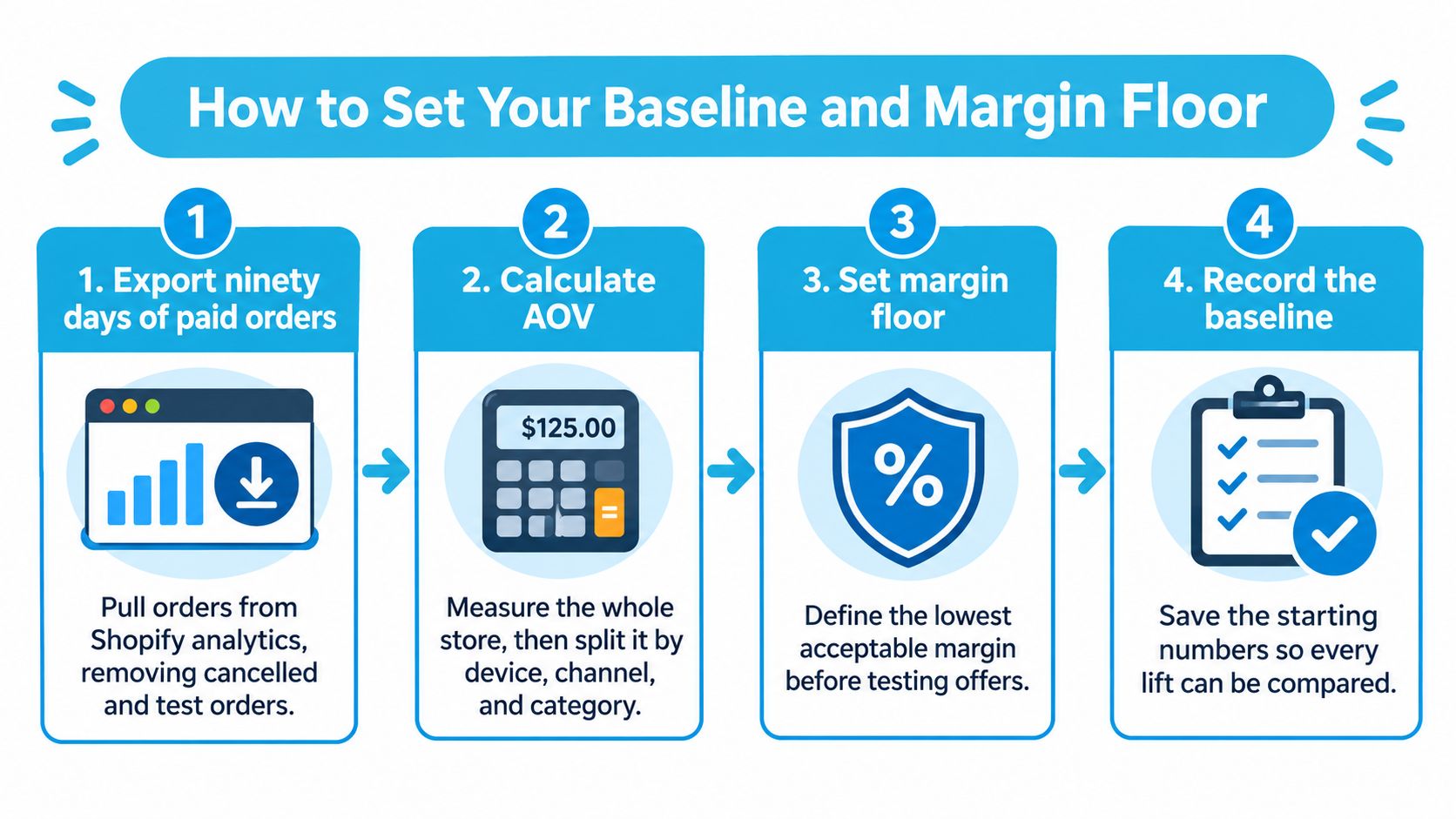
- Export ninety days of paid orders from Shopify. Remove cancelled and test orders. Separate wholesale from retail, and tag unusual bulk or corporate-gift purchases rather than letting them set the target for everyday shoppers.
- Calculate storewide AOV, then split it. Examine device, traffic channel, product category, and new versus returning customers. A low mobile basket may reflect awkward cart merchandising rather than weak demand.
- Calculate order economics. Subtract product cost and merchant-paid shipping from revenue after discounts. If you start with revenue before discounts, subtract the discount once, not twice.
- Find the median order value. The median shows the middle basket, while large orders can pull the mean upward. Inspect the basket distribution as well, because the gap between mean and median doesn’t tell you how many shoppers sit near a proposed threshold.
- Record the control measures. Save conversion rate, realized discount rate, units per order, refunds, and cancellations using the same reporting definitions you’ll use during the test.
- Set an attainable first target. Look for a spend level reachable with a relevant additional item. Match the lever to a low-basket segment with a clear merchandising opportunity, not the lowest number on the dashboard.
- Write down the margin floor. Define the lowest acceptable amount left per order after discounts and shipping, then include variable fulfillment, payment, reward, and expected return costs in your contribution calculation.
The operational sequence should be visible to everyone approving the campaign.
Make the floor a launch condition
Gross margin and contribution margin aren’t interchangeable. Keep the familiar gross-margin view, but use the fuller contribution calculation to decide whether an incentive deserves more exposure. Otherwise, extra handling or returns can disappear from the decision.
Don’t approve a reward because its retail value looks small. Approve it because its landed and fulfillment costs fit the incremental contribution.
Quikly’s Grow average order value solution lifts the basket without discounting the store. For initial planning, our free ROI Calculator shows a store’s revenue upside in 60 seconds. Treat that upside as a planning input, then validate the campaign against your own margin floor.
Set a Free-Shipping Threshold That Pays Its Way
A free-shipping minimum works best when shoppers can close the gap with something they want. Start a modest step above the median basket, then inspect the surrounding orders rather than applying a fixed percentage to AOV.
The behavioral principle is loss aversion: customers may prefer adding useful merchandise to paying a delivery charge. In a 2024 FedEx-commissioned study of 2,103 consumers and 510 U.S. merchants, 81% of shoppers said they’d add more items to avoid delivery charges, according to the FedEx Ecommerce Merchant Report. That finding supports testing the mechanic, not assuming every qualifying order is profitable.
Use category benchmarks as a reference
The following average minimums come from parcelLab’s 2025 analysis of U.S. retailers, and illustrate why a generic minimum isn’t a sound pricing rule.
Average minimum order value for free shipping by category
| Category | Average Minimum Order (2025) | First Check |
|---|---|---|
| Homeware | $45 | Is your median basket above this value? |
| Multi-category retail | $49 | Do add-on items close the gap at healthy margin? |
| Health and beauty | $61.25 | Does the gap fit a second product size or a refill? |
| Fashion | $73 | Do two-item bundles sit near the minimum? |
| Electronics | $139.50 | Do accessories cover the gap without shipping heavy items? |
A threshold below most existing baskets mainly grants a subsidy. An unreachable threshold offers little reason to change the order. The useful candidate sits where shoppers can add merchandise and the resulting contribution can cover the delivery cost.
Make qualification clear and economical
Show the remaining spend directly in the cart. A hypothetical message such as Add $12 to qualify for free shipping is more actionable than a banner announcing that free shipping is available.
Present a short selection of relevant, in-stock add-ons beside that message. Let customers add them without leaving the cart, and update eligibility immediately after quantity changes, discounts, or removals.
For a customer-facing reference, EP Fine Jewelry’s explanation of ways to qualify for free shipping is useful when considering how to explain eligibility. Quikly’s guide to a free-shipping threshold provides further context for structuring the offer.
Exclude oversized, heavy, or low-margin products from qualifying spend when their economics require it. Make those exclusions visible before checkout, and confirm that the Shopify shipping profile and promotion logic enforce the same promise.
Test a small set of candidate minimums, changing only one threshold per segment during a thirty-day run. Select the value that produces the strongest contribution per order without unacceptable conversion loss. Pause if refunds or cancellations breach your prewritten tolerance, and investigate whether customers added unwanted filler to qualify.
Build Bundles and Tiered Rewards That Hold Margin
A good bundle removes a buying decision. A weak bundle combines products that happen to be available and adds a discount to make the combination look attractive.
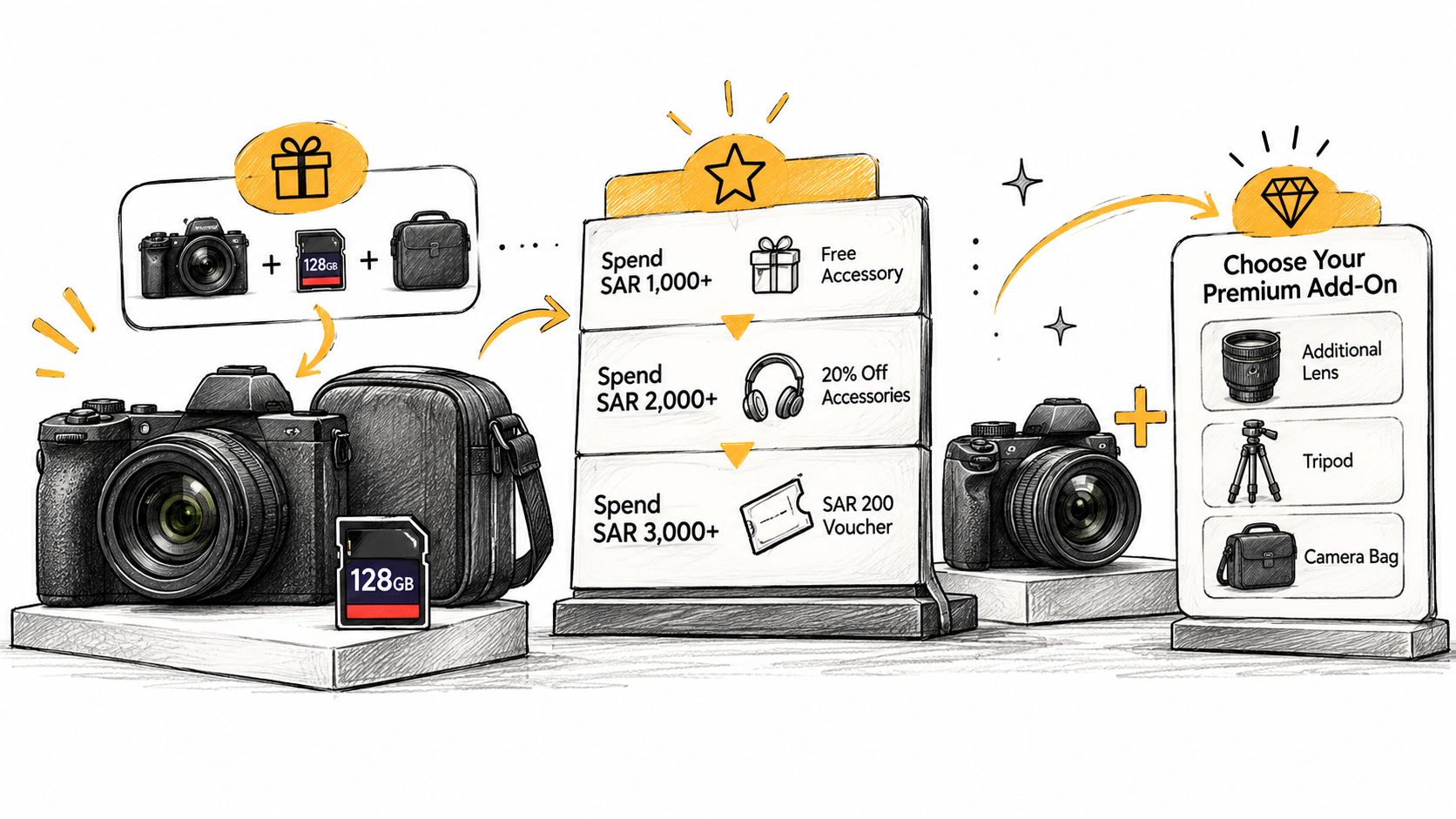
Build around a shared use, then decide exactly which component can fund the incentive. The camera example below makes the distinction clear.
Choose a structure with a defined cost ceiling
A complementary bundle pairs a camera body with a compatible memory card and case. Keep the camera’s anchor price intact and allocate any discount to the accessories. Check stock availability across the components so the offer doesn’t sell a combination you can’t fulfill.
A tier gate offers a small accessory at an initial spend level and a more valuable gift at a higher level. Price each step against the contribution from the additional merchandise. Don’t assume an upper tier is profitable merely because its basket is larger.
A quantity-limited reward caps eligible claims, while a time-bound version closes at a stated deadline. A descending reward becomes less generous as earlier shoppers claim it. This gives customers a reason to act while keeping the deepest reward from reaching every order.
For bundle construction, use Quikly’s bundle pricing strategy guide. Cometly’s guide to increase SaaS revenue through upselling offers a cross-industry perspective on moving buyers toward greater value, though physical retail requires separate checks for inventory, shipping, and returns.
Use scarcity without overstating its evidence
In an experiment involving 182 participants shopping in an online milk-tea store, limited-quantity and limited-time messages increased perceived arousal, which contributed to impulse purchases, according to the published scarcity experiment. That supports scarcity bias as a relevant mechanism, not a guaranteed retail AOV lift.
Apply it to a useful bundle or an earned gift, with a real claim cap or closing time. Resetting deadlines and implausible availability claims undermine the reason customers should believe the offer.
Before launch, document:
- Per-order ceiling: Include the reward’s landed cost, additional pick-and-pack work, and shipping impact.
- Campaign exposure: Reserve enough inventory for eligible claims and enforce the cap.
- Return treatment: State how partial returns affect bundle pricing or gift eligibility.
A reward passes only when its cost fits the margin available from the additional purchase.
Use Personalization to Lift Baskets Without Discounting
Personalization gives shoppers a relevant reason to add an item instead of a financial reason to tolerate an irrelevant one. In its 2021 research, McKinsey found that 71% of consumers expected personalized interactions, while 76% became frustrated when companies didn’t provide them; personalization most often produced a 10% to 15% revenue lift, with company-specific results ranging from 5% to 25% depending on sector and execution.
Those are revenue findings, not promises of equivalent basket growth. For AOV, relevance must translate into an additional product that earns its place at full price.
Put recommendations where they answer a buying question
- Product pages: Show a compatible companion to the item being viewed. A lens cloth beside a camera is straightforward; an incompatible lens creates doubt.
- Cart pages: Recommend an item that fits both the cart’s contents and the remaining threshold gap. Exclude products already present and unavailable variants.
- Post-purchase email: Use Shopify purchase history in Klaviyo to suggest the appropriate refill or companion product. Measure this as a subsequent-order opportunity, not an increase to the completed order’s AOV.
Start with explicit compatibility and category rules before adding more complex recommendation logic. Clean variant data, accurate product relationships, and reliable order history matter more than a long list of suggested items.
Require recommendations to earn their space
Track click-through and attach rate, meaning the share of relevant orders containing the companion product. Then check conversion and contribution: extra clicks aren’t useful if shoppers become distracted before payment.
Quikly’s guide to personalization on websites provides context for applying relevance across the storefront. Keep the recommendation itself free of a discount, so you can tell whether the product match works before spending margin to support it.
Stop Teaching Shoppers to Wait for the Next Sale
A larger promotional basket can come at the cost of weaker pricing habits. When shoppers repeatedly see the same sale, they may delay buying because waiting seems likely to bring a better deal.
A Total Retail analysis citing McKinsey reported that 10% to 15% of promotions at even top-performing grocers can dilute sales and margins. That finding concerns grocery promotions, but the lesson applies broadly: a larger basket is not necessarily incremental growth if the promotion gives away margin on purchases that would have happened anyway.
Make the reward conditional, not routine
An always-available percentage-off offer resets shoppers’ expectations about price. A conditional reward ties the benefit to a specific action, such as reaching a basket minimum during a defined event.
Set eligibility and end conditions clearly. Email or SMS can explain them to returning buyers before they visit. Suppress conflicting offers so shoppers do not see an expiring reward alongside an easier, always-available coupon.
A promotion should give shoppers a reason to act now without suggesting that full price is a mistake.
Quikly turns existing promotions into urgency offers capped by time, claim count, or both. Its campaigns are styled to match the store. The reward goes to shoppers who act within the offer’s limits, rather than becoming an automatic markdown customers can expect at any time.
Treat brand results as evidence to test
Quikly’s approach has been refined across more than 60 million consumer interactions. R., VP Digital at Jordan Craig, said there was a very clear incremental lift as soon as Quikly was turned on. That is one brand’s experience, not a forecast for another store.
LikeAir’s team said Quikly increased its AOV significantly and nearly doubled its conversion rate. TeeTurtle, an apparel brand, said it saw an increase in AOV and conversion from day one of its first campaign. These results show what brands have reported; your own economics depend on the reward cost and whether the sales are incremental.
Check what happens after the campaign, too. If returning customers buy only when an offer is active, or discount depth has to increase from one event to the next, the promotion may be training them to wait. Watch whether full-price purchasing holds in the following month, not just whether campaign-day revenue rises.
Measure Basket Lift Against Margin in a 30-Day Test
A winning AOV test raises basket value and revenue per visitor while preserving or improving margin per order after discounts and shipping. Use contribution after other variable costs as the final economic check.
Run the reward against a randomized holdout where possible. A comparable prior period is a weaker fallback because seasonality, acquisition campaigns, and product availability can change the result. Keep traffic allocation stable during the thirty-day test.
Metrics to track in an AOV test
| Metric | What It Tells You | Win Looks Like |
|---|---|---|
| Average order value | Whether baskets grow | Test arm rises above control over the same period |
| Gross margin per order | Whether added items are profitable after discount and shipping | Holds or rises against baseline |
| Conversion rate | Whether the offer changes the decision to buy | Holds or rises |
| Revenue per visitor | Combined effect of conversion and basket size | Rises above control |
| Units per transaction | Whether shoppers add items rather than just paying more per item | Rises above control |
| Realized discount rate | True cost of the reward across all orders | Stays within the budget set before launch |
| Full-price repeat rate | Whether shoppers buy without a promotion afterward | Holds against the pre-test baseline |
Set the decision rules before reading results
Keep customer assignments consistent so repeat visitors don’t move between treatment and control. Record exposure, reward claims, completed orders, and actual reward cost rather than relying only on coupon redemptions.
Choose the minimum commercially meaningful improvement before launch, then estimate the required sample using baseline conversion and order-value variability. Wait until each arm has enough orders to distinguish that improvement from noise. Don’t stop on the first strong day; extend the test if the scheduled window produces insufficient evidence.
Check what happened after the rush
A campaign spike followed by a dip may indicate pulled-forward purchases rather than additional demand. Review subsequent spending alongside refunds, cancellations, and full-price repeat purchases before declaring a lasting win.
Write keep, adjust, or drop next to each lever’s baseline and test results. Keep a profitable, repeatable improvement. Adjust an offer with a clear eligibility or merchandising problem, and drop one that buys basket growth at the expense of customer economics.
Quikly helps Shopify merchants build time- and quantity-bounded rewards that encourage larger baskets without discounting the whole store. Visit Quikly to explore a minimum-spend campaign, then test it against a holdout using your contribution floor and full-price repeat rate as guardrails.
Topics: AOV in retail, average order value, free shipping threshold, product bundling, retail promotions