Cyber Week 2025 average order value was flat overall despite heavy discounting, according to Stripe’s guide to increasing average order value. That’s a useful correction to the idea that a stronger promotion automatically creates a larger basket. Shoppers still need a relevant reason to add something, and the merchant still needs to earn money on it.
To increase AOV in ecommerce, start with the economics of the additional item, not the size of the discount code. For Shopify merchants, the practical sequence is to calculate break-even, choose a complementary product or reachable spending threshold, and test it without subsidizing every order.
A bigger cart is worth pursuing when it produces more contribution profit without weakening conversion or teaching customers to wait for another sale.
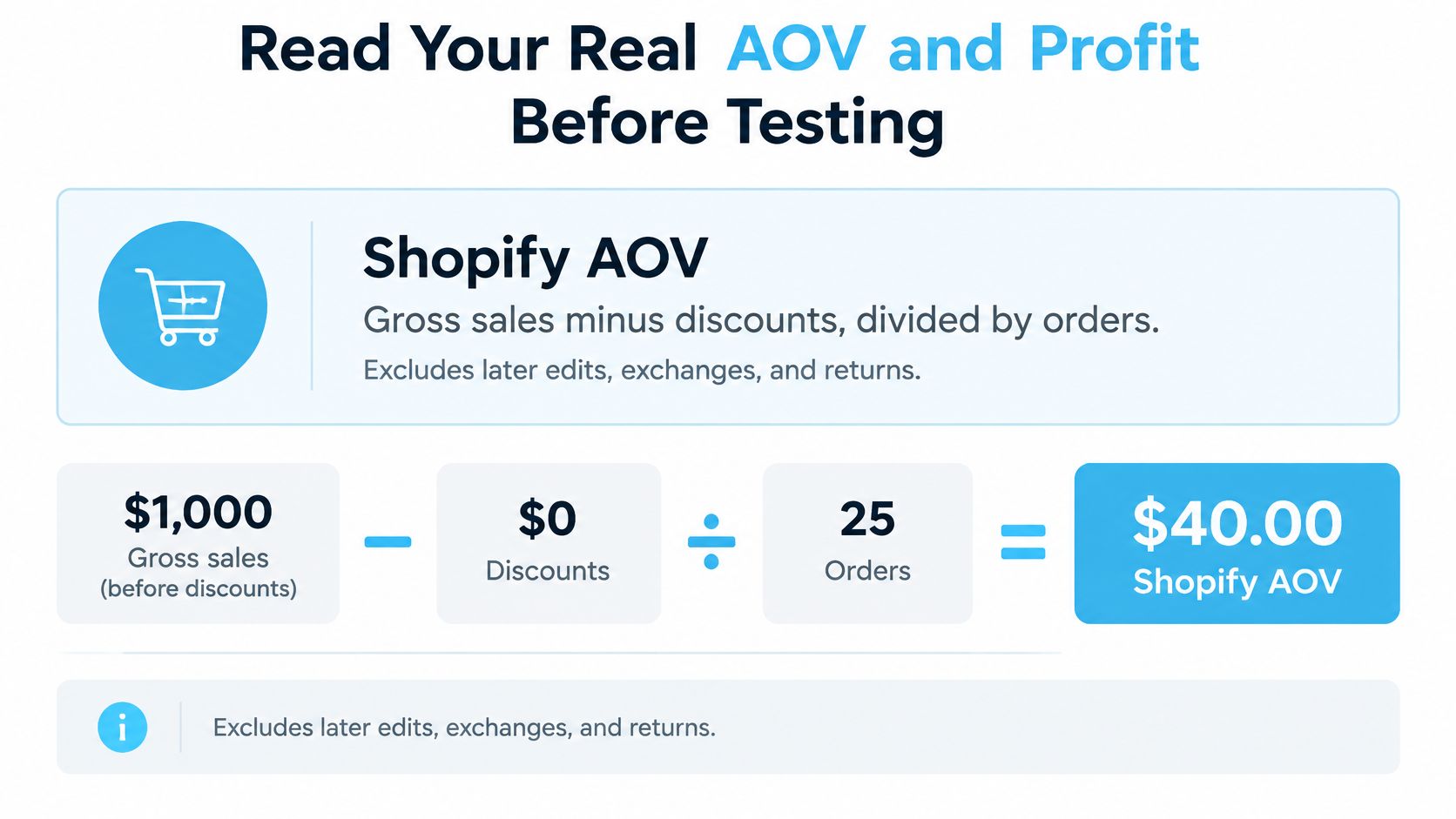
Read Your Real AOV and Profit Before Testing
Shopify’s reported average order value is gross sales minus discounts, divided by orders, excluding later adjustments such as edits, exchanges, and returns. The Shopify sales report documentation illustrates this with $1,000 in gross sales, $200 in discounts, and 10 orders, producing an $80 AOV.
That definition matters because your Shopify AOV report isn’t a return-adjusted profit report. You can increase the reported number while customers return the additional products or while shipping subsidies consume the extra revenue.
Global ecommerce AOV increased from $110.40 in 2020 to $117.40 in 2025, approximately 6.3%, according to Statista. That series measures orders after discounts and returns, so it shouldn’t be treated as directly interchangeable with Shopify’s reporting definition.
The useful operating lesson is that basket growth isn’t automatic. More traffic can produce more orders without changing what shoppers put in them.
Establish a baseline you can actually compare
Pull Shopify’s AOV-over-time report for a campaign period and a quieter period with comparable trading conditions. Check for changes in product availability, acquisition mix, and customer mix before attributing the difference to an offer.
Record baseline AOV excluding shipping, average shipping expense, gross margin, and conversion rate. Then add the variable costs that determine what you keep: payment processing, picking, packaging, shipping subsidies, and expected returns.
Keep those definitions consistent across the treatment and holdout. A practical ecommerce analytics framework should let the team reconcile the promotional dashboard with actual order economics, rather than maintaining separate versions of success.
Calculate break-even before choosing the reward
Use this rule when the added merchandise has a reasonably stable contribution margin:
Break-even rule: Extra basket value multiplied by the incremental contribution margin rate must exceed the additional reward and fulfillment costs.
As a hypothetical example, a $40 basket at a 40% contribution margin produces $16 before any new promotional cost. If a gift and shipping subsidy add $5 to a qualifying order, the added merchandise must generate more than $5 in incremental contribution just to improve that order’s result.
Apply the reward cost to every order receiving it, including orders that would’ve qualified without changing their contents. Counting only the shoppers who added something makes an expensive promotion look artificially efficient.
Don’t subtract the same discount twice. If your contribution rate already uses revenue after discounts, include only additional costs that haven’t yet entered that calculation.
Profit checks beside the AOV line
| Metric | What it catches | Pass signal |
|---|---|---|
| Contribution profit per order | Discount, shipping subsidy, and pick cost | Profit per order up, even if AOV rose only modestly |
| Gross margin after promotion | The discount cutting the revenue numerator | Margin rate holds versus the holdout |
| Return-adjusted revenue | Bundles people send back | Refund rate no worse than the control |
| Repeat purchase by offer | Customers who only return for a deeper code | Offer buyers reorder without a richer discount |
| Full-price conversion | The offer replacing a sale that would have happened anyway | Holdout still buys the core item at full price |
The margin concern isn’t theoretical. The FedEx 2025 Holiday Ecommerce Trends Report found that 78% of consumers considered promotions and discounts important to purchase decisions, while smaller businesses reported reducing promotions because higher costs had damaged margins.
Track customer quality alongside immediate profit. Compare offer-acquired buyers with organic and returning customers, and inspect whether they reorder at sustainable prices. A large opening basket followed by demands for richer codes isn’t evidence of loyalty.
AOV Tactic Benchmarks You Can Plan Against
Planning benchmarks for ecommerce AOV tactics
| Tactic | Acceptance or behavior | Reported AOV effect | Margin watchout |
|---|---|---|---|
| Targeted upsell | About 4–8% acceptance, per EcomHint’s benchmark summary | About 10–20% AOV lift, in the same summary | Don’t discount an item they would buy at full price |
| Relevant bundle | About 6–10% acceptance, in that summary | About 15–25% AOV lift, in that summary | Irrelevant kits can raise refunds and support cost |
| Cross-sell and upsell mix | Not an acceptance rate | An upper-range estimate of 10–30% of ecommerce revenue, cited in that summary | Treat as a ceiling, not a campaign goal |
| Free-shipping threshold | Shoppers add items to qualify | Threshold orders had 24% higher AOV, according to UPS data cited by ContentMation | A bar near current AOV changes little; an unrealistic gap discourages participation |
| Capped reward at a minimum spend | Limited by quantity, time, or both | Compare with an always-on discount control | Judge profit per visitor, not basket size alone |
These are planning ranges, not promises. The rows don’t describe identical audiences, store economics, or experimental conditions. The revenue-share estimate also isn’t an AOV lift, so it shouldn’t be compared directly with the upsell and bundle ranges.
Use the table to shortlist an experiment, not to forecast revenue by multiplying a benchmark into your sales plan. Your catalog, existing attach rate, and discount exposure determine how much incremental opportunity remains.
Choose the lever that matches the purchase
A targeted upsell offers a higher-value substitute after the shopper has established product intent. Commitment and consistency matter here: the shopper has already chosen a direction, so the upgrade should improve that choice rather than restart the decision.
A relevant bundle reduces the work of assembling a complete solution. A care kit paired with a product has a clearer purpose than a collection of slow-moving stock grouped under a discount badge.
A shipping threshold makes purchase progress visible. Loss aversion can matter when the shopper is close to qualifying and would rather retain the available benefit than abandon it. That doesn’t justify pushing someone toward a substantially larger purchase than they intended.
Scarcity bias applies to a capped reward only when the limit is genuine. A finite allocation gives shoppers a reason to decide while the benefit remains available; a countdown that resets doesn’t communicate a trustworthy constraint.
Separate acceptance from incrementality
An accepted recommendation isn’t automatically an incremental sale. The shopper may have intended to buy the add-on anyway, or may replace another profitable item with the promoted one.
Inspect the changed basket, not just the click. Track offer exposure, acceptance, additional units, discount expense, refunds, and contribution. Compare exposed shoppers with a randomized holdout before claiming the offer created the extra demand.
For a capped reward, an always-on discount can serve as an additional comparison when traffic supports it. That helps distinguish the effect of bounded availability from the effect of lowering the price.
A tactic with a smaller reported AOV lift can still be the better choice if you retain more margin and customers keep the products.
I would start with the lever that requires the least subsidy to solve a recognizable purchase problem. Don’t add a shipping incentive when a useful, full-price accessory could complete the basket.
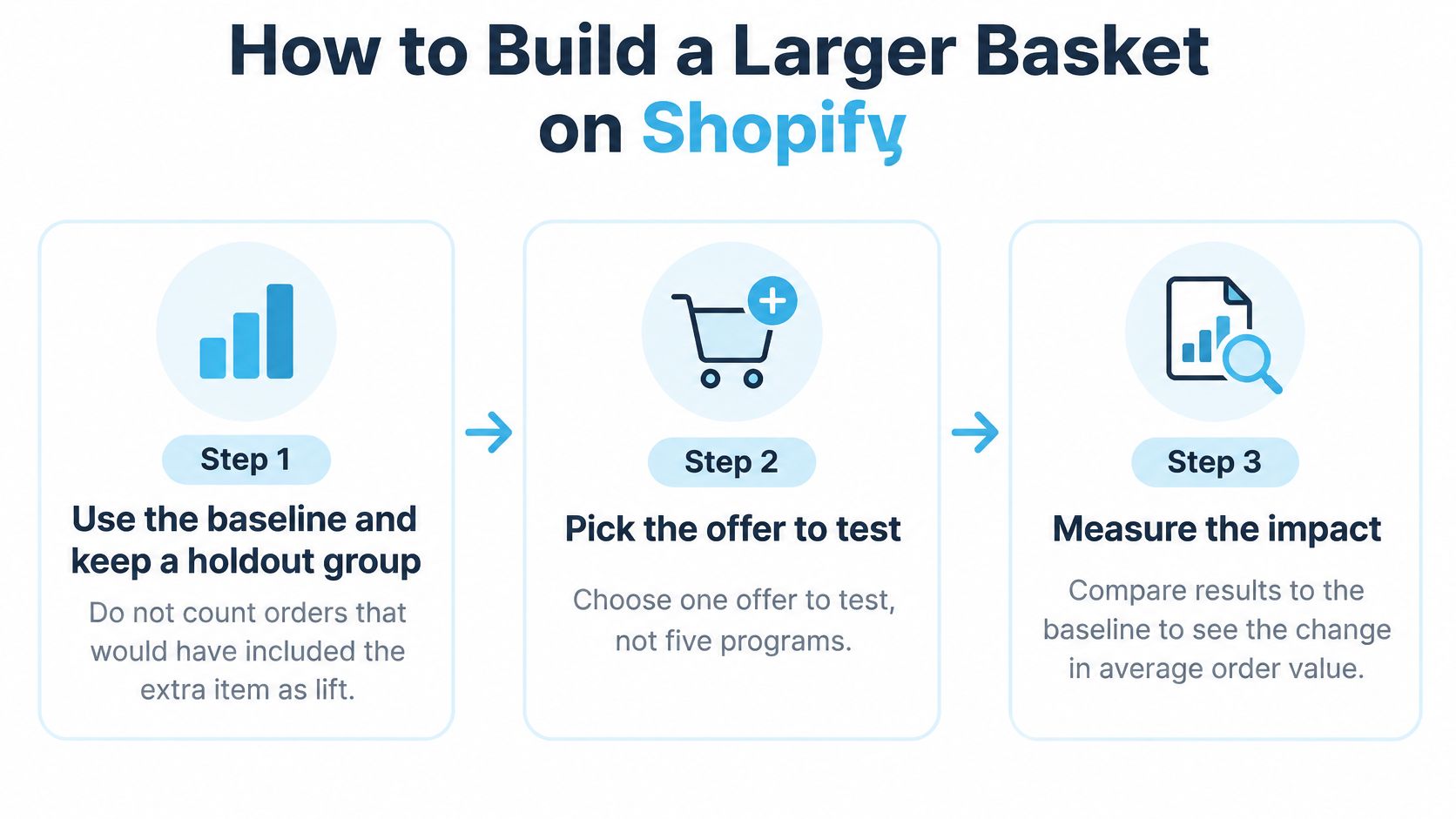
How to Build a Larger Basket on Shopify
Build a single test that your merchandising, lifecycle, and operations teams can explain the same way. If everyone describes a different eligibility rule, the customer experience is already too complicated.
Prepare the audience and the merchandise
-
Keep a holdout with stable eligibility. Randomly assign eligible shoppers to the offer or normal experience, and preserve that assignment where your implementation allows. For example, compare visitors buying the same hero product rather than comparing promotional email traffic with unrelated organic traffic. Avoid moving shoppers between groups when they return.
-
Choose the next useful item. Examine products bought together, then check whether the pairing makes practical sense. A skincare replenishment order might suit a travel-size companion; a first sneaker purchase might suit socks. Don’t assume the product with the largest available discount is the strongest add-on.
Separate replenishment from discovery. A returning customer may understand the product and need convenience, while a new customer may need help choosing a compatible accessory.
Use your bundle pricing strategy to define the merchandise logic before deciding whether a discount is necessary. Avoid building a kit around excess inventory unless those products belong together.
Put the offer where the decision happens
-
Choose a single placement for the initial experiment. Show an upgrade on the product page after intent is clear, an add-on in the cart when it closes a reachable spending gap, or a post-purchase offer when protecting the original transaction matters most. For a cart experiment, leave competing product-page and post-purchase offers unchanged. Don’t stack a recommendation carousel, cart drawer promotion, and popup around the same action.
-
Test an attainable threshold. Shopify’s free-shipping methodology recommends controlled testing, such as thresholds 10%, 20%, and 30% above baseline AOV, and illustrates a $45 threshold against a $40 AOV and $8 shipping cost. Treat those as candidate test conditions, not universal settings. Avoid choosing the threshold solely because the resulting number looks attractive on a banner.
Check the actual assortment against each candidate threshold. A shopper should be able to reach it with a relevant item that’s in stock, not by adding merchandise they don’t need.
Also inspect the distribution of basket values. A blended average can hide a large group of small orders and a smaller group of expensive ones. The same threshold may be easy for one group and irrelevant to the other.
Control eligibility and measure the result
- Make availability operationally real. Set the reward’s claim allocation, closing condition, and minimum spend before publishing. For example, reserve an actual gift allocation and stop offering it when that allocation is exhausted. Don’t leave storefront messaging active after the reward has ended.
Style the experience within your Shopify theme so eligibility, cart progress, and reward status are readable together. Mirror the terms in Klaviyo email or SMS only for customers who can still participate, and ensure the destination checks current availability rather than relying on old message copy.
- Report both basket behavior and business impact. Track AOV, units per transaction, threshold attainment, conversion, and contribution per visitor. Split the result by device, acquisition source, geography, and new versus returning customer. A paid-mobile cohort, for example, shouldn’t disappear inside a blended result dominated by returning desktop buyers.
Inspect discount stacking and product exclusions before launch. A successful test requires the Shopify cart and discount infrastructure to enforce the same promise the campaign makes.
The main slip to avoid is declaring a winner from qualifying orders alone. Include eligible visitors who didn’t purchase, because a larger basket among fewer buyers can still leave the business worse off.
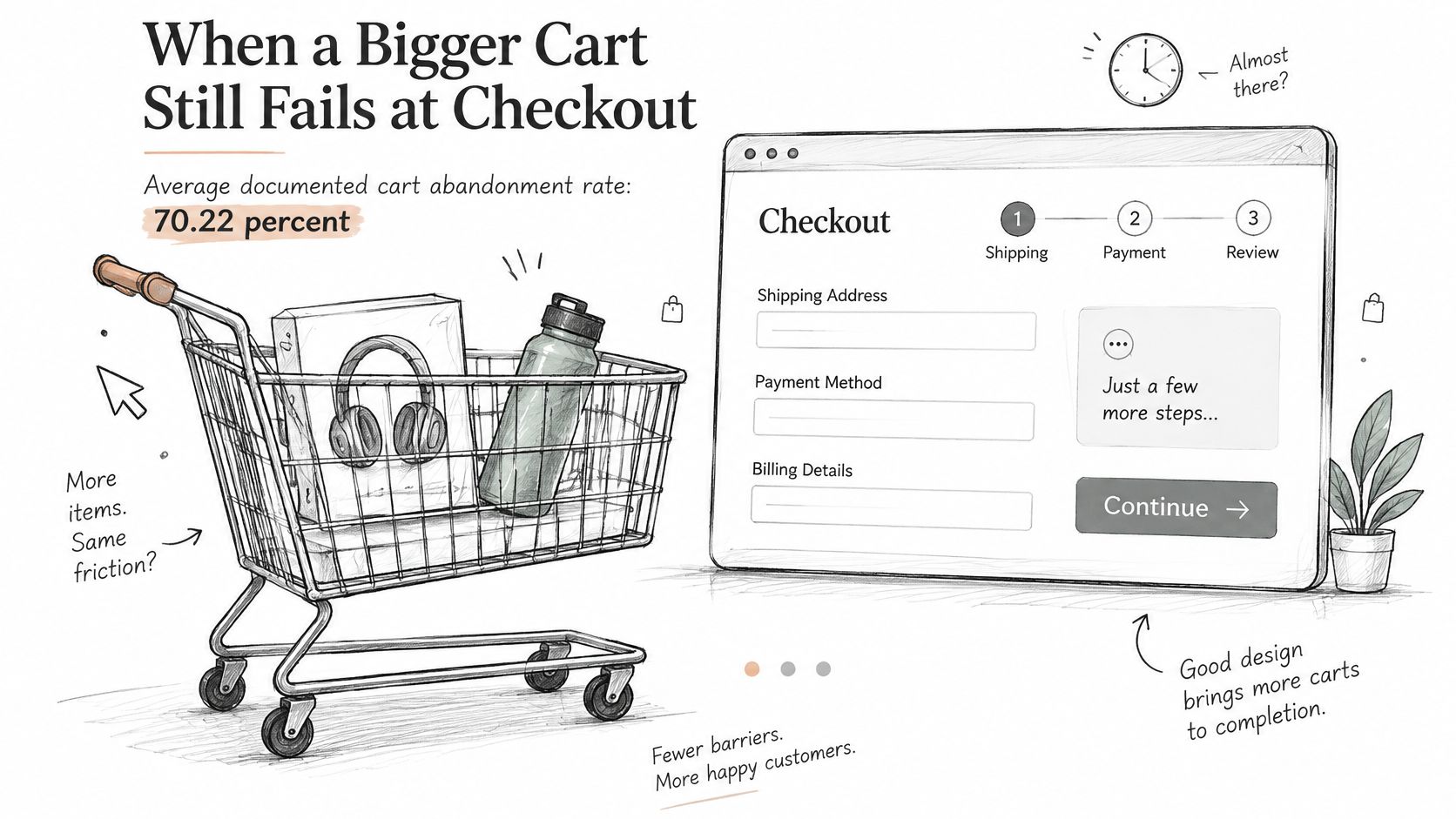
When a Bigger Cart Still Fails at Checkout
Baymard’s analysis of cart-abandonment studies reports an average documented rate of 70.22%, and its survey found that 42% of U.S. online shoppers had abandoned because they were browsing or weren’t ready to buy, according to its cart-abandonment analysis. Among more actionable reasons in that survey, 40% cited extra costs, 20% slow delivery, and 12% an inability to see or calculate the total upfront.
Those are different problems. More promotional pressure won’t resolve a delivery date that misses the customer’s deadline or a shipping charge revealed too late.
Diagnose the failure before changing the incentive
Start with a mobile cart containing the promoted products. Check the qualifying subtotal, shipping treatment, reward application, and final payable amount through the payment step.
- Unexpected charges: Display known shipping costs early and explain when location-dependent taxes or fees will be calculated. Don’t imply that reaching a reward threshold removes charges it doesn’t cover.
- Unreachable qualification: Inspect how far abandoned carts sit below the requirement. Change the merchandise or test a lower threshold rather than enlarging the progress banner.
- Generic recommendations: Replace unrelated products with a compatible add-on, and exclude baskets already containing it from the recommendation opportunity.
- Premature interruption: Move the offer out of the product-selection path if customers haven’t chosen the main item.
- Delivery mismatch: Show the relevant delivery expectation before asking the shopper to expand the order.
The shopper should see the full cost of qualifying before they’re asked to qualify.
Check device economics and technical reliability
In April 2025, U.S. desktop ecommerce orders averaged $227 versus $132 on mobile, making desktop order value 72% higher, according to Fit Small Business, citing Dynamic Yield. That doesn’t establish your store’s device gap, but it gives you a clear reason to test mobile qualification separately rather than copying a desktop threshold.
Inspect the phone experience for more than responsive styling. Confirm that shoppers can see the add-on’s variant, price, eligibility, and removal control without losing their place in the cart.
Technical reliability is a separate launch gate. In Baymard’s checkout usability research, participants abandoned immediately in 8 of 9 instances after encountering problems such as an unresponsive server or error page.
Test the theme, promotional app, cart updates, and discount application together before sending campaign traffic. If the checkout path breaks under demand, pause the promotion rather than spending the remaining reward allocation on a malfunctioning experience.
Test One Minimum-Spend Reward This Week
Set a qualifying spend a shopper can reach by adding a relevant item, then compare the added contribution with the full cost of the reward. Start with one hero product and one compatible add-on. The test should answer whether eligible shoppers add the companion often enough to cover the reward without reducing purchase completion.
Use bounded availability without blanket markdowns
Quikly is a Shopify option for running behavior-led promotions alongside discount rules and merchandising changes. Rewards can be capped by claim quantity, time, or both. A campaign can offer one reward or use descending tiers that step down as shoppers claim them, with an experience styled to match the storefront.
Choose the simplest format that fits the economics. A single reward may be enough. Use descending tiers only if shoppers can understand the changing benefit and the later tier still gives them a reason to act.
The hypothesis is that a bounded offer can improve basket size and conversion with a lighter average discount than a blanket code. Measure whether that happens; the mechanic does not guarantee it.
If shipping is the reward, use this guide to set a free-shipping threshold that makes sense for the order economics. A compelling message cannot make an unaffordable shipping subsidy profitable.
Give the test an owner and a stopping rule
Record the test setup so each person knows what to check:
- Merchandise owner: Confirms add-on compatibility, inventory, and exclusions.
- Campaign owner: Records eligibility, availability, messaging, and holdout assignment.
- Operations owner: Checks fulfillment expense and how returns or canceled qualifying orders are handled.
- Analyst: Reports contribution per eligible visitor and separates additional purchases from orders shoppers would have placed anyway.
Keep assignments stable and let the test run through a full purchase cycle before deciding whether to retain the offer. Account for refunds as they mature. Do not change the reward midway because early sales look encouraging.
Before sending campaign traffic, check the Shopify app listing for setup and eligibility details. Confirm that the storefront and outbound messages state the same reward and spending requirement.
Keep the offer only if the additional contribution covers its additional costs across the eligible audience. If it does not, adjust the add-on, qualification rule, or reward cost before increasing exposure. The goal is a larger basket that earns its reward, not a deeper code for every order.
Quikly offers on-brand Shopify promotions with time- and quantity-bounded rewards for minimum-spend campaigns. Visit Quikly to set up a capped-reward test with a reachable basket target and a contribution-profit rule agreed before launch.
Topics: increase aov ecommerce, average order value, Shopify AOV, free shipping threshold, product bundles