Most advice about personalization on websites starts with a seductive premise: the more individualized the experience, the more the store will sell. That’s wrong. Personalization is useful only when it removes a real decision barrier. Add too many rules, apps, recommendations, and behavioral triggers, and you create a slower, less trustworthy storefront that costs margin while pretending to improve conversion.
For Shopify merchants, the better question is sharper: which personalized experiences help a shopper decide without training them to wait for a discount? The answer involves behavior, segments, recommendations, inventory, delivery, fit, privacy, and disciplined measurement. It also requires accepting that a generic storefront can weaken brand perception, while an overfitted one can feel invasive.
Why Personalization on Websites Is Now a Baseline Expectation
Personalization isn’t a conversion silver bullet. It’s becoming part of the minimum experience shoppers expect from serious ecommerce brands.
One industry summary reports that about 74% of ecommerce companies have implemented some form of website personalization according to Contentful’s ecommerce personalization statistics summary. The same summary reports that 71% of consumers expect personalized communications, while 76% become frustrated when a brand’s website isn’t personalized. Those figures point to a change in customer standards, not a novelty feature.
A Shopify storefront now competes with digital experiences shaped by Amazon, Net-a-Porter, and established direct-to-consumer brands. Shoppers expect a returning visitor to see useful continuity, product rails to reflect demonstrated interest, and the checkout journey to remember what happened earlier in the session. A homepage that treats every visitor exactly the same can make the brand look like a commodity, especially when competitors reduce search effort for the customer.
Personalization protects more than conversion
The margin case matters. Paid acquisition is expensive enough that merchants need more value from existing visitors and repeat buyers. A relevant recommendation, a clearer delivery promise, or a better product comparison can help a shopper proceed without another discount.
That distinction protects brand perception. Blanket promotions tell customers to wait for the next markdown. Useful personalization gives them a reason to act because the experience fits their needs now. A first-time visitor may need category guidance. A returning customer may need a replenishment path. Someone comparing products may need compatibility or fit information, not a louder sale banner.
Operating principle: Personalize the decision, not every pixel.
Website personalization has therefore crossed from experiment into infrastructure for many ecommerce businesses. The practical milestone isn’t the number of dynamic elements on a page. It’s whether the storefront reduces irrelevant browsing while preserving trust, margin, and a recognizable brand voice.
The Three Core Methods Behind Personalization on Websites
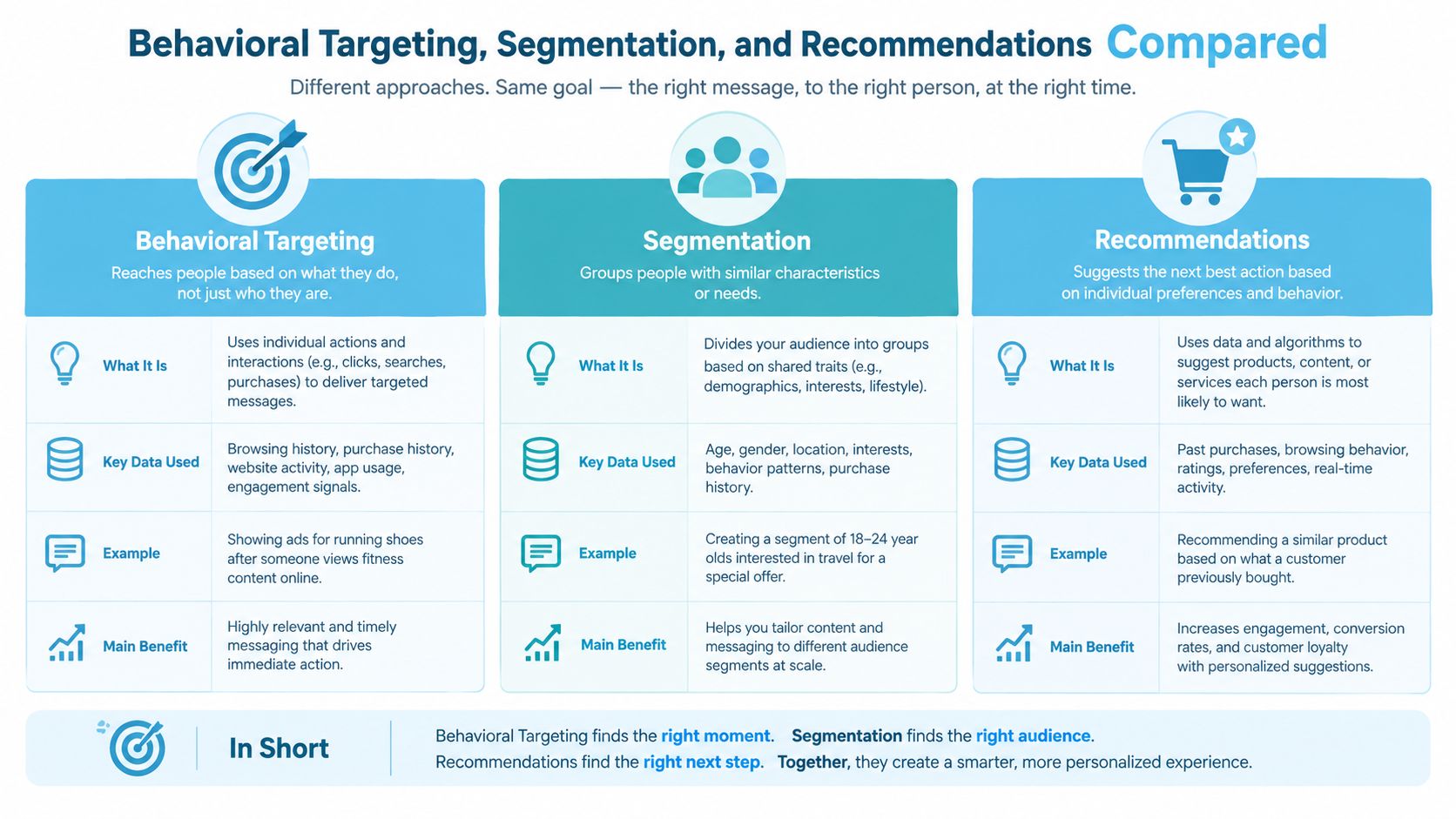
Shopify personalization usually rests on three methods. They overlap, but they solve different problems: behavioral targeting reacts to actions, segmentation groups customers, and recommendations select products or content.
Behavioral signals create context
Behavioral targeting uses events such as viewed products, search terms, cart additions, visit frequency, and time spent on a page. A Shopify storefront can collect these signals through theme interactions, analytics, checkout events, pixels, and connected marketing tools.
A visitor who searches for running shoes and then views several trail models has expressed a stronger signal than someone who lands on the homepage and leaves. The store might respond by changing a product rail, surfacing trail-specific guidance, or showing a comparison CTA. The trade-off is speed versus accuracy. Real-time behavior can react quickly, but it can also misread intent. A shopper may be buying a gift, researching for someone else, or browsing without purchase intent.
Segmentation makes personalization manageable
Segmentation groups signals into usable cohorts. Examples include repeat buyers, high-average-order-value customers, browse abandoners, geographic clusters, or shoppers at different lifecycle stages.
Segments are easier for a small Shopify team to govern than thousands of one-to-one rules. They also support coordinated messaging across the storefront, Klaviyo email, SMS, and paid campaigns. The weakness is coarseness. A segment can hide meaningful differences between shoppers who share one attribute but have different needs.
Recommendations scale product relevance
Recommendation systems connect a shopper to products or content. A merchant can start with rule-based logic, such as pairing a camera bag with a camera, then move toward content-based similarity or collaborative filtering as purchase data grows.
Rule-based recommendations are transparent and easier to control. Algorithmic recommendations can scale beyond manual merchandising, but they carry cold-start risk, data dependencies, and inventory problems. Every added Shopify app also brings possible theme conflicts, latency, subscription cost, and another system the team must QA.
| Method | Core Data | Storefront Touchpoints | Main Trade-off |
|---|---|---|---|
| Behavioral targeting | Live actions and session context | Hero modules, banners, overlays, CTAs | Fast response, but intent can be misread |
| Customer segmentation | Grouped customer and behavioral attributes | Homepage, merchandising, email, SMS | Easier governance, but less individual precision |
| Product recommendations | Product relationships, catalog data, purchase behavior | Product pages, cart, search, post-purchase | Scales relevance, but depends on clean data and stock |
A practical implementation should start with a small number of high-signal rules. Merchants looking at more advanced timing and contextual methods can review real-time personalization for ecommerce, but the principle remains simple: the storefront should respond to useful intent, not merely react because a tool can.
Behavioral Targeting, Segmentation, and Recommendations Compared
These methods look similar in a dashboard, but they behave differently in the store.
Behavioral targeting works best when the shopper has created a clear signal. If someone views two product detail pages in one category, the hero module can shift from broad discovery to a category-specific message. That response is immediate and useful, but behavioral targeting can overfit. A shopper browsing gifts for another person may receive an experience designed for their own preferences.
Segmentation is stronger when the business already knows something meaningful about the customer. A repeat buyer can enter a VIP cohort for early access, replenishment messaging, or a product announcement. Segmentation gives the team control and makes it easier to coordinate Shopify storefront content with Klaviyo email and SMS. It can still be too broad, especially when a high-value customer suddenly shows intent in a new category.
Recommendations influence the basket directly. A cart block can surface complementary SKUs after an item is added, while a post-add-to-cart module can suggest accessories that solve an obvious adjacent need. The logic fails when it promotes out-of-stock products, low-margin items, products with high return rates, or accessories that don’t fit the selected item.
The Shopify implementation trade-offs
| Method | Cold-start viability | Revenue influence per visitor | Implementation cost |
|---|---|---|---|
| Behavioral targeting | Moderate, because anonymous actions can still create context | Strong at decision points | Moderate, with event tracking and QA requirements |
| Segmentation | Strong when rules use broad, reliable signals | Strong for repeat and lifecycle use cases | Moderate, depending on customer-data integration |
| Recommendations | Weak for new products or sparse catalogs | Strong when product relationships are clear | Moderate to high, depending on catalog and app setup |
A sensible sequence is segmentation for broad context, recommendations for warm traffic, and behavioral cues as a final nudge. Don’t let the methods compete for the same space. Give each one a defined job.
The Diminishing Returns of Stacking Personalization Layers
More personalization creates more opportunities for contradiction. A dynamic hero may promise one category, predictive search may prioritize another, a recommendation app may push a third, and an email click may land the shopper on a fourth message. The store feels active, but the customer feels guided by software rather than understood by a brand.
Evidence from an analysis of 28 companies shows why stacking needs discipline. One personalization element lifted conversions to 3.2%, while two elements lifted conversions to 8.1%. More elements didn’t scale linearly: three reached 6.5%, four reached 7.3%, and five or more reached 8.8%, as reported in Neil Patel’s summary of personalization’s impact on conversions. The figures don’t justify adding layers indiscriminately. They show that complexity can dilute gains.
Complexity becomes an operating cost
Each layer adds data dependencies, QA scenarios, app interactions, and brand-voice risk. Shopify merchants also need to account for theme customization, app latency, discount logic, checkout behavior, and the cost of maintaining every integration.
| Personalization Layer | Marginal Lift vs Previous Stack | Data and Tooling Overhead | Brand and Risk Exposure |
|---|---|---|---|
| Segmented homepage module | Often meaningful when the segment has a clear need | Low to moderate | Low if fallbacks are strong |
| Product recommendations | Useful when product relationships and stock are reliable | Moderate | Moderate if margins or availability are ignored |
| Behavioral CTA or message | Useful near a decision point | Moderate | Moderate if the trigger feels unexplained |
| Dynamic pricing or discounting | Can create urgency, but may train waiting | High | High, especially for premium brands |
| Predictive search and multi-surface rules | Potentially useful at scale | High | High if results conflict or feel invasive |
The right stack is usually small and intentional. Test one layer against a control, keep it only if it improves contribution after discounts and returns, and remove it when the incremental value disappears. Subtraction is a strategy, especially for a lean Shopify team that can’t afford maintenance debt.
Measuring Personalization Without Trusting Vendor Claims
Vendor dashboards often report the most flattering version of performance. They may emphasize clicks, use a short test window, or compare exposed shoppers with a default group that wasn’t randomized. That isn’t enough to decide whether personalization belongs in your storefront.
A benchmark covering 200 ecommerce retailers and 600 shoppers reported that personalized retailers saw conversion rates increase by more than 40% in many cases, cart abandonment fall below 50%, and revenue per user rise by more than 10%. The report summarized an average conversion lift of 45% in its benchmark findings from the Netcore ecommerce personalization benchmark report. Treat that as external benchmark context, not a forecast for your store.
Build a test you can defend
Start with a true holdout. A fixed portion of eligible traffic should continue seeing the default experience while the rest sees the personalized version. Keep the assignment stable through at least two full purchase cycles, so the result isn’t distorted by a brief promotion, payday pattern, or unusual traffic mix.
Track three commercial outcomes:
- Incremental conversion lift: Compare randomized treatment and control groups, not exposed users with all other visitors.
- Revenue per visitor: Segment the result by personalization exposure and customer status.
- Contribution after returns and discounts: A conversion that requires a deeper discount or produces more returns may reduce profit.
Read-through metrics matter too. Session depth can show whether shoppers find relevant products faster. Repeat purchase rate can indicate whether the experience supports customer value. Unsubscribe rate can reveal that your personalization is accurate but unwelcome.
A clean test also records what the shopper saw, which rule fired, which product was recommended, and whether the recommendation was in stock. Without that exposure log, you can’t distinguish a weak strategy from a broken implementation.
The Privacy and Trust Side of Personalization on Websites
Relevant content can still feel wrong when the shopper can’t explain why it appeared. A first-time visitor may accept “recently viewed” products, but feel uncomfortable if the site uses location, browsing history, or inferred identity in a way they never knowingly enabled.
The central distinction is helpful personalization versus unexplained personalization. Consumer research reports that 71% of consumers worry about unclear consent and data misuse, 69% worry about personal data being used for hyper-personalization, and 71% say AI-driven personalization feels intrusive in Capgemini’s Consumer Trends 2026 report. The implication is direct: relevance doesn’t excuse opacity.
Design for consent and reversibility
A responsible Shopify storefront gives shoppers understandable choices. Consent should be clear, the purpose should be visible, and the experience should be reversible. Don’t stitch anonymous browsing behavior to an email identity merely because a technical path exists. Don’t display location-specific promises unless the shopper has provided or confirmed the location.
Use simple explanations where they help:
- Explain the reason: “Based on products you’ve viewed” is clearer than an unexplained product rail.
- Respect the choice: If a shopper declines optional tracking, preserve a useful non-personalized experience.
- Offer a reset: Give customers a way to clear recommendations or suppress personalization.
- Limit sensitive inference: Don’t expose assumptions about identity, finances, health, or private interests through merchandising.
- Audit technical collection: Teams assessing tracking exposure can use resources on browser fingerprinting tools to understand what browsers may reveal and where safeguards are needed.
Privacy is a commercial concern, not just a compliance task. A shopper who feels watched may abandon the session, avoid signing up, or decline to return. Merchants can also use zero-party data in ecommerce when they want customers to state preferences directly instead of relying on increasingly aggressive inference.
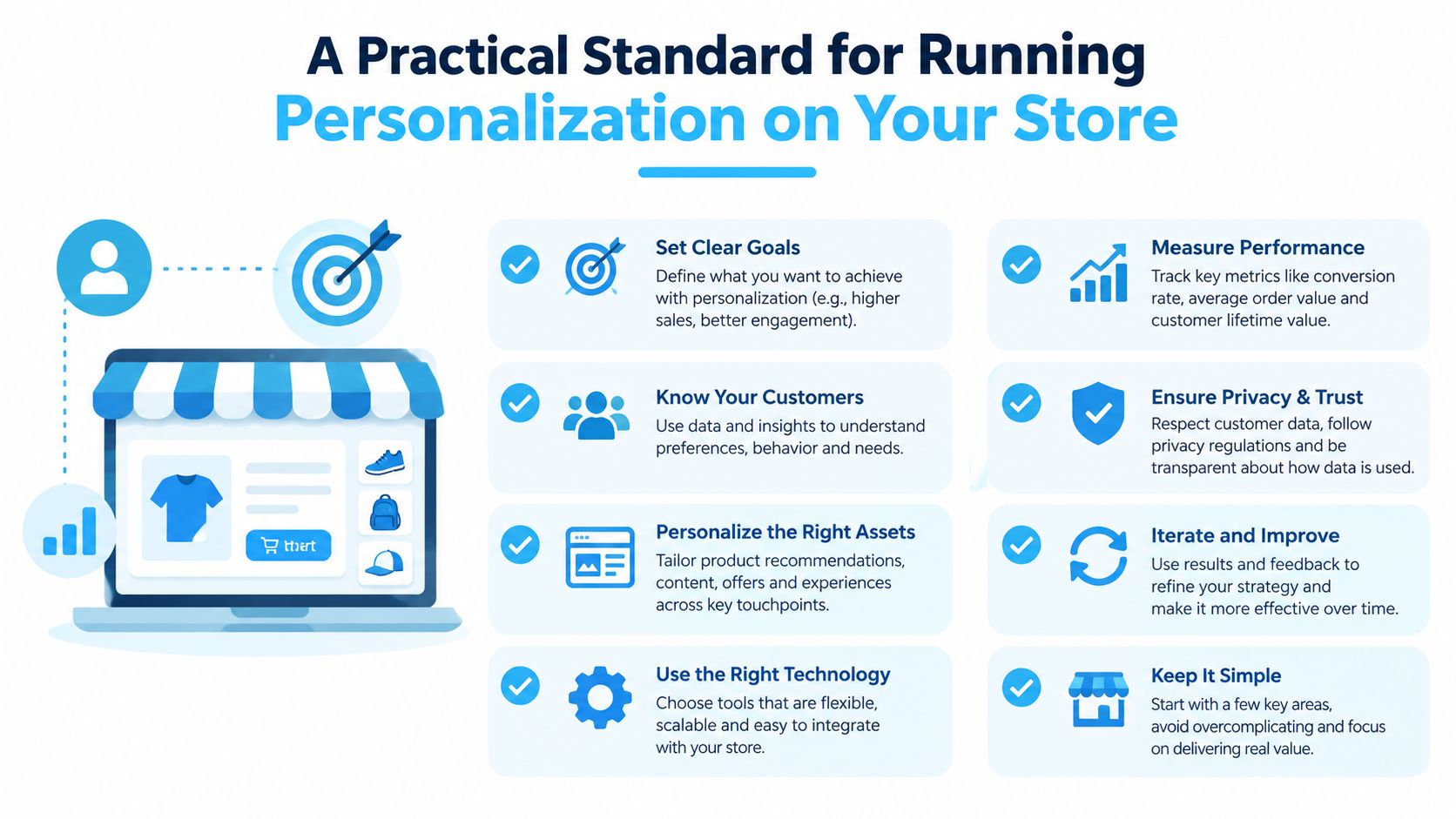
A Practical Standard for Running Personalization on Your Store
Run personalization as an operating discipline, not a feature race. Pick one or two layers that solve a visible customer problem, then connect the decision to stock, fulfillment speed, fit, compatibility, return rates, margin, and brand position.
Consider a Shopify apparel store. A useful first layer could be a “complete the look” recommendation block that excludes out-of-stock sizes, products with poor margin, and items that don’t match the selected product. A second layer could identify repeat buyers and give them early access to a relevant collection. The combination has a clear job: increase basket relevance and recognize loyalty without making every visitor chase a discount.
Adding a third layer, such as dynamic pricing, predictive search, or several overlapping behavioral banners, may create noise without adding commercial value. It also increases development time, app bloat, site-speed risk, and the chance that the customer sees an experience that feels too familiar for the data they provided.
Keep the storefront honest
Use these guardrails before expanding the stack:
- Fallbacks for cold visitors: Every dynamic module needs a strong default experience.
- Stock-aware recommendations: Suppress unavailable products and verify variant-level availability.
- Operational promises: Personalize delivery, fit, and compatibility only when the underlying data is current.
- Margin filters: Don’t optimize clicks for products that weaken contribution.
- Kill switches: Give the team a fast way to disable a bad rule or broken recommendation.
- Exposure logs: Record what appeared, why it appeared, and what happened afterward.
- Privacy controls: Make consent, explanation, and reset options easy to find.
- Periodic audits: Review what fires on the storefront, not what the strategy document says should fire.
Teams evaluating ecommerce personalization software should apply the same standard. The tool matters less than whether the experience is useful, measurable, operationally accurate, and restrained enough to protect the brand.
Quikly adds behavior-driven promotional experiences to the storefront, email, social, and SMS, using rewards limited by time, quantity, or both rather than relying only on blanket discounts. For Shopify merchants, that creates a way to connect relevant on-site action with urgency while keeping the promotion on-brand. Visit Quikly to see how it can fit into a personalization and margin-protection program.
Topics: personalization on websites, ecommerce personalization, website personalization, product recommendations, conversion optimization