Most Shopify brands don’t have a demand problem, they have a margin-quality problem. More traffic, more orders, and more promo activity can still leave you with thinner profit if the path to conversion depends on heavier discounting, higher fulfillment drag, or lower-value customers.
That’s why the usual advice to “just sell more” often misses the point. In practice, how to improve profit margins starts with better price realization, tighter promotion design, and a clearer view of which sales deserve more spend.
Why More Sales Won’t Fix Your Margin Problem
Scaling revenue sounds clean until you look at what’s happening under the hood. If every extra order requires another discount, another free-shipping threshold, or another round of promo pressure to get the same response, you’re buying volume with margin you can’t easily get back.
A useful reality check comes from the profit sensitivity analysis summarized in the Harvard Business Review-linked material on margin improvement. A 1% price increase with volume unchanged can lift operating profit by 8.7%, while a 1% improvement in variable costs lifts profit by 7.3%, and a 1% increase in volume lifts it by only 3.3%. That’s why pricing is often the most impactful margin tool, especially when fixed costs are already covered. show true value of your campaigns can be a helpful reminder that topline growth and profit quality are not the same thing.
Revenue quality beats revenue quantity
Retailers feel this especially hard when promotions become the default acquisition engine. Vend’s 2019 benchmark study of more than 13,000 retailers found an average gross profit margin worldwide of 53.33% source. That leaves less room than many assume once product cost, shipping, labor, and marketing enter the picture.
Practical rule: If an order only converts when the discount gets heavier, that order is often weaker than it looks.
That’s why discount discipline matters as much as traffic growth. A brand can grow orders and still erode the pool of dollars that pays overhead, staff, and profit.
The goal is to improve revenue quality, not just revenue quantity. If you want a Shopify-specific starting point, this internal resource on Shopify profit margin basics is worth keeping handy while you audit your own numbers.
The trap of repeating the same promotion
Once a store trains shoppers to wait, every future campaign has to work harder. That doesn’t just compress margin, it also changes brand perception, because the customer learns that the “real” price is negotiable.
The short version is simple. More sales help only when those sales arrive with healthy contribution, sane discounting, and a customer who didn’t need to be bribed into action.
Building Your Margin Bridge to Find Hidden Leakage
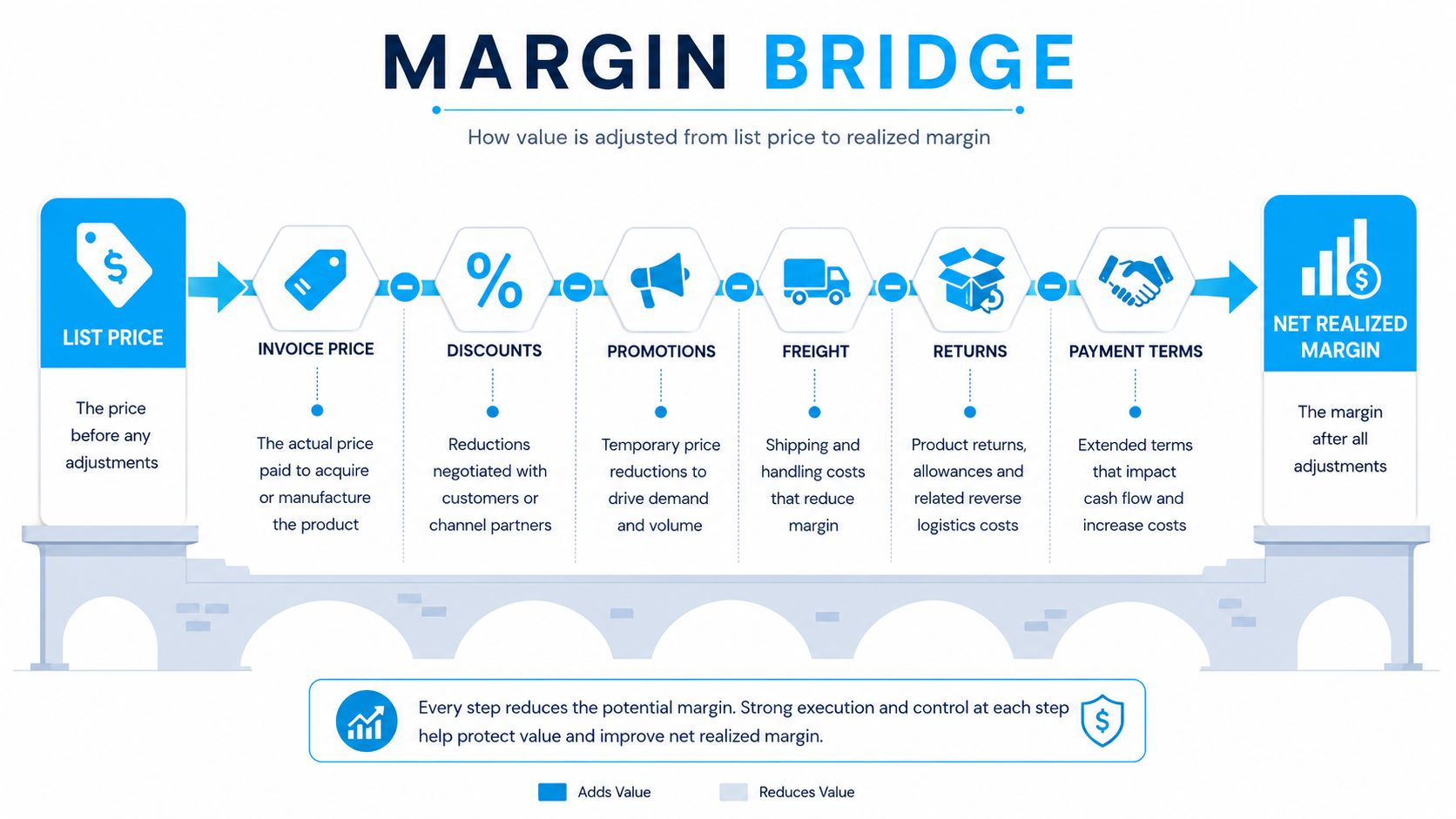
Pricing changes and promotion tweaks are the wrong first move if you do not know where the margin is leaking. A margin bridge makes the leak visible by separating list price, discounts, freight, returns, payment terms, and COGS instead of letting all of it disappear into one blended average.
What pocket margin actually tells you
Gross margin is where many teams stop, and that is where the blind spots start. The better question is what stays after discounting, shipping concessions, credits, shrinkage, and the other leaks that show up after the sale is booked.
Practical rule: If you cannot see pocket margin by product, customer, and channel, you are managing averages instead of outcomes.
That distinction matters because ecommerce businesses often think they have one margin problem when they really have several. A product can look profitable on paper, turn weak after returns, and get worse once freight and promotion cost are added. A channel can also look fine in aggregate while a few campaigns or customer cohorts drag the economics down.
Start with a simple bridge from list price to net realized margin. Use your highest-volume SKUs first, then add the largest sources of leakage in sequence so you can see where the drop really happens.
How to segment the analysis without drowning in data
Focus on the parts that move profit. Review the top products, the biggest discount buckets, the highest-return cohorts, and the channels with the most orders or the heaviest fulfillment burden. Then compare those groups against one another instead of relying on a company-wide average that hides bad behavior.
A useful framework is to ask three questions:
- Where does the sale start strong but end weak? That usually points to discounting, freight, or returns.
- Where does margin look healthy until credits appear? That often signals post-purchase leakage.
- Where do repeat customers outperform new ones? That can show which channels or cohorts deserve more attention and which ones deserve less spend.
The point is not to build a more complicated spreadsheet. It is to stop making broad cuts that punish good business along with bad. If you want a practical reference while you build your own reporting stack, ecommerce metrics for profitable growth can help frame the right questions.
Strategic Price Increases That Protect Conversion
Raising prices does not automatically raise profit margins. Broad price hikes often hit the wrong products, while focused increases on the right SKUs can improve contribution without damaging demand.
Start with the products that can carry more
The practical move is to segment by profitability first, then set price. Protect the items that matter most to the business, test modest increases where value is already clear, and leave alone the products that are close to a conversion ceiling.
Independent business guidance recommends modest, value-justified increases of 3 to 5% on the most valuable offerings after a profitability analysis, rather than blanket price hikes source. That works because customers do not react to every SKU in the same way. Some items are more price sensitive, some are more tied to brand perception, and some have enough perceived value to absorb a small increase without losing demand.
A practical sequence looks like this.
- Identify high-margin items first. Those are the cleanest candidates for controlled testing because a small lift changes contribution more noticeably.
- Test less price-sensitive segments before the full audience. The goal is signal, not a universal reaction.
- Watch conversion and contribution together. If conversion softens but contribution improves, the change can still be worth keeping.
- Roll back only when the economics justify it. Short-term discomfort is not the same as a failed test.
What to watch when you test price
Monthly review keeps price changes from turning into guesswork. At minimum, track gross margin, operating margin, and customer acquisition cost on a regular cadence, then compare the test cohorts against a clean baseline source.
If a price increase only looks risky because the team is comparing it to last month’s promotional peak, the baseline is wrong.
The message to customers matters too. Value justification should be tied to materials, craftsmanship, product utility, or bundle economics, not vague brand language. Customers handle price movement better when the offer still feels fair, coherent, and intentional.
If you need a useful companion resource for pricing work inside a Shopify context, this internal guide on Shopify pricing strategy is a solid reference point.
Designing Promotions That Drive Action Without Eroding Margin
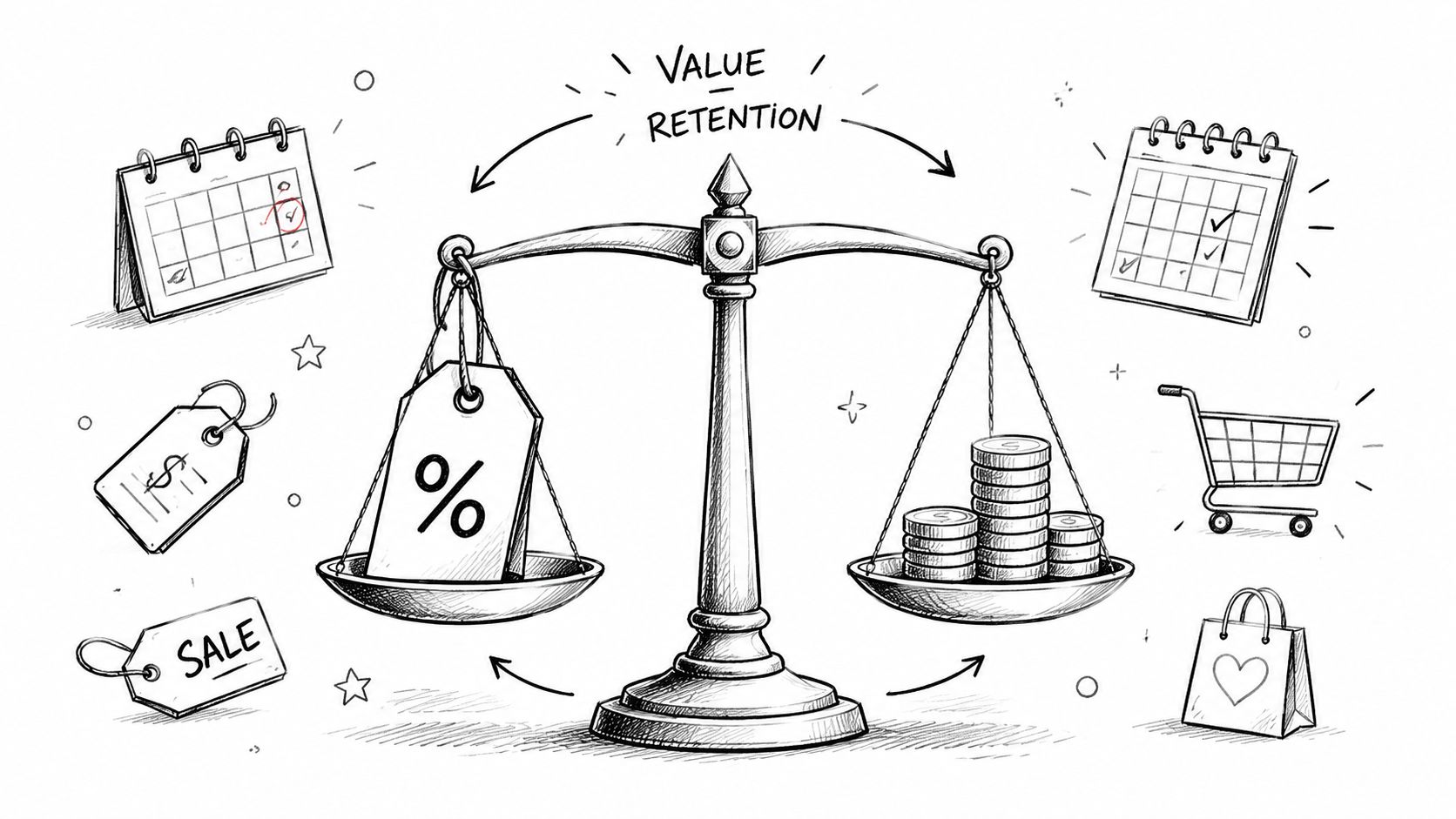
Blanket discounts are easy to launch and hard to unwind. They train shoppers to wait, they teach your own team to rely on lower prices, and they often move demand forward without improving the underlying economics.
Why urgency works when discounts don’t
Behavioral principles matter here because shoppers don’t decide in a vacuum. Scarcity bias makes limited availability feel more valuable, loss aversion makes people act to avoid missing out, and temporal discounting explains why a closer reward usually pulls harder than a later one.
That’s why a promotion with real constraints can outperform a generic markdown while protecting margin better. The shopper is still incentivized, but the business isn’t teaching them that waiting is the smarter move.
The key is to keep the constraint real. If everyone can get the same offer all week with no real limit, the urgency is cosmetic. If the incentive is capped by time, quantity, or both, then early action has a reason to happen now instead of later.
Earned incentives beat automatic markdowns
There’s a meaningful difference between giving every visitor a discount code and rewarding the people who act. Automatic discounts flatten value. Earned incentives preserve it.
A stronger pattern is to shape the offer around behavior, not just price:
- Limit by quantity so the offer rewards action instead of indecision.
- Limit by time so the decision window feels clear and finite.
- Tie the reward to participation so customers feel they earned it rather than stumbled into it.
That’s where Quikly fits naturally for Shopify brands that need urgency without falling back on blanket markdowns. It turns a promotion into a behavior-driven experience, where shoppers compete for a capped reward or a descending tier rather than receiving the same automatic discount as everyone else. Quikly’s model is also built to match the store’s brand, so the experience reads like part of the shop instead of a bolted-on overlay.
Practical rule: If the promotion only works because the discount is deeper, the offer design is weak.
For brands that want more tactical ideas without defaulting to price cuts, this internal resource on promotion ideas without discounting is a useful companion.
Optimizing Product Mix and Customer Segments for Higher Margins
A higher revenue number can hide a weak business. If the wrong products, channels, and buyers are doing the heavy lifting, the store can look healthy while margin keeps thinning out.
Where mix creates more profit than volume
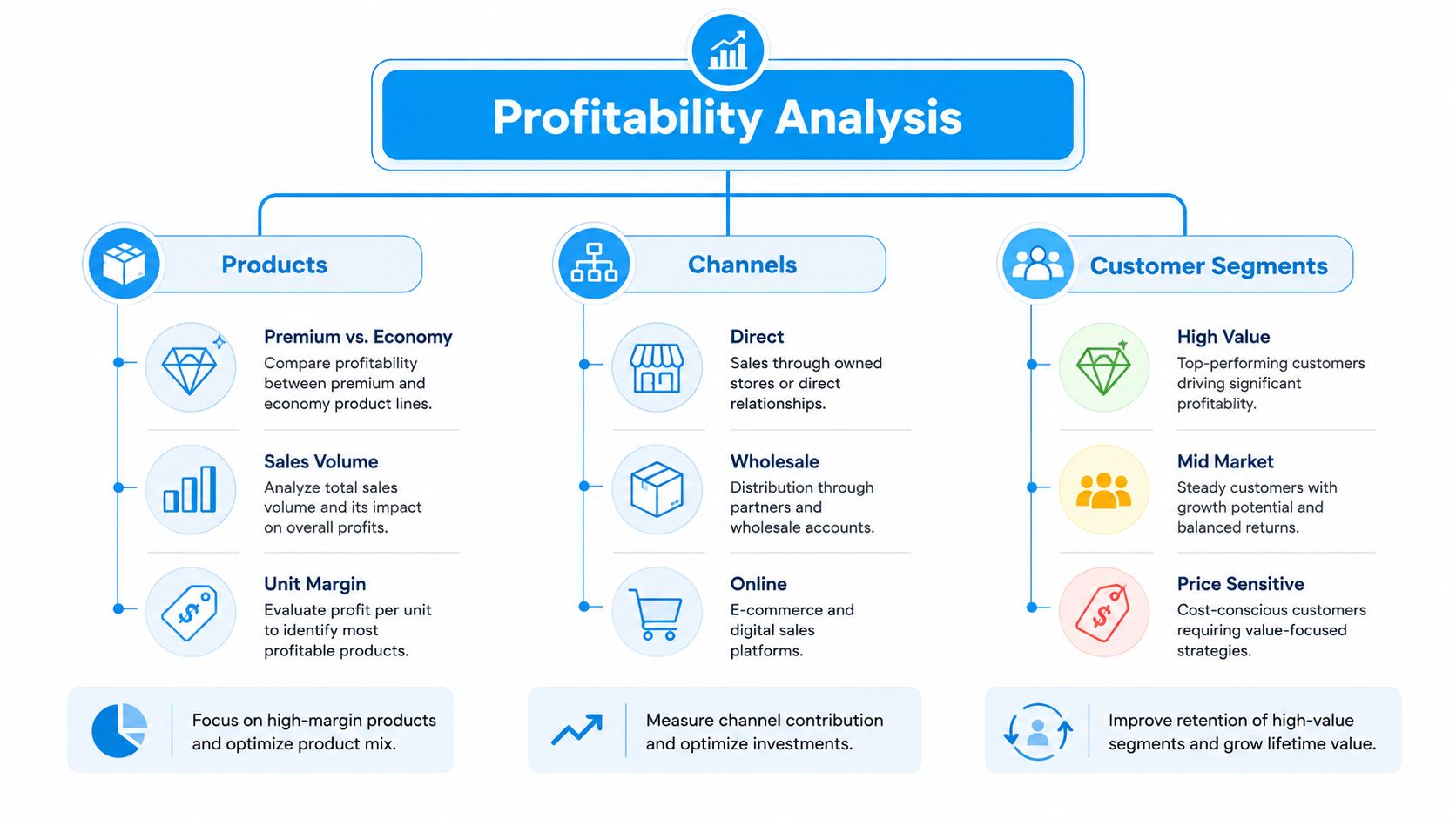
The most useful shift is to evaluate product mix, channel mix, and customer mix together. A lower-volume product sold through a low-cost channel to a repeat buyer can be a better margin driver than a fast-moving item that depends on paid traffic and constant discounting.
Segmentation is where that becomes visible. Different customer cohorts do not deserve the same offer, and not every channel deserves the same level of spend. If your paid media keeps buying cheap conversions from buyers with weak repeat behavior, you are improving a front-end number while leaving profit behind. That is why teams need a tighter read on ecommerce metrics for profitable growth before they decide where to scale.
Bundle with intent, not just convenience
Bundles can raise average order value, but only if the margin math still holds after COGS and discounting. Quikly’s bundle pricing guidance focuses on checking total COGS, applying discounts carefully, and confirming that the final bundle price still hits profit targets, which is the right discipline for any ecommerce team building bundles into a margin plan.
Merchandising should follow the same logic. Promote the products with stronger unit economics more aggressively. Use lower-margin items as traffic drivers only when attachment rate or repeat purchase behavior makes the trade-off worth it.
A simple way to sort the catalog is this:
- High-margin items deserve visibility because they support store economics.
- Mid-margin items work best in bundles or cross-sells if they lift basket size without a heavy discount.
- Price-sensitive items need tighter control, since they can drive volume while leaving too little room to operate.
Reassign acquisition to better downstream value
Paid acquisition should be judged on more than front-end conversion. A campaign that attracts repeat buyers with stronger lifetime value deserves a different budget decision than one that only works when the promo is steep. Some campaigns should be cut even if they look efficient at first glance, because they bring in low-quality orders that do not hold up over time.
The broader lesson is direct. Margin leakage often sits in the mix, not just in unit economics. Once you see that clearly, the way you buy traffic, merchandise products, and structure offers starts to shift.
Your 90-Day Margin Improvement Implementation Plan
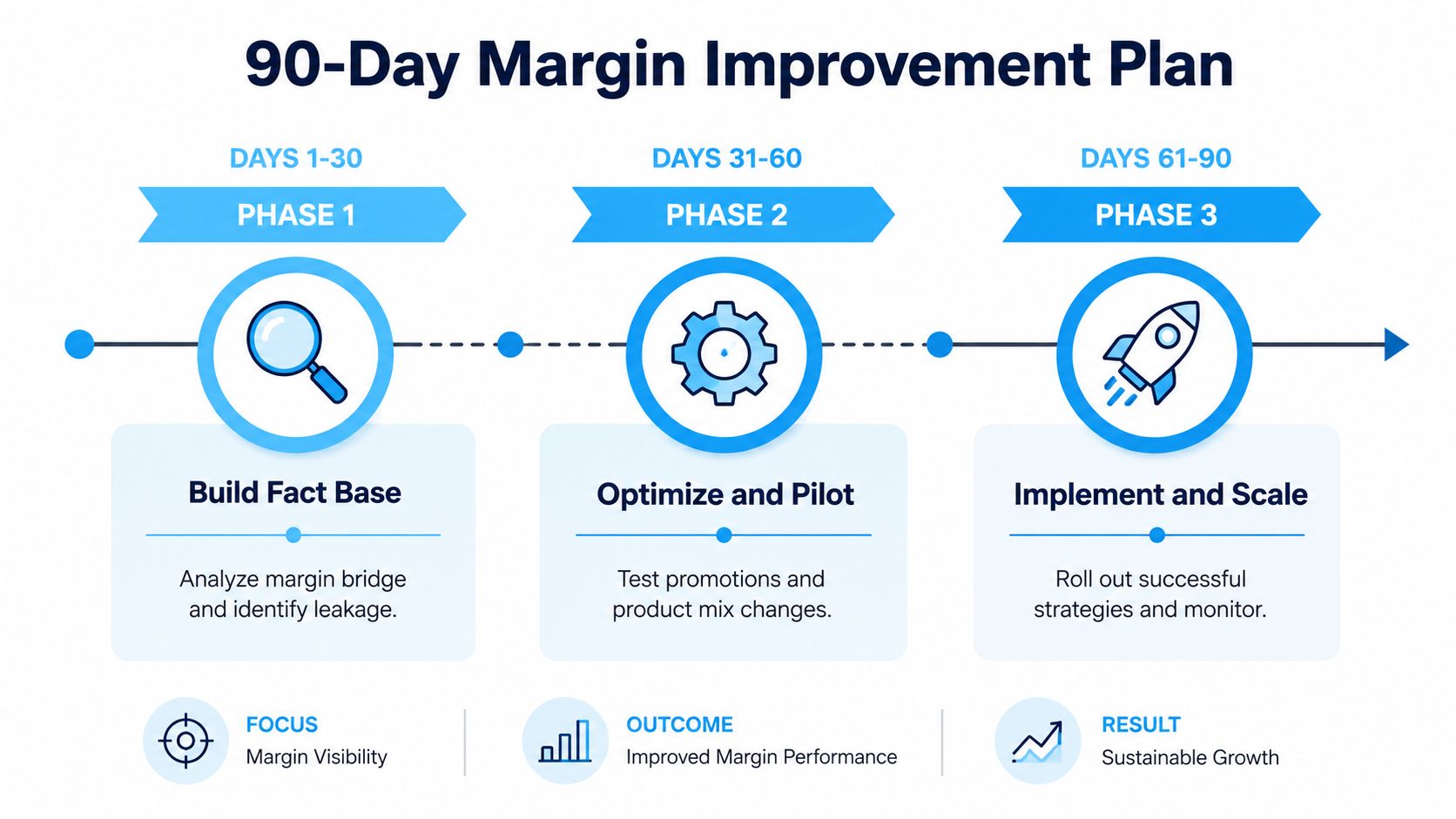
A margin turnaround works best when it has a clock on it. Without deadlines, teams keep discussing pricing, promo strategy, and customer quality without changing much in the actual business.
Days 1 to 30 build the fact base
Start with the margin bridge, your top SKUs, and your discount guardrails. Use this window to identify where discounting, freight, returns, and cost of goods are doing the most damage, then decide which categories deserve immediate attention.
The point isn’t to fix everything at once. It’s to find the biggest leaks and stop treating all revenue the same way.
Days 31 to 60 test and adjust
Run pricing tests on selected products, evaluate promotional experiments on targeted segments, and pressure-test supplier terms where the economics are weak. Keep the tests narrow enough that you can learn from them without risking the whole store.
At this stage, monthly KPI review matters more than opinion. Track gross margin, operating margin, and customer acquisition cost, then decide whether each initiative gets expanded, modified, or stopped.
Days 61 to 90 scale what worked
By the final phase, successful pricing or promotion changes should be ready for broader rollout. What worked on one product, one segment, or one campaign should only scale if the margin math still holds after volume increases.
A disciplined cadence keeps you honest:
- Review monthly: gross margin, operating margin, and customer acquisition cost.
- Audit leakage quarterly: discounts, returns, freight, and customer-level profitability.
- Revisit hidden costs periodically: the business resource guidance from the Partner Colorado Credit Union suggests auditing hidden costs every 12 to 18 months source.
Xero’s guidance also reinforces the right operating habit, review pricing regularly, identify your most profitable customers, and track gross profit margin, net profit margin, and revenue trends on a recurring basis source. That rhythm is what keeps margin work from becoming a one-time cleanup project.
Quikly helps Shopify brands design promotions that create urgency without defaulting to deeper discounts, so the offer can drive action while protecting margin. If you’re trying to improve profit margins without training customers to wait, visit Quikly and look at how behavior-driven promotions fit into your pricing and promo strategy.
Topics: profit margins, Shopify margins, DTC profitability, pricing strategy, margin optimization