You can feel when a sale is working in Shopify. Sessions hold up. Orders spike. The dashboard turns green. Then finance closes the month and the excitement fades because the campaign moved revenue, not profit.
That’s the trap. Most brands don’t get in trouble because they ran promotions. They get in trouble because they used lazy promotion structures, blanket discounts, and predictable timing that taught customers to wait.
If you want to know how to run a sale without hurting margins, start by changing the question. Don’t ask, “What discount should we offer?” Ask, “What behavior do we want to reward, and how do we structure that reward so the economics still work?”
The Uncomfortable Math of Flat Discounts
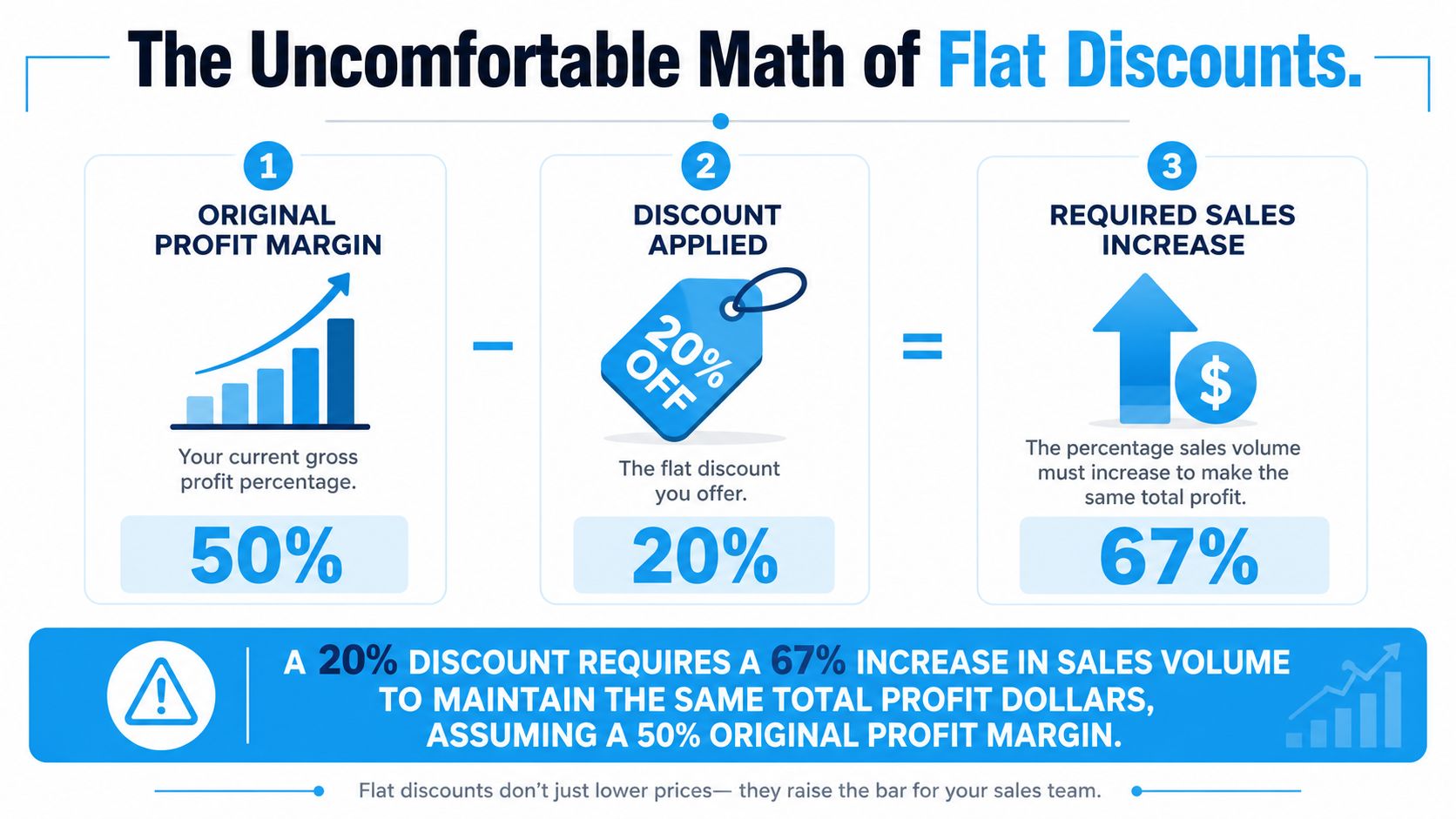
Friday looks great. Orders jump, conversion climbs, and the promo report makes the sale look like a win. Then the margin report lands, and the story changes. A flat discount does not just reduce price. It lowers the profit on every unit in the cart, including units many customers would have bought anyway.
That is why broad percentage-off promos are so dangerous. They feel efficient because they are easy to launch, but they apply the same reward to high-intent buyers, price-sensitive buyers, and customers who were already on their way to checkout.
On a product with a 40% profit margin, a 10% discount requires a 33.3% increase in sales volume to maintain the same profit level, a 20% discount requires double the sales volume, and a 30% discount requires four times the original sales to break even, according to Phoenix Strategy Group’s breakdown of discount margin math.
If your first reaction is, “We’ll make it up on volume,” run the math again.
Why a sale can look strong and still hurt the business
Here’s the simple version. Sell 1,000 units at $100 with $40 profit per unit, and total profit is $40,000. Cut price by 10%, and profit falls to $30 per unit. Now the business needs to sell 1,333 units just to get back to the same $40,000 in profit.
That is before returns, pick-and-pack, payment fees, affiliate commissions, and paid traffic. For brands that depend on Meta, Google, influencers, or marketplaces, discounting often hits the thinnest part of the P&L first. What looked like a healthy top-line spike can turn into weaker contribution margin on the back end.
Flat discounts also hide an operational problem. They reward the wrong behavior. Instead of getting customers to build a bigger basket, add a higher-margin item, or commit to a threshold, they pay people less for the same order.
Practical rule: If you have not modeled the required unit lift before launch, you are guessing with margin.
The part Shopify teams often skip
The missed step is not awareness. Ecommerce teams know discounts reduce margin. The missed step is working through the break-even math at the SKU, bundle, or category level before the campaign goes live.
I keep this simple. For every promotion type, model three numbers: expected conversion lift, expected AOV change, and profit dollars per order after all variable costs. If those numbers only work when volume spikes perfectly, the offer is too fragile. A useful refresher on the underlying math is this guide to measuring profitability for service businesses, because the gross margin logic still applies even if the operating model is different.
For a store-specific view, Quikly’s article on ecommerce margins is a good reference point.
What flat discounts train customers to do
The margin hit is only half the problem. Repeated percentage-off sales teach customers to wait, compare less on product value, and shop your calendar instead of your assortment.
I have seen this happen in brands with strong products and decent demand. The first few promos lift revenue fast. Then full-price conversion softens. Email engagement clusters around sale windows. Paid traffic gets harder to scale profitably because the business has trained its audience to expect a code.
This is why promotion structure matters more than discount depth alone. A flat 15% off offer and a threshold-based reward may cost the brand similar headline dollars, but they do very different things to cart behavior. One cuts price across the board. The other can push shoppers toward a larger basket, a better item mix, or a purchase deadline that protects margin instead of draining it.
Establish Your Margin-Safe Promotional Guardrails
Before you build any offer, decide what your store will not do.
Most margin problems start long before launch day. They start when a team has no hard rules, only intentions. One marketer wants conversion, the merchandising team wants inventory relief, retention wants a code for email, and suddenly the store is running overlapping offers that nobody has pressure-tested.
Set the rules before the creative work starts
One of the clearest operating policies I’ve seen is also one of the simplest. Retailers should never allow more than a 15% discount, prohibit simultaneous promotions, and enforce a minimum 60-day interval between category promotions to prevent margin collapse, according to The Plumb Club’s margin tactics analysis.
That won’t fit every catalog exactly, but it’s the right mindset. Promotions need guardrails that are harder than internal enthusiasm.
A practical guardrail set usually includes:
- A maximum allowable discount: Put a hard ceiling in writing. If your economics can’t support anything beyond a certain point, don’t make exceptions because a campaign “needs a boost.”
- Product exclusions: Keep your low-margin, high-return, or already price-sensitive SKUs out of broad offers.
- No stacking: Don’t allow automatic discounts, affiliate codes, loyalty redemptions, and free shipping to collide in one cart unless you’ve intentionally modeled it.
- Promotion spacing: Give categories time to recover so shoppers don’t learn that another deal is always around the corner.
Build your break-even sheet at the SKU level
The fastest way to lose control is to evaluate promotions at the store level only. A campaign can look fine in aggregate while specific products lose money.
Use a pre-launch sheet with at least these inputs:
| Item to model | Why it matters |
|---|---|
| Regular selling price | Sets the baseline contribution |
| Discounted selling price | Shows the actual revenue per unit |
| Gross margin percentage | Tells you how much room you really have |
| Variable fulfillment cost | Prevents overestimating profit |
| Expected attach or bundle behavior | Changes the real cart economics |
| Required unit lift to break even | Keeps the campaign grounded |
For Shopify merchants, this can live in a spreadsheet if your catalog is manageable. Larger catalogs usually need a merch or finance export from your ERP, inventory tool, or BI layer before promo planning starts.
The right time to argue about discount depth is before the campaign is designed, not after the email is approved.
Add blackout periods and exception rules
Guardrails work best when they include timing, not just price.
Create blackout periods around new product launches, best-seller windows, and categories that customers buy at full price without much resistance. Also define exception rules for inventory problems. If you need to clear seasonal stock or broken size curves, treat that as a controlled inventory action, not a storewide pricing habit.
A simple internal checklist helps:
- Can this category sell without an offer right now
- Is the inventory problem real, or are we discounting out of routine
- Would this promotion train customers to wait
- If the offer overperforms, are we still comfortable with the margin outcome
The point of guardrails isn’t to make promotions harder to run. It’s to stop bad promotions from getting out of the building.
Design Smart Promotion Structures to Boost AOV
Once the guardrails are in place, the job changes. Now you’re not trying to avoid damage. You’re trying to structure the offer so the cart gets better.
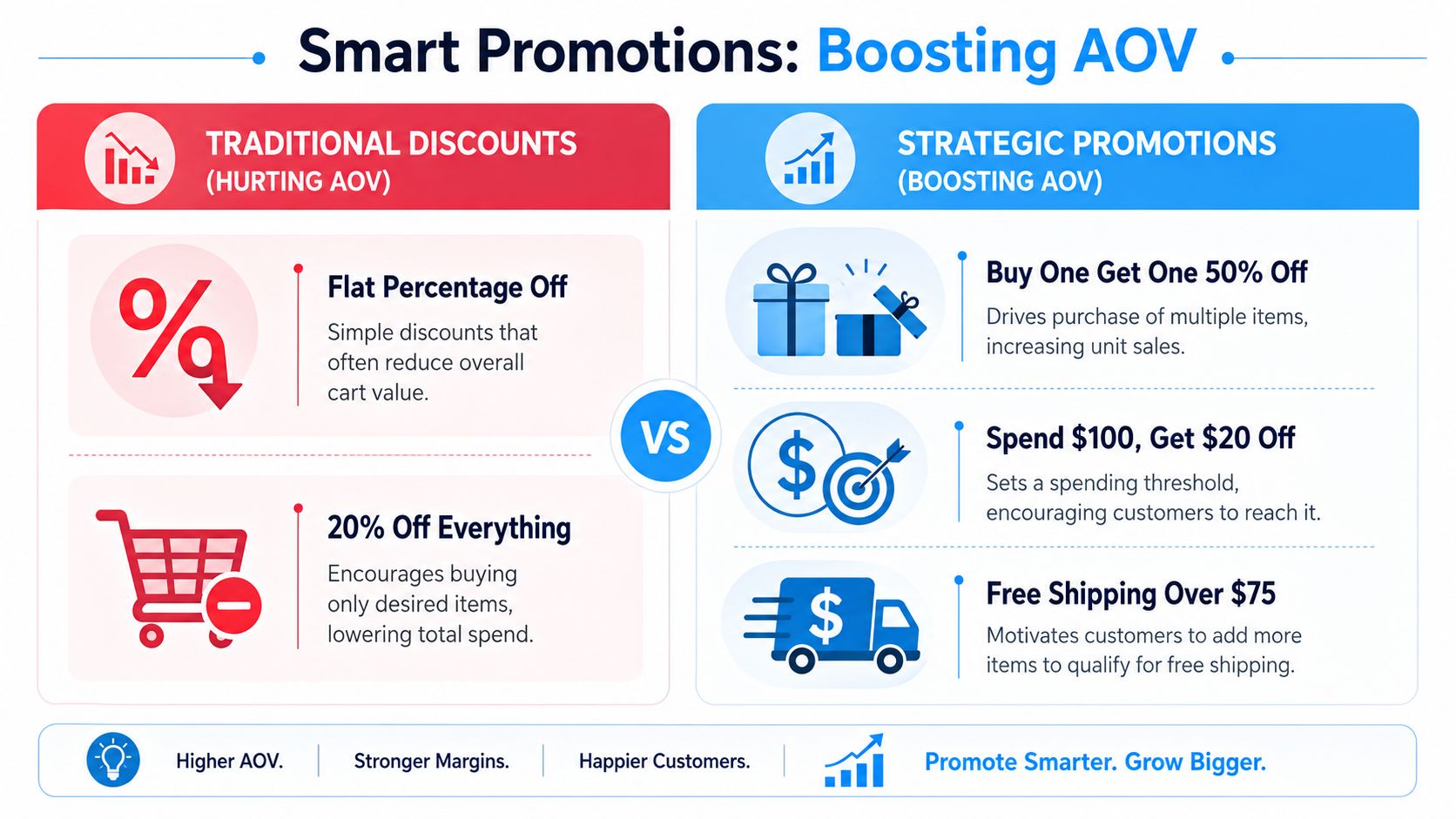
Many Shopify brands leave money on the table by reaching for “15% off sitewide” because it’s easy to set up with native discounts and simple to explain in email. Easy to launch doesn’t mean smart to run.
Flat discounts reduce choice friction, but they also reduce discipline
A critical pitfall in margin-preserving sales is unsegmented flat discounting, which trains customers to wait for the next markdown. A better path is price elasticity segmentation combined with bundling products or adding services instead of percentage discounts to maintain stronger margins and improve loyalist revenue, as outlined in this margin improvement guidance.
That matters because not every customer needs the same incentive. Some are ready to buy. Some need a nudge. Some only respond when the offer feels tied to higher value, not lower price.
Use threshold offers to raise the cart intentionally
Threshold promotions are one of the cleanest ways to protect margin while pushing AOV up.
Instead of “15% off everything,” frame the incentive around a target cart value. Think in structures like:
- Spend more to access value: “Spend $100, get $15 off”
- Shipping threshold: “Free shipping over a set cart level”
- Gift threshold: “Spend more and receive a bonus item”
The psychology is different. Customers don’t just accept a lower price. They add one more item to justify the reward. That gives your merchandising team room to influence the basket instead of marking it down.
For Shopify stores, native discount functions can handle many threshold offers. If you need more advanced logic, such as tiered cart goals or product-specific thresholds, use apps built for cart and discount orchestration instead of forcing it through theme workarounds.
Bundle for margin, not just merchandising
Bundling works best when the bundle solves a buying job, not when it’s just a random collection of SKUs.
Pair products that naturally belong together. Apparel brands can build complete-look bundles. Beauty brands can group regimen steps. Home brands can package room-based sets. The key is to make the customer feel they’re buying a better outcome, not just more units.
Good bundles usually do one of three things well:
- Raise units per transaction: A shopper adds complementary products they might have skipped.
- Protect hero-item pricing: The discount, if any, applies to the package value rather than directly cutting the lead SKU.
- Move supporting inventory: Accessories and add-ons improve the total order economics.
If you’re looking for more practical basket-building ideas, Quikly’s guide on how to increase average order value is useful for thinking through offer structure rather than just discount depth.
Tiered rewards beat one-size-fits-all incentives
Tiered offers give customers a reason to keep climbing.
A single discount says, “You qualified.” A tiered structure says, “You’re close to something better.” That taps commitment and consistency. Once a shopper starts building toward the reward, they’re more likely to continue.
Here’s a simple comparison:
| Promotion type | Customer behavior it creates | Margin impact |
|---|---|---|
| Flat percent off | Buy what I planned, just cheaper | Immediate compression |
| Spend-threshold reward | Add one more item to qualify | Often stronger cart economics |
| Bundle | Buy the solution, not just the hero product | Can preserve pricing on key items |
| Tiered cart reward | Keep adding to reach the next tier | More control over AOV growth |
Handle BOGO carefully
BOGO can work, but only when the product economics support it.
When offering BOGO or “buy several and get one free” structures, the free item should be the lowest-priced product so the customer is still paying for the higher-priced item, which helps keep the transaction margin positive. It’s also smarter to reserve BOGO for high gross margin products or specific medium-margin volume plays, based on Invesp’s guidance on promotions without deep discounts.
Most brands misuse BOGO by applying it to the wrong category. They assume the format is safe because it sounds better than a percentage discount. It isn’t safe by default. It still needs math behind it.
Use Behavioral Science to Drive Urgent Action
A smart offer structure helps the cart. Behavioral science gets the customer to act now instead of “maybe later.”
That distinction matters because urgency is often handled badly in ecommerce. Too many stores rely on fake countdown timers, permanent “limited time” banners, or popups that scream scarcity without proving any. Shoppers see through that fast.
Real urgency works because the risk feels immediate
The strongest urgency mechanics align with how people naturally decide.
A few principles matter most:
- Scarcity bias: People assign more value to opportunities that are limited.
- Loss aversion: Shoppers hate missing something they could have claimed.
- Temporal discounting: Immediate rewards feel more compelling than future savings.
- Commitment and consistency: Once someone starts toward a reward, they’re more likely to complete the action.
The mistake is treating these as gimmicks. They’re not. They’re decision shortcuts that become powerful when the promotion is constrained.
Customers respond to urgency when the limits are real. They ignore it when every sale looks the same.
Time limits are good, quantity limits are better
A countdown can create urgency, but time alone isn’t always enough. If customers know the same sale will return next weekend, the clock loses power.
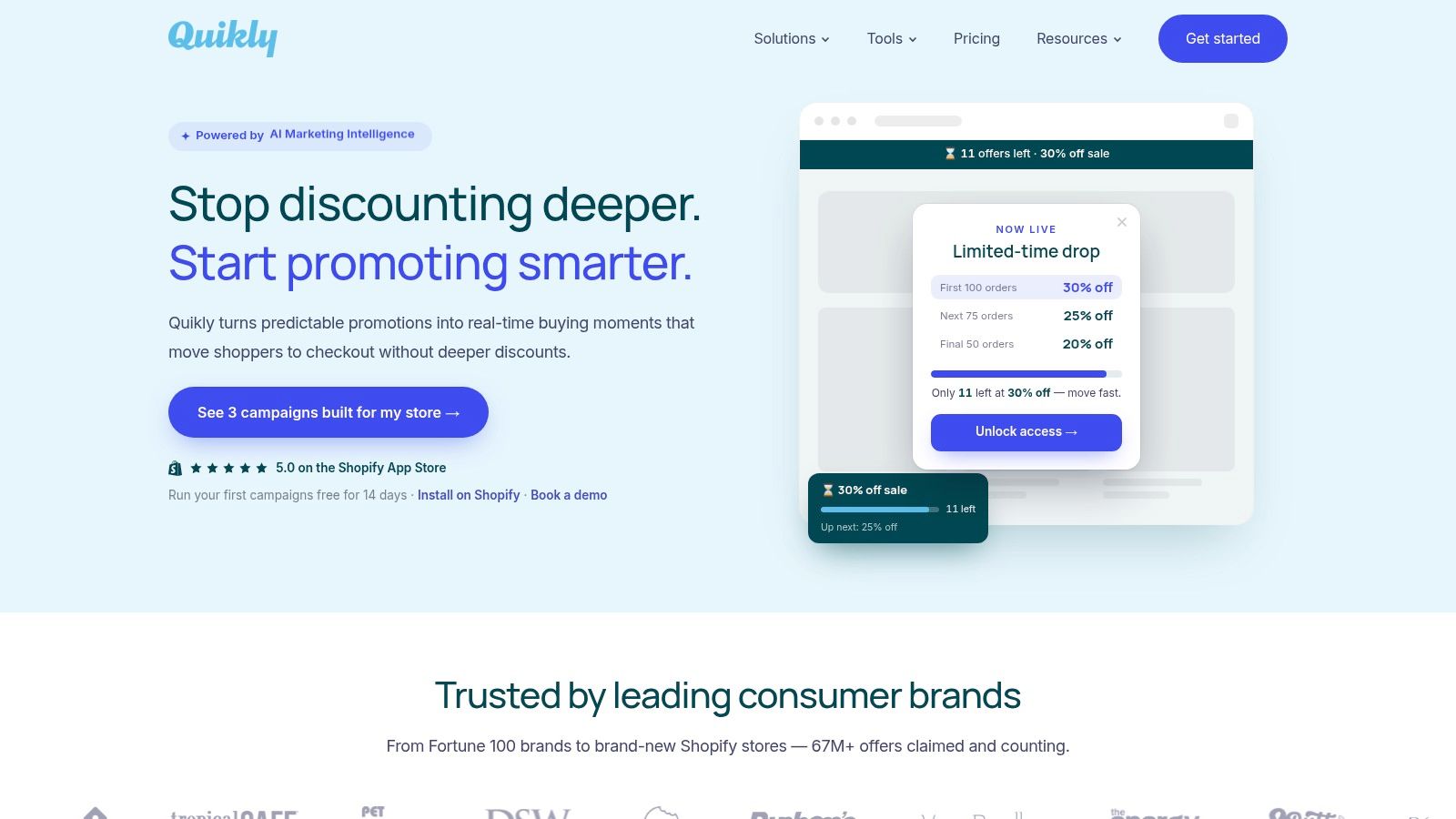
That’s why time-bound and quantity-bound rewards are more effective than open-ended discounting. To run a sale without hurting margins, use capped rewards that are limited by time, quantity, or both. This shifts attention from pure price to urgency, and this approach has been refined across more than 60 million consumer interactions according to Quikly’s business context.
Quantity limits change the emotional math. The customer isn’t just deciding whether to buy before midnight. They’re deciding whether to buy before the better reward is gone.
Reward action, don’t subsidize waiting
This is the strategic shift most brands miss.
Traditional discounts reward indecision because the shopper who waits often gets the same or better offer later. A better promotional system rewards the shopper who acts at peak intent.
That can take several forms:
- Descending reward tiers: Early claimers get the best reward, later shoppers get a lighter one.
- Capped reward pools: Only a limited number of customers can access the top incentive.
- Channel-tied urgency: Email, SMS, and onsite messaging all point to the same finite offer, so the urgency is consistent across touchpoints.
This is much healthier for the brand. It protects margin by limiting exposure, and it protects perception because the offer feels event-based instead of permanently discounted.
For a deeper look at this approach, Quikly’s piece on how to create urgency without discounts gets into the mechanics in more detail.
What this looks like in Shopify operations
From an operator’s perspective, the best urgency campaigns do three things well.
First, they’re clear. The shopper understands what they can get and what causes that reward to step down or expire.
Second, they’re controlled. The team knows exactly how much reward exposure exists because the offer is capped.
Third, they fit the store. The experience feels on-brand instead of bolted onto the storefront.
That last part matters more than people think. If the promotion feels cheap, it doesn’t just hurt conversion. It lowers perceived value. Good urgency mechanics should create momentum without making the brand look desperate.
Measure the True Profitability of Your Campaigns
Revenue is an incomplete answer to whether a sale worked.
If you only measure gross sales, almost any discount campaign can look good for a few days. The harder question is whether the campaign created profitable demand, better carts, and healthier customer behavior.
Track the metrics that show economic quality
Start with gross profit, not top-line revenue. Then look at the customer actions behind it.
A strong post-campaign readout usually includes:
- Gross profit by campaign: Not just what the promotion sold, but what it left behind.
- Average order value movement: Did the structure improve the basket, or did customers buy the same items at lower prices.
- New versus returning customer mix: Did the offer acquire demand or just subsidize existing loyalists.
- Redemption pattern: Which products, segments, and channels consumed the incentive.
- Post-promo behavior: Did customers come back at full price, or did the sale pull demand forward.
Many teams discover an uncomfortable truth: the sale “won” on revenue but underperformed on contribution.
Separate correlation from actual lift
Promotions often get credit for sales that would have happened anyway.
That’s why your campaign review should include some form of holdout, test cell, or controlled comparison where possible. If your team wants a useful primer on the logic behind this, PlotStudio AI has a strong explainer on learn to find true cause and effect.
You don’t need a perfect experiment every time. But you do need more than a screenshot of higher sales during the promo window.
A campaign should have to prove incremental profit, not just coincidental revenue.
Use a simple comparison framework after every sale
Keep the review tight enough that the team will do it. I’d use a table like this after each campaign:
| Question | Weak answer | Strong answer |
|---|---|---|
| Did revenue rise | Yes | Yes, and profit held |
| Did AOV improve | No change | Cart value increased |
| Did margin stay inside guardrails | No | Yes |
| Did the offer create urgency | Hard to tell | Customers acted early |
| Did behavior after the sale improve | More discount dependence | Better buying timing |
If you want to know how to run a sale without hurting margins, implementing the answer involves this strategy. Run one structured promotion against one flat discount. Keep the audience and timing as comparable as possible. Then review profit, AOV, and post-promo behavior side by side.
Businesses often don’t need more promotions. They need better evidence.
Conclusion Shift from Discounting to Rewarding Action
A sale goes bad when the only idea is “cut the price and hope volume makes up for it.” That approach gives away margin first and asks questions later.
Profitable promotions start with structure. The percentage matters, but the mechanics matter more. A well-built offer gets customers to do something useful for the business: buy sooner, spend more, choose a better bundle, or clear inventory you need to move. That is a very different job than handing out a blanket discount.
The practical shift is simple. Reward action, not just purchase.
Reward the shopper who reaches a margin-safe threshold. Reward the customer who buys during a real deadline. Reward the behavior that improves AOV and protects contribution dollars. That is how promotions drive conversion without teaching customers to wait for the next sitewide code.
This is usually what separates a healthy promo calendar from a destructive one. The strongest campaigns are built around guardrails, offer design, and genuine urgency. Then they get judged on profit after the campaign, not just top-line sales during it.
Before the next sale goes live, make two decisions first: what margin you need to keep, and what customer action is worth rewarding. Build the promotion around those answers.
If you want a practical way to run urgency and scarcity promotions in Shopify without defaulting to broad, margin-draining discounts, Quikly is built for that. It helps brands run time- and quantity-bound promotional experiences that reward shoppers who act early, keep offers on-brand, and give teams tighter control over margin exposure.
Topics: how to run a sale without hurting margins, ecommerce promotions, shopify sales, profit margins, discount strategy