Most advice about customer experience design starts in the wrong place. It starts with page speed, cleaner navigation, better mobile layouts, and fewer checkout fields. Those things matter. They just don’t explain why a polished Shopify store can still struggle to convert profitably.
A brand can invest heavily in design, merchandising, and lifecycle flows, then give the whole margin story back at the final moment with a predictable discount. That isn’t a promotion problem alone. It’s a customer experience problem. The purchase moment is part of the experience, and for many brands, it’s the least intentionally designed part of the journey.
For Shopify teams, that’s where customer experience design gets interesting. It’s not just about making the store easier to use. It’s about shaping how people feel when they decide whether to buy now, wait, or hold out for a better offer. If the promotional experience trains shoppers to delay, ignore, or expect the next markdown, the experience is working against the business.
The Hidden Flaw in Your Customer Experience Strategy
Many brands still treat customer experience as a front-end discipline. Make the PDP clearer. Simplify the cart. Improve the mobile menu. Rewrite the shipping copy. Those are worthwhile fixes, but they miss the part of the journey where profit often leaks out.
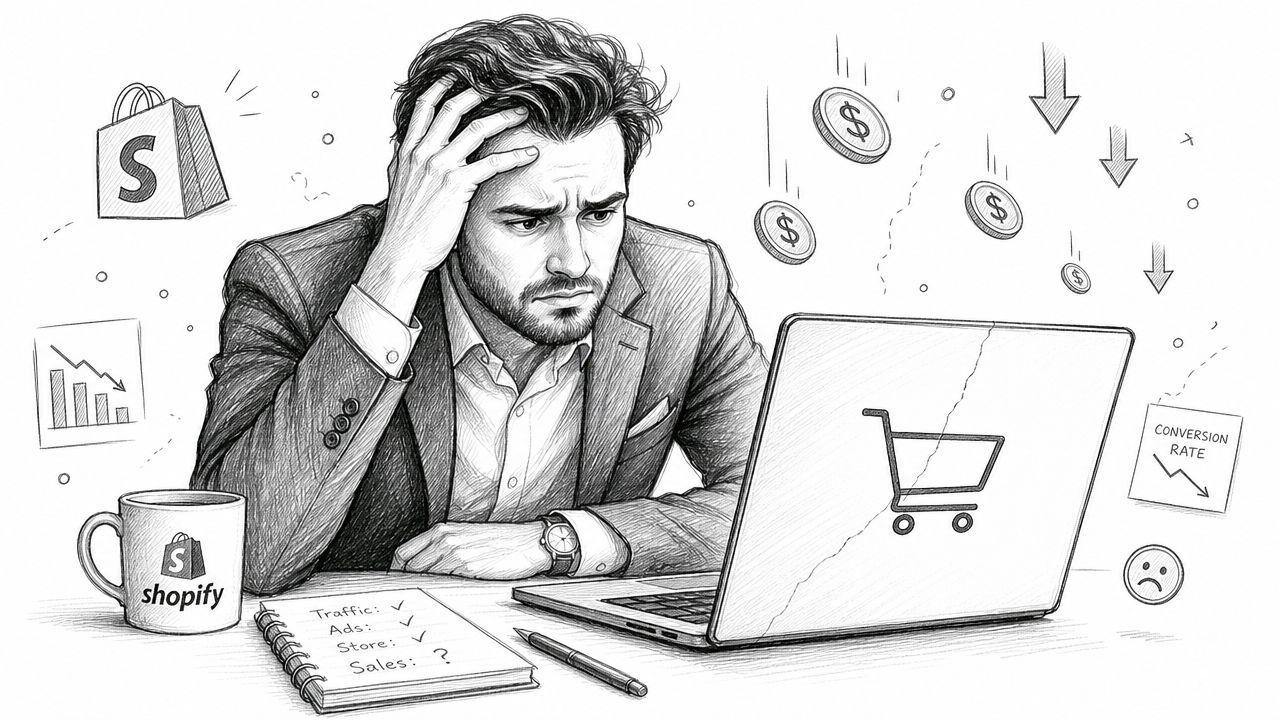
Investing in UX can be highly valuable. Data shows that every $1 allocated to UX generates a return of $100, but if that experience ends in a margin-eroding discount, the business impact gets diluted. A smooth site paired with blunt promotional tactics is still a broken system.
A beautiful store can still create a bad buying experience
The hidden flaw is simple. Most ecommerce teams optimize the shopping experience, then outsource the decision moment to generic promo mechanics.
That usually looks like this:
- Blanket discounting: Sitewide offers that apply to everyone, including people who were already ready to buy.
- Popup-and-pray tactics: Exit-intent overlays that interrupt the journey and teach shoppers to wait for an incentive.
- Calendar-driven campaigns: Promotions dictated by retail habit instead of customer behavior.
None of these are neutral. They shape expectation. They tell shoppers what your brand does when someone hesitates.
Practical rule: If your promotion makes customers feel trained rather than valued, it’s part of the CX problem.
The purchase moment is a brand moment
Customer experience design converges with brand activation. The strongest brands don’t just create awareness. They create participation, anticipation, and a reason to act. If you want a useful outside perspective on that connection, Mr. Green Marketing’s brand activation guide is worth reading because it frames activation as something customers experience, not just something marketers launch.
For Shopify merchants, the question isn’t whether the site looks premium. It’s whether the promotional layer reinforces that premium feel or undercuts it.
A well-designed experience should reduce friction without making the brand feel cheap. It should motivate action without teaching customers to stall. And it should protect margin while still giving buyers a reason to move now.
That’s the gap most CX advice leaves untouched.
What Customer Experience Design Means for Ecommerce
Customer experience design is broader than interface design. UI is what the store looks like. UX is how the store works. Customer experience design is how the whole interaction feels, from first impression to post-purchase follow-up.
For ecommerce, that includes much more than the website. It includes the ad that set the expectation, the email that brought someone back, the way shipping is explained, the logic behind the offer, the checkout confidence signals, the support interaction, and the follow-up after delivery.
Think beyond the storefront
A simple way to frame it:
| Discipline | What it covers | Ecommerce example |
|---|---|---|
| UI | Visual presentation | Typography, buttons, product card layout |
| UX | Usability and flow | Filtering, cart behavior, checkout steps |
| CX | End-to-end perception | Offer logic, support tone, post-purchase trust, promotional experience |
That last column is where many brands underinvest.
Customer experience design has to start from people, not screens. Research confirms that 70% of buying experiences are based on how customers feel they’re being treated, not just the product or website usability, as noted by HeyMarvin’s overview of customer experience design. That matters because promotions are emotional signals. They can feel generous, exclusive, rewarding, chaotic, desperate, or manipulative depending on how they’re designed.
What this looks like on Shopify
On Shopify, CX isn’t one thing. It’s a chain of connected touchpoints:
- Acquisition touchpoints: Paid social creative, Google Shopping listings, influencer mentions, affiliate placements.
- On-site touchpoints: Collection page logic, PDP messaging, cart experience, Shop Pay flow, account area.
- Retention touchpoints: Klaviyo emails, SMS reminders, replenishment prompts, loyalty messaging.
- Service touchpoints: Order updates, return policy clarity, support handoff, issue resolution.
Now add the promotional layer. A discount code in the hero banner, an offer in a welcome flow, a gated early-access drop, a post-purchase incentive, or an SMS-based reward all shape the same customer experience.
Customer experience design isn’t finished when the site is usable. It’s finished when the customer’s path to purchase feels coherent, fair, and worth acting on.
The practical definition that matters
For operators, customer experience design means designing every touchpoint to support two outcomes at once:
- The customer should feel understood and respected.
- The business should move the customer toward a profitable next action.
That’s why promotions belong inside CX strategy, not outside it. They aren’t just sales tools. They’re part of how customers learn what kind of brand you are.
Core Frameworks for Modern CX Design
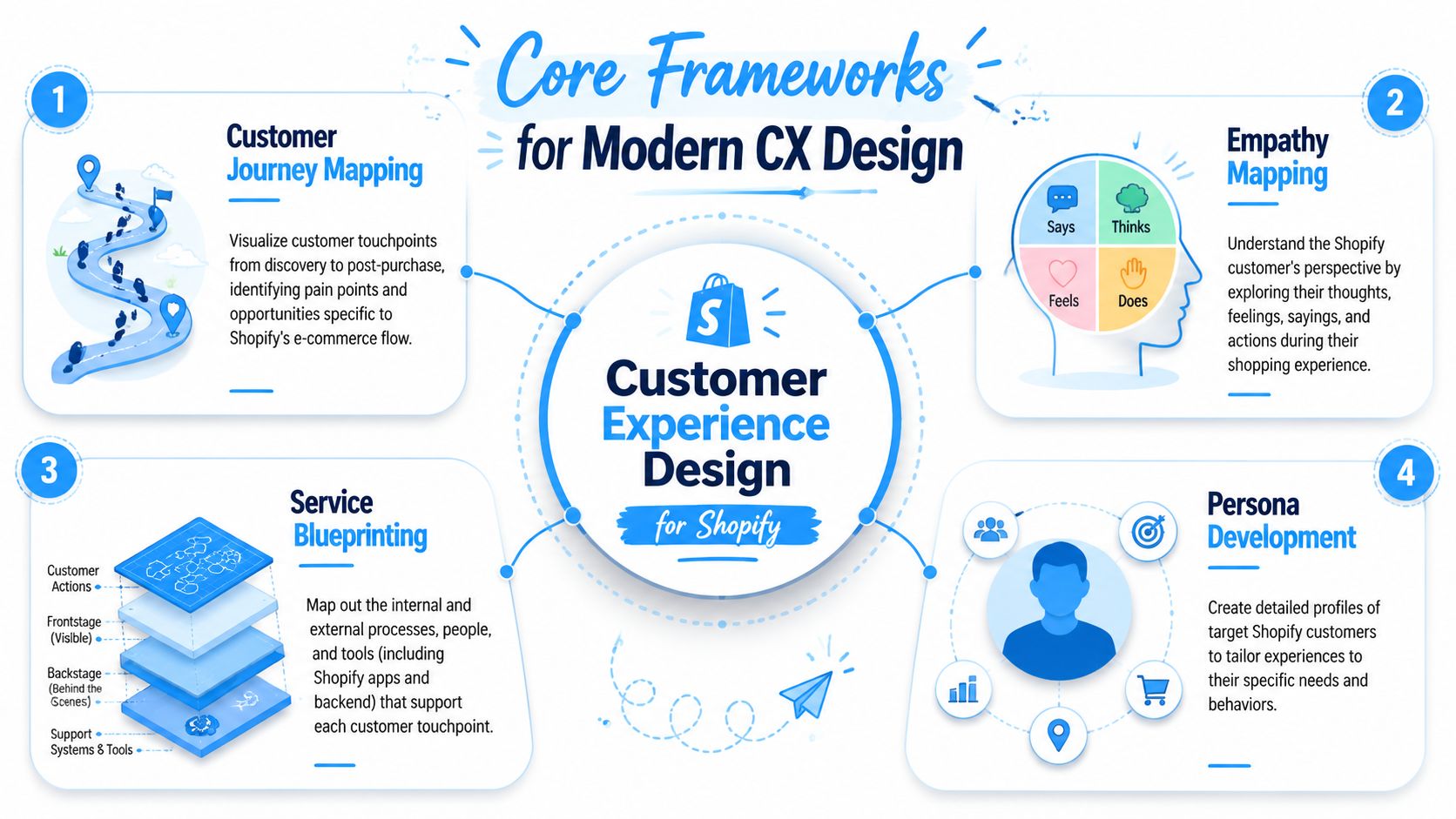
Most CX frameworks sound abstract until you map them onto real Shopify operations. Then they become useful fast. The point isn’t to create a prettier workshop board in Miro. The point is to see where the customer experience breaks, who owns the break, and what system causes it.
Customer journey mapping finds the visible friction
A journey map is the front-stage view. It shows what a customer sees and does across the path from discovery to reorder.
For a Shopify store, that might include:
- Discovery: Instagram ad, creator mention, search result, referral link
- Consideration: Collection browsing, PDP review, sizing questions, shipping concerns
- Decision: Cart review, promo encounter, checkout completion
- Post-purchase: Confirmation email, fulfillment updates, delivery, support contact
- Loyalty: Replenishment, VIP access, early drop communication, win-back flows
This work gets sharper when teams stop treating each touchpoint as a separate channel problem. A cart abandonment issue may be caused by weak expectation-setting in an ad, confusing pricing logic on the PDP, or a promotion that appears too late.
A useful next read on that operational lens is Quikly’s piece on customer experience optimization, especially if you’re trying to connect channel performance with the actual buying journey.
Service blueprinting finds the hidden causes
A Service Blueprint is the operational layer behind the journey. It maps visible customer touchpoints against invisible backstage processes such as automations, app logic, team handoffs, and policy rules. That matters because many customer-facing problems are actually back-end coordination problems.
Here’s a practical example:
| Customer sees | Backstage process supporting it | Common failure |
|---|---|---|
| Exclusive early-access email | Klaviyo segment sync, Shopify discount setup, inventory rules | Wrong audience gets the offer |
| Smooth checkout incentive | Cart logic, discount eligibility, theme behavior | Incentive breaks at checkout |
| Fast support resolution | Helpdesk routing, policy documentation, order visibility | Agent can’t resolve issue on first reply |
If a CX issue keeps repeating, blueprint it. Don’t just rewrite copy.
When teams say “we all own the experience,” what usually happens is nobody owns the friction.
Two more frameworks that keep teams honest
Empathy mapping helps merchants move past assumptions. What are the buyer’s true thoughts during the promotion? Are they excited, skeptical, confused, or waiting for a better deal?
Persona development matters too, but only if it reflects behavior. A high-intent repeat customer doesn’t need the same experience as a passive browser who likes the product but has no urgency yet.
The strongest Shopify teams combine all four frameworks:
- Journey mapping to see the path
- Service blueprinting to trace operational causes
- Empathy mapping to understand emotional response
- Persona development to tailor the experience by buyer type
That combination is what turns customer experience design into a working operating system instead of a design exercise.
Designing Promotions as a Core Customer Experience
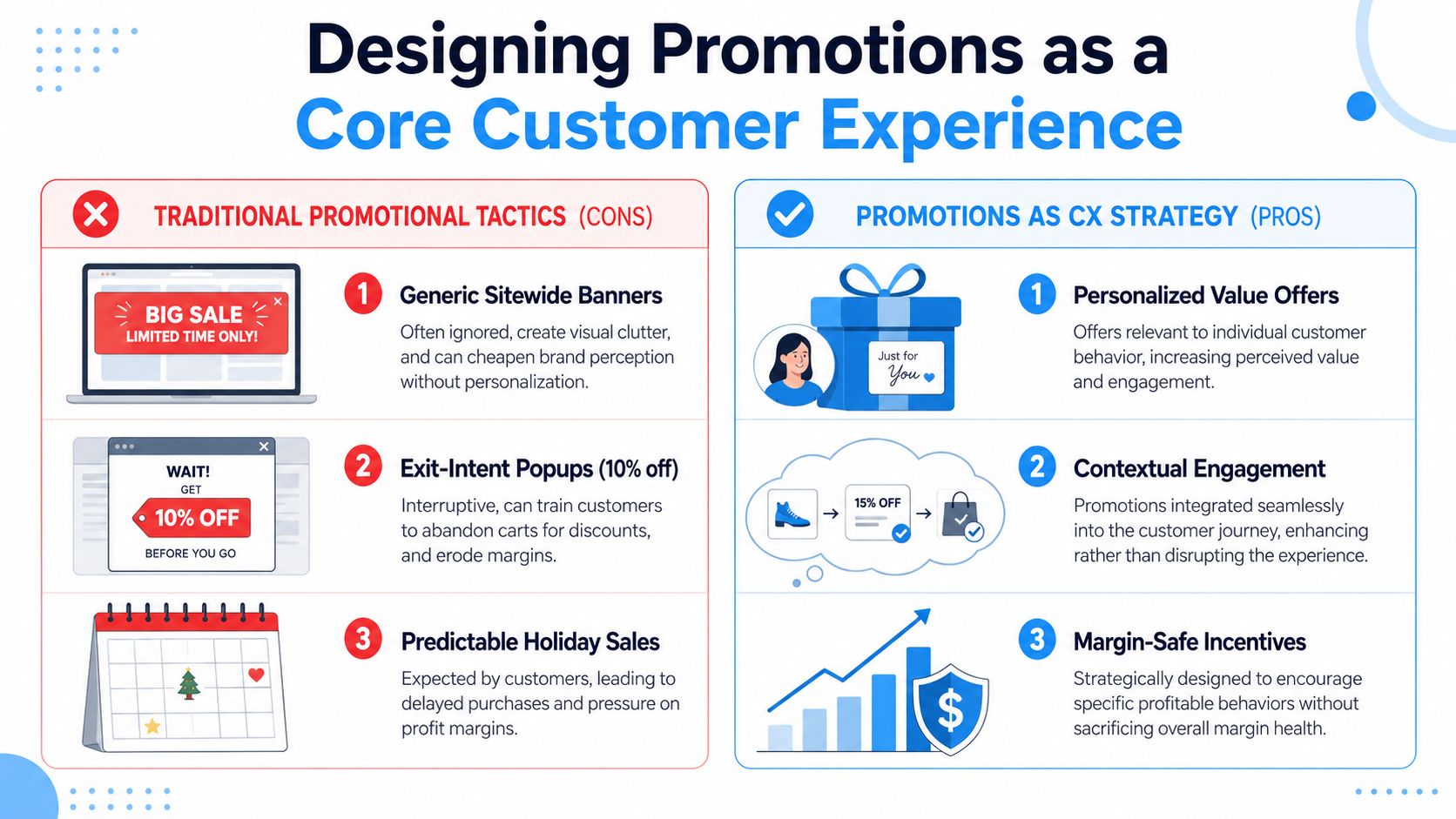
A lot of brands work hard to make the shopping experience feel premium, then switch tone completely at the moment of conversion. Suddenly the experience becomes louder, cheaper, and more predictable. A flashing banner appears. An exit popup offers a code everyone has seen before. A holiday sale arrives right on schedule.
That’s not a minor merchandising issue. It’s poor customer experience design.
Why standard promotions weaken the experience
Generic promotional tactics usually fail in three ways at once.
First, they interrupt the journey instead of supporting it. Second, they flatten value by giving the same incentive to everyone. Third, they train delay by teaching shoppers that waiting pays.
That matters because a large share of buyers aren’t saying no. They’re saying not yet. Existing CX content often focuses on active shoppers while ignoring passive buyers, even though the 2025 McKinsey Consumer Pulse survey found that 68% of modern shoppers delay purchases citing promotional fatigue, as referenced in this McKinsey discussion of CX design limits.
Promotions work better when they feel earned
The better approach is to design promotions as experiences customers participate in, not offers they passively receive.
That changes the mechanics:
- Controlled exposure over blanket access: Not every visitor should see the same incentive.
- Earned rewards over automatic markdowns: Engagement increases perceived value.
- Real scarcity over manufactured pressure: Limited access works when it’s credible.
- Contextual timing over constant interruption: The offer should fit the customer’s moment.
These mechanics line up with familiar behavioral principles. Scarcity bias increases desire when availability feels limited and believable. The endowment effect makes an earned reward feel more valuable than a generic one. Commitment and consistency can increase follow-through when a customer has already taken a small action toward the reward. Temporal discounting matters too. Buyers often favor immediate, concrete value over a vague future benefit.
A practical catalog of ideas in this direction is Quikly’s guide to Shopify promotion ideas, especially if your current playbook is too dependent on repeated markdowns.
A promotion should answer one question clearly. Why should this customer act now without making the brand look cheaper tomorrow?
The margin case for promotional CX design
There’s a direct business argument for this approach. A 2025 Nielsen IQ analysis found that brands using psychology-backed, non-monetary rewards such as exclusive access saw a 24% higher conversion rate among passive buyers compared with deep discounts, while maintaining 15% better margins, as summarized in CMSWire’s coverage of designing for the right users.
That finding matters because it reframes what “better conversion” should mean. Not more orders at any cost. More motivated purchases without using the bluntest tool in the stack.
For Shopify merchants, that can mean early access for a product drop, a reward earned through engagement, or a tightly scoped incentive delivered only to the segment that specifically needs a push. The promotion still drives action. It just does it in a way that protects both margin and brand perception.
How to Implement and Measure Margin-Safe CX
Most brands don’t need another reminder to “focus on the customer.” They need a practical way to redesign the purchase moment and measure whether it improved the business.
The first shift is operational. Stop evaluating promotions only by revenue and conversion rate. If a campaign lifts orders while lowering profit quality, increasing dependency on discounts, or weakening future pricing power, it didn’t improve customer experience in any meaningful way.
Build a balanced scorecard
Effective CX frameworks need a balanced scorecard. That means tracking emotional metrics such as NPS, behavioral metrics such as Customer Effort Score, and financial metrics such as Customer Lifetime Value so teams don’t optimize for vanity signals that never turn into durable revenue.
For a Shopify promotion program, that scorecard might look like this:
| Metric type | What to watch | Why it matters |
|---|---|---|
| Emotional | NPS, post-purchase sentiment, pulse survey feedback | Shows whether the offer felt helpful or cheap |
| Behavioral | Customer Effort Score, redemption friction, repeat purchase behavior | Reveals whether customers had to work too hard |
| Financial | CLTV, profit quality, order mix, incremental impact | Keeps the team focused on business value |
Many brands frequently find themselves stalled. They watch top-line campaign output and ignore how the offer affected future customer behavior.
What to change first
A clean implementation path usually starts with a single touchpoint, not a full CX overhaul.
- Audit one decision moment: Pick the cart, welcome series, browse abandonment flow, or VIP launch sequence.
- Replace the default discount: If the current fallback is “10% off,” challenge whether that incentive needs to be automatic, universal, or public.
- Add a real-time feedback loop: Trigger a short pulse survey after the experience so you can capture immediate reaction instead of waiting for lagging sentiment data.
- Check operational readiness: Make sure Shopify discount logic, inventory rules, support scripting, and Klaviyo flows all match the customer promise.
For a broader CRO lens outside ecommerce, Silva Marketing’s take on CRO strategies for local businesses is a useful reminder that optimization only counts when it changes outcomes, not just click behavior.
Measure the campaign, not just the click
One of the more common mistakes in promotional CX is judging the tactic by engagement alone. Opens, clicks, and redemptions can all look healthy while the economics get worse.
That’s why teams should connect campaign review to promotional return, not just response. Quikly’s article on promotional ROI is useful here because it pushes the measurement conversation toward business impact rather than surface-level activity.
Good measurement answers a harder question than “did people convert?” It answers “did this experience create the kind of conversion we actually want more of?”
A margin-safe customer experience isn’t built from a single KPI. It comes from aligning the emotional feel of the offer, the effort required to act, and the financial quality of the result.
Putting It All Together Your First CX Experiment
The most useful shift is also the simplest one. Stop asking, “How can we increase conversions?” Start asking, “How can we design a more compelling purchase moment?”
That question forces better decisions. It moves the team beyond cosmetic fixes and into the part of customer experience design that actually shapes buyer behavior.
Three experiments worth running next week
Experiment one. Replace your default welcome discount with a limited-access reward for a defined audience. Keep the message tight. The point isn’t to make the offer louder. It’s to make it feel intentional.
Experiment two. Take one high-interest product or collection and create an early-access experience instead of a sitewide markdown. Use email or SMS to invite participation, not just distribute a code.
Experiment three. Add a short journey-based pulse survey after a promotional interaction. Ask how clear, fair, and motivating the experience felt. That qualitative signal often explains campaign performance better than channel metrics alone.
What success should look like
You’re looking for signs that the purchase moment became sharper, not just busier.
- Better intent quality: Customers move because the offer feels relevant, not because they’ve learned to wait.
- Less promotional drag: The brand stops relying on the same blunt incentive every cycle.
- Stronger internal clarity: Marketing, ecommerce, and support understand exactly what promise the promotion is making.
Customer experience design becomes more valuable when it reaches the transaction itself. That’s where margin pressure, customer psychology, and brand perception all collide. If the offer experience is weak, the rest of the journey has to work too hard to compensate.
The brands that handle this well don’t necessarily run fewer promotions. They run promotions that feel more coherent, more deliberate, and more worth acting on.
If your Shopify team wants to turn promotions into customer experiences instead of margin leaks, Quikly is built for that shift. It helps brands create psychology-backed, fully on-brand promotional experiences that motivate action without defaulting to blanket discounting.
Topics: customer experience design, ecommerce promotions, shopify conversions, behavioral marketing, profit margins