The most common advice for ecommerce email is to send more of it, more often, with a bigger percentage off when the last send underperforms. That advice creates its own problem. Shoppers learn the pattern quickly, they stop buying at full price, and they wait for the next code because waiting has always paid. You get a short revenue spike and a customer who now needs a deeper discount next time.
Promotions represented 86.21% of email activity in Q2 while the reported spam rate rose from 5.74% in Q1 to 11.03% in Q2, according to 2025 ecommerce email analysis from TargetBay. More promotional volume did not make inboxes more welcoming. It made relevance, frequency caps, and honest limits harder to ignore.
The eight email campaigns examples below cover welcome, cart recovery, VIP access, flash sale, post-purchase, win-back, back-in-stock, and tiered reward sends. Each one is judged by a different question than opens or clicks alone. Does this campaign reward acting now, or does it train the shopper to wait? Each item names the psychology at work and ends with a practical move you can copy in Klaviyo on Shopify.
1. Welcome Series for Signup Growth
A welcome series is usually three to five automated messages over the first week or two after signup. It’s often the first flow a Shopify merchant builds in Klaviyo, and it sets the promotional tone for the whole relationship. If email one leads with a permanent percentage code, you’ve taught a new subscriber that your list price isn’t real.
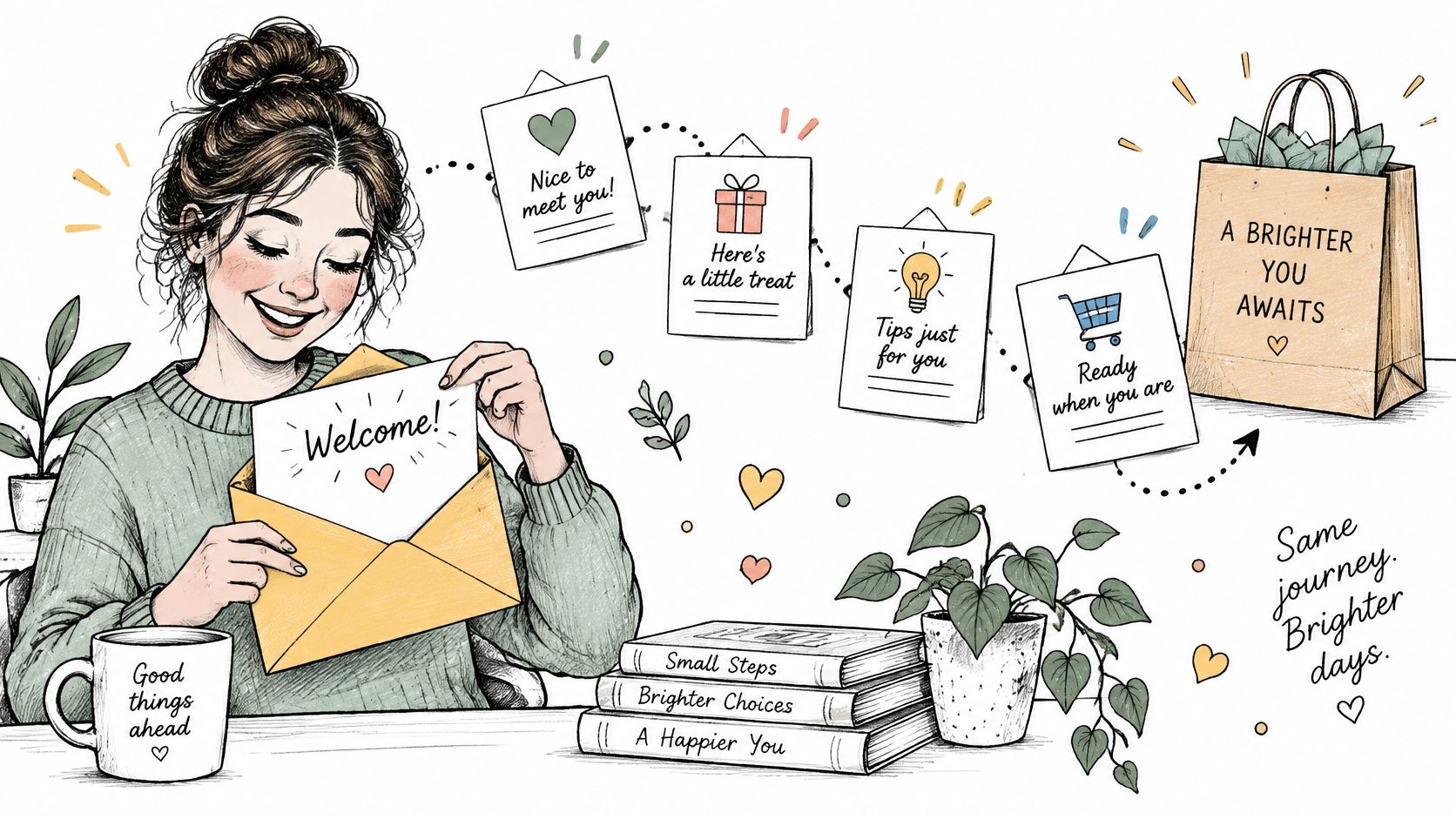
Say a skincare brand runs four emails. Email one tells the founder story and what subscribers will receive. Email two shows bestsellers with reviews for social proof. Email three handles objections on ingredients, shipping, and returns. Email four offers a first-order reward that expires or is capped by claim count, so the decision happens inside the sequence.
Frame the Reward, Don’t Deepen It
Offer framing matters as much as offer size. In a welcome test, describing the same incentive as “up to $73 off” instead of “45% off” increased clicks by 47% and revenue per recipient by 60%, according to welcome-email A/B test results from Essence of Email. The margin didn’t change. The presentation did.
- Lead with value first: Put brand, proof, and expectations before any reward.
- Bound the incentive: Use time or quantity limits instead of an evergreen code.
- Exit buyers fast: Stop welcome offers the moment someone purchases.
- Audit quarterly: Check the sequence against current margin targets, not last year’s.
2. Abandoned Cart Recovery Email
Cart abandonment is high intent, not low interest. The shopper picked products, chose variants, and started checkout. Sending a discount to every abandoner within the hour teaches a simple trick. Leave, wait, get paid to return.
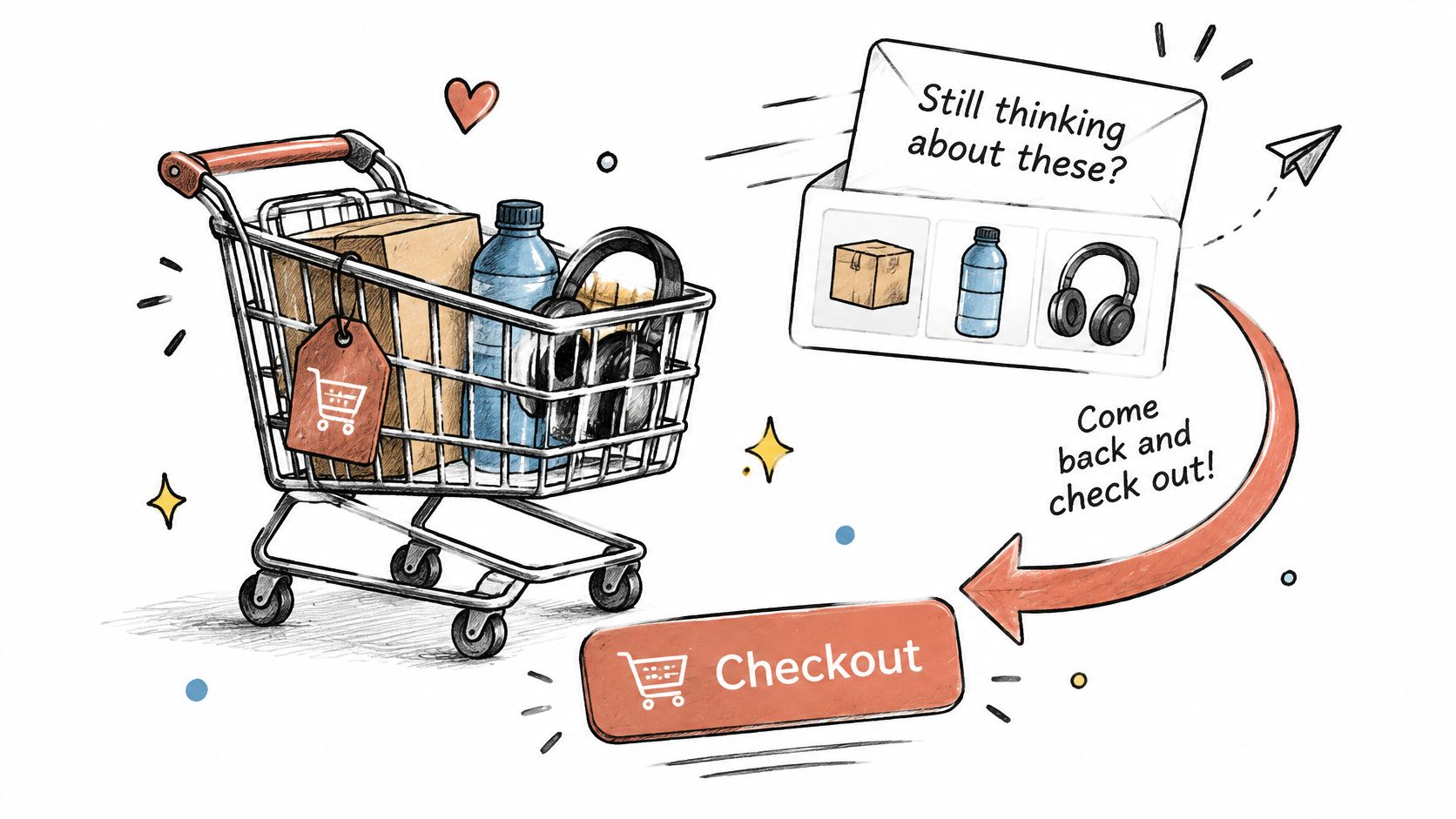
A stronger sequence earns the discount late, if it uses one at all. Email one, sent within one to three hours, shows the cart and a single checkout link. Email two answers the likely friction, such as shipping cost, sizing, or delivery timing, and adds reviews. Email three introduces a reward that expires within a set window. I recommend holding the incentive until that third touch because many carts recover on reminder and reassurance alone.
Test Before You Discount Everyone
Automation and testing change the math here. An abandoned-cart program achieved twice as many conversions after the series was automated and A/B tested, according to a GetResponse ecommerce case-study collection. That lift came from timing and testing, not from automatically cutting price. For more detail on sequencing, see Next Point Digital’s cart recovery strategies.
Practical rule: Treat the first cart email as a service reminder. Treat a later, time-bound reward as a closing tool, and suppress anyone who checks out mid-flow.
3. VIP Early Access Launch Email
Early access flips the usual promotional logic. Instead of lowering price for everyone, you’re giving your best customers time. Access becomes the reward, and loss aversion does the work because missing the window means shopping with everyone else later, possibly after key sizes sell out.
Say an apparel brand opens a seasonal drop for 24 hours to customers with two or more orders. The email states the rule plainly, shows the collection, and notes the quantity available in the run. The next day, the same collection opens to all subscribers at the same price. VIPs got priority, not a markdown, so perceived value stays intact.
Segmentation is what makes this credible. One ecommerce program moved from sporadic, unsegmented sends to consistent, focused messages and saw email sessions rise from 2,809 in 2023 to 13,829 in 2024, according to a Whirlwind Ecommerce marketing case study. A defined audience beat a bigger blast.
- Define VIP in writing: Use order count or lifetime spend, not a gut-feel list.
- Match quantity to inventory: Cap units at what you can fulfill.
- Keep the window usable: Short enough to matter, long enough for people to act across time zones.
4. Flash Sale Announcement With Limited Claims
Most flash sales fail on credibility, not design. A countdown that resets, a sitewide percentage that returns next week, and three reminder emails teach shoppers that urgency on your store means nothing. They’ve seen the timer before. They’ll see it again.
A limited-claims version works differently. The email announces a reward available to the first set of claimants within a fixed window, and the claim count is visible in the email and on the storefront. A descending reward steps down as more people claim, so early readers get the better outcome and later readers still get a reason to participate. The average discount stays lighter than a flat sitewide cut because not everyone receives the top tier.
Why Real Scarcity Changes Decisions
In a controlled experiment with 182 participants, both limited-quantity and limited-time scarcity increased perceived arousal and contributed to impulsive purchases, according to a Springer study on scarcity in online shopping. Scarcity bias shortens deliberation because the opportunity itself can change. That only holds if the constraint is real.
- Enforce every limit: If you state a claim cap or deadline, honor it in Shopify.
- Run flash sales sparingly: Frequency drains meaning faster than a weak subject line does.
- Send one reminder: Place it near the deadline with the current claim status, not five sends across two days.
5. Post-Purchase Second-Order Email
The cheapest second order comes from a customer who just had a good first experience. Commitment and consistency is on your side here, since the buyer has already decided your brand is worth paying for. The mistake is paying for that second order twice: once in fulfillment, and again in a discount the customer never asked for.
Say a skincare brand sends a usage guide three days after delivery, timed to when the product is in hand. The second email recommends a complementary product based on what was bought, not a bestseller grid. A third touch offers a short-window reward tied to that second order. The first email is purely helpful, which is why the later commercial ask lands better.
The sequencing matters because each step earns the next. Help first, recommend second, incentivize last. Reversing that order turns a retention flow into a coupon drip, and a coupon drip at this stage does the most damage of all: it teaches a brand-new customer that full price was a mistake.
Measure Action, Not Just Attention
Post-purchase flows need the right scoreboard. The APSIS email benchmark report for 2024 recorded an average open rate of 38.49% and an average click rate of 2.31% among measured campaigns, according to the report’s published data. Opens tell you a message registered. Clicks, second-order rate by first product, and revenue per recipient tell you whether the recommendation worked.
- Time to the usage cycle: Replenishment prompts should match how fast the product runs out, so a 30-day supply gets a different cadence than a quarterly one.
- Recommend from order data: Use Shopify order history in Klaviyo, not a static list.
- Track by first product: Some entry products create repeat buyers. Some don’t, and you need to know which.
6. Win-Back Re-Engagement Email
A lapsed subscriber and a lapsed buyer aren’t the same problem, and a deep discount treats both badly. It tells people who’ve gone quiet that silence earns the best price you offer. That’s a training program for future lapses.
Define inactivity by category first. Sixty to 120 days without an open, click, or purchase is a common starting range, but a furniture brand and a coffee subscription shouldn’t share a threshold. Say an apparel brand emails subscribers inactive for 90 days with new arrivals first, then a reward reserved for the first claims in the next 72 hours. A final sunset email asks plainly whether they want to stay, with a preference option and an easy opt-out. For a deeper framework, read this guide to winning back lapsed customers.
Consider a Trigger Instead of a Blast
Automated emails accounted for only 2% of sends but generated 30% of email revenue, averaging $2.87 per email versus $0.18 for scheduled campaigns, according to ecommerce email data summarized by Alore. Behavior-based sends to recent viewers or abandoners will often beat a broad win-back blast to everyone who’s gone cold.
Suppress recent purchasers and anyone already in a competing promotion before you send a win-back offer. Sending both wastes margin and confuses the customer.
7. Back-in-Stock and Waitlist Alert Email
Back-in-stock is the cleanest urgency you own because nobody invented it. The product sold out, shoppers asked to be told, and now quantity is limited again. There’s no markdown required. Availability is the offer, which protects both margin and brand value.
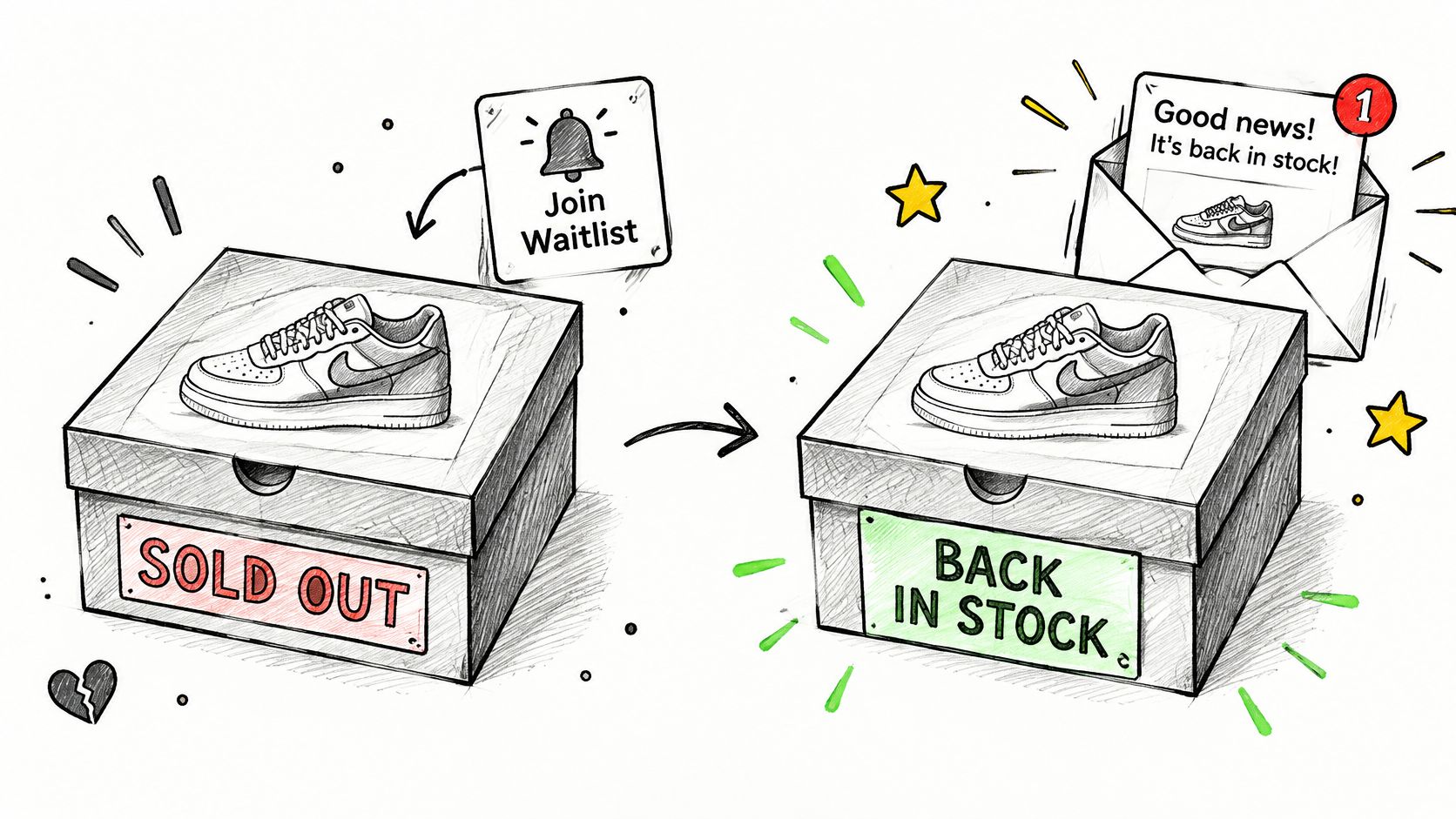
Say a footwear brand restocks a size run and emails the waitlist within minutes. The email lists only the sizes available and gives a short claim window before general release. Shoppers who joined the waitlist have already raised a hand, so speed matters more than copy polish. You can build this flow around the approach in this back-in-stock playbook for Shopify brands.
Waitlist depth is also planning data. A long list for one variant tells you where reorder money should go, and a thin list warns against overproduction.
- Send within minutes: Delay lets intent cool and competitors win the sale.
- Show real variants only: Nothing burns trust like clicking through to another sold-out size.
- Don’t stack discounts: Demand is already proven. Cutting price gives away margin you didn’t need to spend.
8. Tiered Reward Announcement Email
A tiered reward announcement turns one send into a sequence of decisions. Earlier claimants get the better reward, later claimants get a smaller one, and the stage change is visible while the email is still open. That is temporal discounting working for margin: the best outcome exists now, then shrinks with delay.
Say the first 100 claimants get the top reward, the next band steps down, and remaining claims are shown live. Or one reward is capped by claim count and a 48-hour window. Either setup gives the subscriber a reason to act inside the same send instead of saving the offer for a later markdown. The mechanics are covered in this guide to tiered discounts on Shopify.
Prove It Against a Control
Dandelion Chocolate used a control group on every send across 32 campaigns and beat the control on revenue in 23 of them, according to a Yocto Agency ecommerce case study. Run tiers the same way: hold out a flat-discount control and judge contribution profit per recipient.
- Explain tiers in one sentence: If the mechanic needs a paragraph, simplify it.
- Show live status everywhere: Email and storefront must match.
- Keep proof in context: The mechanic has been refined across more than 60 million consumer interactions.
The 8 campaigns at a glance
| Campaign | Trigger | Primary Goal | Discount Dependency |
|---|---|---|---|
| Welcome Series for Signup Growth | New subscriber signup | Convert subscribers into first-time customers | Often includes a first-order incentive |
| Abandoned Cart Recovery Email | Cart created without a completed order | Recover an at-risk purchase | Optional; best reserved for later reminders |
| VIP Early Access Launch Email | New launch for a defined VIP segment | Reward loyalty and build launch demand | Not discount-dependent |
| Flash Sale Announcement With Limited Claims | Scheduled short-term promotion | Drive timely purchases | Promotion is central; limited rewards can protect margin |
| Post-Purchase Second-Order Email | First order, often after delivery | Encourage a second purchase | Optional; a time-bound reward may support return purchases |
| Win-Back Re-Engagement Email | Subscriber or customer inactivity | Reactivate interest or confirm subscription preferences | Optional; avoid relying on deep discounts |
| Back-in-Stock and Waitlist Alert Email | Requested product becomes available | Convert shoppers with demonstrated product demand | Not discount-dependent |
| Tiered Reward Announcement Email | Scheduled tiered promotion | Motivate early claims while limiting average discount | Reward-based; discount level changes by claim stage |
The Question to Ask Before Your Next Send
Conversion rate alone is the wrong scoreboard. A campaign can beat its revenue target while training your entire list to wait for the next markdown, and you’ll pay for that training on every future send. Ecommerce conversion rates typically run in the low single digits, so the pressure to discount your way to a better number is real. The number improves. Margin and perceived value steadily get worse.
Run one audit question against every email in your program, flow and campaign alike. Does this message reward acting now or waiting for the next code? Check the exit rules, the suppression logic, and whether the limit in the copy is enforced in Shopify. Check whether a broadcast should have been a behavior-triggered send to a smaller, higher-intent segment. If a patient shopper gets the same or a better deal than a fast one, the campaign is teaching patience.
Email has worked as a direct-response channel for a long time. On May 3, 1978, Gary Thuerk sent a product announcement to approximately 400 ARPANET users and generated about $13 million in sales, according to MarTech’s history of that first email campaign. The lesson worth keeping isn’t the unsolicited send. It’s that a specific offer matched to a qualified audience, measured on revenue, beat broad distribution. That principle still separates strong programs from busy ones.
For brands that want urgency without deeper flat discounts, Quikly offers capped, time-bound rewards that customers participate in across email, storefront, SMS, and social. Campaigns are styled to match your store, and a small team can launch without code. You can enter your store URL to generate campaign recommendations suited to your brand, choosing from three ready-to-run options built from your category, fonts, colors, and theme. During the first 14 days, you can run unlimited free campaigns, including split tests and segment targeting, which lets you compare a tiered reward against your current flat offer on real margin.
I recommend starting with one flow you already trust, such as cart recovery or a product drop, and changing only the incentive structure. Hold audience, timing, and creative constant so the result means something. Measure revenue per recipient, average order value, unsubscribe rate, and margin together. When the offer aligns with how people naturally decide, acting early becomes the rational choice for the shopper, and margin stops being the price of conversion.
Enter your store URL with Quikly to get three customized, time or quantity bound campaign recommendations you can launch across email, SMS, social, and your storefront without code. Run your first campaigns free for 14 days, test a capped or tiered reward against your standard flat discount, and keep the version that converts without training customers to wait.
Topics: email campaigns examples, ecommerce email campaigns, Shopify email marketing, cart abandonment email, urgency marketing