In 2024, American brands sent 172 million SMS messages and generated $1.4 billion in revenue from 8.5 million sales across email, SMS and push marketing, according to Omnisend’s ecommerce marketing study published by PR Newswire. Volume like that makes texting look like a reach problem.
It’s an evidence problem. Ask a merchant to pick any number on that list and prove what the shopper agreed to, when, on which page and with which words on screen, and the trail usually goes cold somewhere between checkout and the SMS app.
Most failures in Shopify SMS programs trace back to four places. Consent that can’t be reconstructed. Suppression that doesn’t sync between systems. Metrics with mismatched denominators. Promotions deep enough to buy revenue that was already on its way. This guide builds SMS marketing for ecommerce as a permission and evidence system first, and as a channel second.
How to Launch SMS Marketing in Six Steps
SMS earns its budget because of how quickly people look at it. SimpleTexting’s 2024 texting and SMS marketing statistics report that 81% of consumers check a text notification within five minutes of receiving it, and nearly 30% check within 60 seconds. More than 90% of consumers text every day, and the same compilation reports that 79% of consumers opted in to receive texts from businesses in 2024, an 11% increase on the previous year.
Speed is the whole advantage and the whole risk. A back-in-stock text that lands while a shopper is still deciding ends the decision. A promotional blast that arrives eleven hours after your last one spends the subscriber you paid to acquire and gets nothing back.
Order of operations: consent, sync, flows, segments, measurement, campaigns. Skipping a step doesn’t remove it. It moves the cost to a later month.
The launch order below is the one that survives contact with a real store.
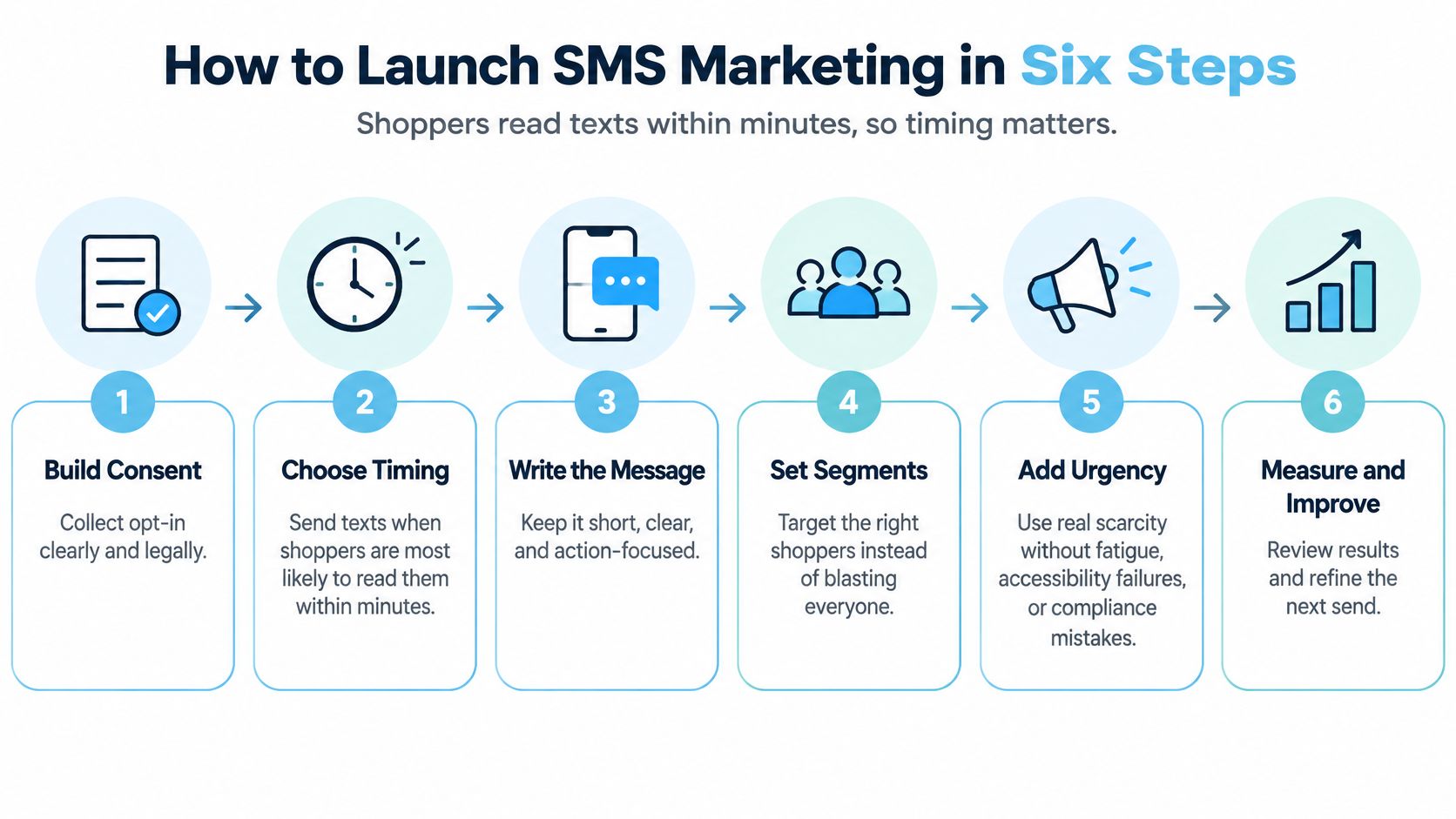
Why each step sits where it does
- Capture consent with the terms attached. The opt-in names the message types, the frequency you intend to keep, and the fact that a purchase never depends on agreeing. Consent collected without those terms isn’t evidence of anything, and the disclosure is the first thing a carrier or a regulator asks to see.
- Sync that status across Shopify, the SMS provider and the suppression list. This sits second because everything downstream inherits it. An opt-out that exists in one app and not the other re-enrolls someone who already told you no.
- Launch lifecycle flows before any broadcast. Welcome, cart abandonment, browse abandonment, back-in-stock and post-purchase. A trigger reaches one shopper at the moment of intent; a blast reaches the entire list on your calendar. Starting with flows means your first messages land when they’re most likely to be welcome.
- Build segments and a per-recipient cap before the first promotion. Once a campaign is out, you can’t take it back. The cap and the suppression rules exist so the first promotion doesn’t cost you the subscribers the flows just earned.
- Write the denominators down and reserve a holdout. Decide before the send what counts as a received message, a click and an order, and which slice of the audience gets nothing. A result you can’t define is a result you can’t repeat.
- Send campaigns only to engaged subscribers, and only once the flows clear their benchmarks. Campaigns come last because they’re the most expensive way to learn something a flow would have told you for free, on a smaller audience, with a cleaner signal.
Run one check today. Write the six steps on a page and mark which ones exist in your store right now. Step 2 and step 5 are the usual gaps, and both cost less to close than another month of list growth.
Consent Rules and Opt-Out Records You Can Prove
A checkbox proves nothing six months later. The ecommerce SMS guidance from BLKDG frames consent as a cross-system evidence and suppression problem rather than a signup-box one, because a phone number passes through checkout, the customer record, the SMS platform, the email tool, the loyalty app and support before anyone asks you to prove anything.
Build the ledger before you build the campaign. Each opt-in row carries five fields: the exact wording the shopper saw, the acquisition source, the timestamp, the campaign it belongs to, and the sending number.
That last field earns its place. Campaigns we run send from a 5-digit short code, so that’s what a shopper sees on the lock screen, and it’s what the disclosure has to name.
The disclosure that holds up
CTIA’s messaging principles and best practices list what a marketing opt-in should identify: the program or product, the sending number or short code, the organization represented, any applicable message fees, opt-out instructions, customer-care details and a link to the privacy policy. Consent is also campaign-specific, and it can’t be transferred to another campaign or another organization.
Which means a number collected for order updates is not permission for a launch text. If the plan is to text a list about a 48-hour reward, that needs a promotional opt-in, worded for that purpose and collected before the send.
Consent and opt-out requirements by market and case
Promotional rules aren’t identical across markets. Guidance on SMS marketing compliance for Europe notes that promotional text messages generally require prior consent, clear sender identification and a simple opt-out, and that UK senders must also explain how recipients can stop messages.
| Market or case | Consent required | Opt-out rule |
|---|---|---|
| United States marketing texts sent with an autodialer | Prior express written consent | Honor revocations through reasonable means, including STOP, before the next send |
| United States messaging best practice, per CTIA | Consent separated by purpose and campaign, not transferable to another campaign or organization | Honor an opt-out at any time, send one confirmation, then stop further messages |
| European Union and UK promotional SMS | Prior consent, with clear sender identification | A simple opt-out mechanism, and UK senders must explain how recipients stop messages |
| Order-update numbers reused for promotions | Not automatically permitted | Collect a separate promotional opt-in before any launch text |
How an opt-out actually gets honored
CTIA’s 2023 messaging principles set the sequence: let consumers revoke at any time, support more than one route such as text, email or phone, and send only one confirmation message before stopping. A STOP reply is an operational event, not a copywriting choice.
The confirmation is the end of the relationship for marketing purposes. Continuing to message after it, or letting a second app re-enroll the same number, undoes the compliance work and the goodwill at the same time.
When checkout, the customer record and the SMS provider disagree about a subscriber’s status, the most restrictive record wins. That rule is easy to write down and easy to forget mid-launch.
The five-subscriber audit
Pick five subscribers at random. For each one, pull the language they saw, the source, the timestamp and the number that would have texted them. If you can’t produce all four in under two minutes, the ledger is documentation rather than evidence.
Then have counsel confirm the obligations for each market you sell into. Rules vary by jurisdiction and change, and nothing here substitutes for that review.
Measure SMS Results with Denominators You Can Trust
Most inflated SMS numbers come from a denominator nobody wrote down. Klaviyo’s benchmark definitions settle two of them. Conversion rate is unique conversions attributed to an SMS or MMS divided by messages received, and click rate is recipients who clicked divided by recipients who received the message.
Write both definitions into your reporting before you run a test, because a click rate measured against sends and one measured against delivered messages differ by enough to change the conclusion.
The same framework puts campaign click rates at 8.9% to 14.5% and flow click rates at 10.9% to 14.9%, then grades campaign conversion as critical below 0.5%, needing improvement at 0.5% to 0.9%, good at 1.0% to 2.0% and great at 2.1% or higher.
Read your own category before you set a target
A universal target misleads, because the top decile in each vertical posts different numbers. According to Klaviyo’s ecommerce SMS benchmarks, the top 10% of apparel and accessories brands average a 16.65% campaign click rate, a 0.59% placed-order rate and $0.80 in revenue per recipient.
| Category | Click rate | Placed-order rate | Revenue per recipient |
|---|---|---|---|
| Apparel and accessories | 16.65% | 0.59% | $0.80 |
| Health and beauty | 11.11% | 0.77% | $0.85 |
| Toys and hobbies | 18.76% | 0.73% | $0.83 |
The gap between those rows isn’t about copy. It’s about how fast each category’s shopper decides, what a typical order is worth, and how much of the click traffic is real.
Where a strong click rate turns into a weak quarter
A time-bound offer can post a healthy click rate and still lose money. Check the funnel one step at a time: click to landing page, landing page to add-to-cart, cart to checkout, checkout to order. An offer that sells out before the traffic arrives, a landing page that loads slowly on mobile, or a discount code that fails at checkout all break the promise the text just made.
That’s a fulfillment problem wearing a messaging costume, and no amount of copy testing fixes it.
Set a holdout and count incremental orders
Split the audience before the send. One group receives the message, one comparable group receives nothing, and you compare orders per recipient across the two. The difference is the revenue the message caused.
Last-click attribution will credit the text for orders that were already on their way, which is exactly the number that makes a discount look profitable. The fuller method sits in this guide to incrementality testing for promotions.
If the only evidence of a campaign’s value is a screenshot of attributed revenue, you don’t have evidence. You have an attribution window.
The monthly review routine
For each flow, check click rate, placed-order rate, revenue per recipient and unsubscribe rate on the same day each month. Read them together, never one at a time.
A rising unsubscribe rate is a stop signal even when revenue looks healthy, because it predicts the next two quarters rather than this one.
The Flows That Earn Their Place in Your Program
Automation isn’t a feature, it’s the economics. In 2023, automated SMS accounted for 13% of SMS sends but generated 26% of all SMS orders among Omnisend merchants, according to Omnisend’s 2024 ecommerce marketing analysis. Half the send share, twice the orders per send.
The conversion gap is as wide. Klaviyo’s SMS marketing benchmarks report average SMS conversion of 1.9% for flows against 0.27% for campaigns, and top-performing accounts reach 3.92% for flows against 0.61% for campaigns.
Five flows carry most of that value.
| Flow | Trigger | Message job | Metric to watch |
|---|---|---|---|
| Welcome | Opt-in confirmed | Set expectations for frequency and deliver the first offer | Placed-order rate and unsubscribe rate |
| Cart abandonment | Cart created, no checkout | Remind with the exact items left behind and one clear reason to return | Placed-order rate per recipient |
| Browse abandonment | Product views with no cart | Show the viewed product with a single next step | Click rate |
| Back-in-stock | Shopper request or inventory returns | Announce availability with a direct link to the item | Placed-order rate |
| Post-purchase | Order fulfilled | Confirm the order, explain use, invite a review or reorder | Repeat-purchase rate |
One message, one job
Timing and content both come from the event. A cart reminder names the items left behind and links to checkout, not to a homepage where the shopper has to start over. A back-in-stock alert links straight to the product and reminds the shopper why they wanted it.
Welcome and post-purchase flows do quieter work that compounds. Welcome sets the frequency expectation, which is the cleanest defense against opt-outs later in the relationship. Post-purchase carries the reorder prompt to the person most likely to place one.
Test one element at a time
Hold audience, offer economics, attribution window and send time constant, then vary one thing: urgency framing, personalization, the call to action, or the delay before the send. Randomize who gets control and who gets treatment, and close the split so nobody lands in both cells.
Run that test on one flow at a time. Two simultaneous tests on the same audience produce two results you can’t separate.
When you need shapes to model, this set of example text messages for ecommerce covers the formats that fit all five flows above.
Where flow tuning goes wrong
The pitfall is optimizing clicks or attributed revenue while list health slips underneath. A flow can post improving numbers for a quarter while frequency creeps up, relevance drops and discount dependence sets in, and the same report looks fine the whole way.
Treat unsubscribe rate as a guardrail rather than a KPI to improve. Klaviyo’s benchmark framework treats unsubscribe rates above 2.0% as critical. A flow that beats its conversion target while crossing that line is borrowing orders from next year.
Segment and Cap Frequency to Protect Your List
Five segments do most of the work: lifecycle stage, recent engagement, purchase history, product affinity and how the shopper responded to previous offers. They matter because the cheapest way to raise click rate is to stop texting people who were never going to click.
Suppression is the other half. Skip anyone who bought the promoted item in the last few weeks, anyone already inside an active automation, and anyone who has ignored the last several sends. Those three rules remove the messages that generate opt-outs without generating orders.
The map below is the one to build first, because it decides who never receives the next campaign.
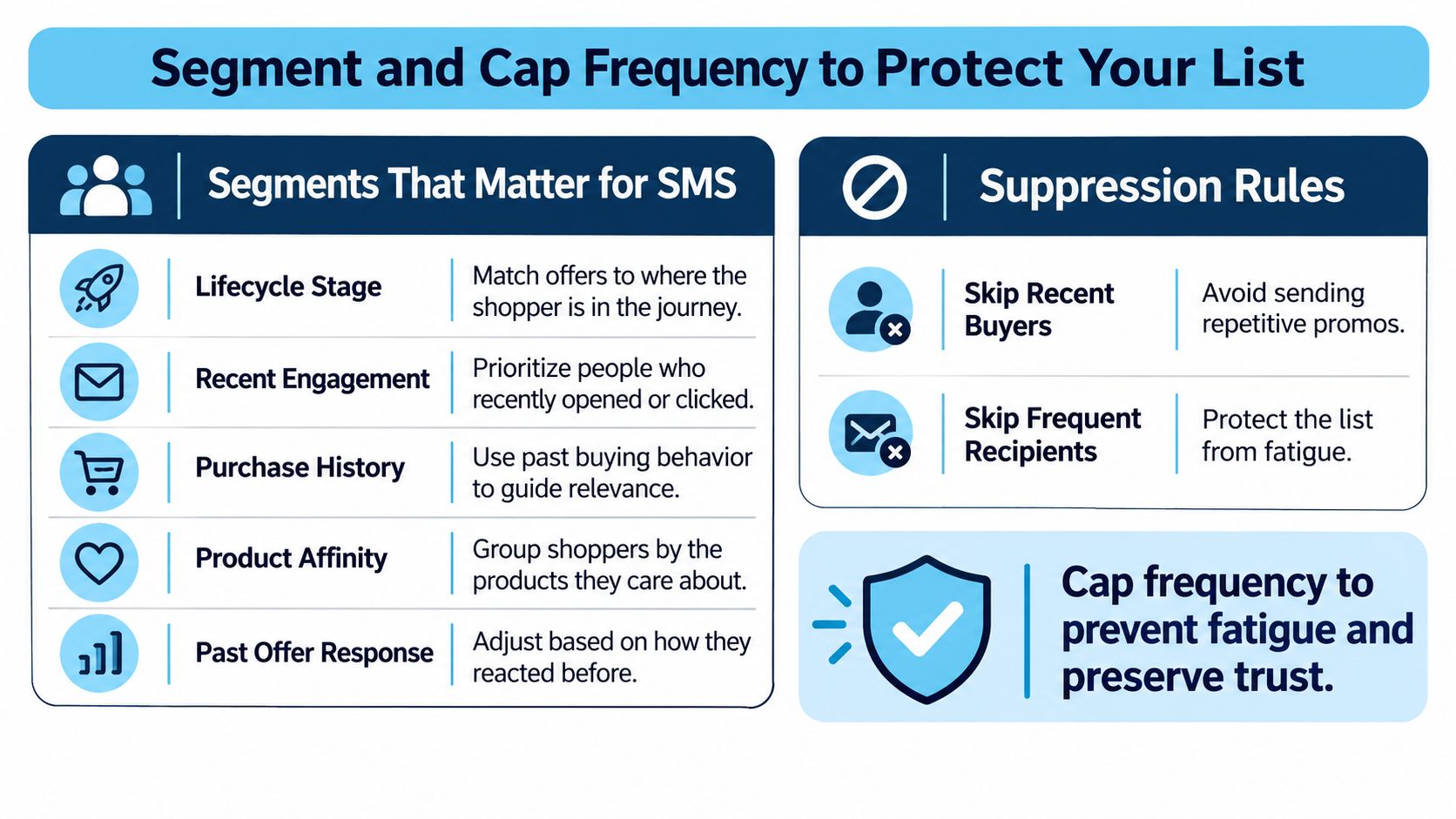
Frequency is the leading reason people leave
The SMS marketing best practices review from Sweatpants Agency cites consumer survey reporting that names excessive frequency as the leading opt-out reason for 40% of respondents, ahead of irrelevant content at 18% and inconvenient timing at 10%. Each figure maps to a switch you can turn on this week.
| Opt-out reason | Share of respondents | Fix |
|---|---|---|
| Excessive frequency | 40% | Set a per-recipient contact cap and suppress recent buyers |
| Irrelevant content | 18% | Segment by purchase history and product affinity |
| Inconvenient timing | 10% | Enforce quiet hours in the recipient’s time zone |
The order of those fixes matters. Capping frequency before segmentation means the same message reaches everyone, just less often. Capping after segmentation means the cap bites on the people who already hear from you too much, which is the point of it.
What a cap and a quiet hour look like in practice
Set a weekly ceiling per recipient across campaigns and flows combined, not per campaign. One email blast and one text in the same hour is two contacts from the same brand, and subscribers count it that way.
Quiet hours run on the recipient’s time zone, not the store’s. STOP and HELP replies need handling at once, including overnight, because a shopper who replies STOP at 11 p.m. and hears nothing back until Monday is a complaint waiting to be filed.
The same review notes that US marketing texts sent with an autodialer generally require prior express written consent, and that revocations through reasonable means such as STOP must be honored within ten business days.
Read unsubscribe rate by cohort
An aggregate unsubscribe rate hides the segment that’s failing. Break it out by campaign, segment, acquisition source and recent frequency. A paid-social cohort that opted in for a giveaway usually behaves differently from organic subscribers who sought you out, and that difference is the part of SMS marketing for ecommerce that stores skip when they only look at account totals.
The spread across senders is wide. The same review cites an independent benchmark across 17 active SMS senders, where click rates ran from 4.5% at the 25th percentile to 20.5% at the 75th, and unsubscribe rates ran from 0.56% to 2.11% across the same band.
Practical rule: if a cohort’s unsubscribe rate is three times the account average, stop texting that cohort until you know why it joined.
The failure modes that do the most damage
- Purchased or borrowed lists: a phone number with no consent record behind it is a liability with a delivery cost attached.
- Suppression that doesn’t sync: an opt-out recorded in one app and ignored in another is the error carriers and regulators find first.
- Sends outside local hours: timing complaints arrive as opt-outs and, at volume, as carrier filtering.
- Treating every subscriber as equally valuable: a one-time discount hunter and a repeat buyer get the same message, and the list gets worse for it.
We keep a longer set of rules in this guide to frequency capping for SMS and email.
Add Urgency That Customers Read as Fair
Urgency works when the limit is real and clear. Tie a quantity limit to the number of rewards available, or a deadline to when the offer closes. A countdown that resets when the page reloads teaches shoppers to wait for the next one.
A fake deadline rewards patience. Customers learn that the offer may return if they wait.
Test the mechanic, not just the discount depth
Compare a quantity-limited reward with a deadline-based offer and a group that receives no offer. Keep the audience and reward value consistent so the test isolates the mechanic. Judge results on incremental profit, not conversion alone, and review opt-outs, complaints and repeat purchases alongside orders. More orders do not make a campaign worthwhile if list damage or discount costs erase the gain.
Make the offer readable, too. Use short sentences, plain language, descriptive link labels and contrast that meets WCAG Level AA. Clarity matters on a small screen and in bright sunlight.
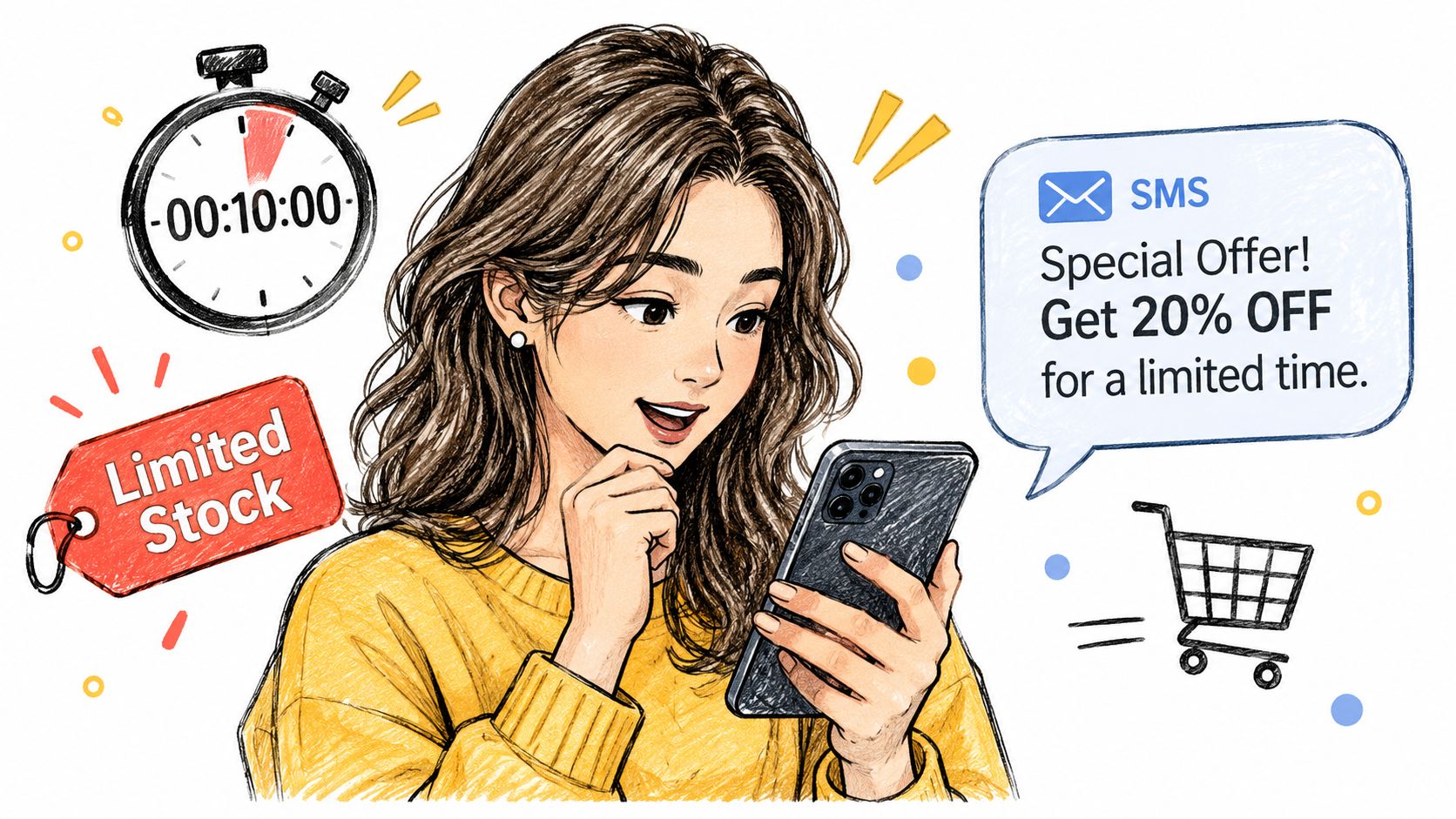
The earned version of urgency
Quikly turns promotions into time- or quantity-bound rewards. A reward can be limited by how many people can claim it, how long it stays open, or both. Earn-time actions most often include subscribing to SMS marketing, downloading the brand’s app, following it on social media or joining its loyalty program. A campaign can be gated behind an SMS opt-in, growing the subscriber list while it runs.
Quikly’s mechanics have been refined across more than 60 million consumer interactions. The margin case is straightforward: a reward that gives shoppers a reason to act now can improve conversion without requiring a deeper discount on every order. Keep the cap and terms visible, then compare the resulting profit and list health with a standard promotion.
Launch Your First Flow Before Scaling Campaigns
The action for this week is one flow, not a calendar. Welcome or cart abandonment, whichever trigger fires more often in your store, launched with the same care you’d give a campaign.
Six checks before the first send:
- The disclosure is live and names the sending number, the message types and the opt-out instruction.
- The consent ledger records source, timestamp and exact wording for every opt-in the flow touches.
- Suppression and the contact cap are wired into the flow, so it can’t text someone already inside three others.
- A holdout group is set aside before the send, not after the results look weak.
- The denominators are written down, matching the definitions your platform reports against.
- Someone owns a review date, with a specific unsubscribe level that pauses the flow.
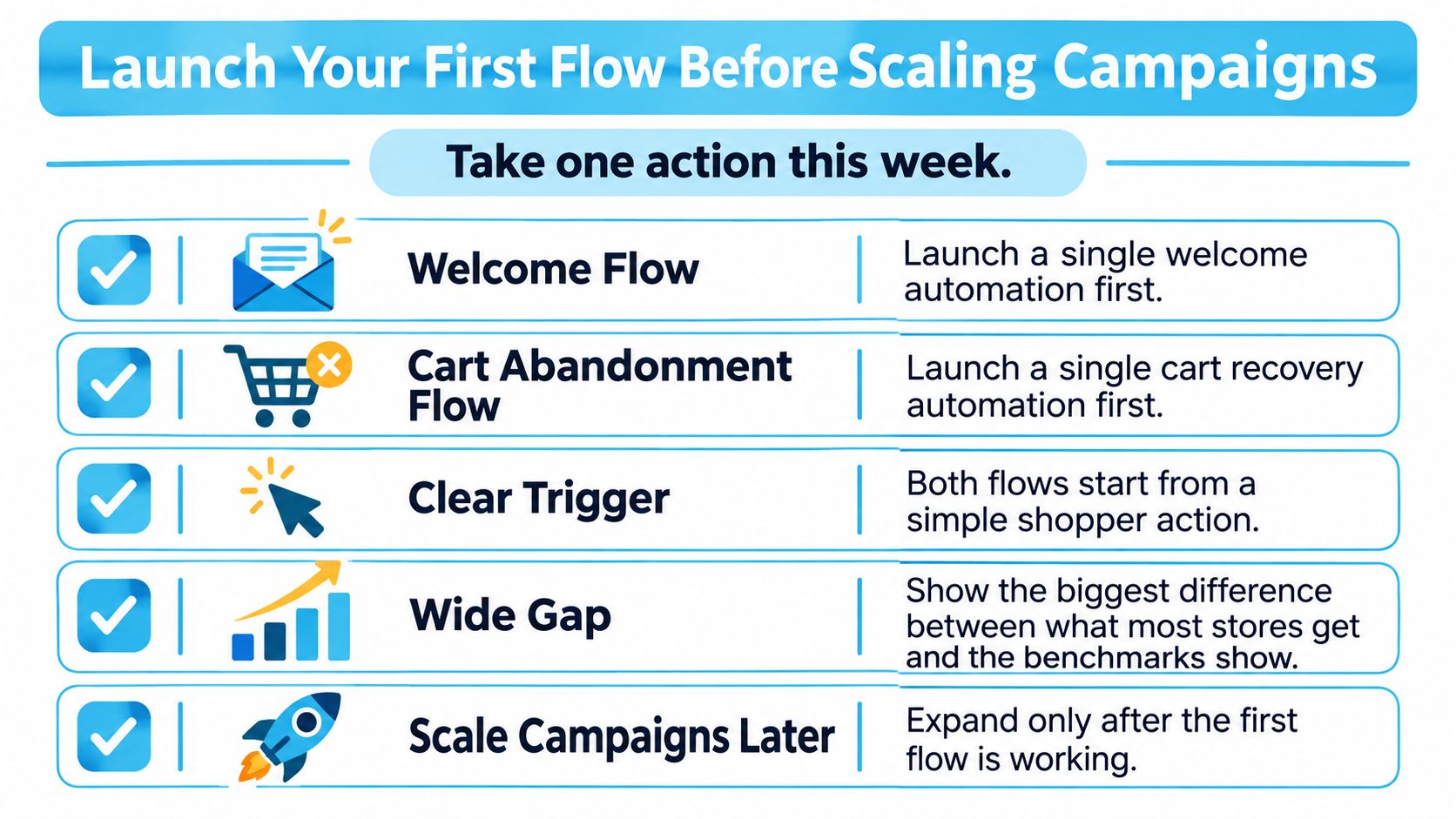
On that review date, read the four numbers together: click rate, placed-order rate, revenue per recipient and unsubscribe rate. Any one of them alone will lie to you.
If you want a starting point before you build, our Store Analyzer returns 3 campaign recommendations you can launch.
List size isn’t the asset. Auditable permission and margin discipline are, and the first flow is where a store proves it has both before the campaign calendar fills up.
Running an SMS program that survives a compliance review and a slow quarter comes down to two things: you can prove what every number agreed to, and your promotions are capped by time or quantity instead of a deeper discount. Quikly turns the offer you’re already planning into a time- or quantity-bound reward that opens when a shopper acts, delivered through SMS, the storefront, email or social, so acting early beats waiting. Enter your store URL at Quikly and you’ll get a free urgency campaign built for your store and its goals.
Topics: ecommerce SMS marketing, SMS automation, SMS compliance, Shopify SMS marketing, SMS flows