A lot of Shopify brands hit the same wall. They want the energy of a product drop, but they also know how easily a drop can turn into a margin leak, a customer service mess, or a credibility problem if the whole thing boils down to “show up fast and maybe get lucky.”
That tension matters because a drop is not just a launch format. It’s a controlled demand event. If you run it well, you create urgency without teaching customers to wait for markdowns. If you run it badly, you train buyers to game your promos, punish loyal customers, and make the brand feel smaller instead of stronger.
How to run a product drop on Shopify comes down to three things. Plan scarcity intentionally, build the store for concentrated demand, and manage the customer experience before, during, and after the moment of release. The merchants who do this well don’t obsess over hype alone. They protect margin, keep the buying experience clean, and use the drop to strengthen brand equity.
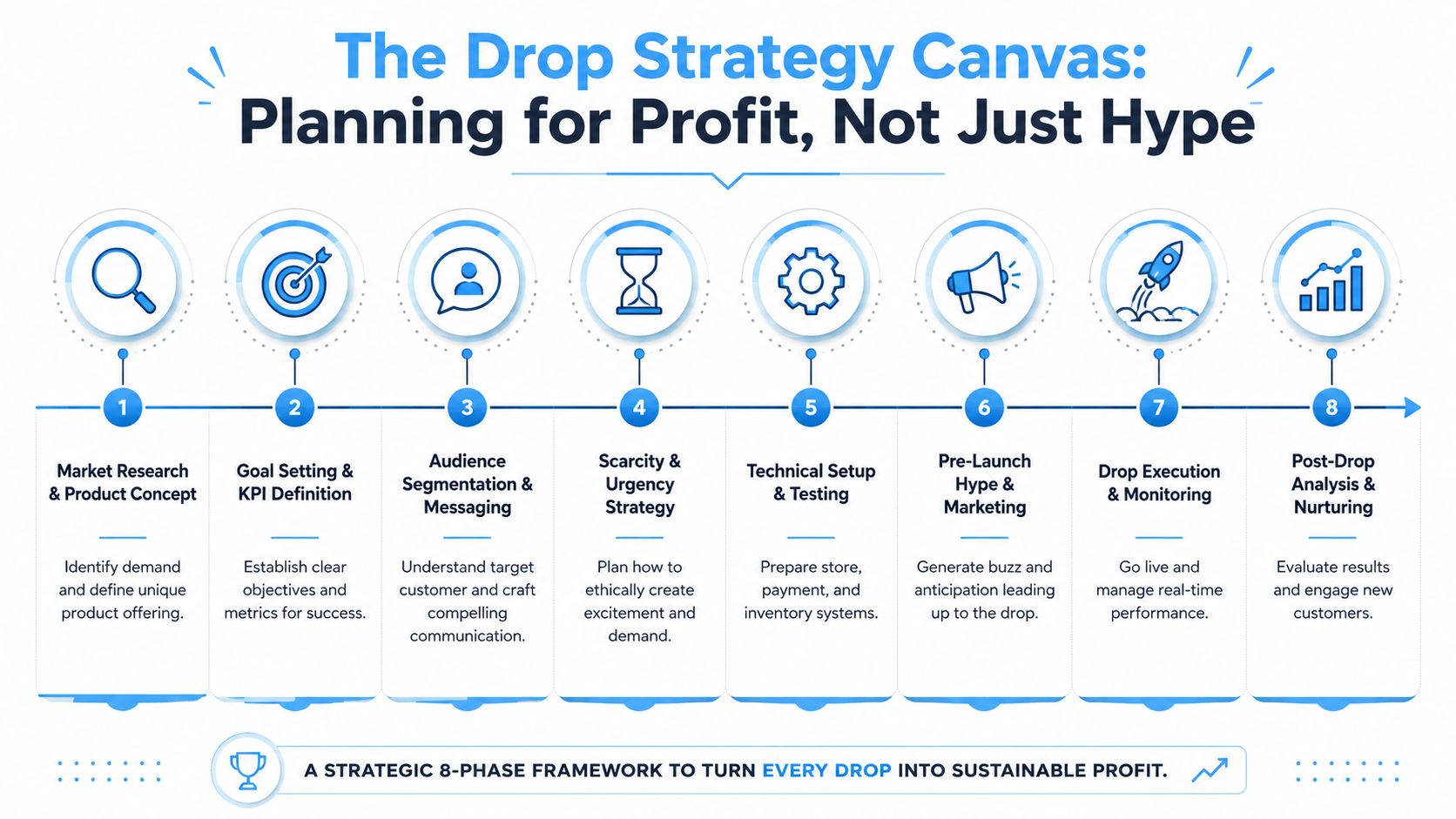
The Drop Strategy Canvas Planning for Profit Not Just Hype
The brands that get drops right start with restraint. They don’t ask, “How do we sell out?” They ask, “What kind of sell-out helps the business?” Those are different questions.
A sell-out can still be a bad outcome if you used too much discounting, priced the item wrong, overpromised access, or created so much frustration that the community leaves annoyed instead of excited. The point of a drop is controlled demand, not chaos.
Start with the business objective
Before you touch inventory, decide which job the drop is doing.
Sometimes the drop is a margin play. Sometimes it’s a customer acquisition event. Sometimes it’s a brand signal that says, “We release selectively, and when we do, it matters.” You can pursue more than one outcome, but one of them needs to lead.
That choice affects everything downstream:
- Margin-first drops usually need tighter offer discipline, stronger merchandising, and cleaner checkout economics.
- Acquisition-focused drops need sharper top-of-funnel messaging and a post-drop follow-up plan for people who don’t buy.
- Brand-building drops need consistency in creative, access rules, and fulfillment, because one sloppy launch weakens perceived value fast.
If your team still treats a drop like a loud campaign instead of a business decision, pause and fix that first. A useful companion read on this is how to build brand trust and choice, especially if your brand is trying to create anticipation without looking promotional.
Use scarcity math, not gut feel
Inventory is where operators either protect the brand or damage it.
For a first Shopify drop, 50–100 units is the optimal inventory quantity for a brand with 2,000 Instagram followers and decent engagement, and that range is statistically confident to sell out 80% of stock while maintaining exclusivity and urgency according to Drop Theme’s guide to Shopify product drops. That same source says the right target for a first drop is a sell-out time of 10–30 minutes, because faster than that frustrates real buyers and slower than that weakens the scarcity effect.
Practical rule: If your first drop disappears instantly, that’s not automatically a win. It can mean you underproduced so aggressively that customers experienced the brand as inaccessible.
There’s a second planning trap here. Teams often chase fake certainty with spreadsheets, but most of the market still lacks a standardized framework for intentional underproduction. Advice in the space often points merchants toward producing 30–50% fewer units than expected demand and using a 3:1 to 5:1 waitlist-to-quantity ratio as a guide, as discussed in this limited-edition drops strategy write-up. That’s directionally useful, but it’s still your job to balance exclusivity against customer frustration.
Define what success looks like before launch
Your scoreboard should be tighter than “it sold out.”
Use a planning sheet that includes:
- Target sell-out window so the team knows whether the drop felt scarce or inaccessible
- Profit per unit so excitement doesn’t hide weak contribution
- New customer quality so you don’t overvalue one-time hype buyers
- Support load and fulfillment strain because operational drag can erase a good top-line result
A drop that protects margin and earns trust is better than a louder launch that burns both. If you want a useful lens for evaluating that trade-off, Quikly has a strong piece on promotional ROI and what actually matters in campaign performance.
Your Pre-Launch Technical and Marketing Checklist
A bad drop usually looks exciting from the outside right up until customers hit the site. Traffic spikes, comments pile up, carts start filling, then the cracks show up fast. A variant is mislabeled. The SMS goes out before the product is live. Support is answering the same shipping question 200 times. Margin disappears in the cleanup.
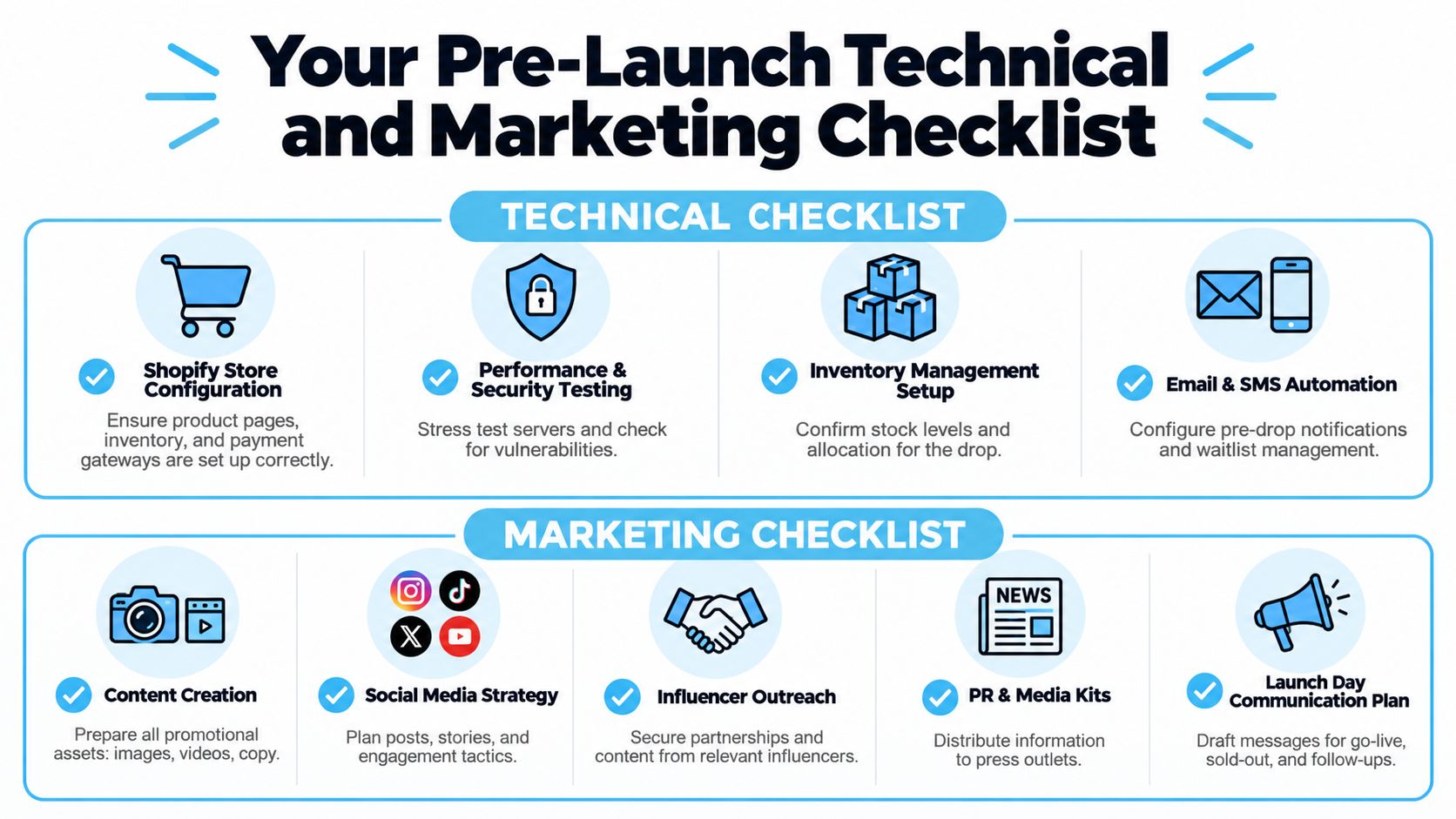
Pre-launch work decides whether the drop feels controlled or chaotic. The goal is not to create more hype at any cost. The goal is to create enough demand, route it cleanly, and convert it without training customers to expect confusion, discounts, or apology emails.
Four weeks out
Four weeks before launch, the offer should stop moving. If product naming, pricing, bundle logic, or access rules are still changing, every downstream team starts building on unstable ground.
Lock these decisions early:
- Core offer. Final product title, price, variants, bundles, purchase limits, and any early-access rules.
- Inventory rules. Reserve units for VIP access if needed, confirm oversell protections, and decide what customers see when sizes or variants sell through.
- App stack. Remove apps that touch cart, checkout behavior, product display, or popups unless they are directly tied to the drop.
- Channel plan. Match your launch time to where your buyers are and which channels will carry intent, not just impressions.
Release timing needs practical judgment. A weekday launch often gives your team better support coverage, faster issue escalation, and cleaner paid media pacing. If you sell across time zones, use your own historical session and conversion data from Shopify and Klaviyo to pick the window, then commit to it. Last-minute timing changes create avoidable mistakes.
Two weeks out
Two weeks out, marketing stops being campaign theory and becomes message operations.
Write every customer-facing message before launch week. That includes the obvious assets and the less glamorous ones that protect trust when something goes wrong. I want the team to know exactly what gets sent if inventory runs low, if a product sells out faster than expected, or if a segment gets early access and starts asking for restock details in replies and DMs.
Build and approve:
- VIP early-access email and SMS
- General release announcement
- Back-in-stock or waitlist fallback, if you plan to use it
- Low-stock messaging
- Sold-out messaging
- Post-purchase follow-up for buyers
- Browse or cart follow-up for visitors who showed intent but missed the drop
- Customer service macros for shipping, sizing, access issues, and order edits
This is also the point to pressure-test your creative mix. Teaser content, founder content, product detail clips, and launch reminders all need a job. If TikTok is part of the acquisition plan, the handoff from content to store has to be tight. Teams looking to sharpen that channel can review proven strategies for TikTok sales.
Final week and final day
The last week is for testing and restraint. No new apps. No surprise bundle. No panic discount because someone wants a bigger top-line number. Those decisions often protect revenue for a few hours and hurt contribution margin and brand positioning for much longer.
Run the final check like an operator, not a marketer.
| Area | What must be true |
|---|---|
| Storefront | Product page copy, media, sizing info, shipping details, badges, and collection placement are final |
| Inventory | Stock counts, variant availability, purchase limits, and sold-out behavior are tested in the storefront |
| Messaging | Email, SMS, and social posts are approved, scheduled, and mapped to the launch timeline |
| Team roles | One person owns site monitoring, one owns support, one owns retention messaging, and one owns social responses |
| Escalation | The team has a written plan for payment errors, oversell risk, shipping delay communication, and customer-facing updates |
I also recommend a full rehearsal the day before. Place test orders. Trigger key automations. Check mobile product pages, shop pay flow, confirmation emails, tracking setup, and support inbox routing. If a customer can hit it during the drop, someone on your team should have tested it before the drop.
For teams that need a broader run-of-show, this product launch checklist for ecommerce teams is a useful planning reference.
A strong pre-launch checklist protects more than conversion rate. It protects margin, customer trust, and the brand memory buyers carry into the next drop.
Shopify Technical Setup for a Flawless Launch
A product drop compresses demand into a short window. That changes what matters technically.
On a normal day, minor friction hides in the noise. During a drop, the same friction turns into abandoned carts, failed checkouts, duplicate support tickets, and customers posting screenshots of broken pages. Shopify can absolutely handle strong demand, but only if you keep the experience simple.
Build the product page for speed and certainty
The product page needs to answer the buying question fast. During a drop, nobody wants to hunt for materials, sizing, shipping clarity, or whether the item is available.
Keep the page tight:
- Use optimized images that still look premium on mobile
- Place the key decision details high on the page
- Show stock state clearly so customers don’t waste effort on unavailable variants
- Reduce moving parts that compete with the primary purchase action
This is also the wrong moment for bloated themes, decorative scripts, or app clutter. If your store has picked up years of add-ons, clean it up before the launch. For merchants working through that process, this 2026 website performance playbook is worth reading because it forces the right question: what on your site is essential when demand spikes?
Checkout is where most drops are won or lost
The fastest way to waste demand is to make shoppers work too hard after they’ve already decided to buy.
Hidden shipping fees revealed at checkout are the single biggest conversion killer for Shopify stores, and accelerated checkout options like Shop Pay, Apple Pay, and Google Pay reduce checkout steps by 60%, according to SiteOptimizr’s Shopify conversion benchmark review. On a drop, that matters even more because every extra step increases the chance that a customer hesitates, reloads, or loses the item.
Use the following setup principles:
- Make shipping costs predictable early so checkout doesn’t introduce a negative surprise.
- Turn on accelerated wallets wherever they fit your payment stack.
- Use Shopify’s one-page checkout, or on higher-volume setups, use Shopify Plus checkout extensibility if your team needs more control.
- Verify payment provider readiness before launch, especially if your traffic will spike hard.
There’s also a useful diagnostic benchmark here. Average Shopify conversion rates sit between 1.4% and 3.0%, with high-performing stores often in the 2–4% range. If your add-to-cart rate is below 5%, the main friction is likely on the landing or product page, not in checkout, based on ECORN’s Shopify conversion rate benchmarks. That’s a strong reminder not to blame the drop mechanic for what is really a merchandising problem.
Inventory controls need to be unforgiving
Scarcity falls apart when inventory logic is sloppy.
Use Shopify inventory rules and your IMS to enforce hard limits. If your catalog is larger or your operations are complex, tools in the inventory and operations layer can help prevent overselling and bad stock states. The important part is not which tool you admire. The important part is that the storefront, checkout, and back-end all agree on what’s available.
A few essentials:
- Automate sold-out and coming-soon badges
- Set purchase limits where appropriate
- Test variant behavior on mobile
- Confirm that inventory updates quickly enough under pressure
If customers can still add unavailable units to cart, you’re manufacturing frustration. If you’re sorting through tools to tighten this setup, this guide to apps for Shopify store operations can help narrow the field.
Engineering Excitement and Urgency Without Discounts
Most brands don’t have an urgency problem. They have a credibility problem.
A timer slapped onto a product page isn’t compelling on its own. A blanket discount isn’t urgency either. It’s just a price cut, and over time it teaches customers the worst possible lesson: wait, and the brand will come back with a deal.

Real urgency comes from structure
What makes a drop feel compelling is scarcity bias combined with loss aversion. People act when access is limited and when delay carries a visible cost. That cost doesn’t have to be a higher price. It can be missing the item, losing preferred access, or watching availability disappear in real time.
That’s why controlled access works better than a free-for-all.
VIP early access, with emails sent 15–30 minutes before the general public, significantly lifts conversion velocity by capturing high-intent buyers before inventory depletes, according to this Shopify community discussion on successful drops. Operationally, it also smooths the traffic curve and rewards the customers who already have the strongest relationship with the brand.
The psychology stack that actually works
Good drops combine several principles at once.
- Scarcity bias gives the item weight because access is limited by time, quantity, or both.
- Social proof builds momentum when shoppers see that others are paying attention and acting.
- Commitment and consistency matter when customers join a list, RSVP for access, or opt into reminders. Small prior actions make purchase behavior more likely.
- Temporal discounting is why a near-term opportunity often beats a vague future reward.
Operator note: urgency should clarify the decision, not bully the customer. If your drop leaves people feeling tricked, the tactic worked against the brand.
This is also why flat discounts are so blunt. They don’t create a meaningful event. They tell every shopper the same thing and reward no behavior except waiting for the promotion to appear. That hurts margin and eventually dulls response.
By contrast, scarcity mechanics shaped around action and access have been refined across more than 60 million consumer interactions, based on Quikly’s business description context. The practical lesson is simple. A customer who feels they earned access responds differently than a customer who feels they were just handed another promo code.
Better formats than a basic countdown
If you want urgency without cheapening the brand, the strongest formats usually look like this:
- Tiered access, where VIP customers go first and public traffic follows
- Quantity-bound rewards, where early action gets the best outcome
- Time-bound windows, where the offer closes cleanly whether or not everything sells through
- Merch drops with visible stock logic, where scarcity is real and not cosmetic
Those formats feel more like an event and less like discount cleanup. That distinction matters.
Launch Day Operations and Real-Time Monitoring
Launch day runs like an operations shift, not a marketing brainstorm.
At 9:59, everything looks ready. At 10:03, traffic spikes, Shop Pay conversions start rolling in, a few customers report they cannot check out on mobile, and someone on the team suggests sending another SMS because “demand is crazy.” That is how brands burn margin and trust in the same hour. The job on launch day is to protect the buying path, protect the customer experience, and protect the economics of the drop.
The strongest teams assign clear roles before the clock starts. One person owns the storefront and checkout flow. One watches session quality and conversion behavior. One handles support triage. One approves outbound updates across email, SMS, and social. Everyone else stays out of production systems unless they are asked.
The first ten minutes show where profit is leaking
Early traffic is only useful if it converts cleanly. Watch the path from product page to payment confirmation in real time with Shopify Live View, GA4, and your payment dashboard. Shopify’s own guidance on launching and monitoring product releases aligns with the practical rule most operators learn the hard way. Traffic is a vanity metric on drop day if checkout friction is hiding underneath it.
Focus on failure points you can act on fast:
- Strong sessions, weak add-to-cart. The page is probably unclear, loading poorly, or mismatched to the traffic source.
- Healthy add-to-cart, weak checkout completion. Payment methods, shipping cost, or delivery timing are creating hesitation.
- Immediate support volume. Customers are confused about access windows, sizing, cart reservation, or sold-out messaging.
- Mobile drop-off. The page may look fine on desktop and still fail where most of your buyers shop.
If the site starts wobbling, pause the urge to push more traffic. Fix the purchase flow first.
Run the first hour on a decision cadence
A good first hour has checkpoints. At launch, confirm the product is live, inventory is decrementing correctly, checkout buttons work on mobile, confirmation emails are firing, and orders are flowing into the right fulfillment logic. Ten to fifteen minutes later, review the first wave of customer questions and update public-facing answers. Thirty minutes in, compare traffic source quality. If one paid source is sending cheap clicks that do not convert, cut it early instead of feeding bad traffic into a strained store.
This is also where discipline matters. Do not react to every spike in sessions with more urgency language. If stock is moving slower than planned, that is usually a positioning or traffic quality problem, not a copy problem. If stock is moving faster than planned, do not create chaos by changing rules mid-drop unless overselling or site stability forces it.
Keep communication tight and honest
As stock gets tighter, simpler messaging works better.
Use plain updates customers can trust: in stock, low stock, waitlist available, sold out. If inventory is not reserved until checkout, say that clearly. If order confirmations are delayed, post that before support inboxes fill up. Customers forgive scarcity. They do not forgive feeling misled.
A sold-out product can still build brand equity if the process feels fair. A sloppy sellout does the opposite. It creates refunds, chargebacks, angry comments, and a customer base trained to wait for the next apology or discount.
Support scripts should be ready before launch
Customer service needs approved responses loaded into the help desk before the drop opens. At minimum, prepare replies for:
- Cannot access the drop
- Item sold out during checkout
- Payment failed
- Order confirmation delay
- Restock requests
- Shipping timeline questions
The goal is speed and consistency. Every vague answer adds friction. Every clear answer protects the brand. On drop day, that difference matters as much as the product itself.
After the Drop Analysis and Nurturing New Buyers
The drop is over. Orders are in. Support has calmed down. This is the point where weak operators declare victory because the SKU sold out, and strong operators start checking whether the drop made money and strengthened the brand.
A sellout can hide a lot of damage. Paid traffic may have been too expensive. Support load may have wiped out margin. Fulfillment errors may have turned first-time buyers into one-time buyers. The essential job after a drop is to measure what happened across contribution margin, customer quality, and post-purchase experience while the details are still fresh.
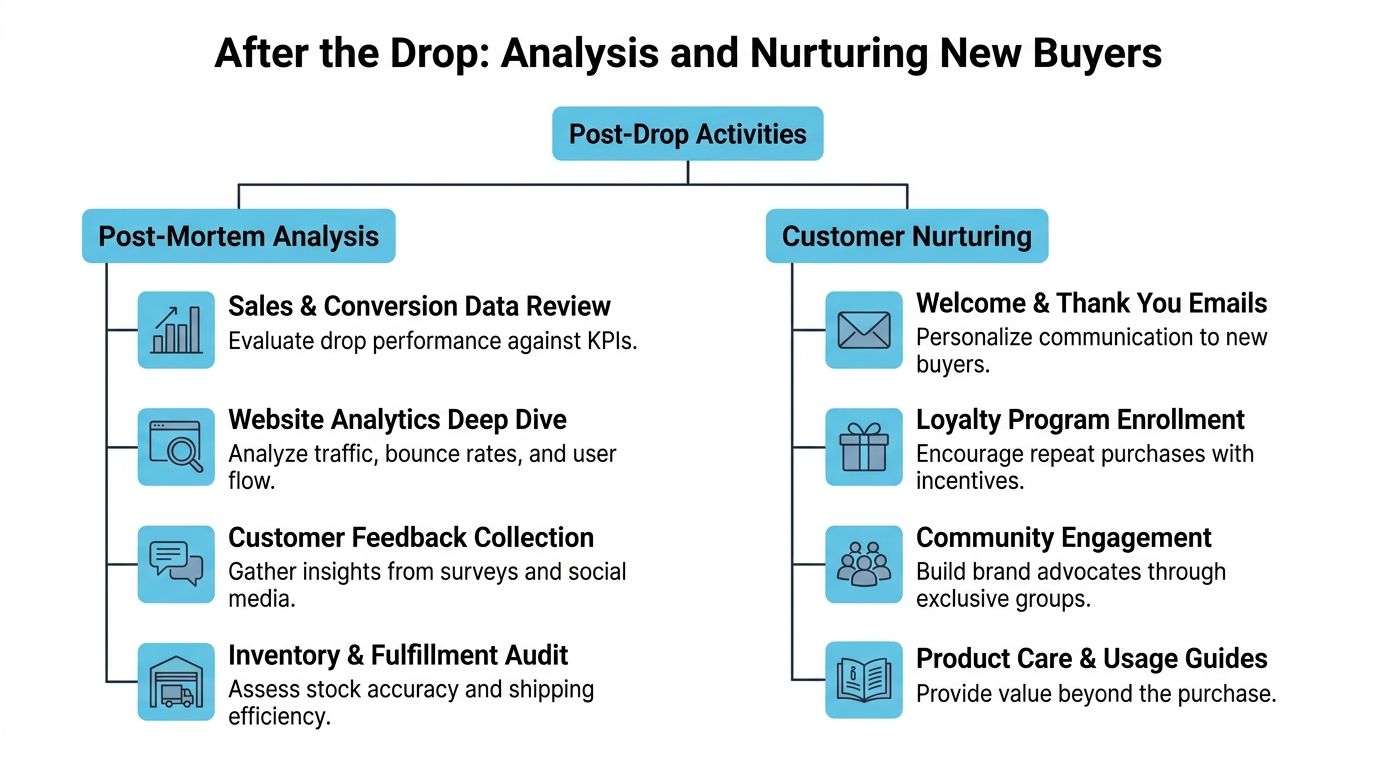
Run the post-mortem within 72 hours
Do it before the team rewrites history.
Pull the numbers channel by channel, not just storewide. Review session-to-cart rate, checkout completion rate, average order value, refund requests, support ticket volume, and actual fulfillment performance. If one paid channel drove a lot of traffic but low checkout completion, that was not a great launch channel. If VIP email traffic converted cleanly with low support demand, that audience likely deserves earlier access next time.
The review should answer a few blunt questions:
- Which channels brought profitable demand, not just cheap clicks
- Where customers dropped off in the purchase path
- Whether inventory and fulfillment matched what was promised
- What customer service issues repeated often enough to fix at the system level
- Which buyer segments are worth prioritizing for the next release
- Whether the drop increased brand heat without creating refund risk or distrust
If you used Shop Pay, the Shop app, Klaviyo, Attentive, Gorgias, or a similar stack, compare the behavior of customers who used those tools against customers who did not. Shopify’s own enterprise team has written about product drops as a retention and brand-building play, not just a short-term revenue event, in its article on creating hype with product drops. That is the right lens here. Post-drop analysis should tell you whether the event created customers you want more of.
Treat drop buyers as a separate retention segment
Drop buyers behave differently from standard catalog buyers. They often purchase faster, ask fewer pre-purchase questions, and care more about access, timing, and status. If you dump them straight into your normal promo calendar, you erase the context that made the purchase feel special.
Keep the segment clean. Tag them by drop name, product type, order value, and whether they were a first-time or repeat customer at the moment of purchase. That gives you a usable base for the next launch and for post-purchase retention.
I care a lot about this split because it protects margin. Brands that treat drop buyers like everyone else usually end up bribing them back with discounts. Brands that respect why they bought can bring them back with identity, access, and product relevance.
The fastest way to cheapen a successful drop is to follow it with generic promotional email.
Build follow-up flows that preserve the event
Buyers and non-buyers should not receive the same sequence.
For buyers:
- Send a confirmation that reinforces what they secured and when it ships
- Follow with product education, fit notes, care instructions, or founder context
- Ask for UGC or a review after delivery, not immediately after purchase
- Offer early access, member access, or preview access before offering any price incentive
For people who missed the drop:
- Acknowledge that they missed it without pretending scarcity was fake
- Offer a waitlist or restock notification only if a restock is possible
- Recommend adjacent products carefully, with a clear reason
- Keep them in a separate segment for future launches because they already showed intent
This part is operational, but it is also psychological. Customers remember whether the event felt fair, whether communication stayed clear after checkout, and whether the brand respected the scarcity it created. A profitable drop does more than clear inventory. It brings in customers who trust the next release enough to show up again without needing a markdown.
If your team wants to create urgency without falling back on blanket discounts, Quikly is built for that exact problem. It helps Shopify brands turn promotions into time- and quantity-bound experiences that reward the shoppers who act, protect margin more effectively than flat discounting, and keep the event feeling on-brand instead of bolted on.
Topics: how to run a product drop on shopify, shopify product drop, shopify launch strategy, ecommerce product drop, limited release