Gamification goes wrong when it becomes a prettier version of the same old popup. You ask for an email, hand over a generic code, and teach shoppers that the reward comes from waiting for the next discount instead of acting when intent is high. That works for a while, then margins get thinner, conversion stalls, and the popup becomes wallpaper.
A better approach turns signup into a moment of anticipation. Chance, progress, earned access, and visible momentum can all make the exchange feel more valuable without defaulting to a deeper markdown. If you’re trying to build an email list for outreach, that’s the shift that matters.
Below are seven gamified email signup ideas for Shopify brands that want more than another popup-and-pray tactic. Each one uses behavior, not just price, to capture attention and collect emails in a way that can protect margin and strengthen the brand instead of cheapening it.
1. Spin-to-Win Wheel Signup Mechanics
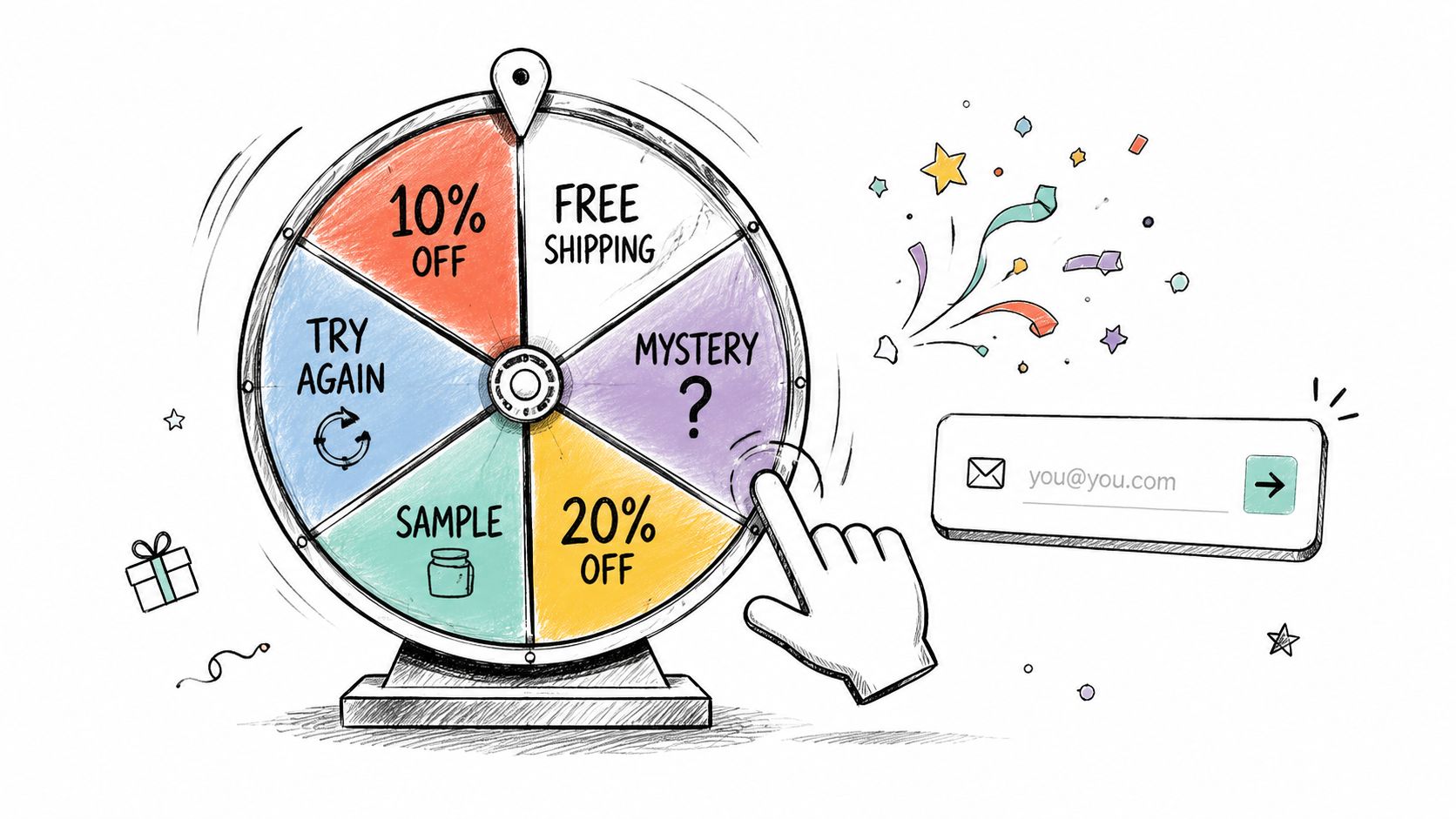
Spin wheels still work when they’re set up with restraint. In e-commerce, gamified email signup forms can lift opt-in rates by up to 40% compared with static forms, with spin-the-wheel and scratch-card mechanics producing the strongest lifts in this context, according to AdGamify’s breakdown of gamification and email opt-ins.
The reason is simple. A shopper doesn’t feel like they’re handing over data for a coupon. They feel like they’re participating in an outcome, and that changes the emotional exchange.
A Shopify apparel brand can use this before a seasonal drop. A beauty brand can use it to reveal free sample tiers or early-access perks instead of only percentage discounts. A supplement brand can use mystery reward tiers to avoid training every new subscriber to expect the same offer.
What makes the wheel convert, or fail
If the wheel feels rigged, slow, or stingy, performance drops fast. The best versions keep the interaction short, show the reward immediately, and ask for minimal information at the point of peak interest.
Practical rule: Let the spin create commitment first, then collect the email to claim the reward. That’s usually less friction than leading with a form.
A few implementation rules matter:
- Keep inputs minimal: Username and email are often enough. Extra fields at signup add friction right when curiosity is highest.
- Protect margin with tier design: Reserve your strongest reward for a small share of outcomes, and make the lowest tier feel respectable.
- Write cleaner copy: “Spin to get your offer” often lands differently than a flat “Get 10% off.” Curiosity beats predictability.
If you want a broader view of how interactive mechanics fit into lifecycle marketing, Quikly’s take on the benefits of adding gamification to your email marketing is worth reading.
2. Scratch-Card Email Capture
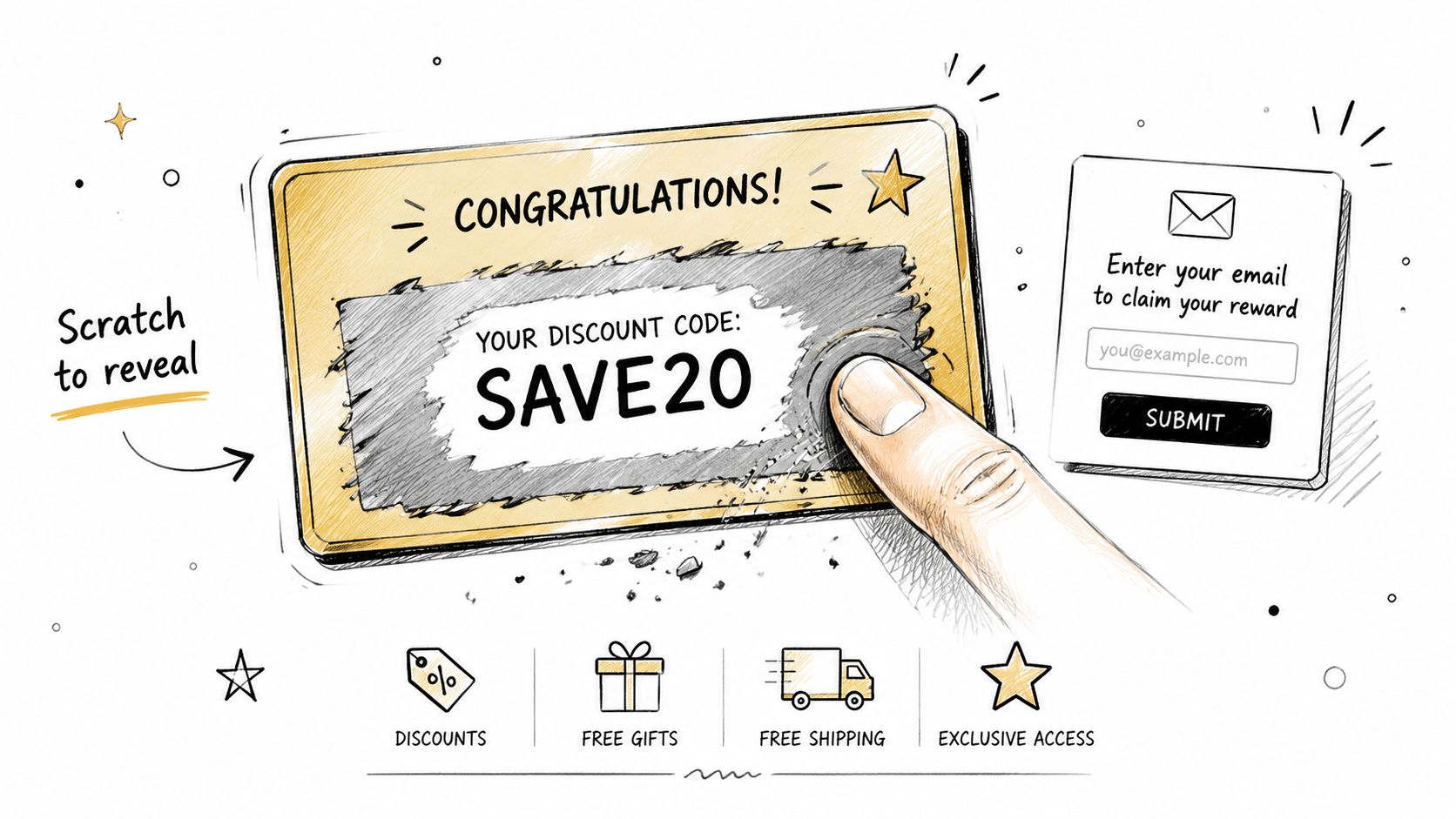
Scratch cards work because they feel earned. The shopper has to reveal something with a finger or cursor, and that tiny bit of effort increases perceived value in a way static offers rarely do.
They’re especially useful for holiday campaigns, checkout-stage capture, and welcome flows where you want a surprise-and-delight moment without turning the whole site into a game. Coffee brands, hobby stores, and giftable product categories tend to fit this mechanic well because the interaction feels playful rather than forced.
Where scratch cards beat plain signup forms
Campaigns that use interactive mechanics like scratch cards, quizzes, or puzzles can generate click-through rates that are 2 to 3 times higher than static signup emails, and in-email game completion rates average 35 to 45% when users feel the reward was earned rather than merely handed to them, based on Email Audience’s summary of email gamification performance.
That doesn’t mean you should hide a weak offer under a layer of glitter.
If everyone scratches and gets the same forgettable code, the mechanic becomes a gimmick instead of an experience.
Use scratch cards when you can vary the reward or reveal. For a beverage brand, that might be free shipping, a bundle bonus, or first access to a limited roast. For a Shopify gift shop, it might be a rotating set of perks tied to a holiday launch.
- Make the interaction obvious: Add simple instruction text so mobile users know to swipe or tap.
- Design the reveal area well: Too small feels fiddly. Too large can feel sloppy.
- Tie it to a real window: A time-bound reveal feels more exclusive than an evergreen scratch card that never changes.
3. Tiered Point Accumulation Signup
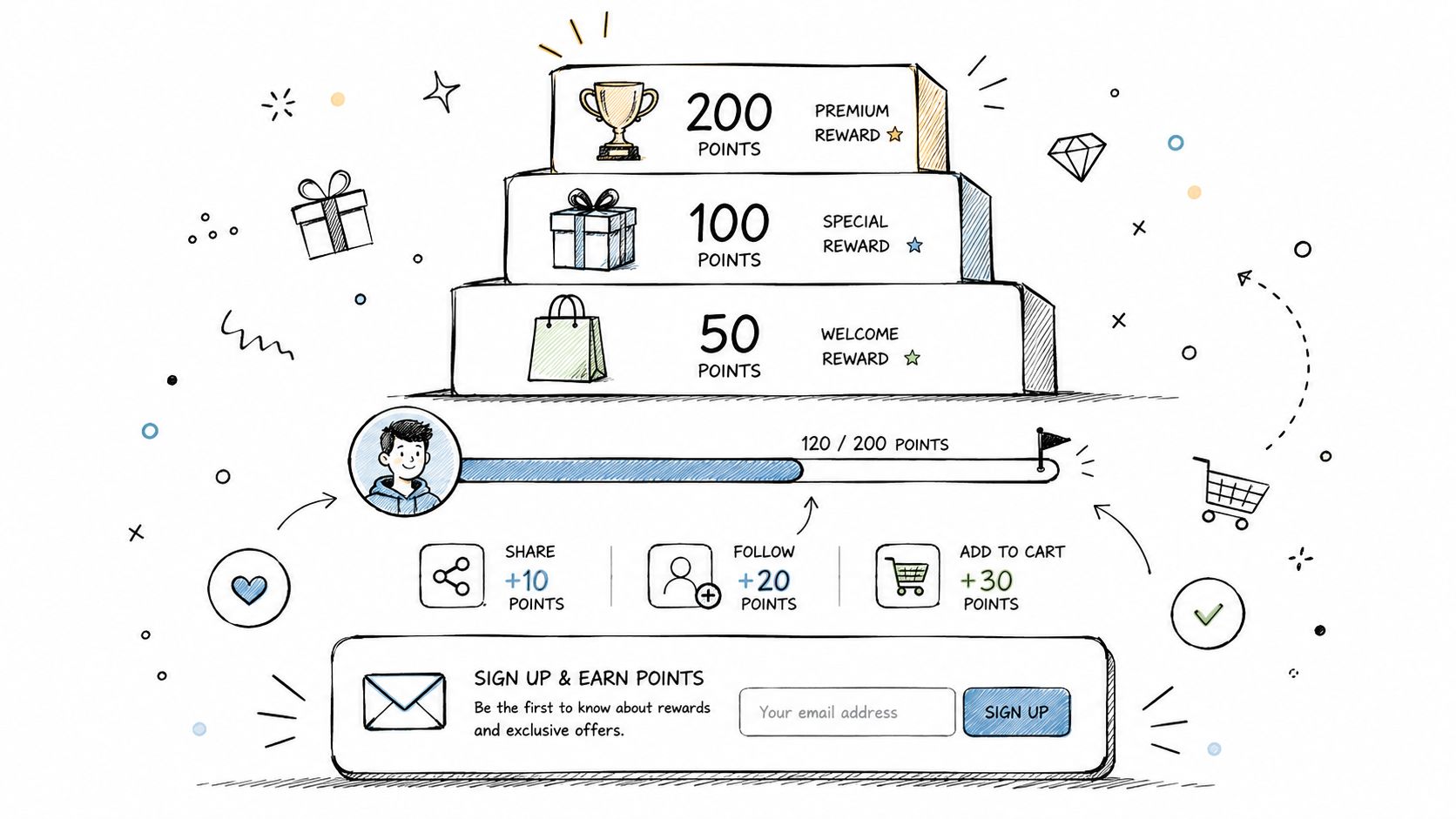
This one is less flashy and often more useful. The shopper signs up by email, earns an initial point balance, then achieves better rewards through a few short actions such as following on Instagram, referring a friend, or building a cart.
For Shopify brands, this works best when you want more than a name on a list. You want a subscriber who has taken at least one extra step that signals intent.
A wellness brand can reward signup, profile completion, and add-to-cart behavior. An apparel store can let customers access a better tier by saving a wishlist or sharing a launch page. The reward doesn’t need to be a larger discount. It can be earlier access, a gift threshold, or first pick on limited inventory.
The trade-off with point-based signup flows
The upside is stronger engagement and richer first-party data. The downside is complexity.
If the highest tier feels too far away, people quit. If the progress bar barely moves, the system feels fake. If every action path looks the same, the mechanic stops feeling like a game and starts feeling like unpaid labor.
A few practical choices make this cleaner:
- Let shoppers finish in one session: The best version feels achievable now, not someday.
- Show progress instantly: Visual movement matters. If points update in real time, the system feels alive.
- Offer more than one route: Some visitors will share. Others won’t. Give alternative actions so more people can win.
For brands trying to reduce blanket discounting, this mechanic has a real advantage. It spreads value across a sequence of actions instead of giving the full reward away at the first touch.
4. Quiz-Based Segmented Email Capture
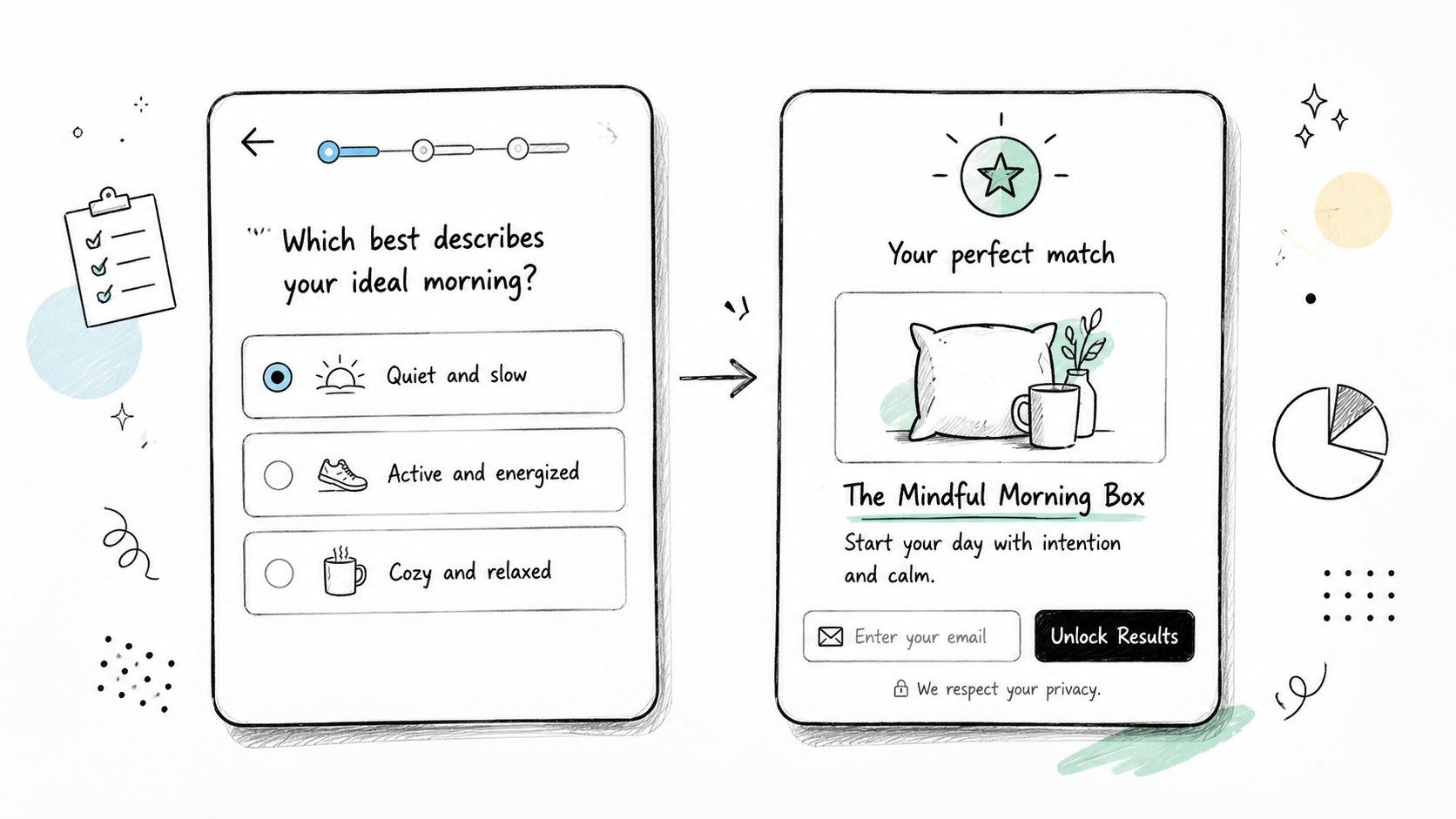
A quiz can do two jobs at once. It captures the email, and it tells you what kind of subscriber you just acquired.
That’s useful for brands with wide assortments or products that need a bit of guidance. Skincare, fragrance, haircare, fitness equipment, and supplements all fit here. Instead of bribing the shopper with a flat code, you offer a useful result, then attach the signup to personalized recommendations or a customized incentive.
The strongest quiz signup flows usually stay short. Keep the questions tied directly to product fit, not generic personality fluff. A customer shopping for moisturizer wants a recommendation that reflects skin type, sensitivity, or routine goals, not a novelty result.
Why quizzes work better when personalization is real
Gamified email campaigns with personalization can see up to 50% higher engagement than generic versions when the questions or rewards align with past purchase behavior, according to Benchmark Email’s overview of gamified emails. Relevance is what turns a quiz from a distraction into a conversion tool.
That matters after signup, too. The answers should feed Klaviyo segments, welcome sequences, and product education flows.
A quiz that collects preferences and then dumps everyone into the same broadcast list wastes the best part of the interaction.
If you work with agency partners on this kind of funnel, this playbook for agencies on survey pages is a helpful framing tool.
Use this when you can tailor the next step. If every result leads to the same hero product, skip the quiz and keep the signup simpler.
5. Limited-Quantity Countdown Signup Incentive
Scarcity works when it’s real. It backfires when shoppers can smell that the timer resets every day or that the “limited” reward somehow never runs out.
A limited-quantity countdown signup gives people a reason to act now without defaulting to a deeper blanket discount. Think early access for the first set of subscribers, a capped founder perk, or a stepping offer that gets weaker as more people claim it.
This fits product launches, holiday drops, restocks, and flash windows especially well. A sneaker brand can offer launch access to the earliest signups. A home goods brand can cap a gift-with-signup campaign. A premium DTC brand can use a lighter initial incentive because the urgency does more of the conversion work.
Why real scarcity outperforms fake urgency
For brands that don’t want to rely on deeper discounts, pairing gamified signups with urgency elements like countdowns or capped rewards can amplify conversion by activating scarcity psychology, as outlined in Email Audience’s notes on gamified signups and urgency. The key word is real.
If your offer is quantity-bound, show the quantity. If the allocation is gone before the timer ends, say so clearly and move people to a waitlist or lower tier.
Quikly is useful here because this is the kind of promotion it was built around. Its approach to scarcity marketing focuses on rewards that close by time, quantity, or both, which is very different from a decorative timer bolted onto a generic popup.
- Be explicit up front: Show the limit before signup, not after.
- Match the window to actual demand: A short claim period keeps momentum high.
- Use scarcity to reduce discount depth: If urgency is doing its job, the reward doesn’t always need to be bigger.
6. Referral Chain Email Signup
This mechanic turns a signup into the first step of an acquisition loop. The subscriber joins your list, gets a referral link, and earns better rewards as friends sign up or purchase.
The obvious benefit is reach. The less obvious benefit is signal quality. A subscriber willing to share your brand with friends is often more valuable than someone who joined only for a one-time code.
Referral chains work well for apparel launches, wellness brands, food and beverage subscriptions, and member-style access programs. They also pair well with Shopify stores that already have some customer enthusiasm but want to channel it into a cleaner acquisition path than blanket discounting.
Where referral chains usually break
The first mistake is making sharing too hard. If the link isn’t easy to copy on mobile, people won’t bother. The second is making the ladder too vague. “Earn rewards” is weak. “Refer 2 more friends to gain early access” is concrete.
The third mistake is margin blindness. Unlimited rewards sound exciting and age badly.
A better structure looks like this:
- Set a visible cap: Put a ceiling on what one person can earn.
- Show progress in plain language: Spell out what’s next, not just current totals.
- Celebrate each step: When a friend converts, send a triggered email or SMS that confirms the win and prompts another share.
This mechanic is strongest when the reward feels social or status-based, not purely price-based. Founding access, priority claim windows, and limited product offerings often preserve brand value better than escalating discount ladders.
7. Social Proof Milestone Signup Campaign
Momentum can be a stronger motivator than a coupon. When people see that others are joining and that a milestone is close, signup feels like participation in something moving, not a cold transaction.
This works well for launch lists, founding member programs, waitlists, and community-led brands. You show the current count, define what happens when the milestone is reached, and make the reward or status contingent on joining before that point closes.
A fragrance launch might promise founding access before the first cohort fills. A Shopify membership brand might lock in a special onboarding perk for the early group. A niche apparel drop can use visible progress to make the list feel exclusive without making the brand feel inaccessible.
Social proof needs motion, not decoration
The counter has to feel alive. If it sits still, it weakens trust. If the milestone is unrealistic, it looks staged.
The behavioral point is straightforward. People use others’ actions as a shortcut when deciding what deserves attention. Add a real threshold and you combine social proof with scarcity, which is much stronger than either one on its own.
Field note: Seeded momentum can help, but only if you’re transparent about what the number represents. Fake counters are easy to spot.
For a deeper take on why visible participation changes behavior, Quikly’s comprehensive guide to social proof is useful context.
Use this mechanic when the milestone itself means something. If the number is arbitrary and the reward never meaningfully changes, shoppers will treat it like decoration.
Comparison of 7 Gamified Email Signup Ideas
| Mechanic | Implementation complexity | Resource requirements | Expected outcomes | Ideal use cases | Key advantages |
|---|---|---|---|---|---|
| Spin-to-Win Wheel Signup Mechanics | Medium, animated UI, reward logic, mobile optimize | Front-end dev, design assets, email integration, A/B testing | Higher opt-in rates and engagement; variable conversion quality depending on rewards | Retail promotions, cart recovery, seasonal launches | Strong gamified engagement; increases perceived value; good for cold traffic |
| Scratch-Card Email Capture | Medium, canvas interaction and mobile compatibility | Graphics, front-end dev, cross-browser testing, optional pre/post-email flow | High attention and memorable interactions; good email quality | Holiday campaigns, surprise offers, re-engagement | Tactile reveal increases perceived value; memorable and satisfying UX |
| Tiered Point Accumulation Signup | High, tracking, tier logic, real-time progress UI | Backend tracking, CRM integration, UX design, analytics | Increased repeat engagement, richer behavioral data, higher LTV | Loyalty programs, brands wanting repeat actions and referrals | Encourages multiple behaviors; builds habit and first‑party data; cost-effective over time |
| Quiz-Based Segmented Email Capture | High, branching logic and segmentation integrations | Content strategy, logic mapping, CRM/tagging, personalization tooling | High-quality, segmented leads; better targeting and conversion on personalized offers | Skincare, product-fit recommendations, subscription services | Collects intent data; enables personalized journeys; improves relevance |
| Limited-Quantity Countdown Signup Incentive | Low–Medium, timer and counter with claim handling | Simple front-end, inventory/claim tracking, ops coordination | Rapid signup spikes and higher conversion velocity; controlled margin impact | Flash sales, limited product launches, pre-orders | Authentic scarcity drives urgent action; maintains margin control |
| Referral Chain Email Signup | High, referral tracking, reward fulfillment, fraud controls | Referral system, sharing tools, tracking/attribution, monitoring | Multiplies signups via word-of-mouth; lower cost per acquisition | DTC brands, social-first products, viral growth strategies | Turns subscribers into acquisition channel; high-quality referred leads |
| Social Proof Milestone Signup Campaign | Medium, real-time counter and post-milestone flows | Front-end counter, marketing seeding, frequent updates | Momentum-driven signups; community building and social validation | Founding member launches, community-driven products, limited-access offers | Leverages bandwagon effect; visible momentum increases conversions |
Next Steps: Launch Your First Gamified Signup
Start with one mechanic, not three. Most Shopify brands get into trouble when they stack a wheel, a timer, and a multi-step form into one experience and call it optimization. That’s usually just friction in costume.
A simpler path wins. Match the mechanic to the buying context. Spin wheels and scratch cards fit broad top-of-funnel traffic. Quizzes fit considered purchases with more product complexity. Quantity-bound signup campaigns fit launches, drops, and any moment where urgency is real. Referral chains and milestone campaigns work best when the brand already has some energy behind it.
There is a real friction threshold to respect. Background research from MailerLite highlighted that interactive signup forms can increase abandonment by 15 to 22% when the game takes more than 3 seconds to load or asks for more than 2 inputs beyond email, and a 2025 Shopify merchant survey reported that 68% of stores using multi-step gamified popups saw lower capture rates than stores using single-click instant-win mechanics, summarized in MailerLite’s guide to email gamification ideas and best practices. The practical takeaway is obvious. Keep the interaction fast, light, and easy to finish on mobile.
Testing matters, but test the right things. Don’t focus only on opt-in rate. Track signup velocity, downstream purchase quality, unsubscribe behavior, and margin impact. A list that grows faster but converts worse isn’t progress. Neither is a signup campaign that wins more emails by giving away too much.
This is also where many brands should rethink the role of the incentive itself. The smartest gamified signup ideas don’t depend on making the reward bigger. They depend on making the action feel more immediate, more earned, and more worth completing now. That’s a much better long-term position than training shoppers to wait for the next code.
If you want to run urgency- and scarcity-driven signup campaigns without leaning on blanket discounts, Quikly gives Shopify brands a way to turn offers into on-brand experiences that reward action while protecting margin. Its mechanics have been refined across more than 60 million consumer interactions, and brands like Jordan Craig have seen roughly a 20% lift in profit with incremental lift visible immediately on activation.
Topics: gamified email signup ideas, shopify email capture, conversion optimization, ecommerce marketing, email marketing