Chunking is grouping separate pieces of information into one meaningful unit so working memory has fewer units to hold. If you’ve ever memorized a new phone number by saying it in groups, rather than as ten loose digits, you’ve already used it.
That simple move explains a lot of everyday frustration. A shopper can read your promotion, nod, and still forget the rule by the time she reaches checkout. A student can stare at a list for an hour and recall almost none of it. The information wasn’t too hard. It arrived in too many separate pieces.
What Chunking Means and the Examples That Show It
A useful definition you can repeat is this: chunking is grouping separate pieces of information into one meaningful unit, so working memory holds fewer units at once. You’re not expanding storage. You’re recoding the material into a form that takes up less room.
The LibreTexts cognitive psychology chapter on the modal model of memory/04:_Memory/4.06:_Modal_Model_of_Memory) defines chunking as grouping items together during a memory task to improve sequential recall, with the benefit depending on whether the grouping creates a coherent, meaningful unit. That’s the part people miss. Drawing boxes around items doesn’t help unless each box means something to the person reading it.
Physical Elements Versus Psychological Units
Here’s the distinction that makes every example work. Physical elements are what’s on the page, such as ten digits or twelve letters. Psychological units are what your mind holds after recoding, such as three clusters or four names. Chunking changes the second number without changing the first.
| Example | Unchunked form | Chunked form | Why it works |
|---|---|---|---|
| Phone number | 5551234567 | 555-123-4567 | Three groups replace ten separate digits |
| Historical date sequence | 1-9-4-5-1-7-7-6-2-0 | 1945-1776-20 | Three meaningful clusters replace ten unrelated digits |
| Organization acronyms | FBICIAUNNASA | FBI, CIA, UN, NASA | Four known names replace twelve letters |
| Binary digits | 10101 | The named unit twenty-one | One trained name replaces five separate symbols |
| Short word | C, A, R | CAR | One recognizable word replaces three letters |
Read the phone row slowly. Ten digits ask you to track ten things. Three groups ask you to track three things, and each group unpacks when you need it. The date row works the same way, but only if 1945 and 1776 already mean something to you. The acronym row explains why a twelve-letter string feels impossible until you spot four organizations hiding inside it.
The binary row is the clearest proof that chunks are learned. 10101 means nothing to many people, so it stays five symbols. Once someone is trained to read it as twenty-one, it becomes one name. CAR is the smallest version of the same move. Three letters collapse into one word you learned as a child.
Practical rule: Draw chunk boundaries where meaning already exists, in familiar words, categories, patterns, or learned codes. Arbitrary breaks give you formatting, not memory.
This is why simpler presentation usually beats clever presentation, a point covered well in this guide to simplicity in B2C marketing and easy consumer experiences. Each example of chunking in psychology above succeeds for one reason. The reader already recognizes the unit, so the grouping follows meaning rather than appearance.
Why the Magic Number Seven Started the Conversation
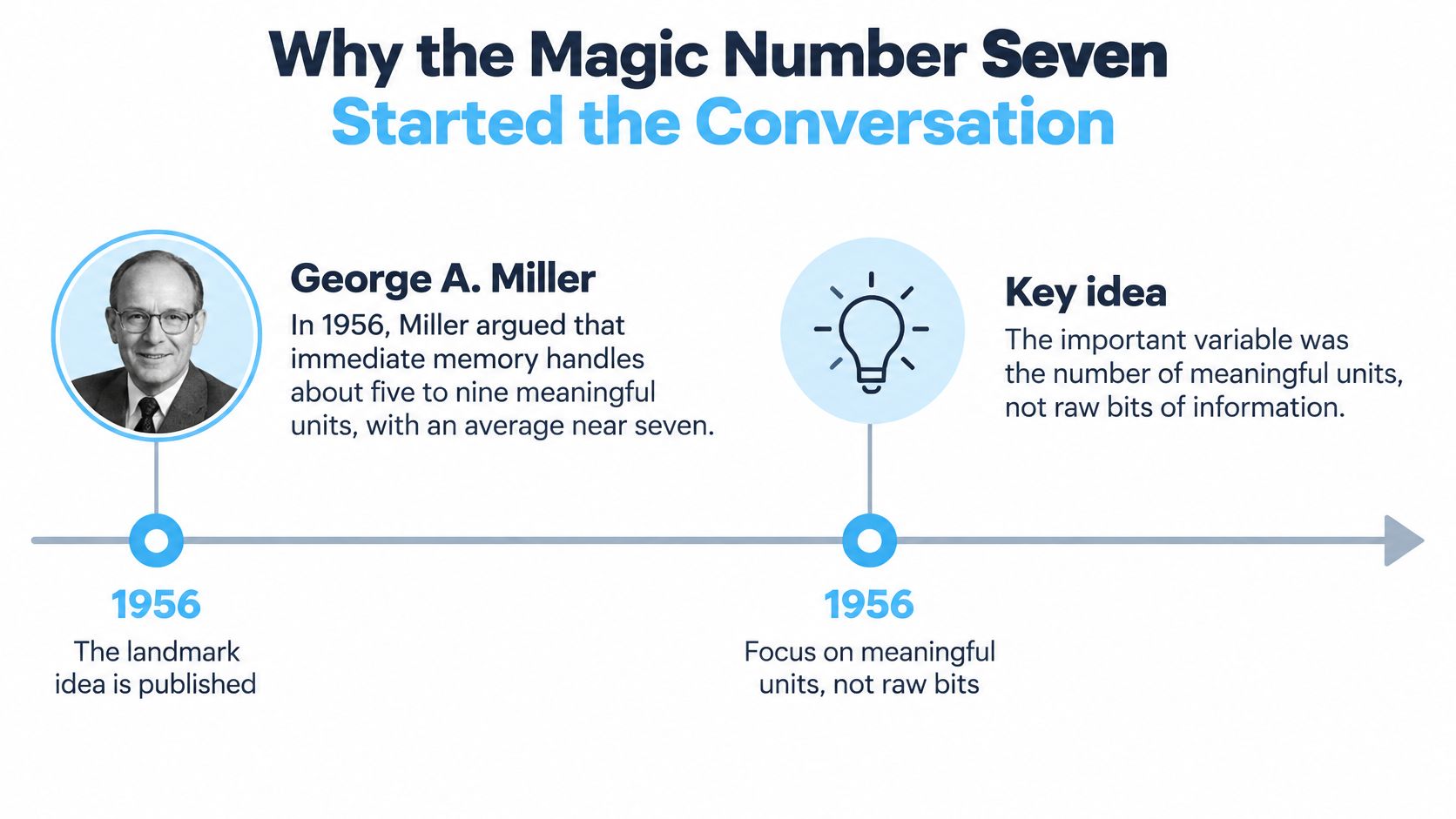
The idea traces back to a famous paper. A PMC review of Miller’s 1956 article “The Magical Number Seven, Plus or Minus Two” notes that George A. Miller argued immediate memory typically handles about 5 to 9 meaningful units, with an average near 7. His key move was separating the number of physical elements from the number of psychologically meaningful units being held.
A unit, in Miller’s sense, is whatever a person recognizes as one thing. A familiar word, date, or abbreviation can function as one chunk for someone who knows it. The same material stays several unfamiliar items for a novice. That single insight shifted memory research toward information organization and recoding, instead of treating capacity as a fixed count of symbols.
Three Tasks, One Converging Number
Harvard’s summary, described in its profile of George Miller, identifies three tasks that converged on roughly the same capacity. People associated about seven labels with continuously varying stimuli such as loudness or color. They rapidly identified quantities of dots without counting up to around seven. They also held about seven items in immediate memory. Miller read that convergence as evidence that people actively recode incoming information into manageable units.
His binary example made the mechanism concrete. As the Wikipedia summary of chunking in psychology) describes it, untrained participants remembered only about nine binary items, while a 1954 training procedure taught one participant to group digits into groups of five and recode each group as a name. The digits didn’t change. The units did.
What Changed After Miller
Later work revised the number downward. When rehearsal and strategic support are limited, working memory looks closer to a few pre-existing chunks than to seven loose items. Treat the seven plus or minus two figure as a historical landmark, not a universal limit across every task or population.
That’s the practical reading worth keeping. The enduring contribution is the chunk concept, not the number attached to it. If you design for seven because a famous paper said seven, you’ll overload most readers. Design for a small number of recognizable units and you’re applying Miller’s actual idea.
How Expertise Decides What Counts as One Chunk
Most short explanations imply chunking works the same way for everyone. It doesn’t. A chunk exists only inside a mind that has learned the pattern, which means the same grouping can help one person and do nothing for another.
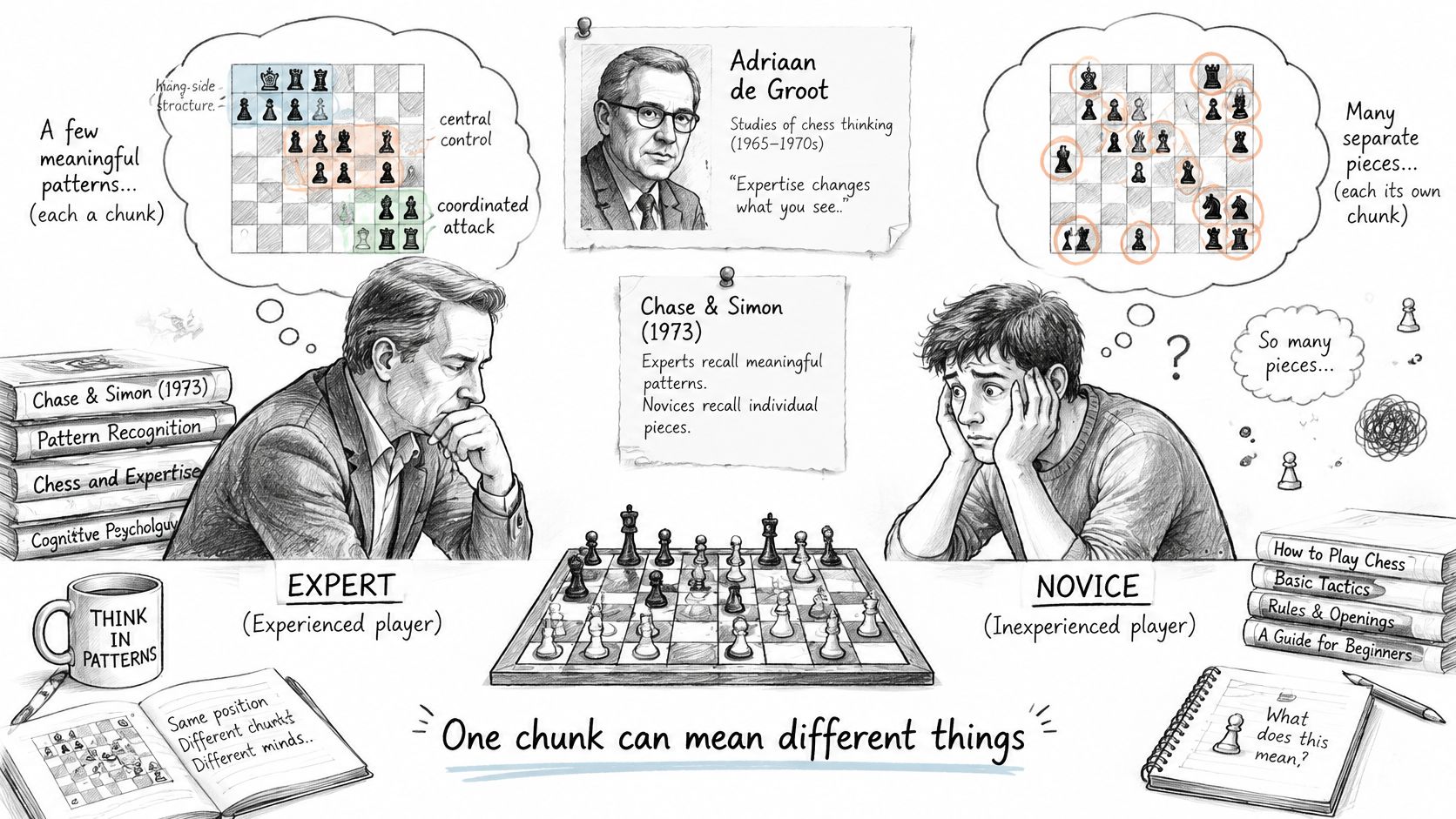
Chess gave psychologists the cleanest demonstration. Research associated with Adriaan de Groot and the 1973 work of William Chase and Herbert Simon, summarized in a PubMed record on chess expertise and memory, found stronger players recalled positions substantially better when pieces formed realistic game patterns. When pieces were placed randomly, the masters’ advantage over less skilled players became small or disappeared.
Recognition, Not a Bigger Memory
Experts weren’t carrying a larger general memory. They’d built thousands of long-term memory chunks, including familiar pawn structures, tactical formations, and arrangements tied to common plans. A board that shows a novice twenty separate pieces shows a master a handful of known configurations. Remove the patterns and you remove the advantage, because there’s nothing stored to recognize.
Chase and Simon even found a behavioral marker for chunk boundaries. They treated successive pieces placed less than approximately 2 seconds apart as likely belonging to the same chunk, and later research found that two second interval remained a reliable marker. Players were placing pieces in bursts, one remembered pattern at a time.
Two Everyday Parallels
- A familiar road: An experienced driver reads a known intersection as one scene, while a new driver processes each sign, lane, and light separately.
- A familiar price format: A repeat shopper reads your standard price and discount layout at a glance, while a first-time visitor decodes each number individually.
Both cases follow the chess result. The grouping works for the person who knows the pattern and fails for the person who doesn’t. Chunks are learned, so a chunk for an expert can be pure noise for a novice.
Chunking in Study and Everyday Memory
You can use this deliberately, and the techniques are plain. Start with acronyms, which turn a list into one word. ROYGBIV compresses the order of colors in a rainbow into a single pronounceable unit. You remember one thing, then unpack seven from it.
Themed sets work well for study sessions. Instead of drilling a vocabulary list in the order it was assigned, sort it into themed groups of five to seven words, such as food words, travel words, and work words. Each theme becomes a retrieval cue. When you recall the theme, its words come with it.
Rhythm and Categories Do Similar Work
Rhythm and phrasing bind items together through sound. Song lyrics stick partly because melody and meter group words into lines you can’t easily break apart. Reading a long number aloud in threes does the same thing in miniature, giving your ear groups instead of a stream.
Meaningful categories rescue lists of unrelated items. A shopping list written in the order you thought of things is hard to hold. Sort it into produce, dairy, and pantry and you have three chunks, each tied to a part of the store. You can even check yourself aisle by aisle.
Learning Chunks Without Being Taught
Chunks also form through exposure. A PMC study on statistical learning and chunking found participants recalled statistically patterned strings more accurately than strings with the same syllables in random order. Repeated co-occurrence raises the odds that elements get encoded and retrieved as a unit. Stable, repeated structures teach people your groupings across encounters, without any instruction.
One boundary matters. Overlapping chunks block the benefit, because an element sitting in two groups can’t be replaced by one compact representation. Two acronyms sharing letters create exactly that problem.
Try this routine on any list:
- Pick one list and group it by meaning, not by order.
- Recall the groups first, then the items inside each group.
- Check your recall and regroup anything you missed.
The same routine transfers directly to learning a product catalogue or your own store’s offer rules. If your team can’t chunk your promotion, your shoppers won’t either.
Using Chunking in Storefronts and Promotion Messages
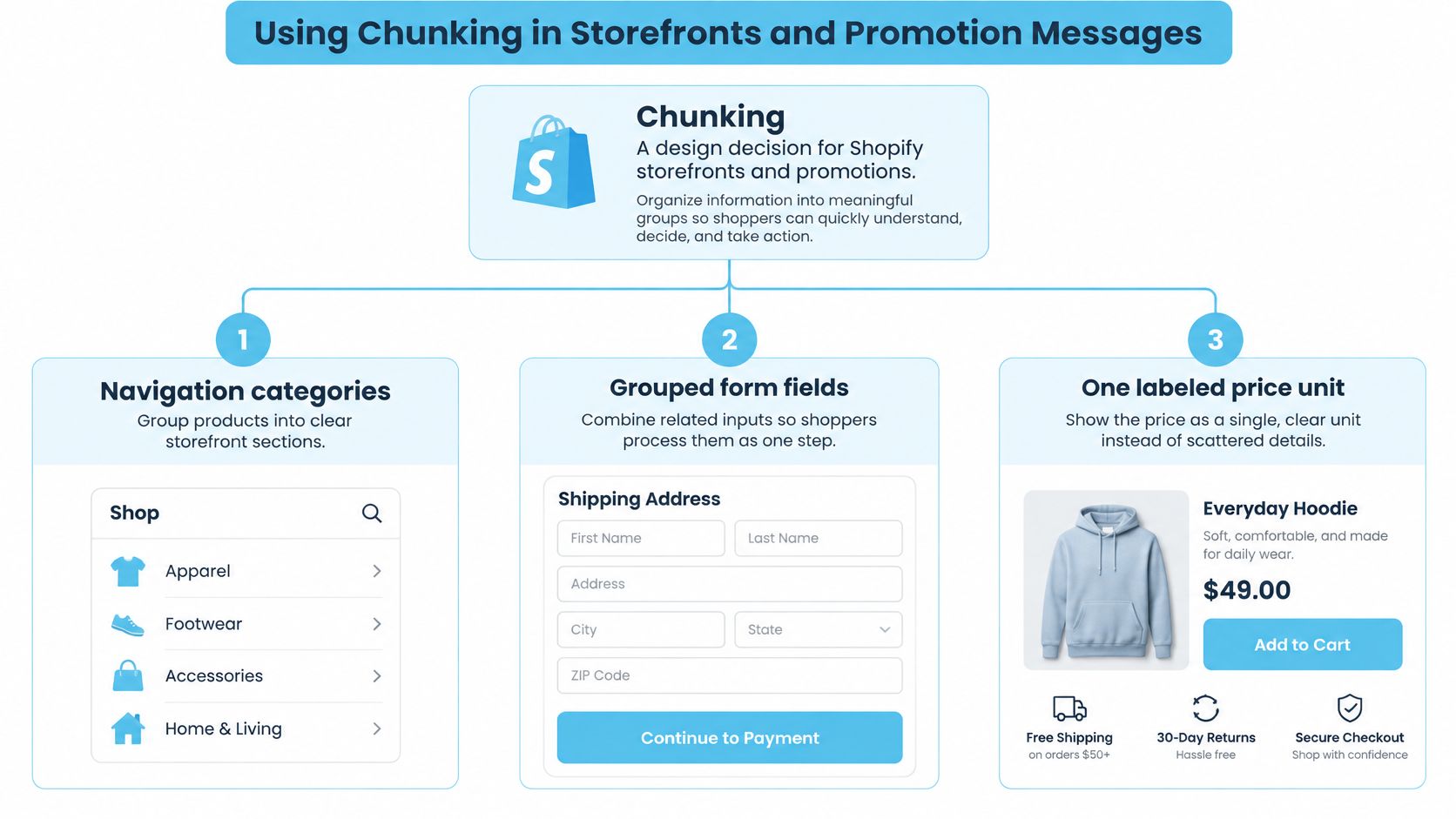
On a Shopify storefront, chunking is a design decision you make whether you name it or not. Navigation categories group products into sections a shopper can hold at once. Grouped form fields turn checkout into a few steps instead of a wall of inputs. A price shown as one labeled unit beats scattered figures a shopper must assemble herself.
The research points to a specific structure for messages. A PMC article on chunking and working memory capacity uses the example of remembering FBICIAUNNASA as four familiar units, FBI, CIA, UN, and NASA, rather than 12 independent letters, and notes modern estimates place working memory at about three to four pre-existing chunks when rehearsal is minimized. It draws the direct lesson for ecommerce messaging: organize offer conditions into a small number of meaningful categories such as time remaining, units remaining, and current reward tier, instead of presenting many unrelated details.
The Three Natural Chunks in a Promotion
| Message part | What it contains | Consistency rule |
|---|---|---|
| Offer rule | The reward and its condition | State it in one line in the same spot every time |
| Time limit | The deadline only | Use the same format for every campaign |
| Quantity limit | Units remaining | Use the same wording and position each time |
| Reward tier | Current tier and the next step | Show the next step, not the full ladder |
Each part gets one labeled chunk with a fixed position and wording. Repeat shoppers then learn the pattern through exposure, the same way repeated syllable patterns get learned without instruction. Shopify theme sections and app blocks make this easy to enforce, since each chunk can live in a consistent layout slot across campaigns.
A promotion with one deadline and one tier is easier to chunk than one stacking five conditions. Clarity comes from structure, not from adding explanatory text.
Say each part plainly, following the principles in these examples of concrete language. The margin payoff is direct. A shopper who understands the rule can act on it now, without needing a deeper discount to push her. Blanket discounting buys attention by spending margin. A memorable rule earns the same attention by being easy to hold.
Where Chunking Backfires and How to Spot It
Grouping doesn’t automatically help, and treating it as a free gain will mislead you. Chunking depends on prior knowledge, so the same layout that feels clean to repeat customers can confuse first-time or international shoppers who don’t share your categories. A “starter bundle” is a chunk only if the shopper already knows what belongs in one.
There’s also a trade-off between quantity and precision. Grouping can let people track more items while blurring distinctions between them. An eLife reviewed preprint on adaptive chunking reported in 2025 that an adaptive chunking model showed recall advantages over a non-chunking model when set size exceeded allocated capacity, with chance performance reported as approximately 19%. The benefit is conditional, not automatic. It shows up under load, and it comes with costs.
Symptoms, Causes, and Fixes
| Symptom | Likely cause | Fix |
|---|---|---|
| Shoppers miss the reward tier | The tier sits inside a mixed block, so it is not a chunk of its own | Give the tier its own labelled group |
| Customers recall the deadline but not the rule | The grouping favors speed over meaning | Test recall of the rule, tiers and deadline together |
| New visitors misread a bundle | The organizer’s category is unfamiliar to them | Label groups in plain words and test with first-time visitors |
| Eligibility confuses shoppers | A broad category hides a difference that changes the decision | Split the group where the difference alters the outcome |
| The same element appears in two groups | Overlapping chunks block a compact representation | Give each element one home on the page |
Read the eligibility row carefully. When a broad category hides a difference that changes who qualifies, your chunk is actively hurting decisions. The page looks simpler and performs worse, which is the trap described in this piece on having so many options. Simplicity on the surface can hide complexity underneath.
The test that catches these failures is recall, not reading speed. Ask whether shoppers can state the rule, the tiers, and the deadline after one viewing. A message that feels quick to scan but leaves nothing behind hasn’t chunked anything. Fewer visible elements does not automatically mean lower cognitive load.
Test What Shoppers Actually Remember
A shopper sees a promotion once, then has to recall its rule, reward tier, and deadline. Test whether those parts stick before changing the whole message.
Choose one live or upcoming promotion. Show its message once to five customers or team members, take it away, and ask them to repeat the rule, tier, and deadline. Record which part they miss.
Then revise only that part. Give it a clearer label, a consistent position, or plainer wording, and repeat the test. A single unclear group may be enough to make the offer hard to remember.
Clear rules and limits let shoppers understand what they can claim and when. Quikly turns existing offers into time and quantity bound experiences that customers actively claim, rather than relying on a deeper discount to make the promotion noticeable.
Keep one standard for every campaign: a shopper should be able to explain the offer’s rule in one breath. If the explanation takes longer, check whether the groups are unclear or the message asks shoppers to remember too many details.
If your promotions take a paragraph to explain, shoppers are spending memory you could be saving them. Quikly turns your existing offers into time and quantity bound experiences with a clear rule, a real limit, and a visible tier, so customers can hold the whole offer in mind and act while intent is high. Visit Quikly to see how a memorable promotion structure protects margin instead of spending it.
Topics: chunking psychology, chunking examples, working memory, memory recall, cognitive psychology