A launch looks simple from the outside. The creative is approved, the promo is live, the dashboard is open, and the team expects the same plan to keep working long enough to matter.
Then the numbers stall, Slack starts filling up, and someone says the quiet part out loud, “We need to change something now.” That’s usually the moment a good team makes a bad call, not because people stop caring, but because the room gets crowded with urgency, bad assumptions, and the fear of missing the window.
The Moment a Good Team Makes a Bad Call
The most expensive mistakes usually happen in ordinary campaign meetings, not dramatic crises. A launch is live, the hero offer isn’t moving, paid social is lagging, and the channel mix needs a pivot before the next reporting cycle closes.
What happens next is familiar. One person anchors on the first discount number that sounds aggressive enough, another protects the existing media spend because cutting it feels like admitting defeat, and the loudest voice in the room starts shaping the decision before anyone has checked whether the problem is creative, channel fit, or timing.
Where the call starts to fray
Three things tighten the room. Time shrinks, cognitive load climbs as people juggle dashboards and Slack messages, and the stakes make everyone more defensive than they want to admit.
That’s when teams stop seeing the choice in front of them. They start optimizing for relief, not judgment, which is why a campaign can drift into a worse offer, a worse channel mix, or a worse rollback plan faster than anyone expected.
Practical rule: if the first instinct in the room is to “just move faster,” that’s usually a sign the team hasn’t clarified what kind of decision it’s making yet.
The useful mindset shift is simple. Pressure isn’t something to merely endure, it’s something to design around. Once you treat it that way, you can separate the calls that need speed from the calls that need structure, and that changes everything about how your team reacts when the dashboard turns red.
What Pressure Actually Means for a Decision
Decision making under pressure isn’t one thing. It can mean an acute event, like a broken launch page or a campaign that’s suddenly overperforming and needs a budget move, a chronic crunch week where everyone’s depleted, or a manufactured deadline the team created for itself by stacking too many choices into one hour.
Three kinds of pressure, three different failures
Acute pressure is the cleanest to spot. A flash sale is underperforming at noon, inventory is moving oddly, and the team has to decide whether to change the offer, the creative, or the channel emphasis before the afternoon traffic spike.
Chronic pressure is quieter and often worse. People have been in meetings all day, context is fragmented, and by the time the group gets to the actual decision, no one has enough mental bandwidth left to challenge the first workable idea.
Manufactured pressure is the one leaders create by accident. A team turns an artificial countdown into a hard deadline, then behaves as if speed itself proves quality, even when the decision could have been made better with a brief pause and a better boundary.
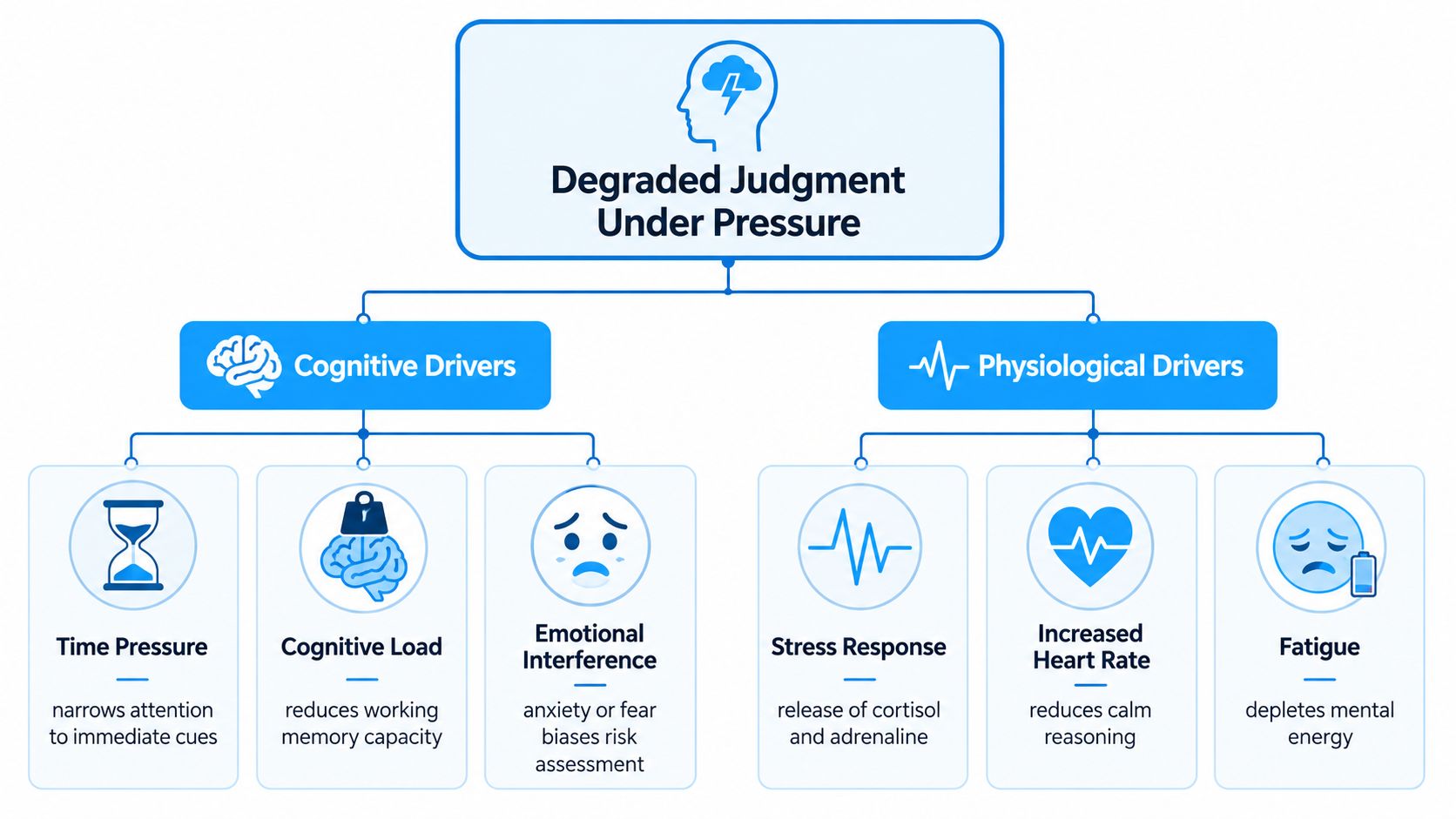
The key point is that pressure changes decision quality less by “raising stress” in the abstract and more by changing the shape of the task. Quality depends on whether the information is complete enough, how complex the choice is, and whether the team has made the same kind of call before.
A simple example makes the difference obvious. A marketer deciding whether to pause a broken ad set has a different burden than a merchandiser deciding whether to change the actual promo architecture mid-flight, because one choice is reversible and the other can affect margin, customer behavior, and brand perception long after the sale ends.
The best teams don’t ask, “How do we stay calm?” first. They ask, “What kind of pressure are we under, and how much reversibility does this decision actually have?”
That framing matters because generic stress advice collapses all three situations into one vague emotional problem. Real operating discipline starts when you can name the pressure, then match the decision process to it.
Cognitive and Physiological Drivers Behind Bad Calls
Pressure changes more than speed. It changes what feels safe to choose. In one experimental study, people under time pressure became more conservative at lower risk levels and more willing to take risks at higher risk levels, and the shift reflected a lower decision threshold rather than a clean change in judgment style. Response times also fell across risk levels, especially in choices that were slower without pressure, which points to a threshold tradeoff instead of a simple fast-guess response (PubMed experimental study).
What that looks like in a marketing room
A marketing team sees this when it stalls on a small, reversible tweak, then approves a much bigger move once the stakes feel higher. Nobody in the room feels inconsistent while it is happening, but the threshold has moved, so two decisions get treated as if they deserve different levels of proof.
That same shift shows up in how people process information. Under pressure, people become less influenced by uncertainty, less value-directed, and more likely to repeat previous choices, while eye-tracking work on intertemporal loss decisions found reduced fixation duration, shorter decision time, and a lower selection of the larger-later option, with attention shifts partly mediating the move toward heuristic processing (Nature Scientific Reports study).
The room starts favoring the first number, the most familiar action, or the move that is easiest to defend. In marketing, that often means anchoring on the first discount depth someone says out loud, then building the rest of the discussion around it instead of testing whether that number fits the offer.
The biases that show up first
- Anchoring: the first proposal becomes the reference point, even when it is arbitrary.
- Confirmation bias: once a senior person speaks, the team looks for support instead of alternatives.
- Loss aversion: the group protects yesterday’s spend, even when reallocation would be healthier.
If you want to see how those shortcuts distort recall and comparison in real decision rooms, the difference between representative and availability heuristics is worth revisiting.
Pressure does not erase judgment. It narrows it. Attention shrinks, working memory gets crowded, and the team starts mistaking speed for clarity.
Why Gut Instinct Often Fails in High-Stakes Calls
A team can look composed and still make a poor call the moment the clock gets loud. The problem is not that people stop caring. Pressure changes what gets noticed, what gets ignored, and which option feels easiest to defend in the room.
Gut instinct works best when the situation is familiar enough that the mind can match it to a real pattern. When the context is new, or when the pressure is intense enough to blur the signal, a quick reaction can feel sure and still be off-target. That is why seasoned operators sometimes make a fast move that fits a past campaign, but not the one in front of them.
When intuition helps, and when it punishes speed
The research on sequential sampling models points to a useful threshold idea. Under time pressure, people do not become worse at deciding. They shift how much evidence they require before acting, and the threshold can drop when the situation feels more risky, which changes the final choice without necessarily changing the person’s overall style of reasoning.
That matters in practice because one leader can hesitate over a small bid change, then approve a large discount adjustment without realizing the standards changed between the two calls. The team usually sees the result, not the inconsistency behind it. Later, that can show up as margin erosion or a promo that is harder to unwind than anyone expected.
Useful test: if the decision depends on a pattern you have not seen often, intuition should be treated as a hypothesis, not a verdict.
The other trap is that pressure makes bad familiarity feel safe. In a live campaign room, people often reach for the first number that sounds defensible, then build the rest of the discussion around it instead of questioning whether the offer structure fits shopper behavior. That is where choice architecture starts to matter, because the way options are framed can steer the team toward the wrong default.
Intuition is not the enemy. Unchecked intuition is. It should be trained on recurring situations, then bounded by a process that prevents a fast reaction from overruling a better decision. In a field where urgency is often created by dashboards, calendars, and internal pressure rather than true emergency, that separation matters. For a fuller framing on that kind of call, see leading confidently with incomplete data.
The best operators do not worship analysis, and they do not worship instinct either. They know which calls can be reversed later, which ones cannot, and they give each kind of decision the right amount of room.
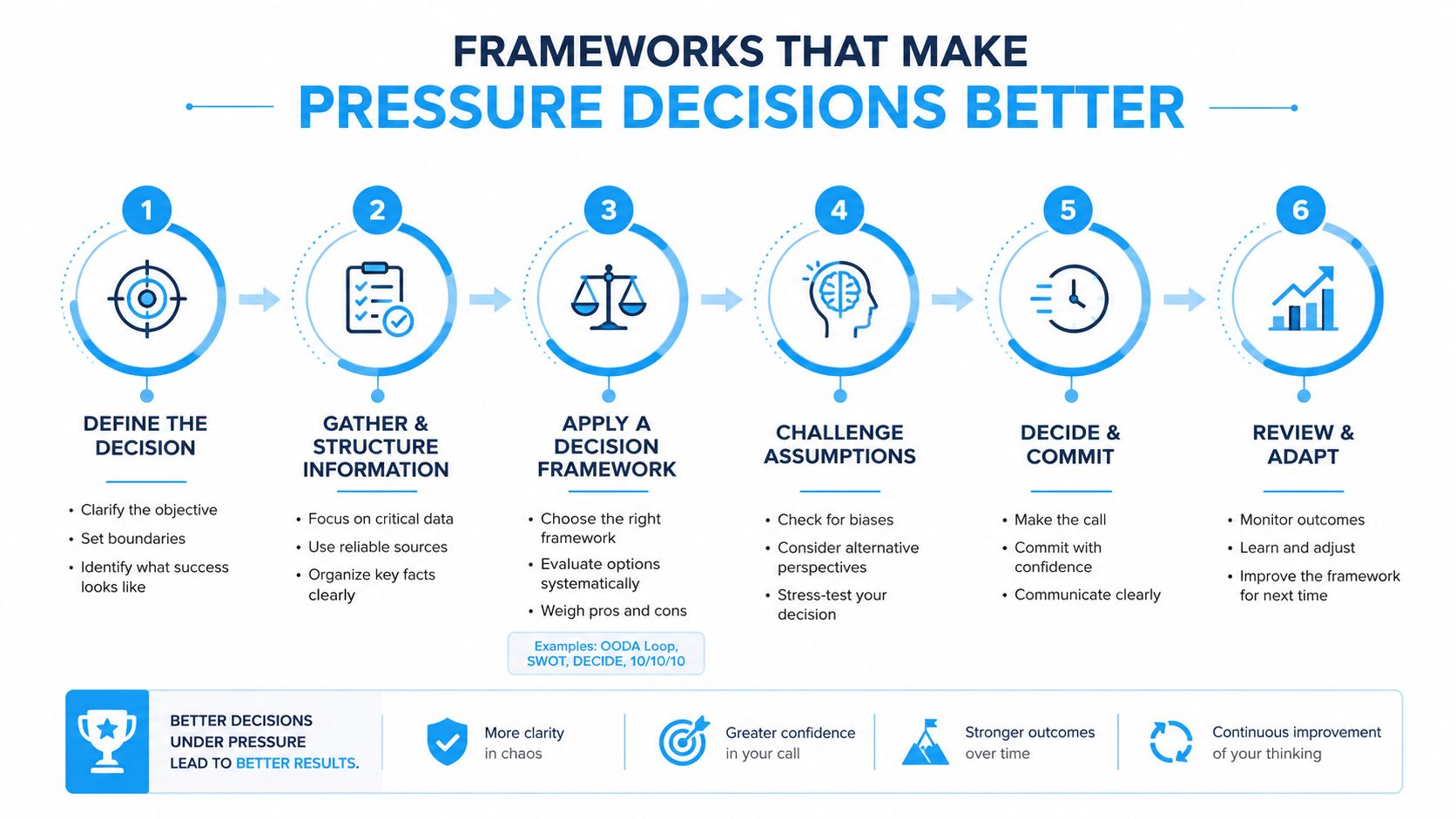
Frameworks That Make Pressure Decisions Better
Good pressure decisions are rarely the product of one brilliant moment. They come from a system that compresses thinking before the room gets hot, so the actual call can be made quickly without being sloppy.
Start with the pre-mortem
A pre-mortem is where the team imagines the decision failed and names why. In a flash-sale dip, that might reveal three likely failure modes, weak offer clarity, the wrong channel emphasis, or a promo structure that looked urgent to the team but not to the shopper.
Turn the answer into a rule
Once the failure modes are visible, encode them into a decision rule. If the campaign is underperforming and the current offer isn’t improving conversion, the team should know ahead of time what evidence is required before changing the discount depth, the channel mix, or the creative.
Use a checklist to protect the call
A checklist keeps the group from skipping the boring but expensive questions. Does the team have the latest inventory view, the current margin impact, the rollback path, and a single owner for execution?
Put a time-box around the debate
A time-box doesn’t mean rushing. It means deciding in a defined window so the meeting doesn’t become a rerun of the same arguments, especially when everyone is reacting to partial data.
For a deeper framing on making careful calls when the information set is incomplete, the resource leading confidently with incomplete data is a useful companion. And if you want a practical model for shaping choice environments instead of reacting to them, the choice architecture overview is a strong next read.
The point of the system is speed with discipline. You’re not trying to slow the team down, you’re trying to compress high-quality thinking into the window you have.
Ecommerce and Marketing Moments That Test These Skills
A product launch misses the mark, and the hero creative is not doing enough work. The team feels the pressure immediately, because there is always a temptation to change something fast. The better move is to return to the pre-mortem and ask whether the problem sits in the promise, the audience, or the offer structure.
The decision rule matters more than the debate once the campaign is live. If the launch weakens a clear engagement signal by the end of the first reporting window, the team should follow the evidence threshold it agreed to before launch, instead of reaching for a bigger discount because that feels safer in the moment.
When the promo is live but conversion lags
A limited-time promotion that stays flat mid-flight creates a different kind of pressure. The instinct is to keep rewriting the message every hour, but that often avoids the harder question of whether the promotion itself is strong enough to drive action.
A checklist keeps the team honest. Before anyone changes the mechanics, confirm the current traffic quality, the checkout path, the stock position, and the rollback option if the new choice fails. Those are the details that usually separate a useful pivot from a panic move.
A flash sale with shifting conditions is the clearest stress test. If the discount depth needs to change within hours, the team cannot be negotiating every option from scratch. A preset rule keeps the discussion grounded in what was decided before the pressure hit.
If the team is rewriting the rules while the campaign is running, the campaign is already steering the team instead of the other way around.
A stronger question is what move preserves the most options if we’re wrong, rather than what is the most aggressive move. That is why reversibility matters so much, especially in Shopify environments where a mistake is rarely just a weak hour of sales. It can also leave a margin wound or send a brand signal customers remember. For a useful way to frame those choice environments, see these nudge theory examples.
The practical habit is to separate the actions you can roll back from the ones you can’t, then let that shape how hard you review the call. The more durable the decision, the less room there is for improvisation.
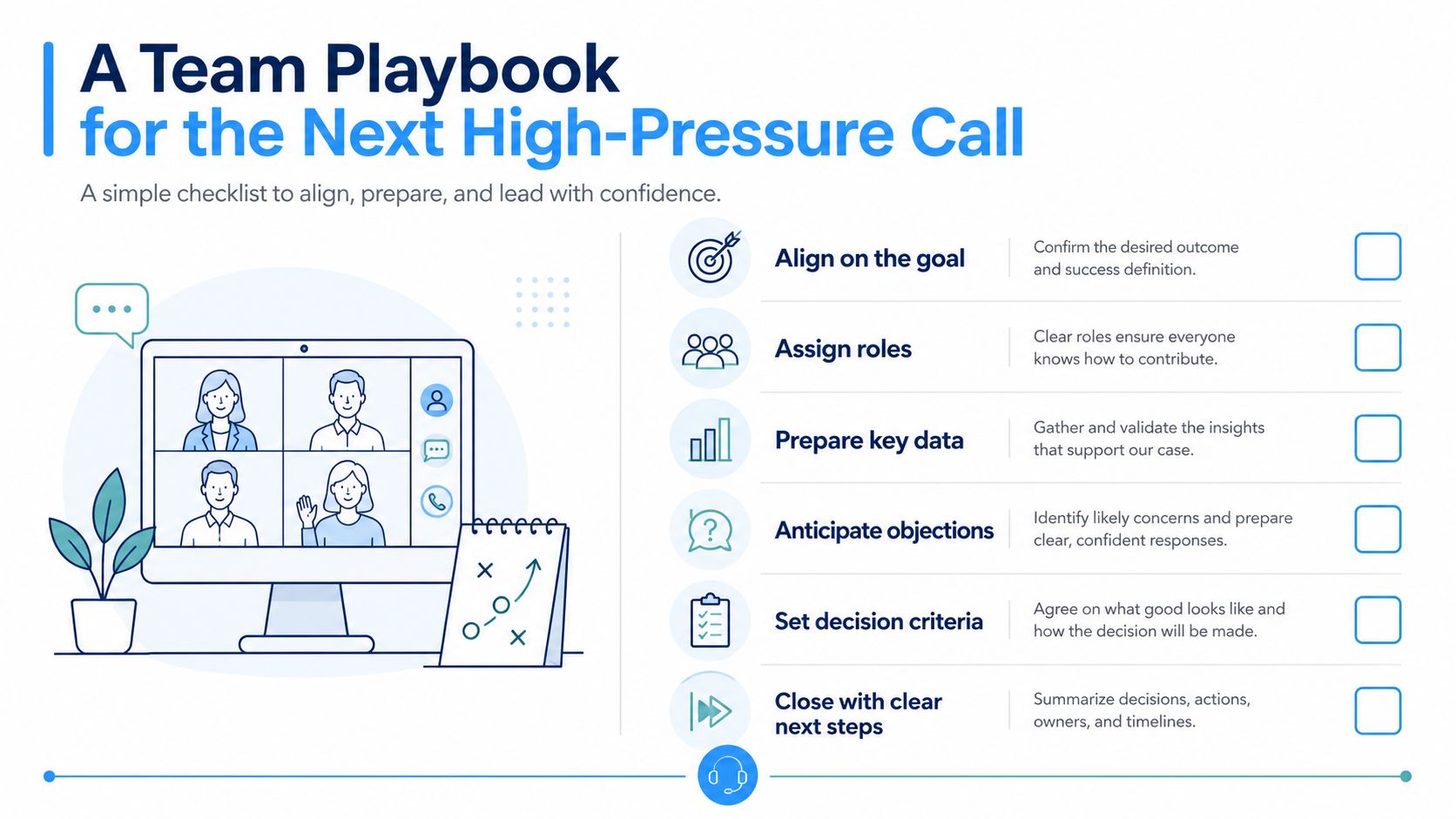
A Team Playbook for the Next High-Pressure Call
The room should know, before the meeting starts, who owns the decision and who advises it. If the team can’t name the single decision-maker, the call will usually drift toward the loudest voice or the person closest to the dashboard.
The playbook is straightforward.
- Name the owner: one person decides, everyone else contributes evidence.
- Show the right data: margin, inventory, current offer performance, and rollback path must be visible before the call.
- Separate reversible from irreversible choices: fast moves are fine when the rollback is clear, slower review is required when the change is durable.
- Use the default when the room disagrees: if the team can’t reach alignment in the time-box, pause and confirm rather than force a weak consensus.
- Keep the rule visible: the pre-agreed trigger should be on the same screen as the live results.
- Capture the reason: write down why the team made the call so the next one is cleaner.
Prepared teams look different from reactive ones. The prepared team doesn’t ask for more adrenaline, it asks whether the decision can be reversed, then acts accordingly.
Rehearsing Decisions Before They Become Urgent
Pressure performance gets built before the crisis, not during it. Teams that rehearse recurring scenarios, like a discount-cap breach or a stock-out in the middle of a promo, are faster because the pattern already exists when the moment arrives.
Tabletop drills are the cleanest practice. Put the team in a short simulated campaign failure, then force the same people to make the same call they’d make live, with the same constraints and the same rollback limits.
What to rehearse first
Post-mortems matter too, especially for the bad calls people would rather forget. The goal is to identify where the team mistook urgency for clarity, or where the first plausible answer crowded out a better one.
Pre-built decision trees help when the same scenario appears often. If stock runs low, if conversion slips below the agreed threshold, or if the promo depth is too aggressive for margin, the tree should make the next move obvious enough that nobody has to reinvent it under fire.
The team that practices one hard call well will usually beat the team that tries to “stay calm” without a script.
That’s the advantage of rehearsal. It gives the team a shared pattern library, so under pressure they’re not inventing judgment, they’re applying it.
Pressure will keep showing up in ecommerce, especially when deadlines, notifications, and live performance data create urgency faster than anyone would like. The goal isn’t to eliminate that pressure, it’s to make sure your team has already decided how to decide when it hits.
Quikly helps Shopify brands turn promotions into behavior-driven experiences instead of flat discount blasts, which matters when pressure is already distorting judgment and every hour counts. If your team needs a cleaner way to create urgency without training customers to wait, take a look at Quikly.
Topics: decision making under pressure, marketing decisions, ecommerce strategy, promo psychology, team playbook