Traffic is up, paid acquisition is getting more expensive, and the Shopify store still converts at about the same rate. The easiest response is another promotion, often with a deeper discount. That can produce orders, but it also spends margin and teaches customers to wait for the next markdown.
Conversion rate lift is worth measuring, but the headline number can hide what a campaign costs. A useful test asks not only whether more visitors bought, but whether the promotion earned those orders without weakening full-price demand, customer trust, or future revenue.
Why More Traffic Is Not Buying You More Conversions
A familiar pattern plays out in many Shopify stores. The team increases acquisition spend, traffic rises, and the conversion rate barely moves. Someone proposes a broader sale. It lifts orders for a time, but the next campaign needs a sharper offer to get the same attention.
The trouble is that a discount can bring forward a purchase without creating a healthier customer relationship. If customers learn that waiting usually earns them a better price, the brand gives away margin on purchases that might have happened anyway. A promotion that looks successful in a campaign dashboard can still be a poor trade if it weakens full-price sales or pulls demand forward from a later period.
That doesn’t mean promotions have stopped working. It means conversion rate lift isn’t a goal in isolation. A Shopify operator needs to understand which visitors are already close to buying, what might help them decide, and what the incentive costs in margin and brand perception.
The distinction matters because different problems need different fixes. Visitors who are undecided may respond to a credible reason to act now. Shoppers who leave because shipping costs are unclear or checkout feels risky need a better buying experience, not a louder offer. And stores that rely on constant markdowns need to know whether short-term conversion gains are building repeat demand or training customers to hold out.
A healthier approach starts with a baseline, tests one meaningful change, and checks the commercial result alongside conversion. The aim isn’t to extract every possible order from every visitor. It’s to earn decisions from shoppers who are ready to buy without paying more than the resulting customer value can justify.
What Conversion Rate Lift Actually Means
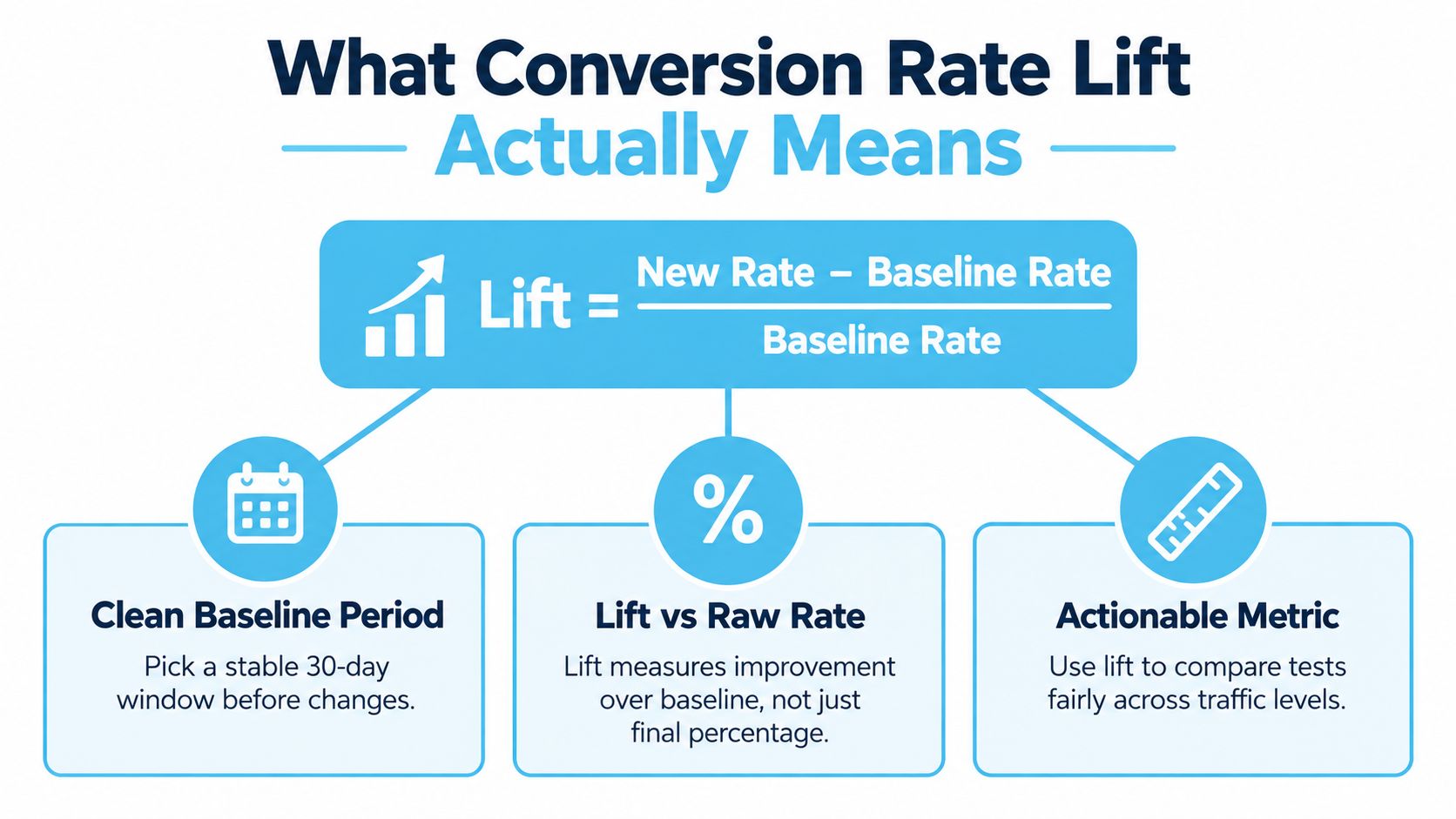
A promotion can raise orders and still reduce profit if the extra conversions come at too high a discount. Conversion rate lift measures the relative change in conversion rate against a defined baseline or control. If a store moves from a 2.00% conversion rate to 2.16%, that is a gain of 0.16 percentage points, or an 8% relative lift, not an 8-percentage-point increase.
A Deloitte and Google study reported that a 0.1-second improvement in mobile load time produced an 8% increase in retail conversion rates. As an illustration, applying that relative lift to a 2.00% baseline across 10,000 sessions would move orders from 200 to about 216. That result reflects observed relationships in mobile retail, not a forecast for every Shopify store. A faster page can improve buying conditions without sacrificing margin, though the result still depends on the offer, audience, and store experience.
Set the comparison before launching
Choose the baseline before changing an offer, page, or checkout. Compare against a stable period or a control group, and keep other campaign conditions as consistent as practical. Changes in traffic sources, inventory, or promotion exposure can distort the comparison, leaving you unsure what caused the movement.
Name the metric you are tracking. Session-to-order lift compares purchases with sessions. Cart-to-order lift focuses on shoppers who have already added an item. Average order value lift tracks basket value, not the share of visitors who buy. Each measures a different outcome, and a discount can improve one while weakening margin.
For more context on store-level conversion work, Online Brand Growth’s conversion rate optimization guide offers a useful reference. Keep the baseline and underlying rates beside the relative lift when reporting results. That makes it easier to judge whether a change improved shopper response at a cost the business can sustain.
The Conversion Ceiling You Are Actually Working Under
Baymard Institute’s aggregation of 49 ecommerce studies puts average cart abandonment at 70.19%, or roughly seven carts abandoned for every three completed purchases (Baymard’s checkout UX research). That benchmark isn’t a promise that any store can recover the same share. It does show why conversion work shouldn’t begin and end with acquiring more visitors: a substantial pool of shoppers has already shown purchase intent.
But abandoned carts don’t all signal the same problem. Some shoppers are interested and still deciding. Others are prepared to buy but run into a practical obstacle. Urgency may help the first group make a choice; it won’t make an unexpected fee feel fair or a slow delivery option arrive sooner.
Separate motivation from friction
Baymard’s survey of 1,026 recent US online shoppers found that 42% had abandoned a cart because they were just browsing or not ready to buy. Among shoppers excluding that group, extra costs such as shipping, taxes, and fees were the leading reason, cited by 40%; slow delivery, lack of trust with card details, and forced account creation were also cited as reasons for leaving (survey findings reported by USA Today).
Those findings point to two different jobs. A relevant, time-bound reward can give a high-intent but undecided shopper a reason to act. Checkout improvements should handle the friction: show shipping costs clearly, make delivery expectations easy to find, provide credible payment reassurance, and avoid unnecessary account requirements.
An urgency campaign that adds excitement but leaves checkout problems untouched risks creating more people who reach the cart and still leave. Before changing the promotion, make sure the path from offer to completed order is clear. For context beyond ecommerce, Silva Marketing’s overview of typical conversion rates for local service businesses also helps show why benchmarks need to be interpreted within their business model.
When Urgency Helps and When It Hurts
Urgency isn’t a single lever, and adding more of it doesn’t guarantee more useful conversion. Limited-time scarcity and limited-quantity scarcity can work through different routes. A 2025 academic study found that time-limited scarcity influenced perceived value and psychological urgency more effectively than limited-quantity scarcity in the online impulse-buying behavior it examined (study on scarcity and impulse buying).
That doesn’t make countdowns universally effective or quantity caps universally weak. The useful question is whether the limit is real, understandable, and suited to the offer. A deadline can clarify when a deal closes. A quantity cap can make sense when the reward itself is limited. A timer that resets whenever someone reloads the page, or a stock message that never changes, can instead create doubt.
Springer research reports that both limited-time and limited-quantity messages can increase arousal and shorten product searches, but the message needs to be specific and credible for that arousal to translate into purchase rather than distrust (research on scarcity messaging). That is the difference between earned urgency and manufactured pressure. Shoppers should be able to tell what is limited, why it is limited, and what happens when the offer ends.
Watch what happens after the campaign
A promotion can increase immediate orders and still weaken the next buying decision. Consumer evidence cited by Salsify and the Digital Shelf Institute reports that 70% of consumers have made an unplanned purchase because of a discount, while 62% identify limited-time discounts as the strongest purchase-completion driver (Salsify’s discussion of discount strategies). Those figures speak to short-term persuasive power, not lasting customer value.
Look for warning signs in your own results: full-price conversion stays flat, customers complain about confusing offer rules, or more people opt out of email and SMS after repeated campaigns. If shoppers routinely wait for the next promotion, the mechanism is teaching delay rather than decisiveness. The answer isn’t to abandon urgency, but to use it selectively and judge it by downstream behavior as well as campaign-day orders.
For a deeper look at how time pressure and scarcity can shape promotional behavior, Quikly’s guide to urgency marketing adds useful context.
How to Measure Lift on a Shopify Promotion
A Shopify promotion needs a comparison that can distinguish the offer’s effect from what would have happened anyway. Start with a specific question, such as whether a capped reward generates more profitable orders than the store’s usual discount. Choose a baseline period or holdout audience, and decide how long after exposure a purchase can count toward the test before launch.
Then keep the comparison honest. If one group sees a standard discount and another sees a capped reward, keep the audience, products, timing, and other campaign conditions as similar as possible. Shopify’s discount and cart infrastructure, theme changes, and messages from Klaviyo or SMS can all affect the buying journey. Avoid changing several of them at once if you want to know what drove the result.
Read the commercial result, not just the headline
A merchant might split eligible visitors between a conventional sale and a reward that fewer shoppers can claim. The comparison should include orders and the cost of each incentive, then follow what happens after the campaign. A larger conversion lift may not be the better result if the store gave up too much margin or attracted customers who don’t return.
| Metric | What it tells you | Why it matters for lift reporting |
|---|---|---|
| Full-price conversion | Whether shoppers still buy without an offer | Helps reveal whether promotions are replacing regular-price demand |
| Average order value | Whether baskets become larger or smaller | Adds context to order volume and discount cost |
| Gross margin per visitor | The margin generated across exposed visitors | Shows whether the promotion earned enough to justify the incentive |
| 30- and 90-day repurchase | Whether customers return after the campaign | Adds a view of value beyond the initial order |
| Support complaints | Whether customers found the offer confusing or misleading | Flags trust costs a conversion metric won’t capture |
| Email and SMS opt-outs | Whether campaign exposure prompts disengagement | Helps identify fatigue in owned marketing channels |
For practical Shopify implementation considerations, Up North Media’s Shopify playbook offers another operator-focused resource. For cleaner tests, Quikly’s explanation of incrementality testing is relevant to the question of whether a campaign caused additional outcomes, rather than receiving credit for purchases that would have happened anyway.
Don’t report only the headline lift. Pair the conversion result with margin per visitor, basket value, retention, and signals of customer friction. That gives the team a clearer basis for deciding whether to repeat, revise, or retire the promotion.
Three Paths to Lift and What Each Actually Costs
A Shopify merchant usually has more than one way to push for a faster purchase. Each route trades something different: a deeper discount spends margin broadly, a basic timer adds a deadline without controlling who receives the incentive, and a behavior-driven reward can limit exposure to shoppers who act.
| Approach | What it can do | What it costs or risks |
|---|---|---|
| Deeper blanket discount | Gives every eligible shopper a straightforward price incentive | Reduces margin on every discounted order and can condition customers to wait |
| Basic countdown timer | Makes an existing offer feel time-bound | Can create pressure without changing the offer’s economics, especially if the deadline isn’t credible |
| Behavior-driven reward | Ties access to a reward to a real time or quantity limit | Requires clear rules and careful testing so shoppers understand the constraint |
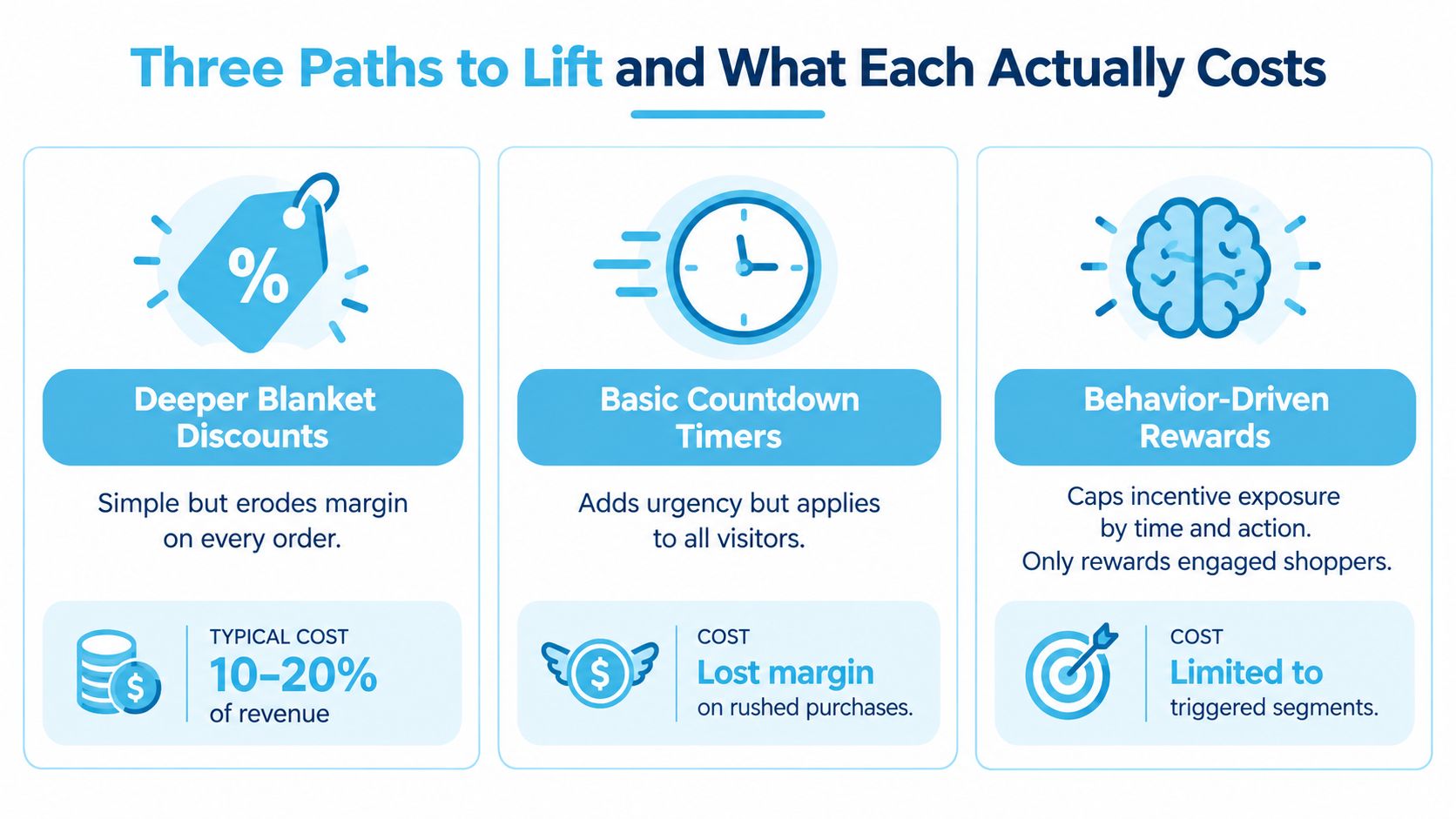
The third route can limit how widely an incentive is claimed, rather than automatically discounting every order. For example, a reward can close at a stated time or after a defined number of claims. That changes who receives the deal, but it doesn’t remove the need to calculate its margin cost or check whether shoppers understand the terms.
The right option depends on the problem. A blanket discount may be straightforward when price is the central barrier and the economics support it. A timer alone can make a deadline visible, but a decorative countdown isn’t a substitute for a credible offer. A behavior-driven promotion is worth testing when the store wants to reward early action while keeping the incentive bounded.
Specificity is a condition of trust. A shopper should know whether time, claim count, or both determine availability. If the store can’t honor the limit it displays, the short-term attention isn’t worth the damage to confidence. The decision isn’t about choosing a universally superior tactic. It’s about identifying which cost the brand can accept, then measuring the outcome on both conversion and commercial terms.
Lift Is Usually Compound, Not a Single Lever
A promotion cannot compensate for a shopping experience that feels slow or uncertain. Research on mobile load times has linked faster pages with stronger retail conversion, but those findings are observed results, not a forecast for a specific Shopify theme or campaign. Treat them as a reason to test the store’s own buying experience, not as a promised lift.
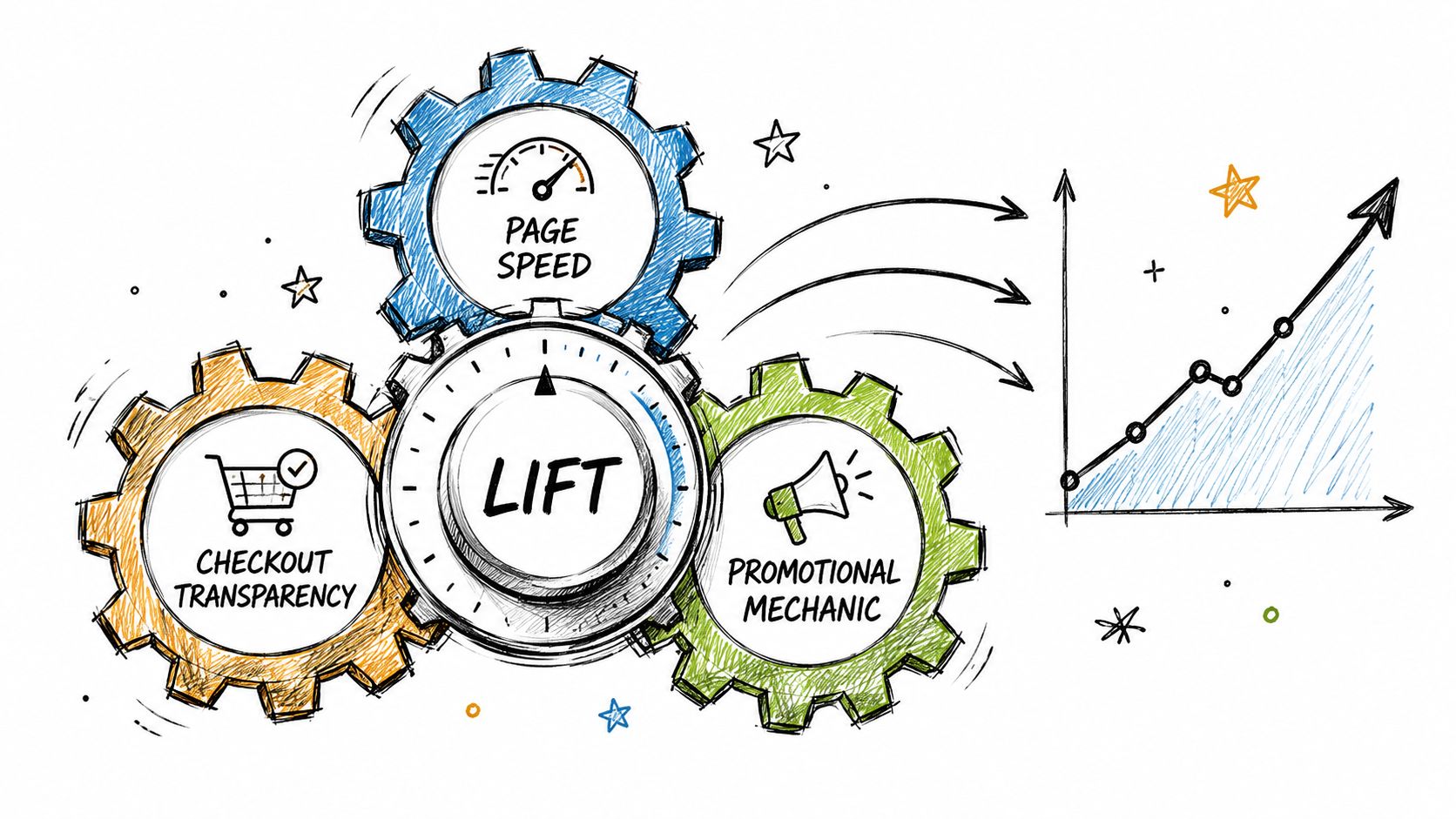
Shoppers weigh the offer alongside the effort and uncertainty of buying. A fast product page helps them evaluate a product; clear delivery costs and an easy checkout help them finish. A promotion can tip an undecided shopper toward purchase, but if it adds confusing terms or friction, it may weaken the offer’s effect.
Conversion rate lift is a stack of testable improvements. A Shopify operator could improve a slow mobile template, test clearer shipping information, then compare a broad discount with a reward for early action. Change one meaningful variable at a time so the team can see what moved results, and distinguish earned urgency from a countdown that creates pressure without a credible limit.
Judge each test against its baseline and its commercial cost. More orders do not automatically mean better performance if the incentive cuts gross margin per visitor. Track what shoppers bought and claimed, alongside whether the purchase path or customer relationship improved. Small gains can add up, but only when the team measures changes clearly enough to learn which ones merit another test.
A Practical Sequence for Earning Lift Without Deeper Discounts
Start with the buying experience, not the offer. Check that mobile pages load reliably, the cart displays the expected total, delivery terms are clear, and checkout doesn’t introduce avoidable obstacles. An incentive can’t fix a purchase path that makes shoppers uncertain about what they’re paying or when their order will arrive.
Next, choose one behavioral mechanic that addresses a real motivation gap. A time limit suits an offer that closes at a stated point; a claim cap suits a reward with limited availability. Write the rules so a customer can understand them at a glance, and avoid countdown pressure that the store can’t substantiate.
Set up a test the team can trust
Before launch, record the baseline and choose a comparable control group or a clean A/B design. Keep the audience and campaign conditions as consistent as possible, and decide the attribution window in advance. Track conversion rate lift alongside gross margin per visitor, average order value, repeat purchase, support complaints, and opt-outs.
Then judge the campaign on the entire result. If conversion rises but margin per visitor falls, the promotion may be buying orders too expensively. If customers convert and return without needing a deeper discount next time, the mechanic may be helping the brand earn more decisive behavior.
Quikly can be considered as one option for Shopify teams testing this approach. Its promotions tie rewards to how many people claim them, how long the offer stays open, or both, and can run as a single reward or a descending tier across storefront, email, social, and SMS. Jordan Craig saw roughly a 20% lift in profit, with incremental lift visible immediately on activation, a result that should be treated as a specific case rather than a forecast for another store.
For teams exploring ways to reduce reliance on blanket markdowns, alternatives to discounting offers a related perspective. The durable advantage comes from testing whether a promotion earns action at an acceptable cost, not from chasing a larger conversion figure at any price. Brands that preserve margin and trust while helping ready shoppers decide will be better placed to grow than brands that keep paying customers to wait.
If discounting is doing too much work in your Shopify store, explore how Quikly uses time- and quantity-limited rewards to test urgency with controlled incentive exposure. Compare the result against your baseline on conversion and margin, then decide whether the mechanic deserves a place in your promotional calendar.
Topics: conversion rate lift, ecommerce conversion, lift measurement, promotional strategy, shopify growth