A lot of Shopify product launches fail before launch day.
Not because the product is bad. Because the launch strategy is thin, the audience isn’t warmed up, the product page doesn’t answer real objections, and the team falls back on the oldest move in DTC: push a bigger discount and hope urgency does the rest.
That works once in a while. It also burns margin fast, trains customers to wait, and makes your brand look less confident than it should.
A better Shopify product launch strategy treats launch as a controlled conversion event. You validate demand before you scale traffic. You build anticipation across channels instead of spamming “coming soon.” You design urgency around real constraints, not fake pressure. And you measure success by what you kept, not just what you sold.
The Pre-Launch Playbook for Validating Demand
The pattern is familiar. A brand spends months getting a product ready, opens the store, pushes traffic hard, and learns too late that interest was shallow. At that point, the easiest move is a discount. It can lift conversion for a day, but it also cuts contribution margin, resets customer expectations, and weakens the brand signal before the product has earned any real demand.
A better pre-launch process treats validation as a margin decision, not a hype exercise. The goal is to prove three things before launch day: the right buyer wants the product, the positioning creates intent, and enough people will act without being bribed by price.
Shopify recommends an 8 to 12 week pre-launch planning window with milestones for audience building, teaser content, and exclusive previews in its product launch guide.
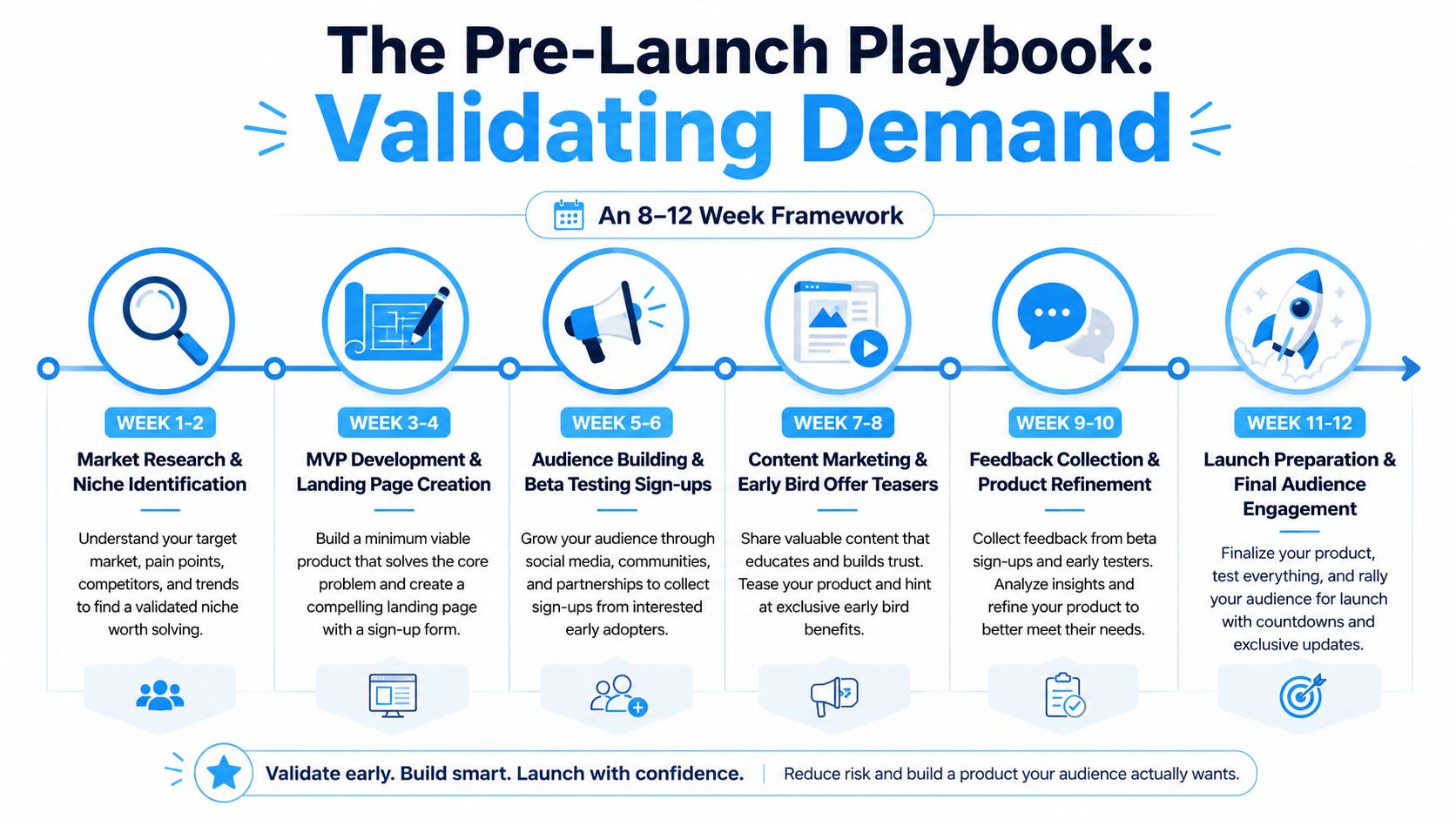
Treat pre-launch as market intelligence
Pre-launch work should answer commercial questions, not just fill a content calendar.
Start with the signals that matter:
- Who is showing purchase intent: waitlist signups, reply rates, early-access requests, quiz completions, and repeat visits
- Which positioning earns action: problem-aware messaging, outcome-led messaging, founder credibility, limited-run framing, or bundle economics
- Where intent is strongest: email, SMS, paid social, creator traffic, organic social, or returning customer segments
This stage is where behavioral psychology matters. People act earlier when the offer feels specific, socially validated, and scarce for a real reason. They stall when the product looks interchangeable or the value proposition sounds inflated. If you need a sharper way to assess market demand for new ideas, use external signal gathering before you commit budget to a full launch.
Use a soft launch to test willingness to buy
Soft launches protect margin because they force a cleaner read on intent. You are not asking whether people say they like the product. You are asking whether they will reserve it, join a priority list, or place an order under controlled conditions.
That difference matters.
Shopify’s launch guidance includes using a soft launch or limited crowdfunding campaign, and Joan Schneider and Julie Hall argue in Launch!, as summarized in Shopify’s launch planning framework, that brands should delay full release until testing shows buying decisions are based on meaningful differentiation rather than overstated claims.
In practice, a soft launch usually looks like one of four setups:
- A coming-soon page with a clear value proposition and segmented waitlist capture
- A limited drop to existing customers or VIP subscribers
- A pre-order window with transparent ship dates
- A small paid traffic test to a launch page before broader rollout
Each format gives you evidence you can use. If conversion only appears after a heavy discount, the issue is not just traffic volume. It is offer strength, audience fit, or message clarity. If shoppers join the waitlist but do not convert when access opens, trust or urgency is probably weak. If a small VIP batch sells through at full price, that is the strongest argument for scaling without cutting margin.
For brands validating demand with reservations or delayed fulfillment, Quikly’s guide to running Shopify pre-orders without creating fulfillment problems is worth reviewing before you open the floodgates.
Build two waitlists with different jobs
A single email list is rarely enough for a strong launch. Email is where you educate. SMS is where you capture immediate action.
Use them differently:
- Email for narrative, objection handling, product education, and social proof
- SMS for early-access alerts, launch reminders, and short conversion pushes tied to real deadlines
- Social for repetition, comment-driven proof, and visible momentum
This structure does more than improve reach. It lets you test buying psychology before launch. Email clicks tell you who is curious. SMS opt-ins tell you who wants speed and priority. Returning visitors tell you who is comparing and considering. Those are different levels of intent, and they should not be treated the same.
The strongest pre-launch campaigns I have seen do not chase the biggest list. They build the cleanest one. A smaller waitlist with clear intent, believable scarcity, and strong message-market fit usually outperforms a larger audience that only responds when the price drops.
Anatomy of a High-Conversion Shopify Product Page
A shopper taps your launch email, lands on the PDP, scrolls for ten seconds, and bounces. Traffic was not the problem. The page failed to answer the buying questions fast enough, and every paid click that hits that page gets more expensive.
A launch product page has one job: turn intent into conviction without training customers to wait for a discount. That means the page has to protect margin while increasing conversion. The strongest pages do that with clear value framing, credible proof, low-friction decision paths, and urgency tied to a real constraint.
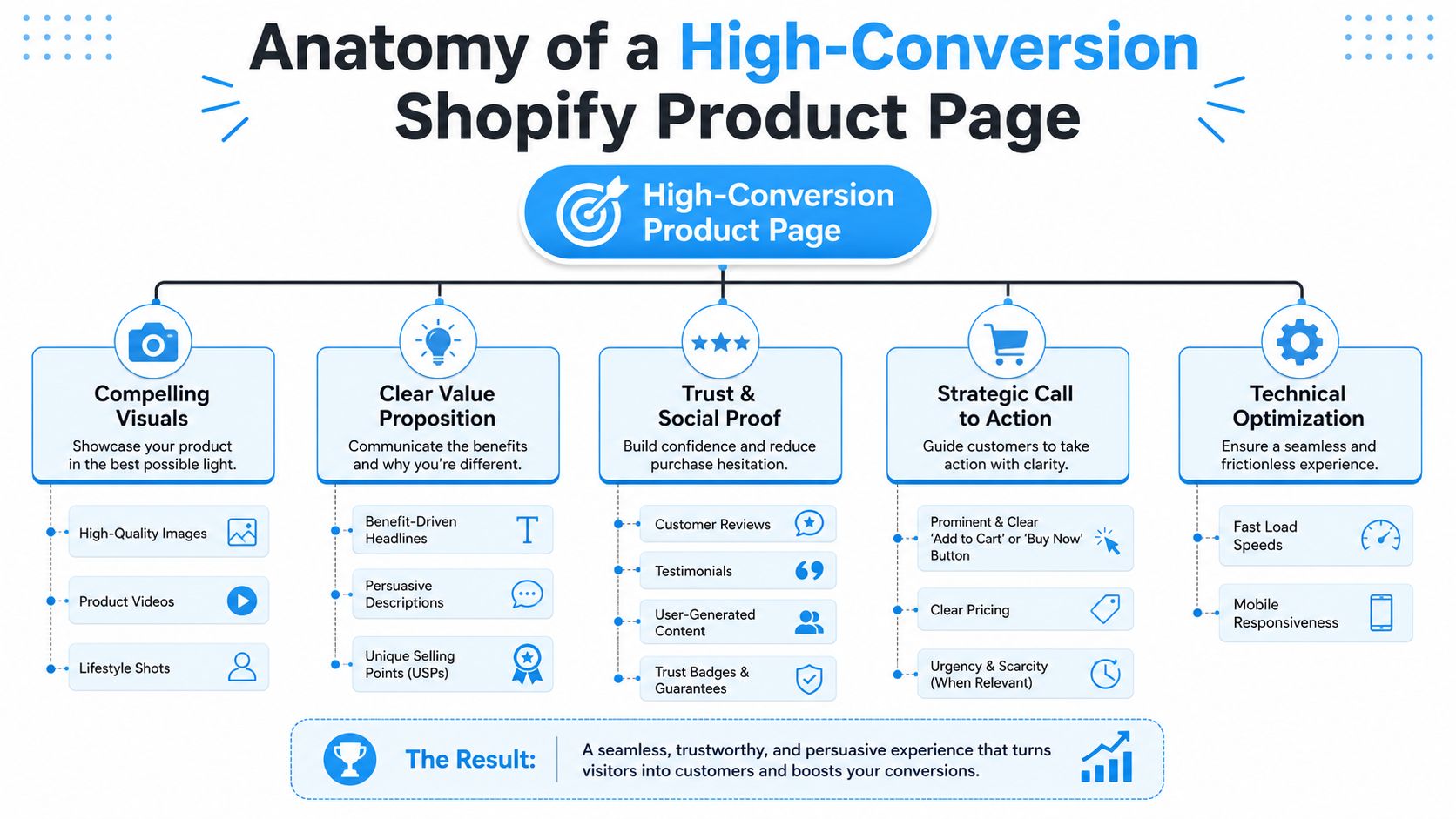
Build the page in four layers
I review launch PDPs in the same order customers experience them. If one layer is weak, the layers below it rarely save the session.
| Layer | What it must do | Common miss |
|---|---|---|
| Attention | Make the product feel immediately relevant | Strong visuals, weak positioning |
| Desire | Turn features into outcomes worth paying for | Specs listed before benefits |
| Objection handling | Remove risk and ambiguity | Missing shipping, sizing, materials, fit, or compatibility details |
| Urgency | Give a credible reason to act now | Countdown timers with no real constraint |
That order matters because urgency works best after the customer understands the product and believes the price is justified.
Attention and desire need proof
The hero section should answer three questions above the fold. What is it. Who is it for. Why is this version better than the alternatives the shopper already knows.
Polished creative helps, but clarity does more work than polish. A sharp headline, a grounded subhead, price framing, review proof, and visible purchase controls usually beat a beautiful hero image paired with vague copy. If your team is reworking the visual explanation layer, Moonb’s video marketing playbook is a useful reference for structuring demos that help shoppers make a decision, not just admire the edit.
Desire gets built with specifics. Show the texture. Show the fit on different body types. Show the before and after. Show how the product behaves in real use, not just in a studio. Good PDPs reduce interpretation. The shopper should not have to infer what the product feels like, how it performs, or why it earns its price.
For a practical framework on friction, hierarchy, and trust signals, Quikly’s guide to elements of conversion on Shopify product pages is worth keeping nearby during your audit.
Objection handling is margin protection
Founders often treat FAQs, shipping details, return terms, sizing help, and ingredient or material callouts as support content. On a launch page, they are sales content.
Every unanswered question pushes the shopper into one of three bad outcomes. They bounce. They buy with hesitation and create return risk. They wait for a discount because the value case was not strong enough at full price.
This stage determines whether brand equity gets won or lost. If the page explains the product with enough precision, you can hold price more confidently. If it stays generic, the team usually reaches for a launch offer to compensate.
Reduce choice overload on day one
Too many variants slow buying, especially during a launch. Shoppers do not need your full merchandising tree on the first visit. They need a clear default and confidence that they are choosing the right version.
A better pattern is guided choice:
- Feature one hero SKU or bundle
- Make the recommended option visually dominant
- Limit variant decisions to the few that change fit, use case, or value
- Use merchandising cues such as “most popular” or “best for first-time buyers” only when they reflect a real recommendation
Behaviorally, this matters because shoppers anchor on the option you make easiest to understand. That is one of the cleanest ways to lift conversion and average order value without cutting price.
For launches, I keep the decision path tight. Prove the core offer first. Add assortment depth after the page is converting and customer questions show where extra options will help rather than slow the sale.
Building Anticipation with a Multichannel Campaign
A strong launch feels coordinated. A weak one feels like isolated blasts from email, SMS, and social teams that never shared a calendar.
That difference matters because anticipation isn’t just awareness. It’s cumulative exposure with rising commitment. Each channel should move the same story forward, but in a different format and at a different depth.
Give each channel a job
Email should carry the narrative load. It has room for founder context, product education, comparison framing, and objection handling.
SMS should carry the immediacy. It’s for short, useful prompts tied to moments that matter: early access is live, exclusive preview just opened, final hours for a launch perk, your product is now available.
Social should make the launch visible and believable. That includes behind-the-scenes clips, manufacturing details, packaging reveals, creator seeding, comments, polls, and save-worthy product demos.
A clean division looks like this:
- Email tells the story: Why this product exists, who it’s for, what changed from development, what makes it worth attention.
- SMS triggers action: Reminder, access, limited window, cart completion, restock notice.
- Social creates repetition: Familiarity, comments, shares, visual proof, community participation.
Sequence matters more than volume
Most brands over-send broad launch messaging and under-send the messages that convert.
The better pattern is to widen attention early, then tighten access as the launch gets closer. Start with teasers and curiosity. Then move to specifics. Then reserve your strongest message for the most engaged audience.
Send fewer “big announcements” and more context. Repeated clarity beats repeated excitement.
One practical way to structure it is:
-
Early interest phase
Focus on the problem, inspiration, and product development signals. Don’t reveal everything. -
Consideration phase
Show use cases, materials, sizing, ingredients, fit, and what makes this release different from what customers already own. -
Commitment phase
Offer waitlist signup, VIP access, first-look previews, or a limited pre-order window. -
Launch phase
Prioritize the people who already raised their hand. They are your highest-intent audience.
For Shopify merchants, a dedicated launch page makes this much easier to coordinate across Klaviyo, SMS, paid retargeting, and social links. Quikly’s article on coming soon pages is a good operational reference if your current setup still sends launch traffic to a generic product page too early.
Build one message spine
A common mistake is changing the angle by channel. Email says premium. Instagram says playful. SMS says discount. Paid says limited edition. The customer experiences that as noise.
Pick one core launch thesis and repeat it everywhere in different forms. That could be durability, exclusivity, reformulation, fit improvement, convenience, or a seasonal drop. What changes is the format, not the promise.
When brands do this well, launch day doesn’t feel like the first time the customer heard about the product. It feels like the moment they were waiting for.
Engineering Urgency Without Eroding Your Brand
Most launch strategies go off the rails at this point.
The team gets nervous about conversion, adds a sitewide discount, drops in a countdown timer, maybe stacks a code on top, and calls that urgency. It can produce sales. It can also reduce margin, lower perceived value, and teach shoppers that waiting gets rewarded.
That isn’t a launch strategy. It’s a tax on your brand.
Ethical scarcity messaging based on genuine inventory limits, actual shipping deadlines, or real limited editions produces a sustained 18% to 32% lift in Shopify conversion rates, while fake or manipulative scarcity can increase return rates and raise acquisition costs through negative reviews, according to Revenue Flows’ analysis of scarcity and Shopify conversion.
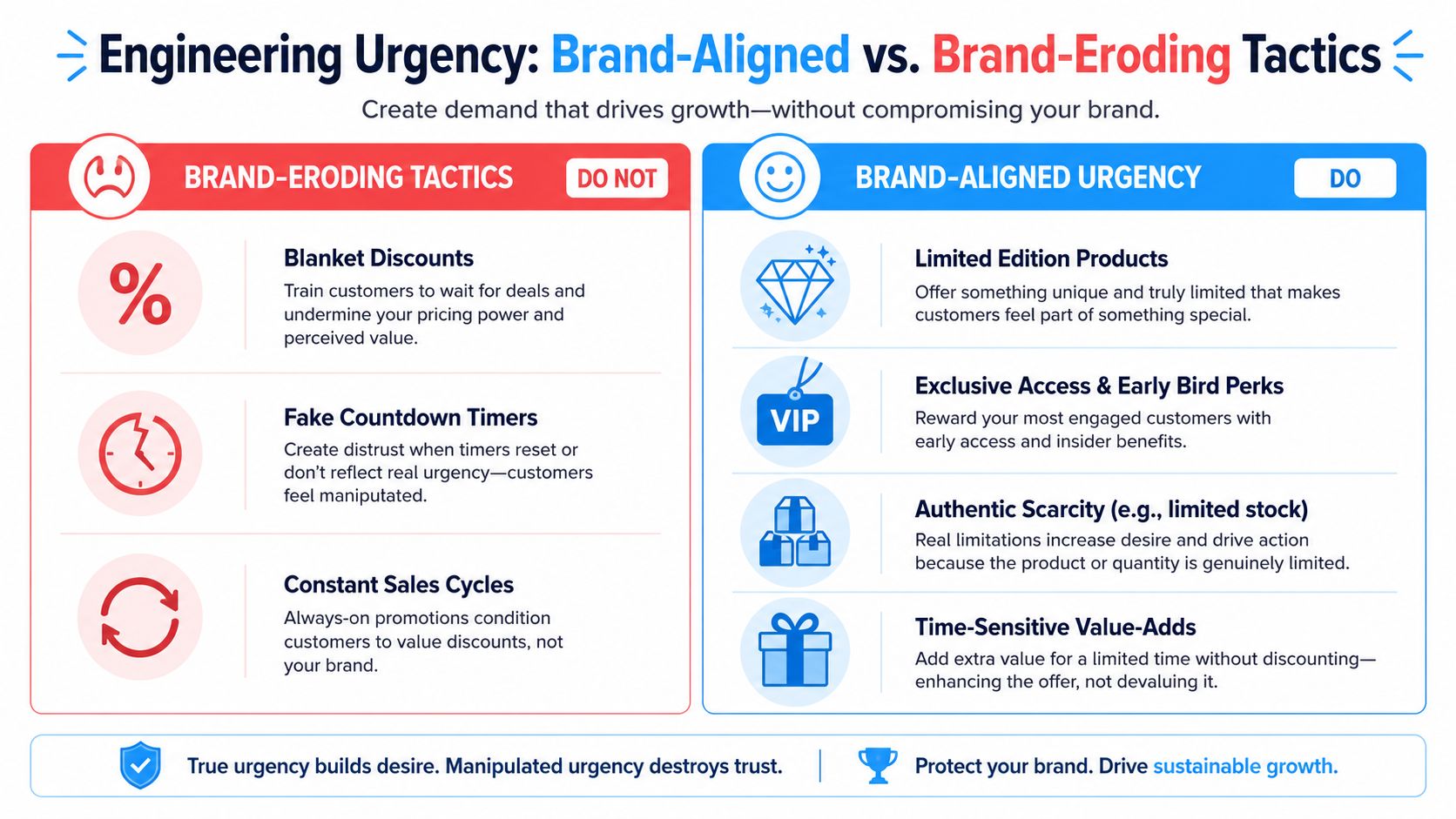
The problem with flat discounts
Flat discounts tell shoppers one thing clearly: there is no real cost to waiting unless the price goes back up.
That works against how most brands want to be perceived. Especially premium, design-led, founder-led, or category-defining brands. If your launch message is “we made something worth wanting,” but your promotional message is “please take 25% off today,” customers notice the mismatch.
Basic timers often have the same problem. If the countdown resets, if the inventory claim is obviously infinite, or if every product is “almost gone,” customers stop believing you.
Use behavioral psychology with real constraints
A stronger approach effectively uses psychology.
Revenue-based discounts are only one way to create movement. The better launch question is: what legitimate reason can you give a shopper to decide now rather than later?
The most reliable principles are:
-
Loss aversion
People act faster to avoid missing a benefit than to gain a generic one. -
Scarcity bias
Limited quantity, limited access, and limited release windows raise attention when the limit is real. -
Social proof
Demand feels safer when buyers can see others are participating. -
Commitment and consistency
Waitlist signups, early access registration, and preview RSVP actions increase the odds of purchase later. -
Temporal discounting
The more immediate and concrete the reward, the easier it is for customers to act now.
A good launch promotion uses those principles without screaming discount. Think reserved access, first-run inventory, launch bundles, threshold-based perks, or early-buyer rewards tied to a real window.
Operator view: Urgency works best when it clarifies a decision. It fails when it tries to bully one.
What works better in practice
On Shopify, the best urgency mechanics are usually tied to facts your operations team can stand behind.
Examples that protect brand better than blanket markdowns:
- Limited initial run: Only the first production batch qualifies for early access or launch packaging.
- Shipping cutoff: Orders placed by a real deadline ship in the first wave.
- Exclusive access window: Waitlist subscribers or SMS subscribers shop before the public.
- Tiered launch incentives: Early claimers get the best reward, later claimers get a lighter one.
- Product-plus-value offers: Bundle exclusive add-ons, gifts, or content instead of dropping price across the board.
This is also where many teams miss the distinction between urgency and manipulation. Real urgency aligns a decision with a genuine constraint. Fake urgency borrows the language without the truth behind it.
If your launch has no real limit, don’t pretend it does. Find a real one, or use a different conversion mechanism.
Your Launch Day Operations Checklist
At 9:07 a.m., paid traffic is landing, SMS clicks are spiking, and support already has three tickets asking the same shipping question. That is a normal launch morning. The brands that hold margin on launch day are rarely the ones with the loudest offer. They are the ones that execute cleanly enough to keep customers confident at the point of purchase.
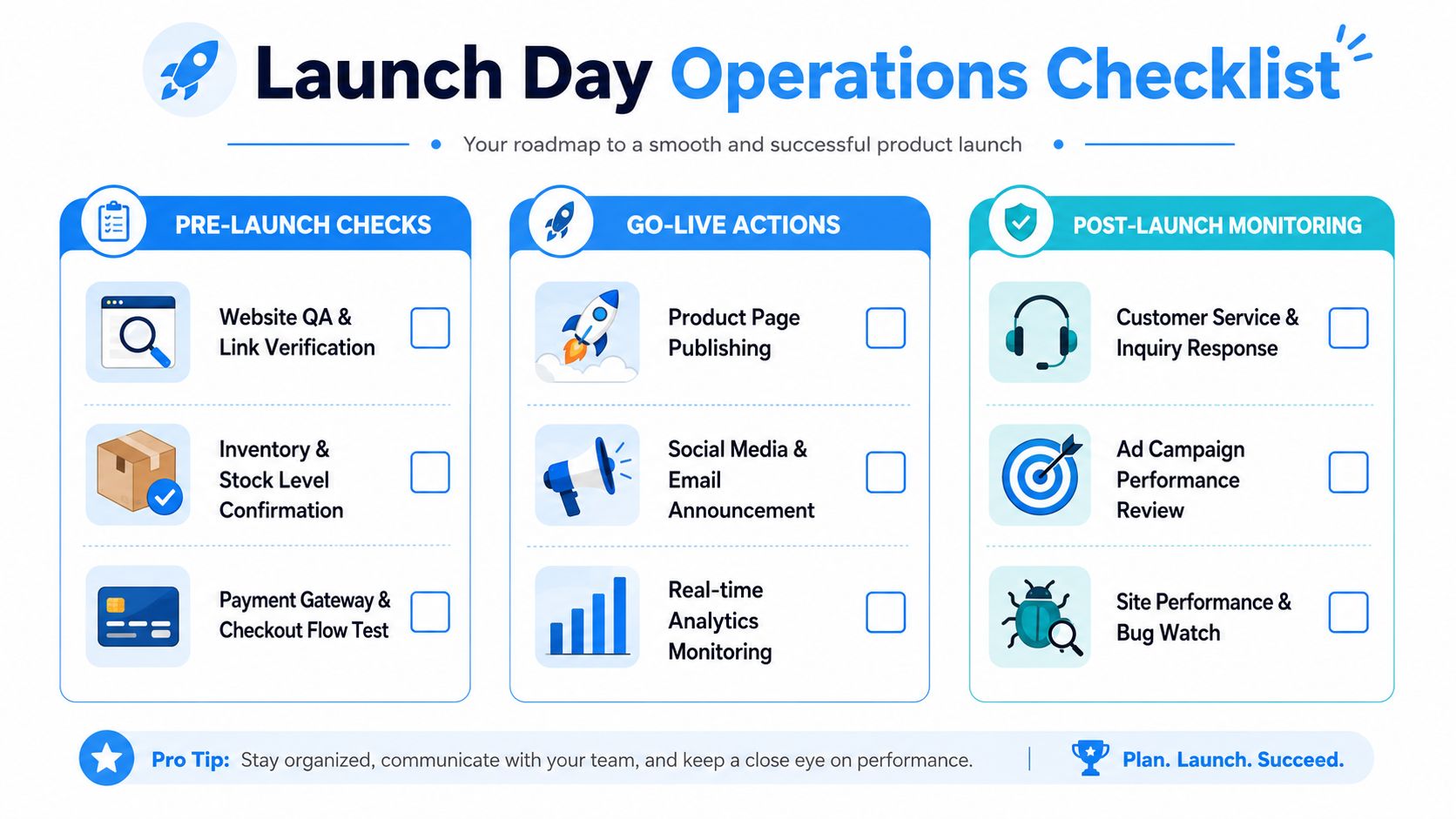
Launch day is not a strategy exercise. It is a controlled handoff from planning to execution. If the store is slow, the offer is misconfigured, or the team answers basic buyer questions too slowly, conversion drops and the usual reaction is to add more discount. That is how brands give away margin to fix an operational problem.
Before you go live
Run a final store check as a customer with buying intent, not as the person who built the campaign.
- Test the full purchase path: Product page, cart, checkout, confirmation email, and any post-purchase flow.
- Verify inventory logic: Stock counts, variant availability, preorder settings, and oversell rules should match what operations can fulfill.
- Test every launch incentive: Discount codes, automatic discounts, bundles, gifts, and free shipping thresholds should all work under real cart conditions.
- Review mobile experience: Launch traffic is usually mobile-heavy, so check page speed, sticky add-to-cart behavior, image load order, and checkout friction on a phone.
- Confirm tracking: Shopify analytics, ad platform pixels, Klaviyo events, and attribution tools should all fire correctly before spend ramps.
One missed detail can force a bad decision later. I have seen teams cut price by 15% because conversion looked weak, when the actual issue was a bundle app failing on mobile.
During the launch window
Watch operational signals first. Revenue alone hides too much.
Use a live dashboard that shows:
- Traffic by channel
- Conversion rate by channel
- Sales by channel
- Cart abandonment patterns
- Customer service volume and recurring questions
- Site speed, theme errors, or checkout issues under load
If source quality gets muddy once campaigns stack on top of each other, Cometly Shopify attribution helps separate which channels influenced the sale from which channel happened to get the last click.
The key trade-off on launch day is speed versus control. Teams that react to every dip usually create more problems than they solve. Set decision thresholds in advance. For example, decide what triggers a resend, what triggers a budget shift, and what triggers a pause while the technical owner checks the store.
Assign one owner to the dashboard, one to store issues, and one to customer communication. Clear ownership shortens response time when something breaks.
Staff the day like an operations room
Even a small team needs named roles and a decision chain.
| Role | Responsibility |
|---|---|
| Ecommerce lead | Decision-maker on pacing, offers, and escalations |
| Technical owner | Theme issues, app conflicts, checkout errors, inventory sync |
| CRM owner | Email and SMS sends, segmentation adjustments, resend decisions |
| Support lead | Customer replies, FAQ updates, issue tagging |
| Paid media owner | Budget shifts, audience exclusions, retargeting changes |
Communication usually fails before the storefront does. A shopper asks about sizing, shipping dates, or whether a sold-out variant will return. If that answer takes too long, hesitation spreads fast and paid traffic gets more expensive to convert.
Strong launch teams protect brand equity in small moments. They do not rush into broad markdowns because support is behind or because one channel underperforms for an hour. They fix the constraint, clarify the message, and keep the offer disciplined.
Post-Launch KPIs and The Optimization Loop
Three days after launch, revenue still looks strong. Then refunds start climbing, support tickets pile up with the same objection, and the only traffic converting is the traffic tied to your deepest offer. That is the moment teams find out whether they launched a product well or just rented demand.
Revenue matters, but it is a weak scorecard on its own. A launch can clear inventory and still hurt the business if margin slips, discount dependency rises, or new customers arrive with low intent to buy again.
Start with the KPIs that show whether the launch created healthy demand:
- Profit margin on launch sales
- Full-price versus discounted purchase ratio
- Conversion rate by source
- Refund and return patterns
- Customer questions that delayed purchase
- Repeat purchase behavior from launch cohorts
The full-price versus discounted ratio deserves more attention than it usually gets. If too much of your volume only converts with an incentive, you did not just lower margin on this launch. You also taught customers how to wait you out next time.
Source quality matters too. Last-click reporting often overstates the channel that closed the sale and hides the channel that created intent earlier in the path. If you need a clearer read on assisted conversions and channel quality after launch, Cometly Shopify attribution helps tie purchases back to the sources that influenced them.
Watch for offer fatigue
Offer fatigue usually shows up before teams admit it. Traffic stays decent, but conversion softens, click-through drops on repeat sends, and shoppers who were responsive on day one stop reacting by day four.
Do not extend the same promotion out of habit. Test offer structure instead. A smaller incentive with a sharper reason to buy now often protects margin better than a broader discount that drags on. Easy Apps Ecom notes in its urgency and scarcity guide that time-bound and quantity-bound offers create a clearer reason to act than an open-ended promotion.
Good launch offers have clear edges. Once shoppers believe the offer will still be there later, urgency disappears and brand perception starts to slip.
Build the optimization loop fast
The best post-launch teams do not wait for a perfect report. They review signals daily, make small corrections, and protect what is already working.
Use a simple loop:
-
Collect friction points immediately
Review support transcripts, post-purchase surveys, ad comments, and on-site search terms. Look for repeated objections, not isolated complaints. -
Tighten the product page
Add the missing answer where hesitation happens. That usually means stronger FAQs, clearer shipping language, better size guidance, or a sharper comparison against alternatives. -
Adjust the offer structure
If the incentive drove conversion but compressed margin too far, change the mechanics before the next push. Bundles, threshold gifts, or capped quantity drops often preserve more value than a deeper markdown. -
Segment follow-up by behavior
Buyers, waitlist subscribers, product viewers, and cart abandoners should not get the same message. Each group stalled for a different reason. -
Plan the second wave with proof
Customer reviews, creator content, UGC, restock timing, and objection-handling creative usually outperform another generic reminder blast.
Behavioral psychology matters more than raw promotion pressure. Shoppers convert when the path feels credible, the offer feels bounded, and the product feels worth paying for. The optimization loop should improve those signals first. Cutting price should be the last move, not the default one.
A strong Shopify product launch strategy keeps refining the page, the message, and the offer until conversion improves without giving away more margin each round.
If your team wants urgency that drives action without defaulting to deeper discounts, Quikly is built for that. It helps Shopify brands run time- and quantity-bound promotional experiences that feel on-brand, not bolted on, with mechanics refined across more than 60 million consumer interactions. For brands trying to improve conversion while protecting margin and perception, that’s a much better direction than training customers to wait for the next markdown.
Topics: shopify product launch, product launch strategy, ecommerce marketing, shopify conversion, behavioral promotions