Risk averse is the correct term for someone who avoids risk, while risk adverse is almost always a mistake. The distinction matters beyond grammar because the way customers perceive uncertainty can shape whether they buy, wait, or abandon a promotion.
A Shopify merchant might describe a customer as “risk adverse” in an email brief, product page, or investor update without noticing the problem. The reader may understand the intended meaning, but the wording still signals imprecision. The behavior behind the phrase deserves closer attention. A shopper who wants certainty isn’t necessarily cautious in every situation, and a promotion that reduces uncertainty can convert without forcing a deeper discount.
The Grammar Answer You Came For
Risk averse is the standard term when you mean unwilling to take risks or inclined to avoid them. Cambridge defines risk-averse as wanting to avoid risks as much as possible, which matches the way finance, economics, marketing, and everyday writing use the expression.
Risk adverse usually reflects a wording mistake. The confusion comes from two words that sound similar but perform different jobs:
- Averse describes a person’s dislike, reluctance, or inclination to avoid something. Someone can be averse to uncertainty, averse to long contracts, or risk averse.
- Adverse describes something harmful, unfavorable, or working against a desired result. A business might face adverse conditions, adverse effects, or an adverse outcome.
Merriam-Webster explains the distinction in similar terms. Its grammar guide on adverse and averse uses averse for a person’s distaste and adverse for harmful or unfavorable things.
The easiest test is to ask what you’re describing. If you’re describing a person’s attitude toward risk, write risk averse. If you’re describing a negative result caused by risk, write something like adverse effects of risk or an adverse market reaction.
Practical rule: People are averse to things. Circumstances and outcomes can be adverse.
That rule applies across professional contexts. A finance article might say, “The risk-averse investor prefers capital preservation.” A product page might say, “This guarantee helps risk-averse customers feel comfortable ordering.” A UX researcher might write, “Users were averse to entering payment details before seeing delivery information.”
Using the wrong term isn’t mere pedantry. Product copy, investor communications, and UX documentation rely on precise language because ambiguity creates friction. If your brand is already asking shoppers to trust a new product, unfamiliar checkout process, or unfamiliar promotion, avoidable wording errors weaken that trust. For a useful look at how language influences buyer response, see Quikly’s guide to psycholinguistics and brand messaging.
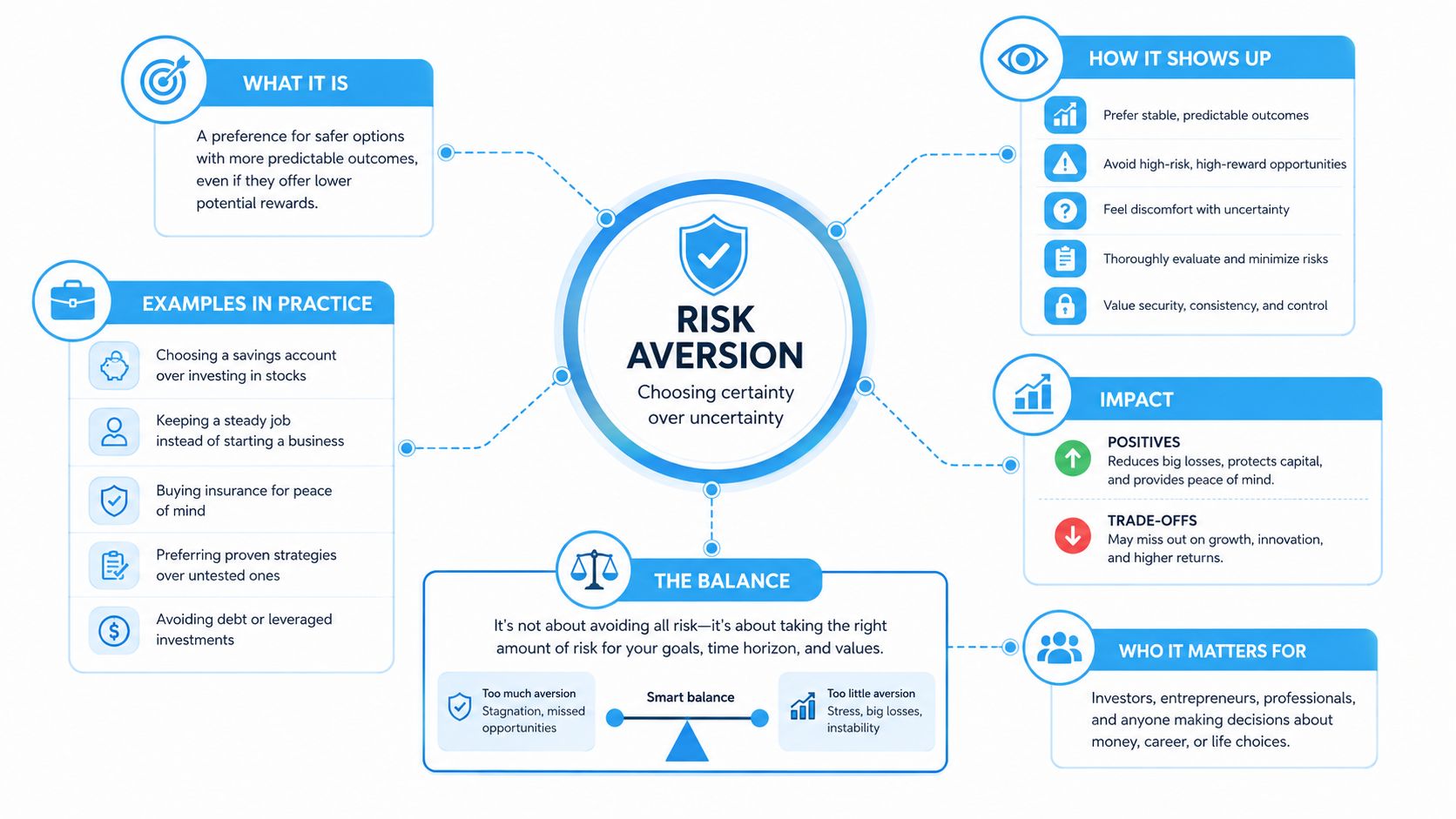
What Risk Aversion Actually Means in Practice
In decision theory, a person is risk averse when they prefer a certain outcome to a gamble with the same expected monetary value. This preference corresponds to a concave utility function and a positive risk premium, meaning the person may accept a smaller guaranteed result rather than face an uncertain one. A plain-language explanation of risk aversion connects the formal definition to the practical idea that people will pay to remove uncertainty.
Consider a simple choice. Someone can receive a guaranteed $50, or take a gamble with a 50% chance of receiving $120 and a 50% chance of receiving nothing. The gamble has a higher expected monetary value, but a risk-averse person may still choose the guaranteed amount because certainty has value.
That same preference appears throughout ecommerce. A customer may favor free shipping after reaching a clearly stated threshold over a mystery discount at checkout. Another may choose a subscription with transparent billing and an easy cancellation policy rather than a one-time purchase with uncertain replenishment costs. The customer isn’t necessarily calculating utility curves. They’re responding to how much uncertainty the offer asks them to absorb.
Certainty has a price
For a merchant, the key question isn’t whether customers are rational. It’s which part of the decision feels uncertain.
The uncertainty may involve:
- Product performance, especially for unfamiliar products or higher-consideration categories.
- Financial commitment, including subscriptions, bundles, and larger baskets.
- Delivery and returns, when the customer worries about being stuck with the purchase.
- Promotion value, when the shopper can’t tell what reward they’ll receive.
- Timing, when waiting feels safer than acting immediately.
A clear return policy can reduce perceived product risk without changing the price. A delivery estimate can remove uncertainty without adding a reward. A transparent bundle can make the value easier to evaluate than a loosely described “surprise savings” offer.
This is distinct from loss aversion, which focuses on the pain of losing something already possessed or expected. Quikly’s overview of loss-aversion psychology is useful because it helps marketers avoid treating every cautious behavior as a general dislike of risk. The customer may not fear uncertainty itself. They may fear losing free shipping, a saved cart, a preferred price, or the opportunity to receive a promised benefit.
Why Risk Aversion Is Not as Simple as It Seems
Many marketers treat risk aversion as a fixed customer trait. That shortcut is convenient, but it can lead to blunt promotions, excessive discounts, and audience assumptions that don’t match actual behavior.
A widely cited 2013 meta-analysis of 92 studies found that reported relative risk-aversion estimates were heavily inflated by publication bias. Across 1,021 observations, the mean estimate was 23.36, the median was 3.77, and the standard deviation was 98.58. After correcting for bias, the authors concluded that true risk aversion was much lower on average, about 1 in economics settings and 2 to 7 in finance settings, with some correction methods producing roughly 1 to 3. The meta-analysis is available through EconStor.
The important lesson isn’t that one number replaces another. It’s that measured risk aversion depends heavily on context, data, stockholding, country, and utility model. People can appear highly cautious in one decision and quite willing to take risks in another.
Risk preferences move with the situation
A household survey from the Bank of Italy illustrates why distribution matters. Among 3,458 respondents, 96% were classified as risk averse by the study’s measure, while 144 respondents were classified as risk prone. The survey reported a median relative risk aversion of 5.8 overall and 6.03 among the risk-averse subgroup, with values from 1.9 at the 10th percentile to 13.3 at the 90th percentile. The Bank of Italy study provides the full household survey findings.
That distribution suggests caution is widespread, but it doesn’t make every shopper identical. A first-time visitor evaluating an unfamiliar product may need reassurance. A repeat customer who already trusts the brand may respond to a different structure. A financially pressured shopper may prioritize protecting cash, while another customer may value upside and novelty.
Recent material also points to changing conditions. A 2025 Harvard Gazette piece describes younger people taking fewer risks partly because career and education paths feel less reversible, while a 2026 annual tracker reported 81% of Americans saying they had become more risk averse amid affordability and long-term security concerns. The Harvard Gazette discussion addresses why young people are taking fewer risks.
For Shopify brands, this creates a practical constraint. Don’t build one permanent “risk-averse customer” persona and send it deeper discounts forever. Test how shoppers respond to different forms of certainty, then protect margin by solving the specific uncertainty that blocks action.
How Risk-Averse Customers Respond to Different Promotions
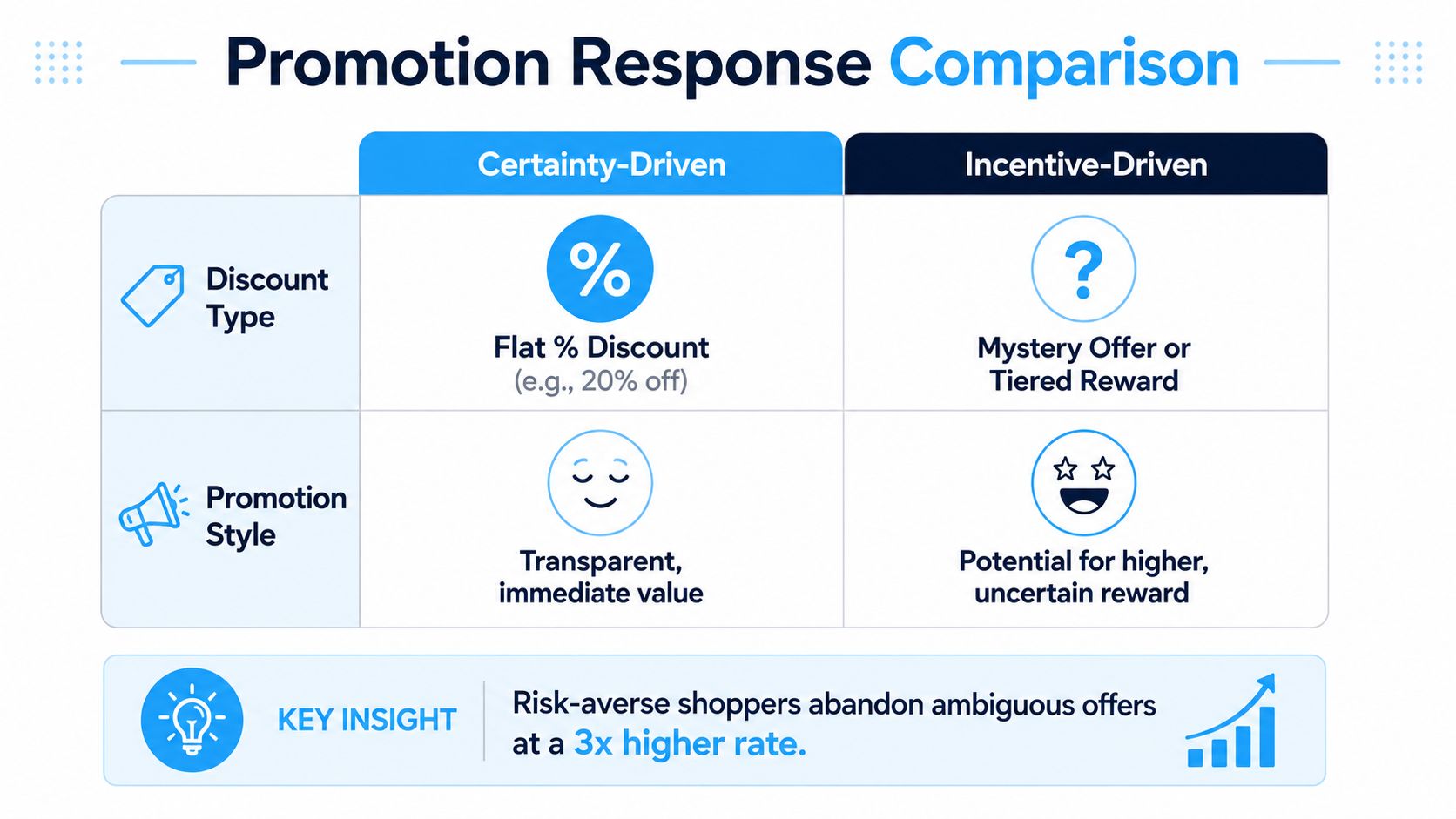
Promotional mechanics change the amount and type of uncertainty in a purchase. A flat discount lowers price risk, a mystery offer increases reward uncertainty, and a clearly bounded earned incentive can give shoppers both a known path and a reason to act.
Flat percentage discounts
A blanket offer such as “20% off everything” is easy to understand. It reduces price uncertainty, but it often does little to shorten the decision window. The customer can assume the same offer will be available later, especially if the store runs similar promotions repeatedly.
That creates a margin problem. The discount absorbs value without necessarily changing behavior. It can also train shoppers to wait, which weakens full-price demand and makes future promotions harder to manage.
Mystery offers
Mystery discounts appeal to curiosity and potential upside, but they introduce uncertainty into the reward itself. A risk-prone shopper may enjoy the reveal. A risk-averse shopper may abandon because the value isn’t clear enough to justify action.
Mystery mechanics work better when the shopper understands the boundaries. State what the customer is guaranteed to receive, what could vary, and when the offer ends. Ambiguity should create interest, not confusion.
Tiered and earned rewards
A tiered reward gives customers a visible path. For example, a shopper might gain a better benefit after adding a qualifying product or reaching a basket threshold. The customer knows what action earns the reward, which reduces uncertainty and draws on commitment and consistency. Once shoppers take a small step toward a stated benefit, they’re more likely to continue in line with that commitment.
A time or quantity limit adds scarcity bias, but it must reflect a real campaign rule. A genuine cap or closing window gives the customer a reason to act now without pretending that an arbitrary countdown represents limited inventory.
The useful distinction: Risk-averse shoppers don’t need every promotion to be larger. They need the path to value to be easier to understand.
Compare the likely responses:
| Promotion structure | What the shopper knows | Likely friction |
|---|---|---|
| Flat discount | The price reduction | The offer may feel indefinitely available |
| Mystery offer | The existence of a possible reward | The final value remains unclear |
| Earned incentive | The action required and the reward condition | The shopper must decide whether the step is worthwhile |
| Genuine time or quantity limit | The reason to act within the campaign window | Pressure rises if the limit feels artificial |
Quikly supports limited-quantity and limited-duration promotional experiences, including rewards that can change as shoppers claim them. That structure can help a merchant reward early action instead of automatically giving the same discount to every visitor, while keeping the campaign styled as part of the storefront and connected to email, SMS, or social distribution.
Writing Copy That Respects Risk Aversion Without Manipulation
Risk-aware copy answers the questions a cautious shopper is already asking. It explains what the customer gets, what happens next, and what protection exists if the product isn’t right.
Start by replacing vague reassurance with specific information:
- Unclear: “Shop confidently today.”
- Clearer: “See the delivery estimate before checkout, and review the return terms before you order.”
- Unclear: “Don’t miss this amazing deal.”
- Clearer: “This reward is available while the campaign remains open, subject to the stated claim limit.”
- Unclear: “Try it risk-free.”
- Clearer: “If the product doesn’t meet the stated return conditions, follow the published return process.”
The second version of each example gives the shopper something concrete to evaluate. It lowers perceived variance without pretending that every purchase is consequence-free.
Match the message to the hesitation
A cart abandoner may need a reminder of delivery, returns, or the exact contents of the cart. A first-time visitor may need product reviews, demonstrations, and transparent pricing. A repeat customer may respond better to a clear reward for acting now than to another generic sitewide markdown.
Use scarcity carefully. Real inventory limits, genuine campaign closing times, and clearly stated reward caps can clarify the decision window. Fake urgency does the opposite. When shoppers notice that the timer resets or the “last chance” message appears repeatedly, the promotion loses credibility.
Email and SMS copy should follow the same principle. In Klaviyo or another Shopify-connected messaging workflow, state the reward and its conditions in the message itself rather than forcing the customer to discover them after clicking. Clear information protects trust, and trust supports conversion without requiring a deeper discount.
Segmenting Your Audience by Risk Preference
Segment customers by revealed behavior, not by assumptions about age, income, or identity. Review purchase history, cart abandonment patterns, responses to prior promotions, product-page engagement, and email or SMS clicks.
A practical starting framework includes:
- Certainty seekers, who engage with guarantees, return policies, and transparent delivery information.
- Calculated researchers, who spend time with specifications, reviews, comparison content, and demonstrations.
- Deal-driven impulse buyers, who respond to genuine flash sales and closing windows.
- Cautious comparers, who need social proof and clear differentiation before committing.
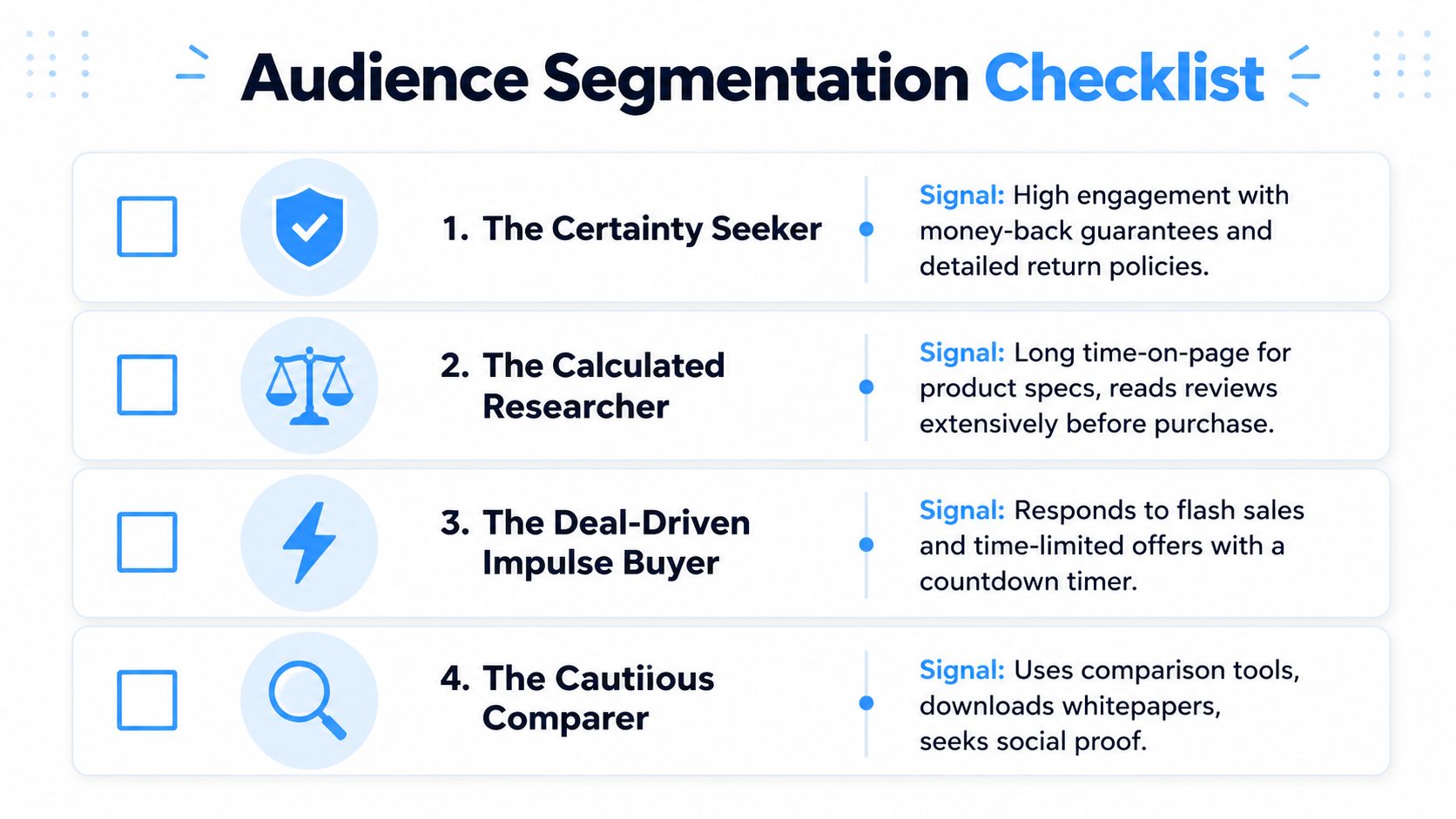
Use customer segmentation for Shopify as a resource when building the underlying audience framework, then connect each segment to a promotion structure. Certainty seekers may prefer guaranteed rewards with clear caps. Deal-driven buyers may respond to variable upside. Mixed audiences need an offer that states the guaranteed value first and makes any additional upside easy to understand.
The point isn’t to label people permanently. Reassess segments as customers encounter new products, financial conditions, and campaign formats. This customer segmentation example from Quikly can help translate behavioral signals into campaign decisions.
Quikly helps Shopify brands create on-brand promotional experiences with real time or quantity limits, so rewards go to shoppers who act instead of training everyone to wait for another markdown. Visit Quikly to explore a promotion approach that addresses perceived risk, creates a clear decision window, and protects margin more thoughtfully than blanket discounting.
Topics: risk averse, risk adverse, grammar guide, consumer psychology, ecommerce marketing