The most popular advice about marketing vs transactional email is incomplete: automation doesn’t define the category. An automated flash-sale campaign is still marketing email, while an order confirmation remains transactional even when Shopify generates it automatically.
That distinction affects more than compliance. It determines which consent rules apply, how you protect inbox placement, and whether a promotional quarter damages the messages customers rely on. It also matters for margin. If every operational touchpoint becomes another discount opportunity, customers learn to wait and your brand trains itself into deeper promotions.
Why the Distinction Matters More Than Most Shopify Teams Think
A sudden inbox-placement decline after a heavy promotional quarter rarely starts with the order confirmation itself. More often, the problem comes from treating every send as one audience, one reputation, and one reporting pool. Marketing complaints and weak engagement can then create pressure on the same delivery system that carries receipts, shipping updates, and account-security notices.
The common shortcut is to classify messages by trigger. “It was automated” sounds like a useful rule, but it fails immediately. A scheduled campaign can run through Klaviyo or another automation platform and remain promotional. An order notice can be generated by software and remain operational.
Primary purpose and content hierarchy decide the classification. A message exists to confirm an order, communicate shipment information, or protect an account when it’s transactional. A message exists to create a new purchase, promote a product, or push an offer when it’s marketing.
Practical rule: Keep the information the customer needs to complete or understand an existing action clearly dominant. Treat anything designed to create a new commercial action as marketing.
This separation protects more than legal positioning. It prevents an attractive coupon from competing with the order number, delivery status, return information, or security instructions the customer opened the message to find. It also gives Shopify operators a cleaner margin conversation. Urgency belongs in a promotional journey where you can control exposure and measure incremental demand, not hidden inside a receipt that customers expect to be neutral and reliable.
What Each Email Type Actually Is
Marketing email is promotional communication sent to a group of recipients. Newsletters, product launches, seasonal campaigns, segmented offers, abandoned-cart urgency messages, and win-back campaigns all fit this purpose because they aim to influence a new action.
Transactional email is sent individually after a specific customer or account event, or because essential service information must be delivered. Shopify identifies order confirmations, shipment confirmations, payment receipts, and double-opt-in verification emails as typical examples, while also treating promotional consent as a separate concern from operational notifications, as explained in Shopify’s email marketing teardown.
A useful Shopify test has two steps:
- Ask why the message exists. If the store needs to confirm an order, provide a shipping update, reset a password, or report an account-security event, the operational purpose points toward transactional email.
- Check what the message asks the recipient to do next. If the primary action is to buy a product, claim an offer, browse a launch, or respond to a campaign, the purpose is marketing.
The trigger alone isn’t enough. A signup-triggered email can be marketing if it promotes an offer. A purchase-triggered message can move toward marketing if a coupon, product grid, or urgent cross-sell becomes the dominant content.
For practical examples of how to preserve the operational role of receipts, see Quikly’s guidance on order confirmation email. The design principle is simple: make the customer’s existing transaction easy to understand first, then keep any secondary commercial content visibly subordinate.
Consent follows the purpose. Shopify says promotional content should go only to customers who agreed to receive marketing, while operational notifications such as order confirmations and shipping updates serve a different function. An automated send doesn’t bypass that distinction.
Legal and Technical Differences Side by Side
The legal framework is easier to apply when the team starts with the message’s purpose, then checks the content hierarchy. Under U.S. CAN-SPAM, a message whose primary purpose is transactional or relationship-based is generally exempt from most commercial-email requirements. If commercial content becomes the primary purpose, the message is treated as commercial and must meet marketing-email requirements, according to the CAN-SPAM classification summary.
| Dimension | Marketing Email | Transactional Email |
|---|---|---|
| Primary purpose | Promote a product, offer, launch, newsletter, or new action | Confirm or support an existing order, account, or service event |
| Typical trigger | Marketer-selected audience, campaign calendar, behavior-based promotion | Order, shipment, payment, password, signup verification, or security event |
| Consent basis | Appropriate marketing consent and unsubscribe controls | Operational necessity tied to the customer or account relationship |
| Content hierarchy | Persuasion and commercial action are central | Required information stays central, promotions remain secondary |
| Sending architecture | Campaign platform, segmentation, scheduling, suppression | Event-driven service stream, template, and delivery monitoring |
| Core risk | Complaints, unsubscribes, poor engagement, margin-heavy promotion | Delayed or filtered critical messages, plus reclassification if promotion dominates |
GDPR analysis commonly distinguishes marketing consent from a contractual or legitimate-interest basis for necessary service communications. UK rules also make the distinction operationally important. Marketing generally requires specific consent, subject to a limited existing-customer exception for similar products and a clear opt-out in each message.
Purchasing from a Shopify store doesn’t automatically create permission for promotional email. Shopify records marketing consent through mechanisms such as a newsletter form, a checkout marketing checkbox, or an opt-in during account sign-in. The store should preserve that consent state and use it in campaign suppression logic.
Content hierarchy is the difficult boundary. A clearly operational receipt with a small accessory recommendation may be defensible. An order confirmation dominated by a coupon, product grid, and “buy now” pressure may be treated as commercial marketing. Send time and automation don’t settle the issue.
Technical separation should reflect the legal distinction. Keep templates, suppression rules, event logic, and reputation monitoring separate. Teams that want a deeper operational primer should review email authentication, since authenticated sending supports trust and helps operators diagnose delivery problems without confusing campaign performance with critical-message performance.
What the 2025 Benchmark Numbers Actually Show
Open rate makes transactional email look only modestly stronger than scheduled marketing email. Click behavior shows a more useful gap.
In North American 2025 data, scheduled marketing sends averaged a 41.7% open rate and 1.0% click-through rate, while transactional messages averaged 44.6% opens and 2.6% clicks. Transactional messages also produced a 5.7% click-to-open rate, compared with 2.5% for scheduled campaigns, according to Acoustic’s email marketing metrics.
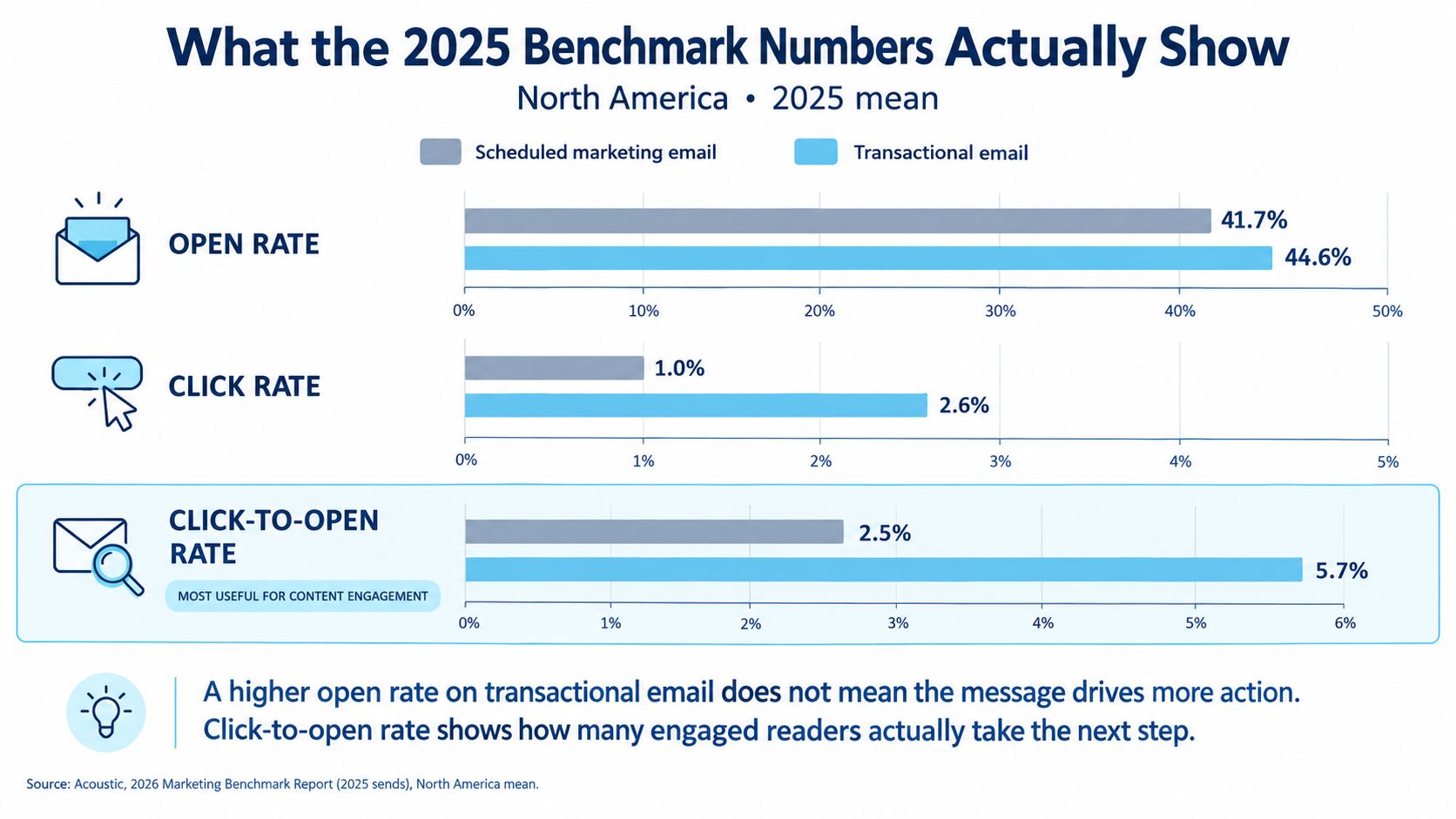
The open-rate difference reflects expectation. A recipient who just placed an order has a reason to look for the message. Click-to-open rate tells you what happens after that attention exists. It asks whether engaged readers take the next step, rather than treating the initial open as the outcome.
That distinction creates a measurement trap for Shopify teams. A receipt with unusually strong clicks can make the overall email program look healthy even when promotional campaigns struggle. It can also tempt a team to load more commercial content into receipts, borrowing the attention of a high-intent event while weakening the message’s operational purpose.
Transactional engagement is a benchmark for expected relevance, not a target for promotional content.
Measure urgency offers against the marketing stream. Use delivered-message CTR, conversion rate, revenue per recipient, unsubscribe rate, complaint rate, and incremental lift by campaign. For a broader comparison, benchmark guidance places ordinary marketing-email CTR commonly around 2% to 5%, while transactional messages often exceed 5% and can achieve click-to-open rates above 30% when the content is essential, as described in Salesforce’s email benchmarks.
Ecommerce Use Cases That Stay Clean
The cleanest setup gives each stream a job the customer can recognize.
Transactional email belongs to the existing event. Order confirmations should show what was purchased, payment or fulfillment information, and the next useful step. Shipping updates should explain movement or delivery status. Password resets and account-security notices should make the required action obvious. Back-in-stock alerts can sit near the boundary, but if the message promotes a product now available for purchase, treat it as marketing unless the customer explicitly requested that notification.
Marketing email creates the next commercial action. Product launches, promotional campaigns, segmented offers, abandoned-cart urgency flows, and win-back messages belong in the permission-based marketing stream. A post-purchase journey can contain a time- or inventory-bound reward, but the promotional module should be clearly presented as a new offer rather than disguised as fulfillment information.
Consider an order confirmation with a large “20% off your next purchase” hero, a product grid, and a countdown-style call to action above the order details. The customer may still find the receipt, but the store has made a campaign the visual and commercial center of a critical message. That creates complaint risk, makes the classification harder to defend, and can teach customers to associate every purchase with another discount request.
For Shopify teams managing several apps, event ownership matters. Confirm which system sends each notification, which app controls suppression, and where support staff can inspect failures. A specialist help desk for Shopify apps can be useful when app interactions create uncertainty about which workflow owns a customer-facing message.
A practical urgency placement is a signup-triggered campaign or a separate post-purchase marketing flow for customers with the required consent. The offer can reward acting early, but it shouldn’t borrow the trust of a receipt to make the sale.
Combining Both Streams in a Retention Strategy
Transactional email is the trust backbone. Marketing email is the demand-generation engine. A retention plan works when both systems share customer context while keeping their sending responsibilities distinct.
A new subscriber can enter a permission-based marketing flow with education, product relevance, and a behavior-driven urgency offer. A first order then triggers the operational sequence: confirmation, payment information, and shipping updates. Later marketing messages can use purchase history, engagement, and consent to decide whether replenishment, cross-sell, or win-back makes sense.
The margin advantage comes from changing the reason to act, not merely changing the size of the discount. A flat promotion tells the customer there’s little cost to waiting. A time- or quantity-bound reward gives the shopper a reason to decide now, while letting the brand control eligibility and exposure.
That approach can support broader acquisition work too. Stores building coordinated journeys across email, SMS, and social can pair lifecycle messaging with tactics designed to drive sales with social commerce, then pass consented first-party behavior into the appropriate marketing flow.
Quikly fits the marketing side of this architecture as an urgency and scarcity promotion layer for Shopify. It creates on-brand promotional experiences with rewards capped by time, quantity, or both, so the campaign can encourage immediate action without turning an order confirmation into a sales campaign. Teams planning the handoffs can also use marketing automation workflows to coordinate event data and follow-up timing.
The operating principle is share data, not reputation. Marketing and transactional systems should know when a customer orders, opts out, or becomes ineligible, but poor promotional engagement shouldn’t put a password reset or shipping notice at risk.
What to Separate, Measure, and Watch Next
A Shopify operator can tighten this system within the same week by auditing three areas.
- Separate infrastructure: Use distinct sending streams, templates, suppression logic, and reputation monitoring for promotional and operational messages.
- Separate reporting: Track delivered-message CTR, conversion, revenue per recipient, complaint rate, and unsubscribe rate by stream. Don’t let receipt engagement hide weak campaign economics.
- Review content hierarchy: Inspect every order confirmation for coupons, product grids, urgency language, and oversized promotional modules. If the offer visually dominates, move it into a marketing flow.
- Watch inbox placement: Look for a drop after a heavy promotional push, a complaint spike on a specific campaign, or pressure from merchandising teams to turn receipts into acquisition space.
Commercial email must provide an opt-out mechanism under U.S. CAN-SPAM, and businesses must honor opt-out requests within 10 business days, while GDPR can add consent and identification requirements for recipients in the European Union, as noted in Shopify’s email guidance.
Use email evaluation guidance to review urgency campaigns against the right commercial metrics. The aim isn’t to maximize every click. It’s to protect the trust and deliverability of transactional email while giving marketing campaigns a credible way to create action without relying on ever-deeper discounts.
Quikly helps Shopify brands run on-brand urgency and scarcity promotions across marketing journeys, with rewards limited by time, quantity, or both. Visit Quikly to see how you can separate operational email from promotional urgency while giving customers a clear reason to act now.
Topics: marketing vs transactional email, transactional email, email deliverability, ecommerce retention, Shopify email