“I don’t have a choice” means the speaker feels their options are fixed, which may reflect a real constraint, a negotiating stance, or a sense of helplessness.
You’ve probably heard it from a colleague defending a decision, a supplier holding a price, or a customer explaining why they won’t buy yet. If you run a Shopify store, you might feel it yourself when another promotion seems like the only way to convert the traffic you’ve already paid for.
The useful response isn’t to insist that everyone always has options. It’s to ask whether a real alternative exists, or whether the available alternative feels unacceptable. That distinction helps you respond with care, negotiate without conceding too soon, and create offers customers can choose without feeling cornered.
What I Don’t Have a Choice Means in Different Settings
A colleague says, “I don’t have a choice. The launch has to happen.” Before you suggest working late or cutting the scope, ask what’s fixed. A contractual deadline, a manager’s preference, and a fear of disappointing someone call for different responses.
The phrase usually means that the speaker sees only a single acceptable path. It doesn’t necessarily mean every other path is physically impossible. Perceived control and actual alternatives are different questions.
What the phrase usually means by setting
| Setting | Usually means | Listen for |
|---|---|---|
| Everyday conversation | Plans or obligations feel fixed, often a mild complaint | Tone and what the speaker does next |
| Workplace | Authority is limited and a decision came from above | Who set the rule and whether it can be escalated |
| Negotiation | A stated limit that may be real or used as an anchor | Whether the limit is explained or only repeated |
| Legal and contract | Consent given under pressure with no reasonable alternative, potentially raising economic duress | Whether a workable alternative existed at the time |
| Psychological | Perceived loss of control, sometimes helplessness | Whether the phrase repeats across unrelated situations |
| Shopping | A purchase postponed while waiting for a better deal | Whether the deadline or discount is real and verifiable |
In everyday conversation, someone may want acknowledgment rather than problem-solving. “I have to attend” might mean that declining would damage a relationship they value. Pointing out that attendance is technically optional misses the cost they’re describing.
At work, the sentence often concerns decision authority. An employee may be able to request an exception without being able to grant it. Ask who owns the decision before asking that employee to change it.
Feelings matter, but they aren’t the whole test
In contract disputes, a claim of having no choice can raise questions of economic duress, including whether pressure was improper and whether a reasonable alternative existed. That’s a factual and jurisdiction-dependent legal assessment, not a conclusion established by someone feeling pressured. A disputed contract needs qualified legal advice.
In negotiation, the same words may describe a genuine limit or establish an anchor. In shopping, they may describe an uncomfortable trade-off: pay today’s price or postpone something the customer wants.
Practical rule: Take the experience seriously without accepting the claimed limit as the final explanation.
Avoid answering, “Of course you have a choice.” Ask, “What would happen if you didn’t take that option?” The answer can reveal a consequence, an authority boundary, or a concern nobody has named.
Identical words carry different weight depending on who says them, what they refuse to discuss, and what they do next.
Why People Feel Trapped Enough to Say It
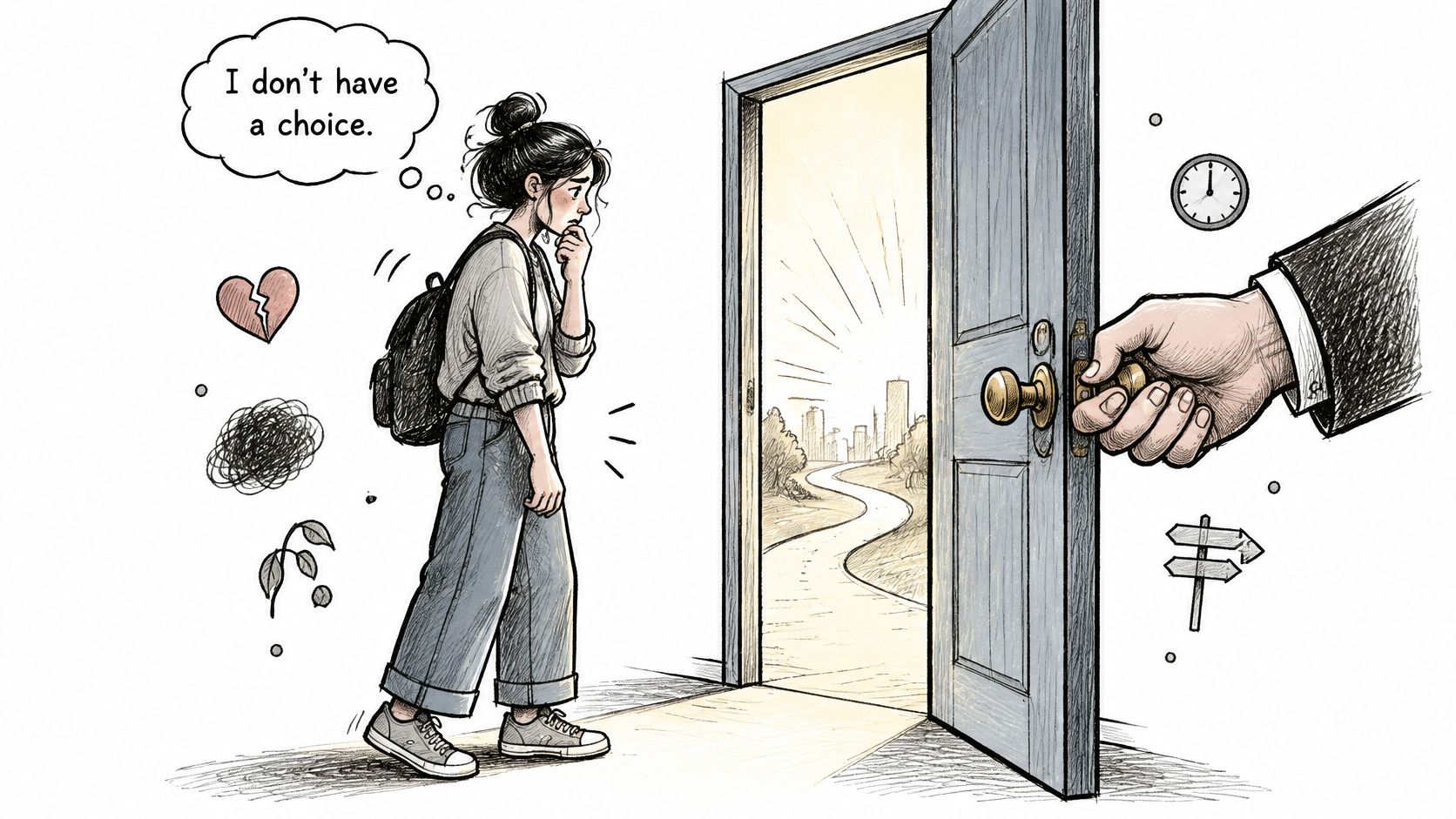
Having permission to refuse isn’t the same as feeling able to refuse. Someone may technically be free to reject an assignment while fearing the professional consequences. A shopper may be free to leave a cart while feeling overwhelmed by the work of comparing alternatives.
Learned helplessness names the more extreme idea that someone comes to expect their actions won’t change an outcome. Don’t use it as a casual diagnosis of a colleague or customer. Everyday “I don’t have a choice” language can express frustration without indicating a persistent psychological condition.
More options don’t always make choosing easier
Consider a diner facing a sprawling menu. They say, “I’ve got no choice, I’ll get the usual,” although plenty of meals are available. They’re avoiding the effort and possible disappointment of choosing something unfamiliar.
A 2015 meta-analysis covering 99 observations and 7,202 participants found that choice overload depends on the following conditions, and identified satisfaction or confidence, regret, choice deferral, and switching likelihood as useful indicators:
- Choice-set complexity: Options are difficult to compare because their attributes differ.
- Decision difficulty: The task requires effort, judgment, or uncomfortable trade-offs.
- Preference uncertainty: The person doesn’t know what they want or which attributes matter.
- Effort minimization: The person wants to reach an acceptable answer without extensive work.
The implication isn’t that a large assortment is bad in itself. A buyer who knows the required size, material, and use case may welcome variety. Someone who hasn’t established those criteria may need help understanding the decision before seeing more products.
For a Shopify merchant, adding a deadline to confusing variant names and overlapping discount rules may leave the underlying problem untouched. Explain the differences, identify the qualification rule, and make the next action understandable.
Turn the question inward
Autonomy also belongs in the wider discussion of the core psychological needs of consumers. Helping someone choose requires more than presenting alternatives they can’t interpret or realistically use.
When you hear yourself say the phrase, ask: Am I facing a closed door, or avoiding a costly choice? Write down the alternative, the consequence you dislike, and what waiting will cost. You may still choose the original path, but you’ll be clearer about why.
Telling a Real Constraint From a Negotiating Posture
“I don’t have a choice” is ambiguous in a commercial conversation. A supplier might lack authority to change terms. They might also prefer not to discuss terms they could change.
Treat the following signals as prompts for investigation, not a lie detector. A negotiator can be vague about a genuine restriction, and a confident explanation can still conceal flexibility.
Signals of a real constraint versus a negotiating posture
| Signal | Points to a real constraint | Points to a posture |
|---|---|---|
| Source of the limit | Names a policy, clause, budget line, or rule | Offers a vague explanation such as “It’s just how we do things” |
| Willingness to share the rule | Shares the document, schedule, or threshold | Refuses detail or changes the subject |
| Offer of a closest option | Explains the nearest workable path | Repeats the phrase without moving |
| Flexibility on minor items | Holds firm on everything, including small points | Concedes small items while holding the main one |
| Consistency over time | The limit applies whenever you ask | The limit appears only near the close |
Small concessions don’t prove that the main limit is invented. A supplier could control delivery scheduling while having no authority over pricing. Look for a coherent explanation of which terms are connected and who can change them.
Test the rule without accusing the person
Consider a hypothetical wholesale negotiation. The supplier says the minimum order is fixed, so the buyer asks, “Which policy sets the minimum, and when does it apply?”
The supplier explains that the rule covers opening orders because onboarding creates additional work. That gives the buyer something concrete to discuss: a smaller initial shipment tied to a larger commitment might address the supplier’s concern, if an authorized person approves it.
Useful follow-up questions include:
- Conditions: “What would have to change for you to move?”
- Authority: “Who decides this?”
- Consequences: “What happens if we do nothing?”
The purpose is to identify the cost or risk behind the stated position. The discussion of loss aversion in marketing offers a related lens: pay attention to what someone believes they’ll lose, rather than assuming they’re only pursuing a better price.
A constraint can be real and still be negotiable at a cost.
An exception might require a deposit, a different schedule, or approval from someone else. Your job is to discover that exchange before deciding whether it’s worthwhile. Accepting a limit and accepting the first proposed solution aren’t the same decision.
How to Respond When Someone Says It to You
Start by slowing the conversation down. You don’t need to agree that the person is trapped, and you don’t need to challenge them immediately.
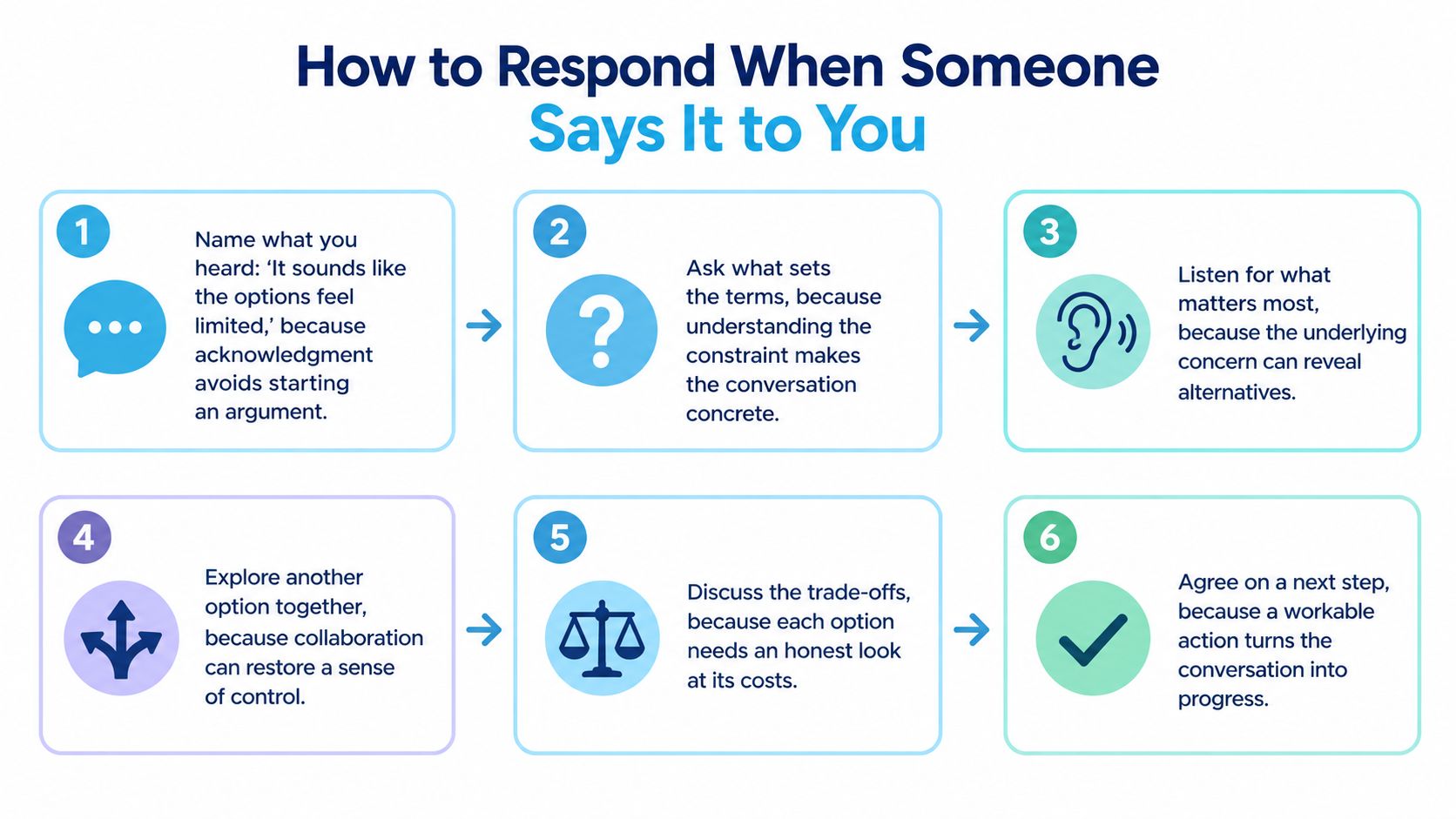
The sequence below works as a conversational guide, not a script to recite without listening. In a personal conversation, ask whether they want help finding options before turning the exchange into a negotiation.
A response that makes room for an answer
-
Name what you heard without arguing. Say, “It sounds like the options feel limited right now,” because acknowledgment lets you begin without disputing their experience. Don’t add “but you obviously have options” immediately afterward.
-
Ask, “What specifically sets the limit, and who controls it?” Specifics help separate an external rule from a preference, assumption, or concern. Give the person room to explain before suggesting a solution.
-
Separate fixed points from flexible ones, so you can work on something changeable. Try, “If the deadline can’t move, can the scope or delivery sequence change?”
-
Offer the closest realistic alternative because a workable adjustment is more useful than an imaginary escape. “Could we approve the essential work now and review the remainder later?” is concrete enough to evaluate.
-
State the choice and its consequences without a threat, so the person can weigh the trade-off consciously. Say, “We can accept these terms and start now, or decline and revisit the schedule.”
-
Agree on a checkpoint or close the discussion if the limit is genuine, because repeated questioning won’t necessarily create flexibility. Specify what new information would justify reopening it.
Why agency belongs in the conversation
A meta-analysis of 36 independent samples involving 12,906 participants found a moderate positive relationship between autonomy satisfaction and subjective well-being, r = 0.46, p < 0.001, across U.S. and East Asian samples.
That finding doesn’t establish that a particular sales script improves conversion. It supports taking perceived agency seriously rather than treating it as an obstacle to agreement.
For merchants and negotiators, the common slip is offering a discount before understanding the constraint. If the actual issue is delivery timing, internal approval, or product uncertainty, a lower price may leave it unresolved while sacrificing margin.
Keep this sentence available for your next commercial conversation: “Before we talk price, what rule sets this?”
Why Shoppers Say It Before They Buy
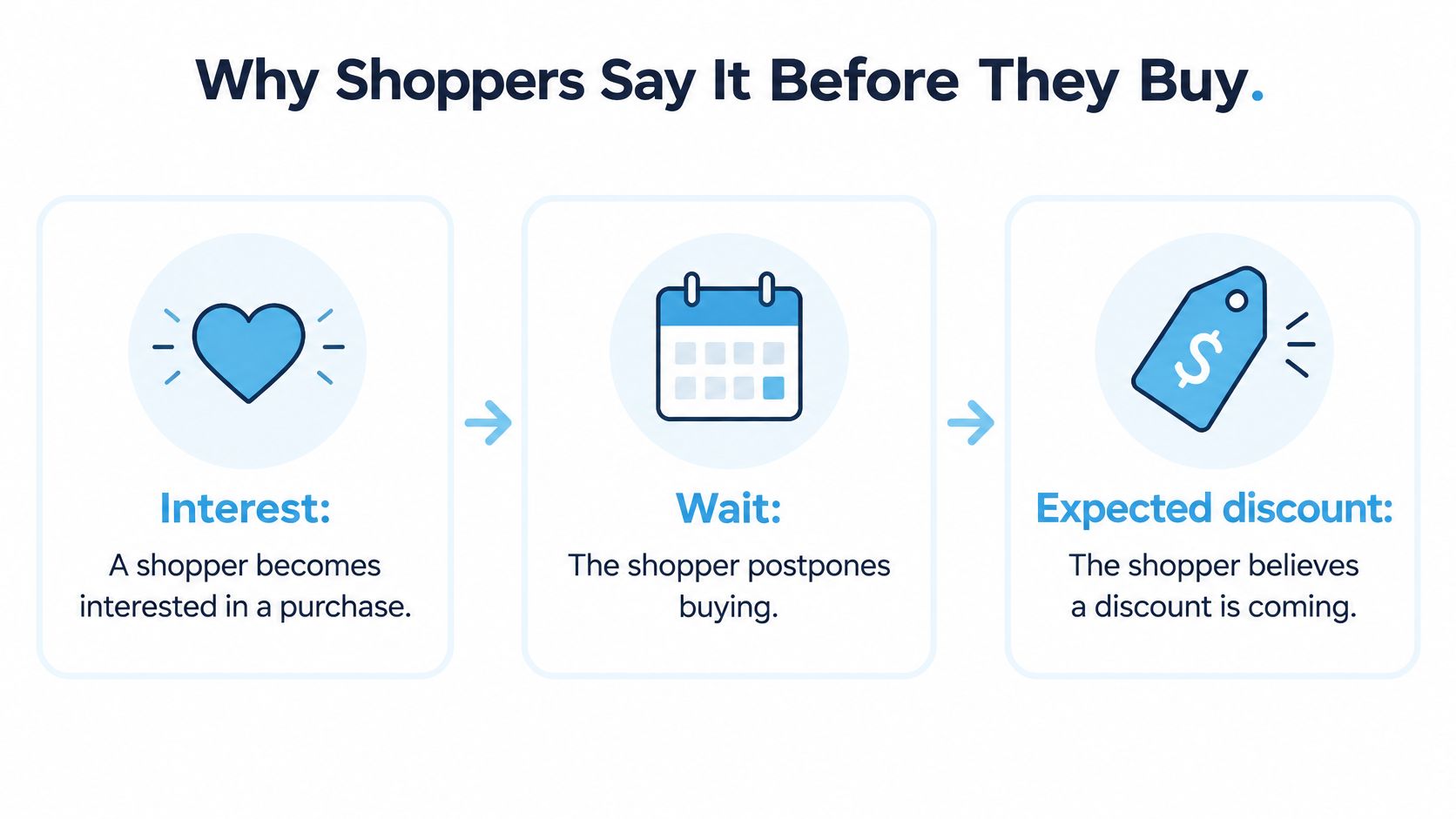
A customer can want a product and still feel unable to justify buying it today. If they expect another code soon, postponement may seem like the sensible option rather than indecision.
That’s the shopping version of the phrase: “I don’t have a choice” becomes “I’ll wait for the next sale.” For a merchant, the important question is whether the promotional schedule makes waiting worthwhile.
Headline figures from a U.S. consumer survey
A 2026 survey of U.S. consumers reported the following discount-waiting behavior: 91% delayed purchases for discounts, 61% would wait at least a month, 8% would wait indefinitely, the average discount needed to make immediate purchase worthwhile was 26%, and 73% identified holiday or seasonal sales as the strongest signal of another discount.
| Measure | Value |
|---|---|
| Delay purchases while waiting for a discount | 91% |
| Willing to wait at least one month for a better offer | 61% |
| Would wait indefinitely rather than pay full price | 8% |
| Average discount needed to make buying now feel worthwhile | 26% |
| Read holiday or seasonal sale cycles as the signal of another discount | 73% |
These are directional findings from a single U.S. survey, not a global estimate or a forecast for your store. The table summarizes those same findings.
Diagnose what makes waiting attractive
Review your recent storefront offers and email calendar together. If a customer who ignores today’s offer can reasonably expect an equivalent incentive later, the campaign provides little reason to act early.
Don’t confuse that pattern with affordability. A customer who can’t comfortably pay needs a different conversation from someone watching for a predictable markdown. For a category-specific resource on that distinction, BEDHEAD discusses consumer retail financing in its guide to turn showroom interest into mattress sales.
Merchant test: Would an informed customer expect a better outcome by ignoring this offer?
A flat, continuously available discount effectively says “buy whenever.” A legitimate time- or quantity-bounded offer says “buy now if this particular benefit matters to you.” The distinction depends on an actual change in availability, not stronger wording.
Designing Promotions That Keep the Choice Visible
A shopper sees a discount timer, reaches checkout, and notices the same price was available yesterday. The timer has not created a meaningful choice; it has made the offer harder to trust. A promotion should help customers see what changes if they act now and what remains available if they wait.
“I don’t have a choice” reports a perceived loss of control. Use one test across conversations, negotiations, and promotions: is there a real alternative, or only one the person finds unacceptable? For a shopper, the regular-price path may still exist, but the offer can obscure it. Show both paths clearly.
Urgency depends on context
Research on scarcity and urgency can inform offer design, but a finding from one setting does not prove what will happen in a Shopify campaign. Treat urgency as a design choice to test, not a guarantee that customers will buy or feel good about buying.
A useful comparison is a doorway with a clear exit beside one with a hidden handle. Both lead into the same room, but the first leaves people in control. Make the terms as legible as the offer.
Pressure signals versus agency-preserving signals in an offer
| Feature | Pressure signal | Agency-preserving signal |
|---|---|---|
| Deadline | A timer that resets on refresh | A stated end time that stays fixed |
| Quantity | “Low stock” with no inventory basis | A claim cap that the system enforces at checkout |
| Reward | The same discount forever, or a vanishing reward with no explanation | A descending tier where each step and its trigger are defined |
| Price anchor | An inflated original price used only as a reference | The regular price shown honestly beside the offer |
| Decline option | A guilt-laden exit or hidden “no thanks” | A plain decline path at the regular price |
A capped reward and limited stock are different things. If the promotional claims are limited while the product remains available, say that plainly. A customer should not mistake an incentive ending for the product disappearing.
A descending reward can make the exchange clear: eligible early claimants receive one tier, and later claimants see the next defined reward. Explain what counts as a claim and whether the reward has its own redemption window. This is an application of choice architecture, arranging information so the customer can understand the options. Prefer one clear qualification rule to several competing deadlines.
Protect the price outside the campaign
On a Shopify store, check the actual wording and displayed discount on the product page, in the cart, and at checkout. Confirm that the eligibility notice appears identically in all three places, and that the discount applies only under the stated conditions. A theme review is useful only if it catches a mismatch customers could encounter.
For organizations selling memberships, plan 2026 membership offers with GolfRep and distinguish joining terms from ongoing membership terms. The same choice test applies: make eligibility and the alternative visible.
A well-designed offer gives customers a reason to act while keeping the regular purchase path understandable. That lets the merchant set clear limits on promotional exposure without making a deeper discount the default answer.
Run Your Next Promotion Through a Choice Test
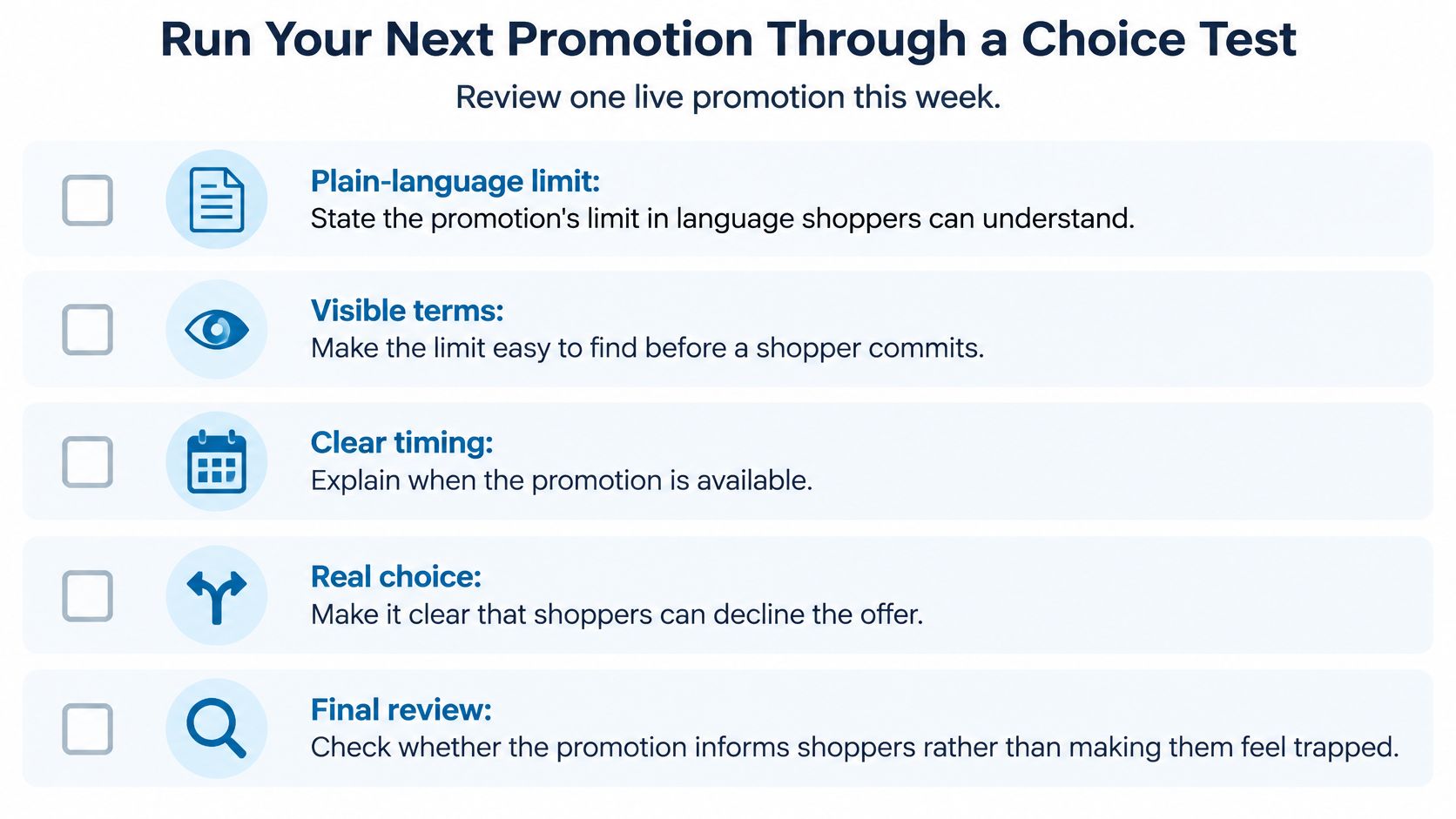
Choose a live promotion this week and review it from the customer’s first exposure through checkout. Check the actual experience, not just the campaign settings.
Check the promise against the system
- Plain-language limit: State what’s limited on the offer itself, including the relevant eligibility condition.
- Checkout enforcement: Confirm that the system enforces the limit rather than merely displaying it.
- Channel agreement: Compare the storefront, email, SMS, and social versions. Each should communicate the same governing condition.
- Purchase clarity: Show landed costs where calculable, explain delivery expectations, and make the guest-checkout path clear before commitment.
- Audit record: Log reward tiers and their triggers so your team can reconstruct what customers were offered.
Check edge cases as well. What does a shopper see after a reward closes, after eligibility fails, or after arriving through an older email? Those experiences need an honest explanation, not a broken promise.
Measure whether customers complete a sound decision
A four-experiment study of digital scarcity found that social and temporal cues increased intentions to seek the product from alternative retailers, partly through reduced information credibility and greater perceived inconvenience; product-based scarcity didn’t produce the same response.
Track claim velocity, checkout completion, customer-service contacts, refunds, and repeat purchase alongside conversion. Note alternative-site behavior where it’s observable, and review incremental margin rather than treating every discounted order as an unqualified gain.
Use a clear decision rule: if urgency lifts clicks while exits, complaints, or refunds also rise, investigate friction before celebrating. Shorten the message, clarify the terms, or retire the offer if customers can’t reliably understand it.
A shopper who buys should be able to say they chose it, and one who waits should be treated fairly next time.
Quikly offers Shopify merchants on-brand promotions with time- and quantity-capped rewards, including tiers that step down as shoppers claim. Visit Quikly to explore an approach that gives customers a clear reason to act while keeping the choice visible, rather than relying on another blanket discount.
Topics: I don't have a choice, choice overload, negotiation tactics, promotion psychology, ecommerce urgency