You’ve got the idea. Maybe it’s in a Notes app, maybe on a sample pulled apart on your desk, maybe in a Figma file next to ten tabs for packaging vendors and freight estimates. Then you hit the part most first-time founders underestimate. Having a product idea and producing a product profitably are two different jobs.
A lot of advice on how to produce a product still follows an old playbook. Sketch it, source it cheaply, order inventory, launch with a discount, hope demand catches up. That approach breaks fast for Shopify brands. Acquisition is expensive, margins are thin, factories push MOQs before your forecast is real, and one bad batch can poison reviews before your second reorder.
The work isn’t just getting an item manufactured. The work is building something customers want, at a cost structure that leaves room for shipping, fulfillment, returns, paid media, packaging, and actual profit, while still feeling like your brand when it lands on a customer’s doorstep.
That’s the lens that matters. If you’re learning how to produce a product, treat every decision as both an operations decision and a brand decision.
The Hard Truth About Bringing a Product to Life
The first wall usually isn’t creativity. It’s economics.
Founders often think the hard part is finding a factory. It isn’t. The hard part is producing something with enough quality to earn repeat purchases, enough margin to survive Shopify reality, and enough differentiation to avoid becoming just another SKU that needs constant discounting to move.
Most products don’t fail because a founder lacked passion. They fail because too many assumptions stayed untested until cash was already committed. Unit costs looked fine before freight. Packaging looked premium before it got crushed in transit. A supplier seemed responsive before production started. The brand story felt compelling before customers compared it to five alternatives in the same browser session.
Production problems start before the factory
If you’re at the notebook stage, slow down. Before you spend on tooling, molds, custom packaging, or a large first PO, map the sequence of decisions you’ll have to make from concept to reorder. A practical reference is this roadmap for product business success, especially if you need to pressure-test whether your idea fits the realities of product-based commerce.
Producing a product is a cash flow exercise disguised as a creative exercise.
That sounds harsh, but it saves people money. Every early shortcut tends to show up later as a more expensive problem. Cheap materials become higher return rates. Vague specs become inconsistent batches. Overordering to hit MOQ becomes dead inventory that traps working capital.
What good operators optimize for
The brands that stay healthy usually make decisions in this order:
- Demand first: Prove people care before committing to volume.
- Margin second: Build around a realistic landed cost, not a hoped-for one.
- Quality third: Define what “acceptable” means before a supplier does it for you.
- Brand experience throughout: Packaging, delivery, product feel, and post-purchase all need to reinforce why the customer chose you.
That’s the actual job. Not “make product.” Make a product system that can survive a first order, a second order, and the inevitable surprises in between.
From Idea to a Validated Product Concept
The fastest way to waste money is to treat your first idea like a verdict instead of a hypothesis.
Product research is a foundational step where companies gather primary data directly from potential buyers to validate buyer personas and isolate specific problems. Industry standards recommend developing three to five detailed buyer personas before creating a solution hypothesis, according to SurveyMonkey’s guide to product research.
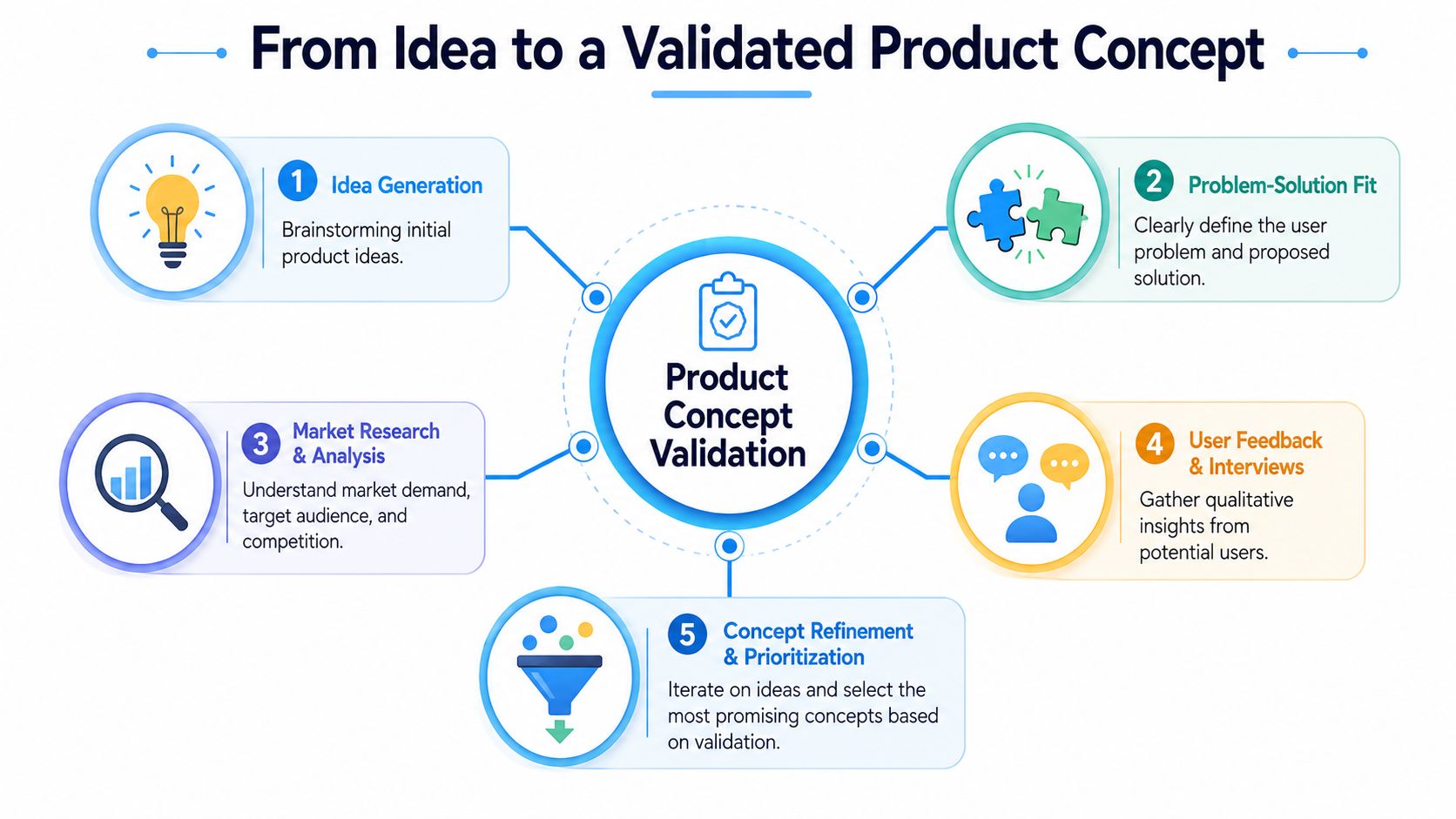
Three to five personas doesn’t mean making fluffy marketing avatars. It means getting precise about who has the problem, what workaround they use now, what annoys them about current options, and what they’ll pay to fix it. “Women 25 to 40” is not a persona. “Urban dog owners who need a travel bowl that doesn’t leak in tote bags” is much closer to something usable.
Validate the problem before the product
Most founders start with features. Stronger product teams start with pain points.
Use interviews, short surveys, DMs, niche Reddit threads, existing customer lists, and preorder interest pages to answer basic questions:
- What job is the customer hiring this product to do
- What does the current alternative cost them
- What detail makes them reject existing products
- What price feels reasonable versus suspicious
If you sell on Shopify or plan to, one of the cleanest early tests is a simple landing page with clear product positioning and one action. That action might be “Notify Me,” “Join Waitlist,” or “Get Early Access.” You’re not trying to fake a launch. You’re trying to see whether strangers care enough to act.
Treat every assumption like it’s fragile
Your product idea usually hides a stack of smaller assumptions:
| Assumption | What to test |
|---|---|
| The problem matters | Interview real buyers about current frustrations |
| The feature set is right | Show mockups and ask what feels unnecessary |
| The price works | Test messaging with different price framing |
| The audience is correct | Run traffic from different channels to one landing page |
A founder who validates demand early is in a stronger position later. You can negotiate with suppliers from a position of evidence, not hope. You can also cut features before they inflate cost.
Practical rule: If you can’t explain the problem in one sentence and the buyer in one sentence, you’re still brainstorming, not validating.
Primary research also keeps you honest about emotional fit. People don’t just buy utility. They buy taste, confidence, convenience, identity, and relief. If your concept only works on paper and not in a customer’s actual life, the factory won’t save it.
Prototyping Without Wasting Your Budget
A prototype is supposed to answer a question. Too many founders use it to chase perfection.
That’s expensive. Early-stage product teams spend 40% of development time on physical prototype iterations, yet 68% of those prototypes never reach commercial viability, according to Luth Research’s underserved market analysis. That’s the scalability trap. Teams keep refining objects before they’ve validated demand, positioning, or emotional resonance.
Use the right prototype for the right question
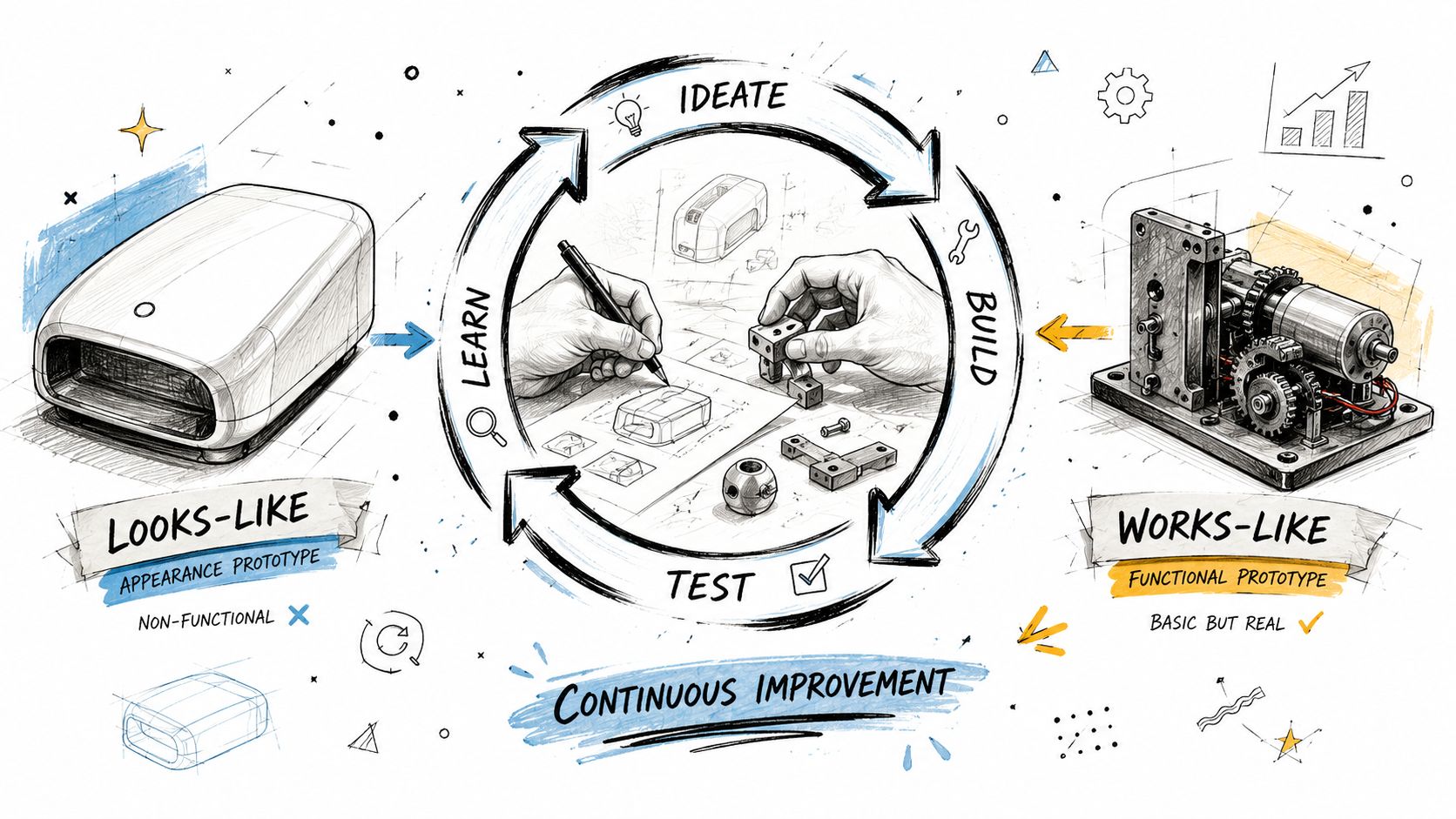
Not every prototype needs to function. Some need to sell the idea. Some need to test engineering. Some need to confirm packaging dimensions or shelf presence.
A simple way to understand this is:
- Looks-like prototypes help you evaluate form, color, finish, scale, and perceived quality.
- Works-like prototypes help you evaluate mechanics, durability, usability, and failure points.
- Packaging prototypes help you test unboxing, shipping protection, and visual consistency.
- Demand prototypes help you test whether customers care at all. These might be renders, samples, or content-driven prelaunch pages.
The mistake is building all four at once.
Build in loops, not milestones
If you want a practical framework for how to produce a product without burning budget, run prototype cycles around one decision at a time.
- Choose one risk. Maybe it’s leak resistance, product feel, assembly time, or whether buyers understand the value fast.
- Make the cheapest version that tests that risk.
- Get feedback from the right people. Not friends who want to be supportive. Actual target buyers, operators, or retail partners.
- Decide what changes. Keep, revise, or kill.
- Move to the next risk.
That loop keeps prototype spend attached to learning. It also protects launch capital. Every unnecessary iteration drains money that should be reserved for freight, inventory buffers, photography, and post-launch fixes.
A beautiful prototype that answers the wrong question is still a bad prototype.
Another overlooked point is emotional response. Founders often test whether a product works, but not whether it feels worth buying. You need both. A sample can function perfectly and still look generic, awkward, too cheap, or too complicated to earn conversion on a Shopify PDP.
Navigating the Production and Sourcing Minefield
Ideas get expensive fast.
The language alone trips people up. COGS is your cost of goods sold. BOM means bill of materials, the line-by-line list of every component, material, and sub-assembly in the product. Tooling is the upfront cost to create molds, dies, or custom production assets. MOQ is the minimum order quantity a supplier requires before they’ll run the job.
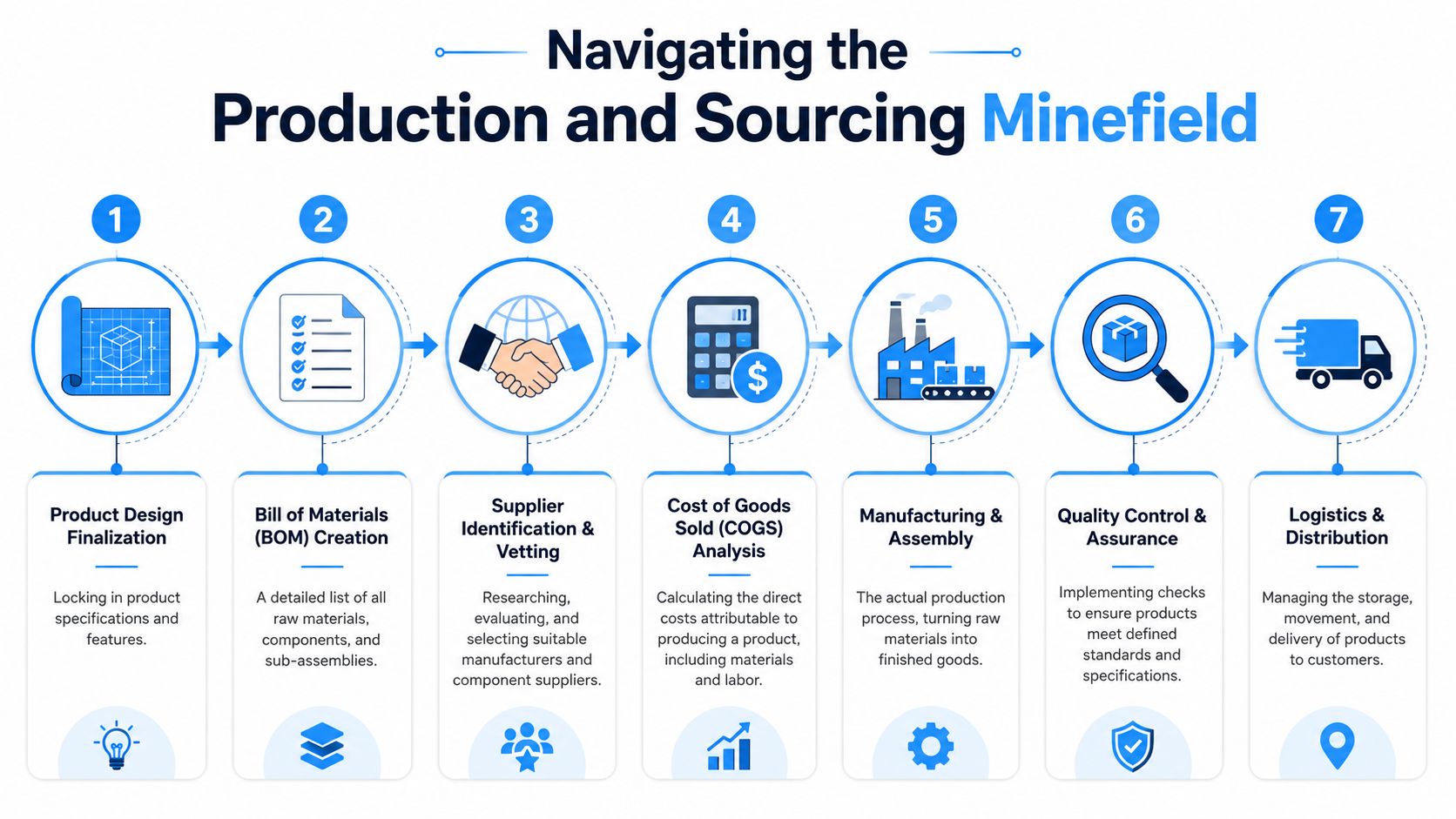
None of those terms are academic. They shape your cash needs, reorder timing, pricing floor, and how much inventory risk you carry from day one.
Cheapest is rarely cheapest
A low ex-factory price can still be the most expensive option once you factor in defects, delays, communication drag, repackaging, and missed launch windows. Supplier selection is not a race to the bottom. It’s a search for a partner who can hit specs consistently, communicate clearly, and scale without breaking your economics.
Lean manufacturing matters here. Scanco’s manufacturing operations guidance notes that adopting lean manufacturing with cross-trained employees and standardized plant floor techniques can reduce production waste by 40%, cut cycle times by 35%, increase on-time delivery rates to 98%, and help firms respond to market changes 50% faster when these practices are fully integrated.
That should influence how you vet factories. Ask how they manage changeovers, standard work, scrap, and quality checks during production. You’re not trying to sound technical. You’re trying to learn whether they run a disciplined operation or improvise their way through each PO.
What to negotiate besides price
A founder with one sample and no plan usually negotiates price only. A stronger operator negotiates the full production relationship.
Consider the levers that affect risk:
- Payment structure: Deposits, balance timing, and how final payment connects to inspection.
- MOQ flexibility: Whether initial runs can start smaller with a path to better pricing later.
- Lead time clarity: Raw material lead times and how delays get communicated.
- QC expectations: Defect definitions, rework responsibility, and documentation.
- Capacity planning: Whether the factory can support your second and third orders if demand is strong.
For a deeper look at how supplier relationships affect innovation, this piece on managing vendors for innovation is worth reading. It’s especially relevant when your supplier is shaping product quality, packaging options, or launch timing.
Find suppliers in more than one channel
Alibaba can be useful, but it shouldn’t be your entire sourcing strategy. Serious brands usually combine several paths:
- Trade shows: Better for seeing product quality and meeting teams face to face.
- Industry referrals: Often the best route to reliable specialty manufacturers.
- Sourcing agents: Helpful when language, region, or category complexity creates risk.
- Competitive teardown: Reverse-engineering what materials and manufacturing methods peers are likely using.
If you don’t know how to compare factories, ask each one to quote the exact same spec pack and BOM assumptions. Then compare the gaps. Wide variation usually means someone misunderstood the brief, excluded hidden costs, or plans to substitute materials later.
Ensuring Quality Control and Product Compliance
A bad batch doesn’t just create returns. It changes how customers talk about your brand.
That’s why quality control can’t live at the end of the line as a final inspection ritual. It needs to begin with the spec sheet. If your tolerances, materials, color standards, dimensions, labeling, packaging requirements, and performance expectations aren’t written down clearly, the factory will fill in the blanks. Usually in ways that protect their efficiency, not your brand.
Write a spec sheet a stranger could follow
Good quality documentation removes interpretation. For each SKU, define exactly what acceptable looks like.
Include items such as:
- Material requirements: Fabric weight, resin grade, finish type, or approved alternatives.
- Dimensional tolerances: What can vary, and by how much.
- Functional tests: Snap strength, leak checks, zipper cycles, fit tests, or drop tests.
- Packaging standards: Insert placement, barcode location, sealing method, and carton labeling.
- Visual defects: What counts as acceptable versus rejectable.
That document becomes the basis for your factory QC and any third-party inspection. Without it, “minor issue” becomes subjective.
Inspect the process, not only the outcome
ComplianceQuest’s overview of manufacturing quality explains that implementing Statistical Process Control with real-time data enables manufacturers to detect deviations early, reducing defect rates by up to 25% and improving overall process success rates to 95% or higher. In plain terms, process monitoring catches problems while they’re still fixable.
That matters because final inspections only tell you what already went wrong. They don’t prevent the entire run from drifting out of spec.
Field rule: If a factory only talks about final inspection and never about in-process checks, expect surprises.
A balanced approach usually includes factory-side QC, your own documentation, and independent verification on important runs. If the order value is meaningful or the product has safety implications, third-party inspections are often cheap compared with the cost of recalls, chargebacks, or a flood of negative reviews.
For a practical manufacturing perspective, Hasit Vibhakar on manufacturing quality is a useful companion read, especially on building repeatable quality habits rather than relying on end-stage firefighting.
Compliance is part of product design
Compliance tends to get ignored until a retailer asks for documentation or a shipment gets held. Don’t treat it as paperwork. Treat it as a design constraint. Labeling, material restrictions, testing requirements, and category-specific certifications can affect components, packaging, claims, and timelines.
If your product touches children, food, cosmetics, electronics, or health-adjacent use cases, get expert guidance early. This is not optional.
Launching and Scaling While Protecting Your Margins
Many brands do all the hard work to build margin into the product, then destroy that margin during the launch.
The usual pattern looks familiar. Inventory finally lands. The brand needs velocity. Someone suggests a broad discount across the store. Orders come in, but now the product enters the market as a deal, not as a product with value. Customers learn the wrong lesson on day one.
That’s a costly habit. Recent 2025 studies cited by MapBusinessOnline’s underserved market piece say 59% of Shopify Plus merchants reduce margins by 15–25% to maintain competitive pricing, while 47% report declining brand perception due to generic discounting. The warning is obvious. Launch tactics can undercut the business model you just built.
Don’t confuse launch momentum with blanket discounting
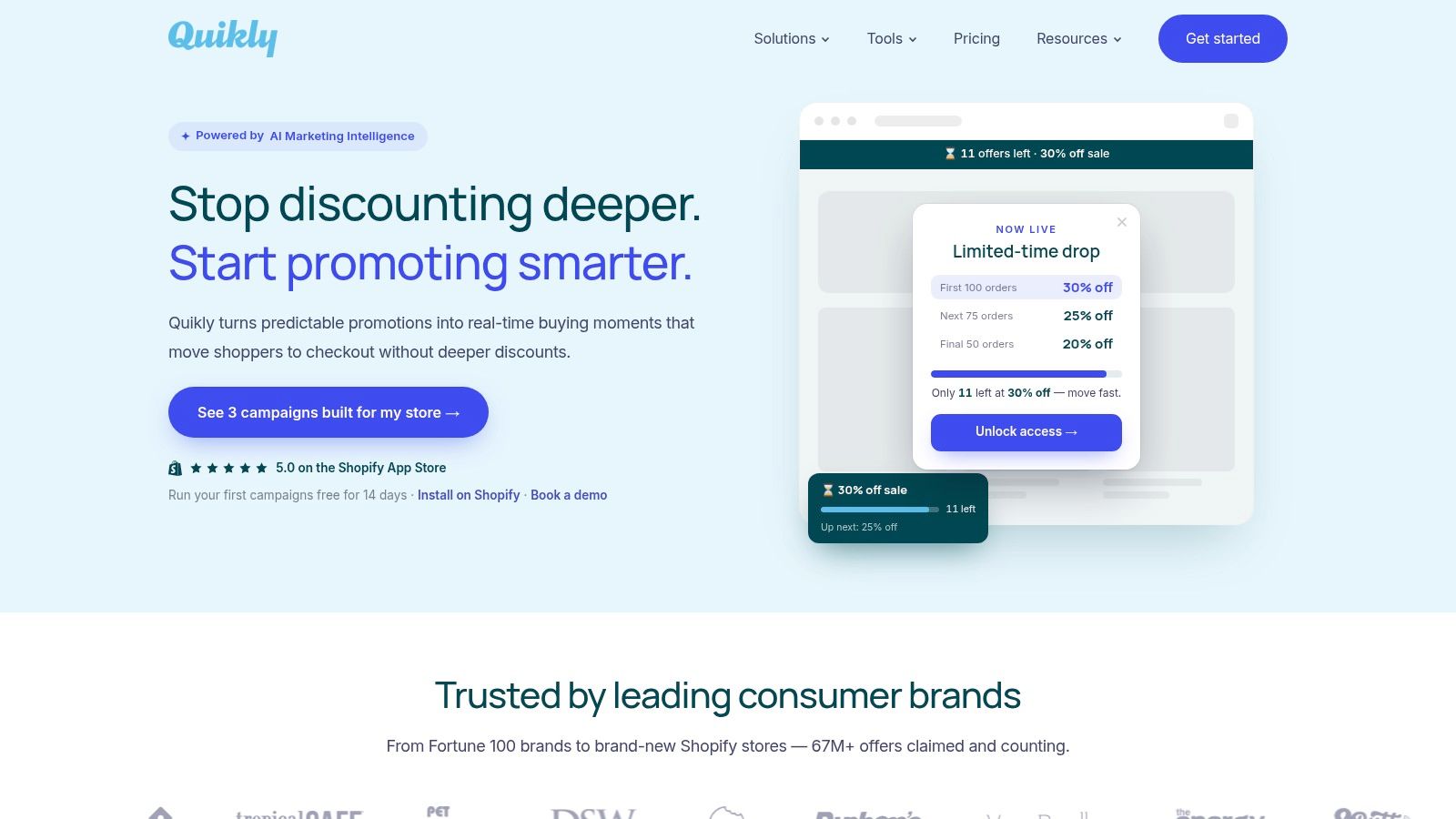
A launch needs urgency, but urgency doesn’t have to mean “take a percentage off everything.” Behavioral psychology gives you stronger options.
Specific triggers such as social proof, urgency, scarcity, and cognitive ease can increase ecommerce conversion rates by 25% or more, according to EC Digital Strategy’s CRO psychology article. Kensium’s behavioral economics article also notes that loss aversion tactics in checkout can increase conversion rates by up to 38%.
Used well, those principles create motivation without training customers to expect a cheap price every time.
Examples that work better for many Shopify brands:
- Early-access tiers: Reward people who joined the waitlist or engaged before launch.
- Limited release windows: Give motivated buyers a reason to act now without devaluing the product broadly.
- Bundled value: Add perceived value through accessories, sets, or exclusive packaging instead of default markdowns.
- Controlled offers: Limit who sees the incentive and when, rather than discounting every visitor.
Brand experience starts at the warehouse
Launch quality doesn’t stop at conversion. It continues through packaging, pick-and-pack, and delivery.
If you use a 3PL, make sure they can handle your packaging standards, inserts, kitting requirements, and exception handling. A premium product in a sloppy fulfillment flow creates cognitive dissonance immediately. Customers don’t split “brand” from “ops.” They experience one thing.
A few checkpoints matter before you scale:
| Area | What to verify before launch |
|---|---|
| Packaging | Survives parcel shipping and still feels on-brand |
| Fulfillment | 3PL can meet your service expectations and special handling rules |
| Inventory logic | Reorder triggers reflect realistic sales and lead times |
| Returns | Clear process for defects versus buyer remorse |
For launch execution details, a product launching checklist for ecommerce teams can help you catch operational gaps before they turn into customer-facing mistakes.
Use launch data to plan the second order
The first production run teaches you how the market responds. Which variant moved first. Which bundle raised AOV. Which channel brought high-intent traffic. Which objections showed up in support tickets. Those signals should shape your reorder, not just your ad creative.
Some psychology principles matter here too. Sitetuners’ ecommerce psychology guide notes that a review profile with roughly 80% positive reviews tends to build more trust than a 100% positive profile, which shoppers may find suspicious. Embitel’s article on the anchoring effect also explains how showing higher-priced options before mid-range ones can lift average order value through decoy pricing and bundling.
Those aren’t just merchandising tricks. They help you protect margin while improving perceived value. That’s the better launch model for Shopify brands. Create participation, scarcity, and relevance. Don’t default to the fastest discount available in your app stack.
The Continuous Cycle of Product Creation
If you want to understand how to produce a product well, stop thinking in straight lines.
The first version gives you customer feedback. That feedback changes the product, packaging, messaging, or forecast. The second order fixes problems the first order exposed. Your best insights often show up after launch, when real buyers use the product in ways your prototypes never fully captured.
Every batch teaches something
A healthy product business keeps information moving in both directions. Operations should inform marketing. Customer service should inform product design. Inventory planning should reflect actual buying behavior, not founder optimism.
That’s why product creation is a cycle made up of practical questions:
- What did customers value
- What failed in fulfillment or packaging
- Which inputs created margin pressure
- What should be simplified before the next PO
On marketplaces, that loop gets even tighter. If you also sell beyond Shopify, this Amazon product launch guide is useful for seeing how launch, listing quality, and operational readiness connect across channels.
Strong brands build systems, not just SKUs
The brands that hold up over time aren’t the ones with the flashiest first launch. They’re the ones that build repeatable decision-making. They validate before they produce. They source for consistency, not just for quoted price. They treat quality as a process. They use launch behavior to sharpen the next forecast.
If you need to improve that loop, this guide to inventory forecasting methods for ecommerce is a good next step. Forecasting is where margin discipline becomes real, especially once reorders, lead times, and promotional plans start interacting.
You’re not just producing units. You’re producing future constraints or future leverage, depending on how you operate.
That’s a key distinction. A product can be manufactured by almost anyone with enough cash. A profitable, trusted, repeat-purchase brand takes tighter judgment at every step.
If you want launches and promotions to support margin instead of draining it, Quikly is worth a look. It helps Shopify brands create psychology-backed promotional experiences that drive purchase action without falling into the blanket-discount cycle. For teams trying to grow conversions while protecting brand perception, that’s a far better place to operate from.
Topics: how to produce a product, product development, ecommerce manufacturing, shopify product, supplier sourcing