The most popular advice about dynamic pricing is to react faster: track more signals, update prices more often, and optimize for conversion. For a Shopify merchant already running too many promotions, that can mean automating the same margin problem at greater speed.
A better dynamic pricing strategy starts by treating every discount as a cost that must earn its place. Before changing an offer, establish the extra volume it needs to generate, the regular-price sales it might replace, and the conditions that will make you stop it. You don’t need an airline-grade algorithm to do that. You need a rule your team can explain, measure, and switch off.
What Dynamic Pricing Means for Ecommerce Stores
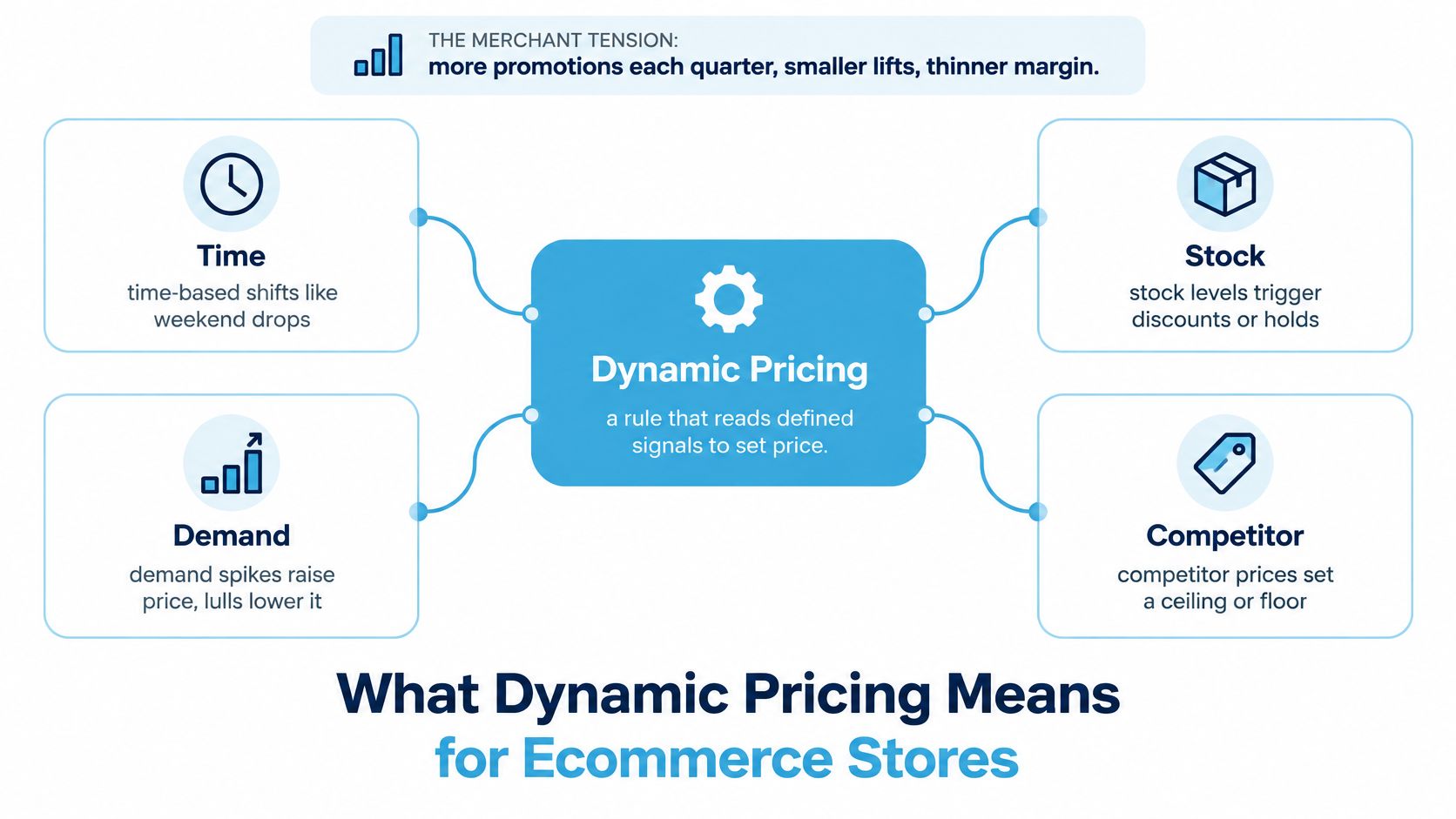
More promotions each quarter, smaller lifts, thinner margin. A familiar response is another sale, but the useful question is whether the offer should change when the conditions change.
Dynamic pricing uses a rule to read defined signals and adjust a price or offer when a stated condition is met. Those signals might include time, stock, demand, competitor prices, or customer response. A static sale, by contrast, shows the same markdown until its scheduled end or until someone remembers to remove it.
Think of a hotel room on a summer Saturday versus a February Tuesday. The room hasn’t changed, but the booking conditions have. The price follows the moment rather than a standing calendar of discounts.
The ecommerce lesson from revenue management
Airline revenue management developed after the United States Airline Deregulation Act of 1978, as carriers moved toward prices tied to booking timing, demand, and remaining capacity, according to this Amadeus revenue-management paper. The approach later spread to hotels, ticketing, and online retail.
For merchants, the useful lesson is allocation. You’re deciding how much inventory or promotional access to make available under particular conditions. Frequent small price changes aren’t the objective.
Say a store reserves a limited reward pool for a product launch. Early shoppers can claim the reward; once the pool is exhausted, the product remains available at its regular price. The merchant has changed promotional access without marking down every order indefinitely.
Every workable rule needs:
- A trigger: The condition that activates or changes the offer.
- A reward: The economic benefit available to eligible shoppers.
- An end condition: What closes the offer and what replaces it.
Four Dynamic Pricing Approaches Compared
| Approach | What Drives the Price | Best Fit | Main Risk |
|---|---|---|---|
| Time-based | Calendar or clock windows | Launches, weekend windows, seasonal pushes | Shoppers learn to wait for the next window |
| Inventory-based | Units left in stock | Aging or overbought SKUs | Visible clearance can signal low value |
| Demand-based | Sell-through speed, traffic, cart activity | Fast movers with reliable data | Feels arbitrary if the rule is hidden |
| Competitor-aware | Rival prices from monitoring | Commodity products compared across sites | Price wars erode margin, and competitor data can be incomplete |
Choose the signal you can operate reliably
Time-based offers are the simplest to coordinate across a storefront, email, and SMS. A launch window or early-access event gives customers a clear decision point. The weakness is predictability: repeat the same promotion too reliably and shoppers have a reason to postpone buying.
Inventory-based offers connect the incentive to a stock problem. Use them for a particular product, size range, or overbought collection rather than making healthy inventory subsidize clearance. Check available-to-sell stock carefully, including reservations and other sales channels, before publishing quantity claims.
The psychological principle is scarcity bias: limited availability can make an existing purchase intention more immediate. It only makes sense when the quantity restriction is genuine. A stock message that contradicts the cart creates doubt rather than urgency.
Where complexity starts to cost more
Demand-based offers react to sales velocity or aggregate shopping activity. They suit products with enough consistent activity to distinguish a real change from noise. Traffic alone is a weak trigger because an acquisition campaign can bring more visitors without bringing more purchase intent.
Competitor-aware pricing is useful when shoppers can compare identical products across stores. Match the exact item, pack size, availability, and shipping terms before responding. A rival’s advertised price isn’t automatically a commercially sensible price for your store.
Washington University Law Review’s analysis of pricing algorithms describes their underlying mechanism as computerized rules applying multiple inputs. That makes the choice of inputs and constraints as important as the automation itself.
Individualized prices inferred from personal data sit outside these four operating models. They introduce additional privacy, fairness, and compliance concerns that a simple inventory or deadline rule doesn’t require.
Starting rule: Choose time or quantity first. If your team can’t explain the condition clearly, adding more signals won’t make the offer easier to trust.
Why Blanket Discounting Erodes Margin
A discount isn’t a free conversion. It’s a reduction in what you retain from the order, including orders you might have won at full price.
Consider a hypothetical product selling for $100 with a $60 product cost. Before fulfillment, payment fees, acquisition, and returns, it generates $40 in gross profit. The break-even calculation is baseline gross profit divided by discounted gross profit.
Break-even volume for a $100 product with a $60 cost
| Discount Off List Price | Gross Profit Per Unit | Units Needed to Hold Gross Profit |
|---|---|---|
| 0% (full price) | $40 | 1x (baseline) |
| 10% | $30 | About 1.33x, roughly 33% more units |
| 20% | $20 | 2x (units double) |
| 30% | $10 | 4x (units quadruple) |
Those are calculated outcomes for the example, not performance benchmarks. They also make the promotion look more forgiving than a full contribution-margin model would, because each additional order can bring additional operating costs.
The second cost is the price shoppers remember
Repeated markdowns can reset a customer’s reference price, the amount they expect the product to cost. Once shoppers regard the sale price as normal, the list price becomes something to avoid rather than an accepted exchange for value.
Temporal discounting describes how people value delayed outcomes less than immediate ones. Repetitive sales create a related timing problem: when the next markdown feels close and predictable, a shopper may decide the expected saving is worth waiting for. Don’t assume that stronger promotional conversion means you’ve created stronger underlying demand.
In 2024, 25% of Americans surveyed by The Harris Poll for NerdWallet said they would buy only when prices were reduced, while 22% said they wouldn’t spend money at a business that uses dynamic pricing, according to NerdWallet’s survey findings.
Make the incentive earn its cost
Conditional discounts still have a role. A deadline or quantity cap can concentrate the incentive on a particular purchasing moment rather than subsidizing every visitor. The financial discipline in creating a smart discount strategy starts with what the merchant keeps, not just what the customer saves.
Would this shopper have bought at full price within two weeks?
You can’t answer that for every individual. A holdout can help answer it for a group, which is much more useful than treating every redeemed code as an incremental sale.
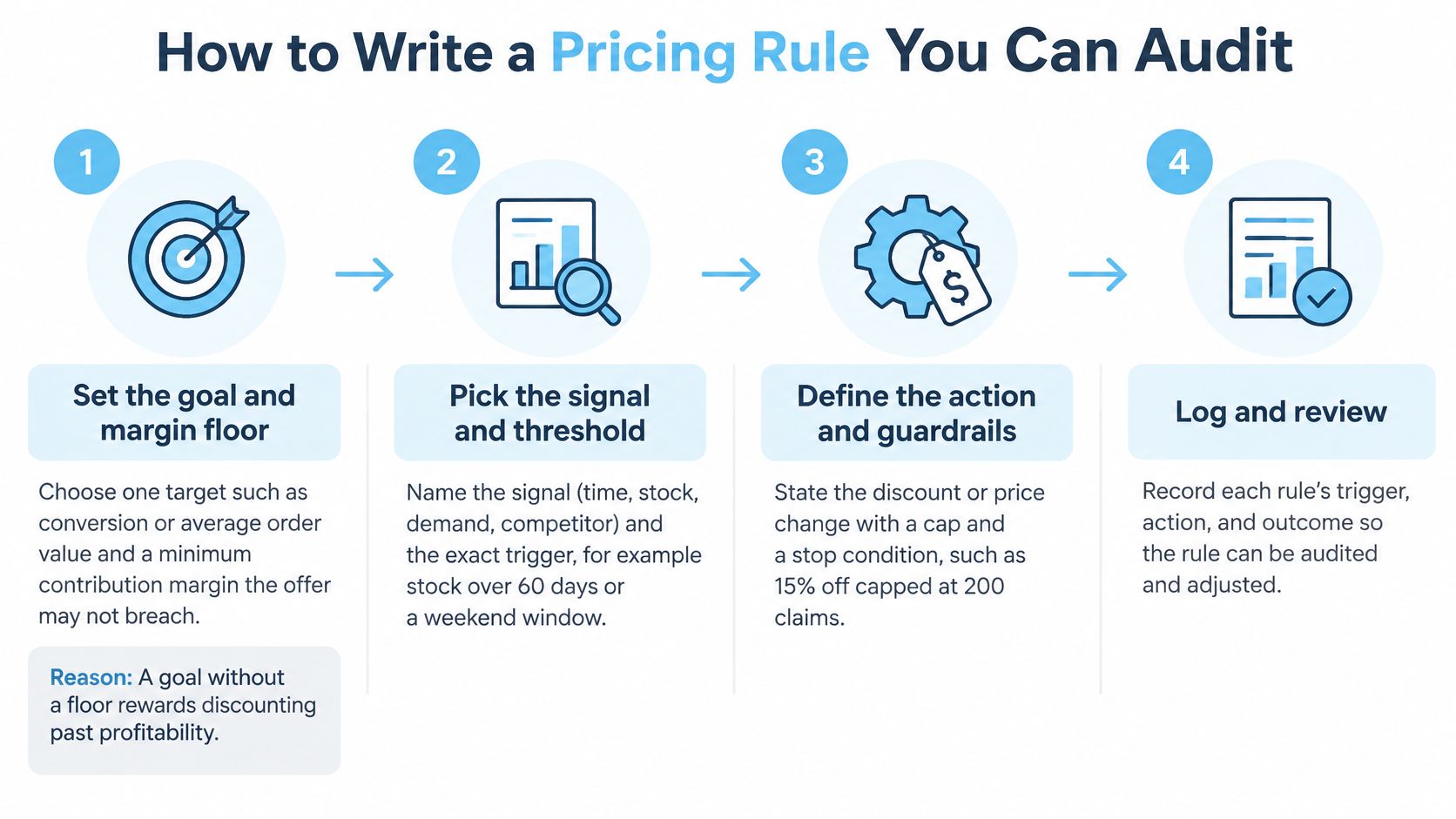
How to Write a Pricing Rule You Can Audit
A usable rule should fit on a page, survive a handoff, and leave a record of what happened. A countdown on the storefront doesn’t provide any of that by itself.
McKinsey’s dynamic-pricing analysis reports that well-designed programs can typically produce 2–5% sales growth and 5–10% margin improvement. Those are program-level findings, not a forecast for a Shopify pilot; the analysis emphasizes coordinated pricing capabilities and business rules rather than indiscriminate price changes.
Specify the economics before the experience
-
Set the goal and margin floor. Choose a primary outcome, such as conversion or average order value, and the minimum contribution margin the offer must preserve. Calculate contribution after product cost, fulfillment, payment fees, shipping subsidies, and expected returns so the target doesn’t reward unprofitable volume.
-
Choose one trigger. Start with a clock window, stock threshold, or sell-through condition. A single trigger makes it easier to identify why the offer changed and whether the underlying signal was accurate.
-
Define the reward and exposure cap. Decide whether the campaign uses a flat offer, stepped offer, or timed countdown, then limit claims, duration, or both. Specify whether other Shopify discounts can combine with it, because stacking can breach an otherwise sensible floor.
-
Write the end state. State exactly what happens when the cap is reached or the window closes, including any treatment of in-progress checkouts. Don’t leave an expired campaign’s discount code active after its promotional message disappears.
Make measurement and reversal part of the rule
-
Set the reference price and disclosure. Show a genuine regular price where appropriate and explain the condition in plain language on the product page. Keep the same terms in the cart, campaign landing page, and outbound messages.
-
Reserve a control group. For an initial test, you might hold about 10% of eligible shoppers on the standard experience, provided traffic supports a useful comparison. Treat that as an illustrative starting allocation, not a universal testing requirement, and keep assignments consistent across repeat visits.
-
Choose the rollback threshold. Establish the contribution-margin floor and refund-rate ceiling before launch, with a named person authorized to pause the campaign. Include an immediate stop for incorrect pricing, broken eligibility, or an inaccurate stock claim.
-
Log each change. Record the date, rule version, trigger value, action, and outcome. Save the customer-facing copy too, so support staff can reconstruct what a shopper was promised.
A clean rule sheet contains the eligible products and audience, primary goal, trigger, reward, cap, end state, contribution floor, disclosure, control assignment, rollback limits, and owner. If someone else can’t operate it from that sheet, the rule still depends too heavily on memory.
Guardrails for Trust, Fairness and Compliance
Market-responsive pricing changes with conditions such as inventory, deadlines, or a stated reward pool. Customers can understand the condition even if they don’t receive the same offer at different moments.
Individualized pricing uses information about a person to determine their economic terms. Device signals, location, or inferred willingness to pay can make differences difficult for shoppers to understand. Location can also reflect legitimate tax or delivery differences, so distinguish those charges from hidden personalization.
Gartner’s survey of 303 U.S. consumers, conducted in October 2024 found that 68% said they felt taken advantage of when brands used dynamic pricing. The commercial risk extends beyond an abandoned cart: some shoppers reject the practice itself.
Treat disclosure as an operating requirement
According to Reuters’ legal analysis, New York’s algorithm-pricing law took effect in November 2025, California amended its antitrust law in October 2025 to address common pricing algorithms, and Maryland enacted restrictions on certain dynamic or personal-data pricing uses.
These developments don’t establish a single nationwide rule. Applicability depends on the mechanism, inputs, disclosures, jurisdiction, and conduct involved.
Build the following into campaign approval:
- Document eligibility. Record who can participate, which products qualify, and whether loyalty or returning-customer status affects access.
- Preserve an honest reference price. Don’t inflate a regular price to manufacture a saving.
- Exclude sensitive personal inputs. Don’t infer what someone can afford or how urgently they need the product.
- Avoid coordinated pricing. Public price monitoring isn’t permission to arrange common prices through shared systems or competitors’ algorithms.
- Obtain market-specific legal review. Have counsel assess the actual implementation, including app inputs, message copy, and checkout behavior.
A useful final test is whether you can explain the offer in a sentence on the product page. If the explanation requires hiding how the price was determined, simplify the mechanism before launching.
Examples of Each Approach in Practice
These are illustrative scenarios, not merchant results. Their numbers describe possible campaign configurations rather than recommended benchmarks.
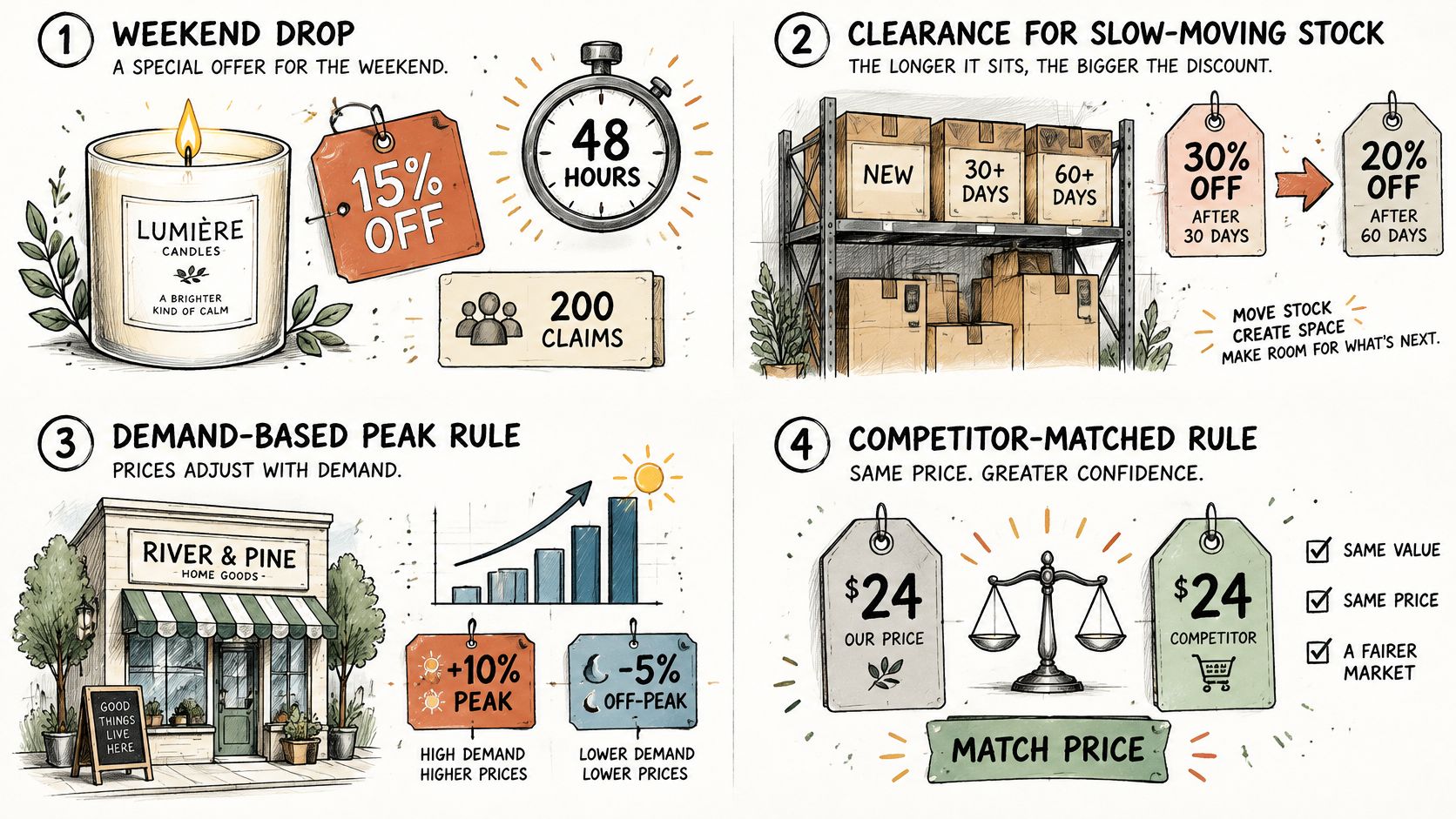
A candle brand uses a weekend window
A candle brand runs a 48-hour weekend drop at 15% off, capped at 200 claims, then returns to list price. A Klaviyo flow sends the offer within 24 hours to consented subscribers who viewed the product but didn’t buy, while suppressing purchasers and checking that the campaign remains open.
The deadline and claim cap must match across the email, storefront, and Shopify discount configuration. An email sent late shouldn’t promise availability the store can no longer honor.
An apparel label ties the reward to stock
An apparel label begins a jacket offer when 40 units remain, with a 20% reward that steps down to 10% at 15 units. The rule covers that jacket line only, and ends at its declared deadline or when eligible inventory sells out.
The smaller later reward gives shoppers a reason to act early without extending the same markdown to the entire catalog. Stock synchronization matters more than decorative urgency messaging.
A supplement store responds to demand
A supplement store opens a returning-customer bundle when weekly sell-through exceeds its three-week average. For this scenario, the bundle has a fixed claim cap and closes at the end of its stated window.
The operator excludes out-of-stock periods and unusual bulk orders from the comparison. Otherwise, distorted inputs could activate an offer for the wrong reason.
A kitchen tool store matches selectively
A kitchen tool store monitors ten products weekly but allows matching on only three SKUs that retain contribution above the floor. Each approved match expires at the next review, when the operator rechecks availability, shipping, and pack size.
Shopify admin discount codes can support simple offers; more elaborate eligibility may require app logic. Shopify Plus stores often have additional room for checkout customization and automation, but no plan removes the need to test discount combinations and the end state.
Measuring Whether the Strategy Pays Off
| Metric | What It Tells You | How to Read It |
|---|---|---|
| Contribution margin per order | Profit left after product, fulfillment, and other variable costs | Compare exposed and holdout groups; crossing the margin floor ends the rule |
| Conversion rate | Share of sessions that buy | Read alongside margin, never alone |
| Average order value | Size of the basket | Rising order value with flat margin percentage can improve contribution dollars |
| Refund rate | Share of orders returned | A spike can indicate that the offer set the wrong expectations |
| 60-day repeat purchase | Whether buyers return, especially at full price | A drop is a warning to investigate promotion dependence |
| Opt-in quality | Signup rate and unsubscribe rate on offer emails or SMS | High signups followed by fast unsubscribes are an early warning |
Compare shoppers exposed to the rule with shoppers who weren’t
For an illustrative pilot, reserve about 10% of eligible shoppers for the standard experience and run for at least two full weekly cycles. The allocation and duration need to fit your traffic and purchase cycle; a small store may need longer before the comparison is informative.
Compare concurrent groups, not this month against last month. Acquisition mix, seasonality, and product availability can otherwise look like promotional lift.
Margin comes first. A conversion increase that pushes contribution per order below your declared floor fails the test, even if revenue rises. Also compare total contribution per eligible visitor, so you can distinguish a controlled unit-margin trade-off from unprofitable growth.
Watch what happens after redemption
Track 60-day repeat purchase as a chosen evaluation window, separating full-price and discounted returns. A decline among exposed shoppers can suggest that buyers are waiting for another offer, but check product replenishment cycles and customer mix before assigning a cause.
Refunds and unsubscribes can reveal a mismatch between the promise and the experience. Don’t interpret a large signup count as permission to ignore the quality of those contacts.
Quikly includes performance analytics and order and discount analysis. Combine those views with Shopify exports and lifecycle reporting, using consistent definitions such as those discussed in ecommerce analytics.
Review question: Would I run this rule again with the same cap and the same floor?
Apply rollback limits in either direction: a minimum margin can be breached downward, while a maximum refund rate can be breached upward. Pause when a limit is crossed, preserve the evidence, and record why before changing the configuration.
Choose One Offer to Test This Month
Start with the store you already run. As a practical audit window, list every discount active in the last 90 days, record claims and contribution, and flag offers that have stayed live for more than a few weeks. Those deserve scrutiny because shoppers may already regard them as the ordinary price.
Quikly’s Promo Intelligence Report is a free tool that finds profit in a store’s own discounts. Use that starting point to identify an offer worth restricting, redesigning, or retiring rather than immediately creating another promotion.
Keep the pilot narrow enough to explain
Choose conversion or sell-through as the primary goal, then choose a trigger you can verify without stitching together unreliable reports. Campaign offers can be a stepped offer, a flat offer, or a timed countdown. Keep the initial scope to a single offer type so the result leads to a clear decision.
A stepped reward can apply loss aversion by making an available benefit worth claiming before it decreases. The customer must be able to understand the changing terms, and the decrease must occur. That’s different from a timer that resets whenever someone refreshes the page.
Use incrementality testing to judge additional business, rather than counting all campaign orders as additional sales. Decide how you’ll handle low sample sizes before the first results arrive, so a quiet start doesn’t prompt an impulsive deeper discount.
A first-month operating plan
- Audit existing discounts. Capture claim data, contribution, stacking rules, and any offers that never properly ended.
- Select the goal and trigger. Assign a campaign owner and identify the source of truth for the activating signal.
- Draft the offer. Write its cap, end state, and customer disclosure before designing the creative.
- Approve the safeguards. Set the margin floor, holdout, refund ceiling, and rollback authority.
- Launch and review. Use a two-week initial run as a planning example, extending measurement if the sample is insufficient.
Then keep the rule, adjust one variable, or stop it. Quikly can handle the offer mechanics once the rules are set, but the economics and customer promise still determine what deserves to run.
Visit Quikly to enter your store URL and generate a free urgency campaign suited to your store and its goals. Use it as a concrete starting point for a time- or quantity-bound offer, then launch only after you’ve defined the margin floor, exposure cap, and rollback rule.
Topics: dynamic pricing strategy, Shopify pricing, promotion strategy, pricing rules, ecommerce margin