Most advice about abandoned cart email Shopify treats recovery like a coupon problem. That’s lazy. It hands the easiest decision to the merchant, then taxes margin, trains shoppers to wait, and makes the brand look like it only knows how to sell when it’s cutting price.
The better frame is sharper. Cart recovery is a behavior problem first, a technical setup second, and a discount decision only when the shopper needs one. Shopify gives you the plumbing, but the work is choosing the right trigger for the right abandoner, so you recover revenue without turning every reminder into a markdown event.
Why Abandoned Cart Recovery Is a Margin Question, Not Just a Conversion Question
Cart recovery is a behavior problem first. Shopify’s tools can correct for timing and relevance, and a discount should enter the picture only when the shopper needs one. That matters because the cost of recovery is rarely the email itself. It is the margin you give away, the pricing habits you train, and the urgency you dilute if you treat every abandoned cart like a coupon prompt.
The scale of the opportunity is obvious. The most widely cited baseline for cart abandonment is 70.22%, based on Baymard Institute’s rolling average across 50 separate studies in the Shopify cart abandonment benchmark recap Shopify’s cart abandonment benchmarks. That means roughly 7 in 10 shoppers who add items to a cart still don’t finish checkout, so even small improvements in recovery can matter.
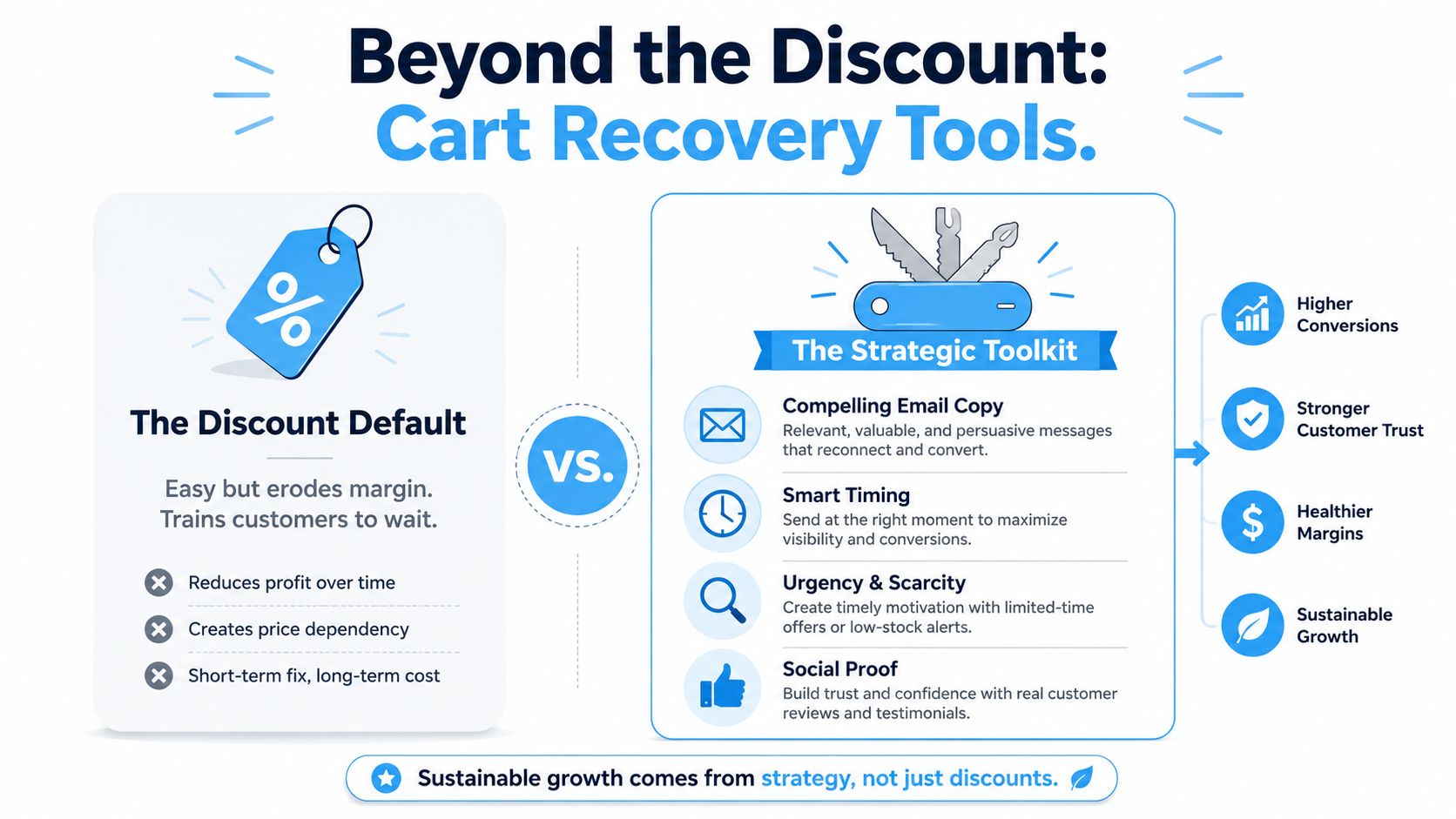
That also explains why the default playbook gets dangerous fast. If every abandoned cart email pushes a discount harder, you are not just trying to close a sale. You are training shoppers to wait for the next markdown, and that shows up later as weaker pricing power, less urgency, and more promo dependence.
Practical rule: recover intent first, discount last. If the shopper still has purchase intent, use timing, relevance, and friction removal before you give away margin.
Shopify’s own guidance treats abandoned checkout email as a standard automation, and that is the right baseline. The platform does not force a blanket discount strategy, which is exactly where merchants should be deliberate. Match the recovery message to the reason the cart was left. A shipping surprise needs a different response than simple hesitation, and a reminder with the cart contents can do the job before price cuts become necessary.
The reduce cart abandonment playbook is worth reading alongside your recovery flow if you want the upstream view. Fixing the trigger is better than obsessing over the last email. Once abandonment happens, the next move should still protect margin.
The central tension for Shopify brands is simple. Margins are shrinking, conversion is insufficient, and constant discounting can distort brand perception. Abandoned cart email should help with all three, not make the last two worse just to patch the first.
Setting Up Abandoned Cart Emails Inside Shopify
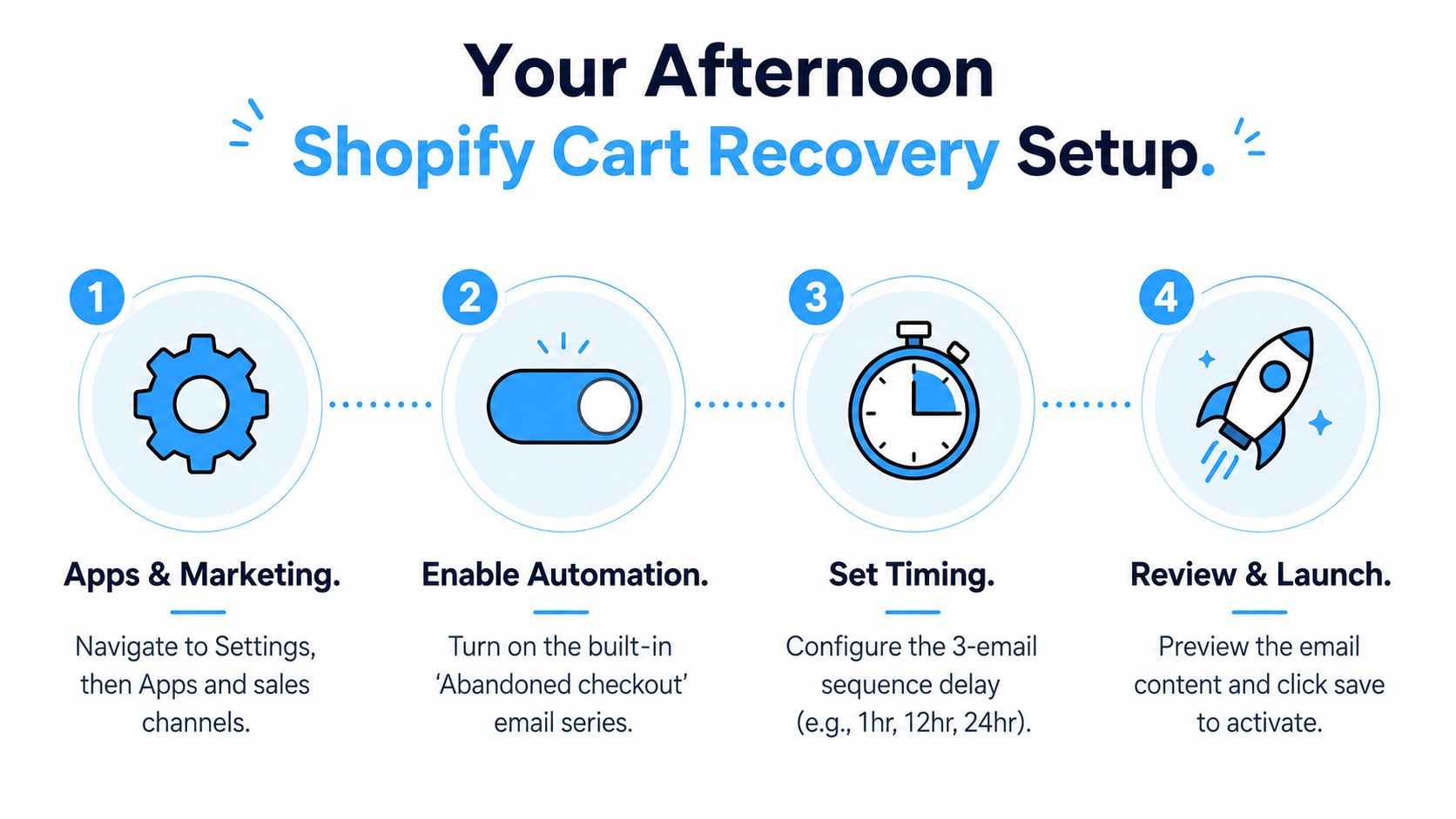
Shopify gives you the recovery workflow out of the box, so the first build should be plain and fast. Open the admin, turn on “Send abandoned checkout emails automatically” under Apps > Messaging > Automations, and get the base flow live in the admin guidance. Merchants waste time when they try to build around the native path before they have a working reminder in place.
Start with the native automation
Open Shopify, go to Apps, then Messaging, then Automations, and choose the Abandoned cart template. Shopify lets you adjust timing, copy, and design there, which is enough for the first version before you add anything more complex. Keep the setup simple. A clear reminder, the cart items, and an obvious path back to checkout will tell you more than a crowded, overbuilt sequence.
The Send to field deserves attention. Shopify’s admin lets you choose which visitor group gets the automation, so do not blast every abandoned checkout through the same path. If your repeat buyers behave differently from first-time visitors, start separating them at the audience setting instead of pretending one message fits both.
Use the admin trail, not guesswork
Recovered orders are easy to inspect once the flow is live. In Shopify’s admin, go to Orders > Abandoned checkouts, open the checkout, and use the customer email to recover the session in the admin guidance. That keeps the workflow tied to actual checkout recovery, not just open rates or sends.
If you are using Shopify natively, this is enough to launch a first pass in an afternoon. Once you need browse, checkout started, and product view triggers, or you want tighter segmentation and broader lifecycle automation, a tool like Klaviyo starts to make more sense. Shopify handles the basic recovery job. Klaviyo adds more event depth once the flow has earned extra complexity.
A clean setup beats a clever one on day one. Send the reminder, inspect the recovered checkouts, and only then add layers.
For a practical walkthrough of cart recovery structure tied to shopper behavior, this Quikly blog post on cart abandonment recovery is a useful companion if you are mapping email to broader on-site behavior.
Timing and Cadence That Match How Shoppers Actually Decide
Timing drives recovery. Shopify’s guidance supports a three-email sequence, with the first reminder going out around 1 hour after abandonment, the second at 24 hours, and the third at 72 hours in Shopify’s abandoned-cart email playbook. Shopify also notes a variant cadence where the first send lands in 2 to 4 hours and the second in 24 to 48 hours, which makes the bigger point clear, the exact minute matters less than the window where the shopper is still deciding.
The first send should catch active intent
That early message is for the shopper who got interrupted, not the one who forgot your brand exists. At that point, loss aversion is still in play, and the cart is fresh enough that the buyer can reverse the omission without feeling like they are starting a new purchase. A simple reminder works because it removes friction while intent is still alive.
Keep the first email short and direct. Say the cart is still there, show the product, and make the return path obvious. If the shopper is ready, extra copy only gets in the way.
The second email should do something different. If the first message was a nudge, the second gives a reason to come back that is not just “you left something behind.” That can be reassurance, product context, or a tighter explanation of why the item still belongs in their cart.
Shopify operator rule: never send the same angle three times. If every email says the same thing, you train the customer to ignore the sequence.
The third message should change the question
By the third touch, the shopper usually is not in a “remind me” state anymore. They are closer to a “why now” decision. Relevance matters more than repetition. Shopify’s own latest guidance suggests the third email should move away from pure incentive pressure and toward related products, which is a useful signal that not every abandoner is waiting to be pushed harder.
That matters because cadence is a hypothesis, not a law. You are testing windows of intent. If your audience responds quickly, a faster sequence can work. If your products need more consideration, the gap between messages can stretch, but the logic stays the same, first re-engage, then reframe, then close with the right nudge.
The mistake most stores make is flooding subscribers with more of the same. That does not increase urgency, it dulls it. Once the message tone stops changing, the sequence becomes background noise.
Subject Lines, Preview Text, and Body Copy That Earn the Open
The open happens before the offer does. If the subject line sounds generic, the rest of the email never gets a chance. Shopify benchmark discussion shows average abandoned-cart email performance depends heavily on execution, with an open rate of 50.5%, a click rate of 6.25%, and a placed-order conversion rate of 3.33% for the average store in the community benchmark thread. That’s the bar, not the ceiling.
What to write instead of a bland reminder
The best subject lines are short, specific, and product-led. Name the shopper if you have it, mention the cart if the product is the hero, and avoid fake urgency. Curiosity works when it feels natural, not when it reads like clickbait.
A few useful patterns:
- Generic reminder: “You left items in your cart”
- Better: “Your cart is still waiting”
- Product-led: “The black hoodie you viewed is still in your cart”
- Relevance-led: “Still thinking about this fit?”
- Name-led: “Maya, your checkout is ready”
Preview text should extend the promise, not repeat the subject. If the subject says the cart is waiting, the preview can add a concrete reason to return, like product reminders or friction removal. Don’t waste that line on filler.
Keep the body copy brutally short
The body should get to the cart in two lines, then move to the CTA. Long intros kill momentum. If you need reassurance, put it after the link or beside the product, not before the shopper knows what action you want.
A simple structure works:
- acknowledge the cart,
- show the items,
- remove one objection,
- link back to checkout.
Here are three rewrites that show the difference:
| Type | Weak version | Better version |
|---|---|---|
| Generic reminder | “We noticed you didn’t complete your order. Please come back when you can.” | “Your cart still has your items. Return to checkout when you’re ready.” |
| Value-led reminder | “Don’t miss out on a great deal.” | “Your items are still available, and checkout only takes a moment.” |
| Relevance-led reminder | “We’d love to see you back.” | “Still considering these products? Pick up where you left off.” |
If you want a practical comparison of tone and structure, this abandoned cart email example is a useful reference point.
The mistakes to avoid are predictable. Vague urgency, stock-phrase reassurance, and long intros bury the click. If the shopper has to read four sentences to find the cart, you’ve already lost the moment.
Recovering More Carts Without Deeper Discounts
Discounts aren’t the only recovery tool, and treating them like they are is how merchants erode margin one abandoned cart at a time. Shopify’s own guidance still centers on a first reminder without a discount, then a later email that can include one if hesitation remains in Shopify’s abandoned-cart email guidance. That sequence is fine, but it shouldn’t be your default answer to every abandoned session.
Swap price cuts for decision support
A lot of abandoners don’t need a bigger coupon. They need less friction. Free shipping thresholds can remove surprise. Product recommendations can reduce comparison paralysis. Payment plan options can help with higher-ticket hesitation. Those moves solve different problems than a blanket discount, and they do it without training customers to wait for markdowns.
Behavioral economics explains why this works. Scarcity bias makes limited availability feel more valuable, and loss aversion makes shoppers more responsive to the idea of missing out than to a generic “10% off” message. That’s why urgency-led experiences can outperform a lazy code, especially when the product already has demand.
The question is not “Should we discount more?” The question is “What kind of hesitation is this cart actually showing?”
Use incentives that match the shopper’s state
A time-bound or quantity-bound offer can reward action now without turning the store into a permanent sale rack. That’s where behavior-driven urgency stands apart from a static coupon code. It aligns the reward with the decision moment, so the shopper feels the pull to act instead of just bookmarking another discount.
Quikly fits that model when you want a promotion to feel like part of the store instead of a bolted-on widget. It lets a merchant run a reward that’s capped by time or by how many people can claim it, and the promotion can be styled to match the brand. That’s a different animal from “wait for the next code.”
The margin case matters too. Quikly’s published proof point says Jordan Craig saw roughly a 20% lift in profit, with incremental lift visible immediately on activation, and the mechanics have been refined across more than 60 million consumer interactions. Use that kind of model when the job is to increase response without defaulting to deeper discount depth.
A good test list for Shopify merchants looks like this:
- Free shipping: useful when checkout friction is about surprise costs.
- Product recommendations: useful when the shopper is comparing or hesitating.
- Payment plans: useful for bigger baskets where cash flow is part of the objection.
- Behavior-led urgency: useful when the shopper needs a reason to act now, not a lower sticker price.
This Shopify alternatives-to-discounting guide is a solid companion if you’re trying to protect margin while still recovering carts.
The point is not to ban discounts. The point is to stop reaching for them before you’ve tried the smarter lever.
Measurement, A/B Testing, and the Suppression and Legal Rules You Cannot Skip
You can’t improve what you’re measuring wrong. The first metric to care about is placed-order rate per send, because that tells you whether each message moved carts forward. Revenue per recipient matters too, since a flow can look efficient while still underperforming on value. Time to recovery shows how fast shoppers convert after the reminder, and discount depth as a share of recovered revenue tells you how expensive your recovery is becoming.
Ignore vanity metrics that flatter the wrong thing
Open rates can be useful for diagnostics, but they’re not the win. Click rates are better, but they still don’t prove revenue. A flow that gets attention and no orders is just noise with a subject line.
Run one clean A/B test at a time. Change the subject line or the offer angle, not both. Keep the audience stable, let the test run long enough to gather a meaningful sample for your store, and compare placed orders plus revenue per recipient at the end. Small teams don’t need a statistics degree, they need discipline.
Suppression and consent are not optional
Unsubscribes need to be honored immediately. Recent buyers should be suppressed from the same abandoned-cart flow, because they already converted and don’t need more pressure. If you’re using email and SMS together, frequency caps matter across both channels so you don’t turn recovery into spam.
Regional consent rules apply where relevant, including GDPR, CAN-SPAM, and CASL. The practical version is simple. Don’t message people who didn’t opt in, don’t keep blasting them after they opt out, and don’t assume your automation platform will clean up sloppy list hygiene for you.
If a recovery flow gets complaints, the problem usually isn’t the timing. It’s the targeting.
Troubleshoot the obvious failure modes first
Low open rates usually point to weak subject lines, bad sender identity, or a deliverability issue. Emails going to spam often come from poor list quality or aggressive sending patterns. Discount codes getting abused usually means the incentive is too easy to share or too broadly applied.
Fix the mechanics before you blame the offer. A broken flow can make a good strategy look bad, and a sloppy suppression setup can make a decent flow expensive.
A Rollout Plan and a Sharper Way to Think About Cart Recovery
Start with the native Shopify automation and get it live fast. Baseline your placed-order rate per send, revenue per recipient, and how much discount depth you’re giving away to recover carts. Then test subject lines, timing windows, and whether the second or third send needs a different kind of nudge.
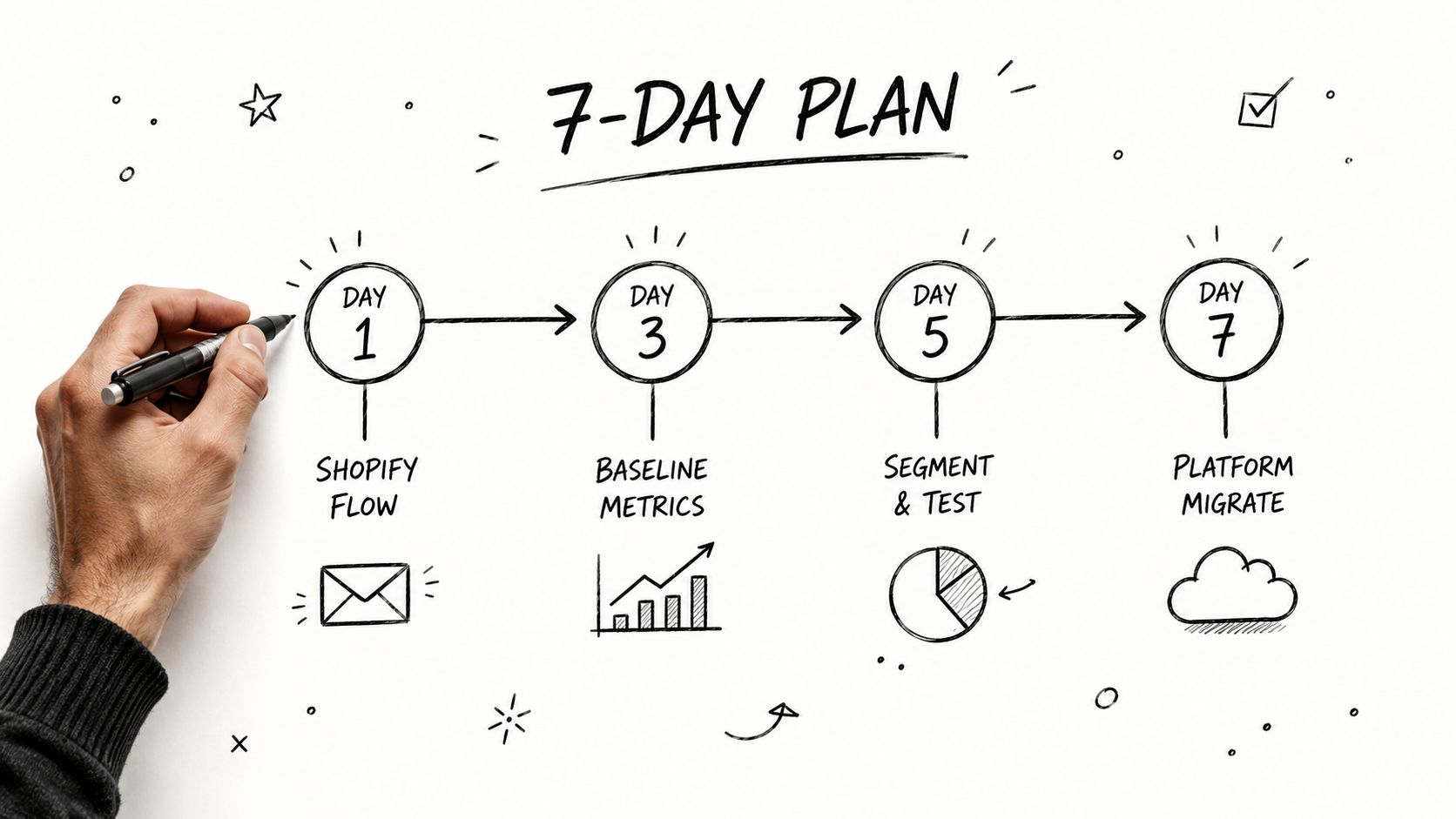
If the store is simple, native Shopify may be enough for a while. If you need richer triggers, tighter segmentation, or broader lifecycle automation, move up to a platform like Klaviyo when the business complexity justifies it. Don’t upgrade because the tooling looks better, upgrade because the recovery logic has outgrown the basics.
The bigger mindset shift is this. Cart recovery is not a lever you keep pulling harder every quarter. It’s a test of what kind of customer behavior you’re rewarding.
Brands that rely on automatic discounts eventually teach shoppers to wait. Brands that use timing, relevance, and controlled urgency train people to act when intent is highest. That’s the difference between squeezing recovery out of a tired flow and building a system that protects both revenue and brand value.
If you want to recover more carts without handing away margin by default, build the flow with intent, not panic. Quikly gives Shopify merchants a way to turn a promotion into a time- or quantity-bound experience that rewards action now, while keeping the experience on-brand. Visit Quikly and see how that approach can fit into your recovery stack.
Topics: abandoned cart email shopify, shopify abandoned cart, cart recovery email, email automation shopify, klaviyo cart flow