A marketing launch plan is a cross-functional document that defines goals, audience, positioning, messaging, timeline, budget, channels, milestones, and team responsibilities. A strong template spans at least 8 core planning dimensions, strategy, research, messaging, audience, channels, timing, resources, and measurement.
The difference between a calm Shopify launch and a chaotic one usually appears before launch day. The product page is ready, but the email sequence is still waiting for creative, the inventory message hasn’t been approved, and the paid campaign is sending traffic to an offer nobody has stress-tested for margin.
A useful marketing launch plan template turns those disconnected tasks into a controlled work-back schedule. It also forces a more important decision: should the launch rely on a familiar blanket discount, or should the promotion give shoppers a credible reason to act now without weakening the economics of the entire campaign?
Why Your Launch Needs a Real Plan
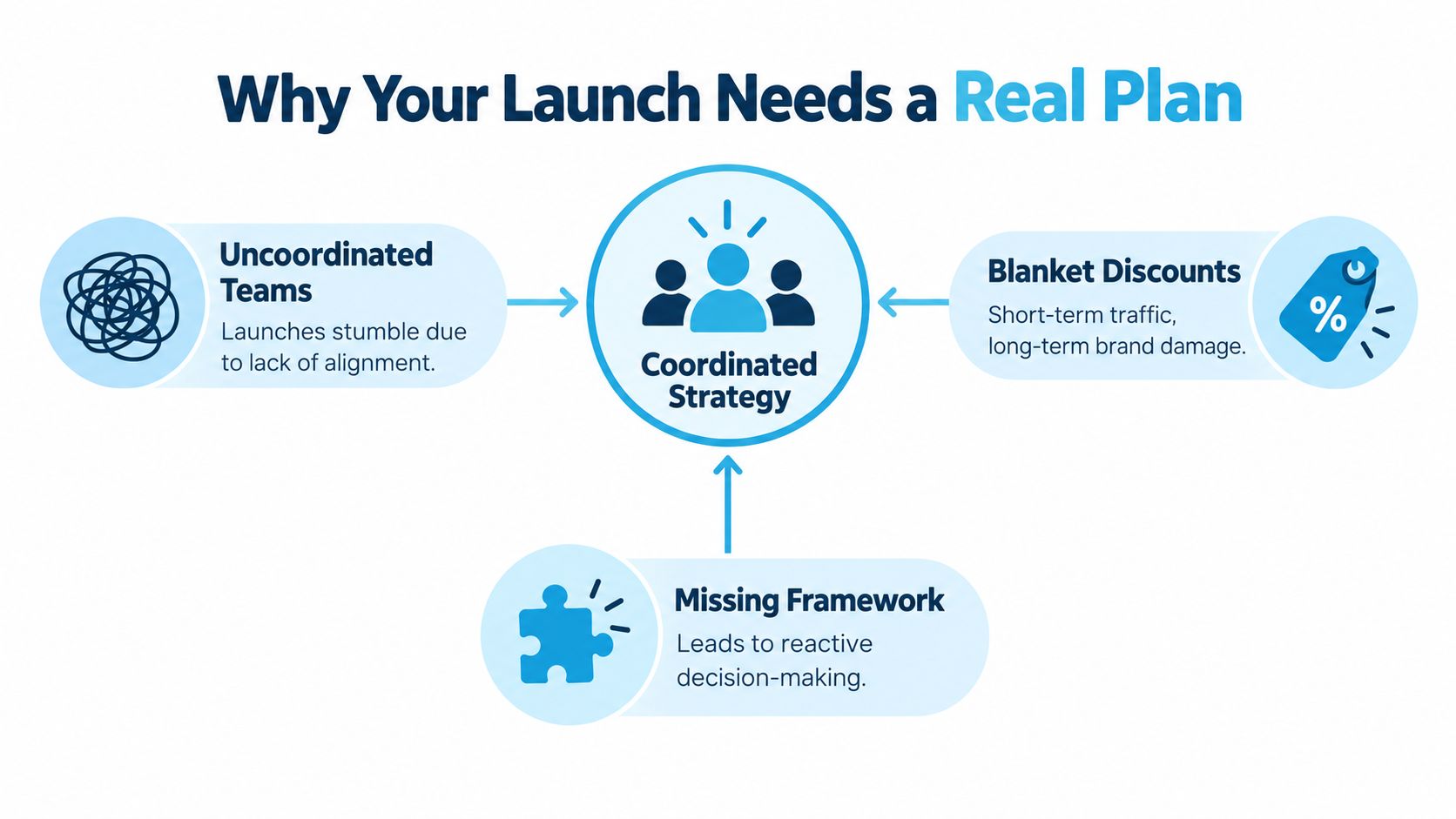
A launch often goes wrong in ways that have nothing to do with product quality. The merchandising team changes the bundle after the email copy is approved. Customer support doesn’t know which claims the campaign makes. Paid traffic arrives before the storefront experience is ready. Then someone adds a larger discount to compensate for weak conversion, and the launch generates activity while eroding margin.
A marketing launch plan template is the document that prevents those decisions from happening in isolation. Shopify’s product launch guidance frames the plan around launch goals and success metrics, audience and positioning, milestones, promotional strategy, budget, resources, and cross-team responsibilities. HubSpot adds positioning, competitive analysis, market analysis, target audience, and key messaging, while Qualtrics includes investment to date and the budget for launch activities. Those components make the template a planning system, not a longer checklist.
Use the launch date as the control point
Start with the public launch date, then work backward. Research and positioning need to be settled before creative production. Product photography, landing pages, email, SMS, paid media, and support documentation need review dates before channel activation. The launch plan should show both the owner and the dependency for each item.
That structure matters especially when a brand is coordinating creators or affiliates. A separate guide to scaling influencer campaigns can help with outreach and campaign management, but the launch plan still needs to record when creator briefs are approved, products are shipped, content is reviewed, and posts go live.
Practical rule: If a task has no owner, deadline, or dependency, it isn’t part of the launch plan yet.
The plan should also protect the business from reflexive discounting. A flat offer can increase urgency for some shoppers, but it tells everyone else they can wait. A better plan defines the intended customer behavior, the acceptable margin floor, and the promotion mechanic before the first campaign asset is written.
That is the distinction between a document that records work and a control system that governs decisions. It gives marketing, merchandising, ecommerce, finance, and support one version of the launch, while leaving room to adjust the tactic when customer behavior or inventory conditions change.
The 30-Day Milestone Framework
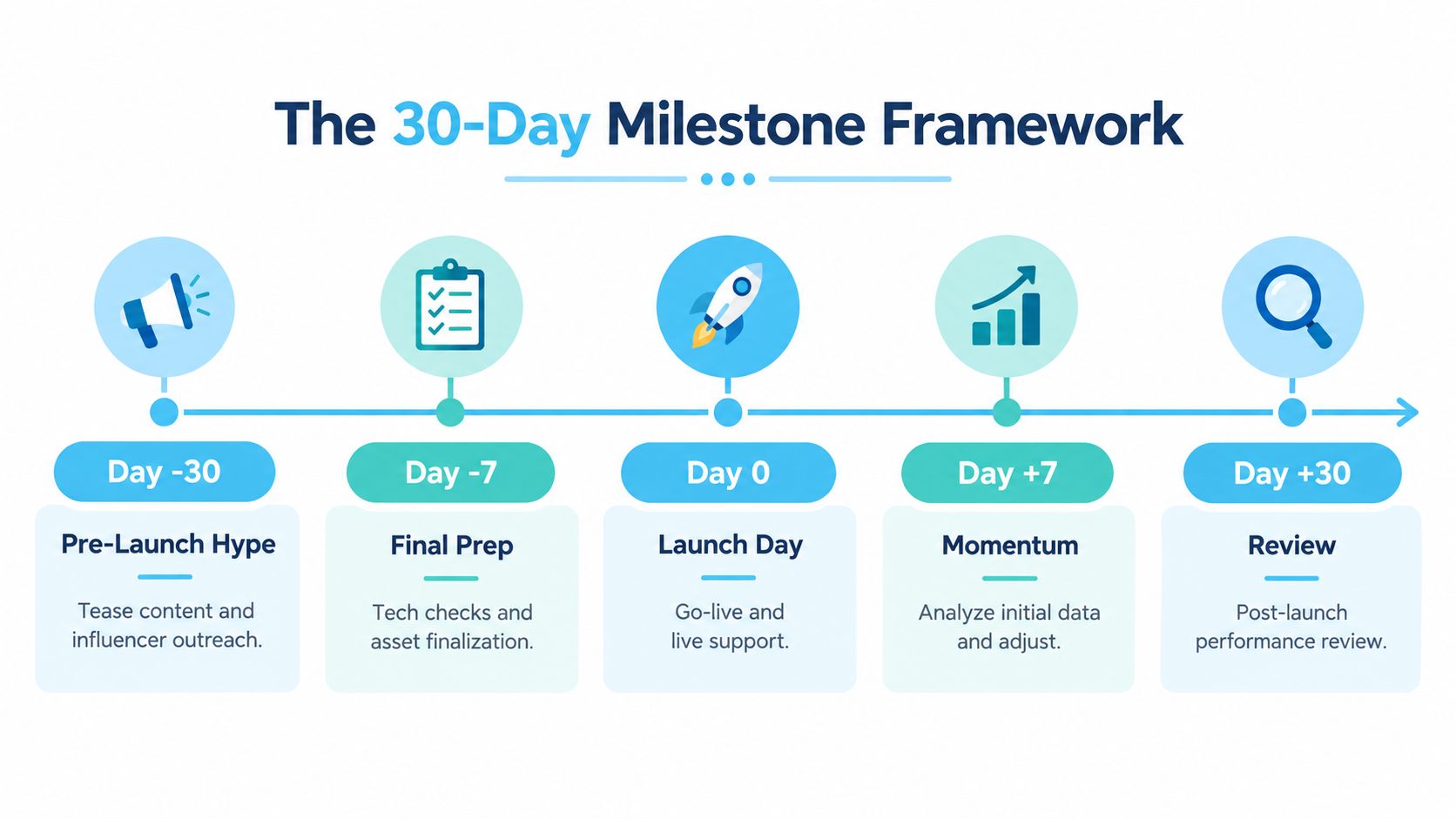
A launch plan becomes easier to run when every task is tied to a milestone. Many current frameworks concentrate the critical operating window into roughly 30 days before and 30 days after launch, with a work-back sequence that makes ownership visible. One published framework uses phases of 8 to 12 weeks for research and validation, 4 to 6 weeks for demand building, launch week for coordinated go-live, and day 8 through day 30 for optimization. The tighter framework below is useful for a Shopify campaign that already has a confirmed product and launch date.
Work backward from D-30
- D-30, strategy and research: Confirm the audience, positioning, product promise, offer economics, inventory assumptions, and launch KPIs. Decide whether the campaign needs a broad release, a segmented early-access window, or a quantity-limited first wave.
- D-21, asset creation: Produce the product page, photography, email and SMS creative, paid media assets, creator briefs, merchandising blocks, and support responses. This is also a sensible point to use cost-effective AI fashion photography when the product needs additional visual variations without delaying the campaign.
- D-14, demand building: Begin teaser content, waitlist activity, creator outreach, and audience education. Don’t reveal every offer detail if the purpose of the pre-launch phase is to build anticipation.
- D-7, channel activation: Schedule campaigns, confirm Klaviyo segments, test SMS consent and links, check theme behavior, validate discount or reward logic, and give support the final launch brief.
- D-1, final QA: Test checkout, product availability, shipping language, analytics events, mobile layouts, codes, cart behavior, and fallback messaging. Run through the launch-day checklist with named owners.
- D-0, launch day: Publish the product, activate the agreed channels, monitor the storefront and support queue, and record decisions in the launch-status channel.
- D+3 and D+7, optimization: Review conversion, average order value, revenue, margin, offer participation, channel quality, and customer questions. Adjust the message or audience before increasing spend.
- D+30, review and handoff: Capture what worked, what failed, and what should change in the reusable template before the next campaign.
For a deeper treatment of anticipation and pre-launch communication, the guide to building hype for a product launch is useful alongside the calendar. The key is to treat hype as a sequence of customer decisions, not as a pile of scheduled posts.
Matching Launch Mechanics to Psychology
A standard launch template usually lists email, social, paid media, PR, and influencer outreach. That answers where the campaign will appear, but not why a shopper should buy during the launch window instead of waiting for the next promotion.
A behavior-driven plan adds that decision layer. It connects the audience, offer structure, timing, and message to a specific psychological mechanism.
| Launch approach | Customer experience | Operational trade-off |
|---|---|---|
| Blanket discount | Everyone sees the same price reduction and can buy whenever they choose | Simple to execute, but it can weaken margin and teach customers to wait |
| Audience-segmented offer | Different groups receive different access, timing, or reward conditions | Requires cleaner data and careful coordination across email, SMS, and storefront |
| Quantity-bound launch | The reward or product access is limited by genuine availability | Creates a reason to act early, but inventory and fulfillment promises must be accurate |
| Time-bound launch | The offer is open for a defined period | Supports a clear decision window, but repeated deadlines can lose credibility |
| Tiered launch | Early shoppers receive one condition, with the reward changing as claims accumulate | Encourages participation and pacing, but requires precise storefront and cart logic |
Scarcity bias matters when the limitation is credible. A shopper who believes an opportunity may disappear evaluates it differently from a shopper who sees a permanent code. Loss aversion adds pressure because people often respond more strongly to losing a current opportunity than to gaining an abstract future benefit.
Temporal discounting explains why a relevant reward available now can be more persuasive than a similar reward promised later. The offer still needs to fit the product and the audience. A countdown placed on every page, disconnected from inventory or campaign timing, is decoration rather than strategy.
consumer psychology in marketing becomes operational here. The plan should specify what is scarce, who can claim it, when the condition changes, and what message appears when the window closes.
A launch mechanic should answer one customer question clearly: “What changes if I wait?”
The margin advantage comes from controlling exposure rather than reducing the price for everyone. Early access can go to a high-intent segment. A limited reward can be attached to a higher-value bundle. A tier can recognize early action without turning the whole store into a sale event. These structures take more planning than a universal code, but they align the promotion with the behavior the merchant wants.
Using Urgency Without Damaging Margin
Urgency works when it compresses an already active decision. It works less well when the brand manufactures pressure that shoppers can recognize as artificial.
A 2026 review of urgency-driven marketing links scarcity cues and FOMO with reduced deliberation, loss aversion, and higher short-term conversion potential, while also warning that repeated use can create fatigue and erode trust (review of urgency-driven marketing). The review identifies flash sales, limited editions, and countdown timers as core mechanics, but a timer alone isn’t the strategy. The customer needs to understand what the timer represents.

Build the offer around a real constraint
For a Shopify launch, define the constraint first:
- Limited quantity: A reward is available while a genuine allocation remains.
- Limited time: Early access or a launch condition closes at a clearly communicated time.
- Limited tier: The first group receives one reward, then the condition changes as shoppers claim it.
- Limited audience: A segment such as a waitlist, loyalty group, or prior purchaser receives access before the public launch.
Each option creates a different operational requirement. Quantity limits need accurate stock or claim tracking. Time limits need consistent timestamps across the storefront, email, SMS, and social. Audience limits need reliable segmentation and a fallback for customers who discover the campaign through sharing.
The launch plan should also state what happens when the condition ends. Does the product remain available at full price? Does the reward disappear? Does a second tier activate? Ambiguity after the deadline can make the original promise feel unreliable.
Discount depth deserves its own line in the economics section. A 2026 ecommerce benchmark reports average discount rates of 12% to 18% of revenue and estimates that realized margin impact can run roughly 2 to 3 times the discount rate because fixed costs remain in place (ecommerce discount rate impact benchmark). The same benchmark gives an example in which a 20% discount on a product with a 50% gross margin reduces margin to 37.5%, a 25% decline in profitability.
That doesn’t mean every launch needs a small offer. It means the plan should distinguish between more orders and profitable orders. A transparent, behavior-based reward can focus the incentive on shoppers ready to act instead of paying every visitor to do what they might have done anyway.
Building the Template Sections
The working document should be detailed enough for finance to assess the offer, creative to produce the right assets, and the launch owner to identify a blocked dependency without searching through message threads.
Start with the decision sections
Executive summary: State the product, launch date, audience, positioning, commercial objective, offer mechanic, margin constraint, and decision owner. Someone joining the project late should understand the launch from this page.
Go-to-market plan: Document the audience segments, customer problem, product promise, competitive context, channels, campaign narrative, and conversion path. For Shopify, map the path from ad, creator post, email, or SMS to landing page, product page, cart, checkout, and post-purchase communication.
Pricing and offer economics: Record the regular price, launch condition, expected average order value, product cost assumptions, shipping contribution, payment costs, and allowable promotional stacking. Finance should be able to see the difference between gross revenue and contribution margin.
Release milestones: Add the D-30 through D+30 dates, dependencies, approvers, and status. A milestone isn’t complete because an asset exists. It is complete when the asset is approved, implemented, tested, and assigned to a live channel.
Assign the work by function
Departmental deliverables should name the person responsible for merchandising, ecommerce, creative, lifecycle marketing, paid media, influencer coordination, customer support, finance, and analytics. Include the final approver and escalation route for each workstream.
Budget and revenue forecast should separate media spend, production, creator costs, technology, fulfillment impact, discounts, refunds, and expected revenue. Model the offer with and without stacking, including free shipping thresholds and loyalty benefits.
Risk register: List inventory shortages, checkout errors, delayed creative, unclear claims, channel disapproval, weak conversion, support volume, and margin leakage. Each risk needs an owner, an early warning signal, and a response.
Launch-status communications: Choose one shared location for daily status, decisions, blockers, and metric updates. A short structured update is more useful than a stream of disconnected messages.
For teams creating internal enablement pages or campaign explainers, a listicle landing page creator can help organize supporting content, but it shouldn’t replace the central launch document. The template remains the source of truth.
End the document with a post-launch review. Record channel performance, customer objections, offer participation, margin outcome, operational incidents, and changes to make before reusing the template.
Why Planning Beats Budget Size
A larger budget can amplify a strong launch, but it can also amplify a weak offer, an unclear message, or a broken path to purchase. More traffic won’t solve a product page that fails to explain the value, and more discounting won’t repair an audience that isn’t ready to buy.
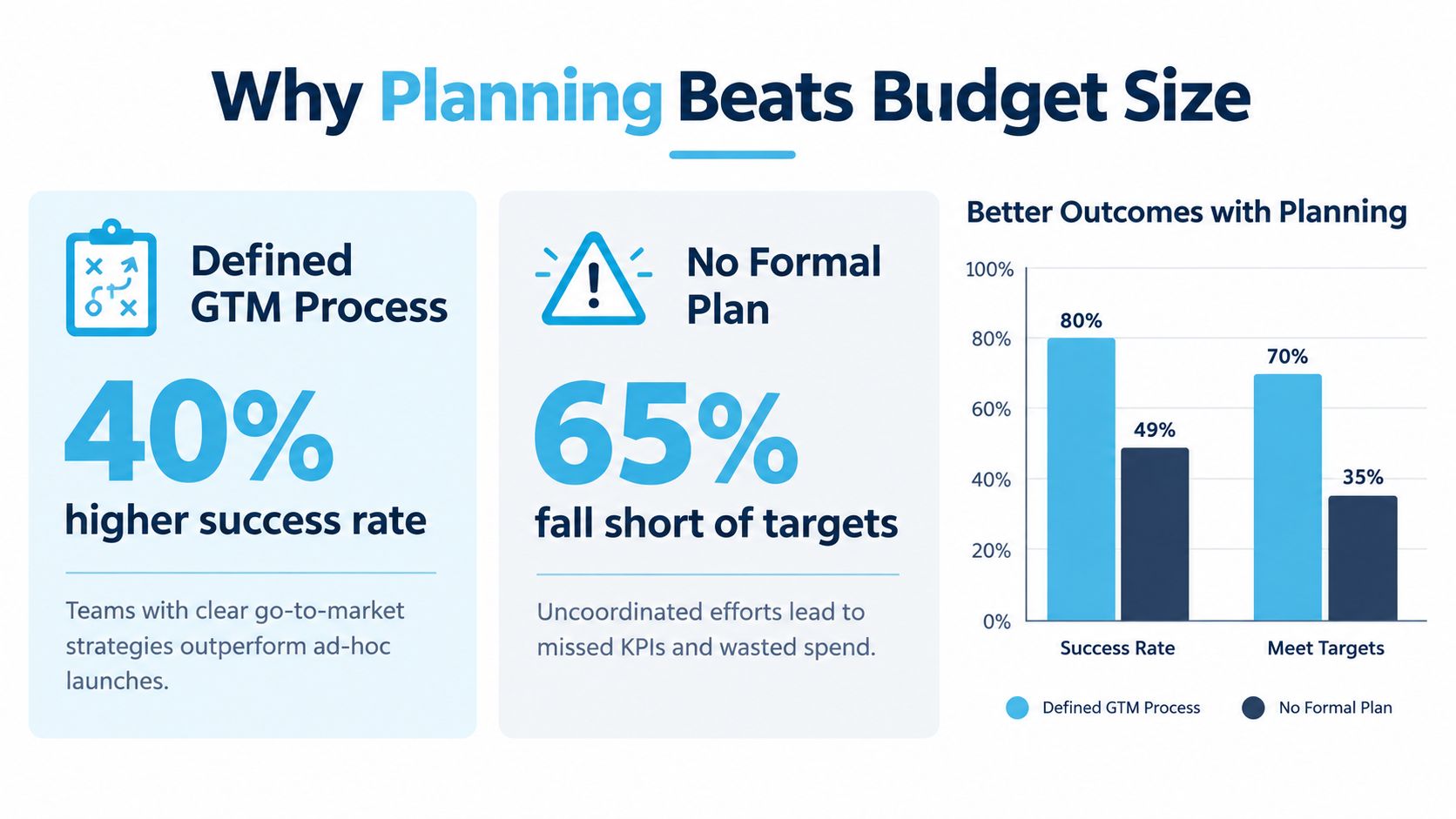
A defined go-to-market process creates discipline before money enters the system. The team agrees on the audience, message, timing, ownership, measurement, and fallback decisions. That makes it possible to diagnose whether the problem is reach, engagement, offer relevance, checkout friction, fulfillment, or economics.
A benchmark reports a 63% launch success rate with a formal process versus 53% without one, and firms using that process show 3x higher median revenue growth (product launch process benchmark). The same source cites McKinsey’s finding that more than 40% of launches fail overall and that launch investment size doesn’t correlate with success. The implication is practical: spending more isn’t a substitute for deciding better.
Measure the launch as a business system
A useful review goes beyond launch-day revenue. Compare the planned and actual result across:
- Demand quality: Which channels brought shoppers who engaged with the product rather than only the discount?
- Conversion quality: Did the offer improve purchase behavior without requiring broader or deeper incentives?
- Margin quality: What remained after discounts, shipping, fulfillment, fees, refunds, and stacked rewards?
- Customer quality: Did the campaign attract customers likely to return, or mainly customers trained to wait for promotions?
- Execution quality: Which approval, technology, or ownership gaps created avoidable delays?
Discount fatigue is a measurable commercial problem, not only a brand concern. A 2026 ecommerce analysis reports that low-discount brands grew gross merchandise value about 2 times faster than deep discounters and held a 19-point margin advantage, while revenue fell about 27% below baseline in the weeks after a promotion (ecommerce discount strategy analysis). The same analysis cites a 2023 ProfitWell study associating discounts more than twice per quarter with 30% lower customer lifetime value than strategic discounting.
A strong marketing launch plan template therefore does more than schedule emails and ads. It gives the team a way to create a credible decision window, protect the margin floor, and learn from the launch without training customers to wait for the next markdown.
Quikly provides Shopify merchants with behavior-driven urgency and scarcity promotions, using rewards that are capped by time, quantity, or both across the storefront, email, social, and SMS. Add it to the launch plan when you want shoppers to participate in a clearly bounded offer rather than receive another blanket discount, then visit Quikly to see how the approach fits your next campaign.
Topics: marketing launch plan template, product launch, Shopify launch, marketing checklist