A Shopify merchant sends a 24-hour sale email, sees a brief bump in orders, then watches the next promotion need a deeper discount to produce similar revenue. The subject line said “last chance,” the store showed a countdown, and the offer still felt familiar. When every campaign sounds urgent, shoppers learn to wait.
The problem often isn’t the wording. It’s whether customers believe the deadline, understand what’s included, and see a reason to act now. A credible limited time offer email connects a real constraint to a relevant benefit, then measures whether the urgency created profitable orders without wearing down customer trust.
Why Most Limited Time Offer Emails Underperform
The first 24-hour sale can feel like a win. Orders come in, the campaign ends, and the Shopify dashboard shows a temporary lift. Then the next sale arrives, and the same “ends tonight” framing gets a weaker response. The merchant adds a larger discount, but the improvement doesn’t last.
That pattern doesn’t necessarily mean the offer is wrong. It may mean urgency has become wallpaper. A countdown graphic and a familiar phrase can’t make a deadline meaningful if customers expect the sale to return, see no reason for the cutoff, or discover that the promotion continues afterward.
The credibility gap
Shoppers weigh the offer and the conditions around it. If the email claims a deal expires at midnight but the landing page keeps showing the same price the next morning, the customer has learned something: the deadline was negotiable. The next campaign starts with less trust.
This is why urgency isn’t a copywriting trick. The offer needs a verifiable end condition, consistent terms, and a customer benefit that makes acting sooner worthwhile. A discount alone may attract attention, but repeated blanket discounts can train customers to delay purchases until the next markdown, putting pressure on both margin and perceived value.
Operator’s rule: If the deadline can’t be explained and enforced, don’t make it the headline.
The same principle applies to shopping decisions beyond email. A retailer’s guide to finding value in McLaren Vale deals is useful context for thinking about what makes a time-bound offer worth considering: the value has to be clear, not merely loud.
A stronger campaign gives shoppers a specific reason to decide, then makes the rules easy to verify. That shift matters for Shopify brands facing weak conversion and shrinking margins. The aim isn’t to make every message more urgent. It’s to make each deadline credible enough that customers can distinguish a real opportunity from routine promotional noise.
What the Research Actually Says About Urgency
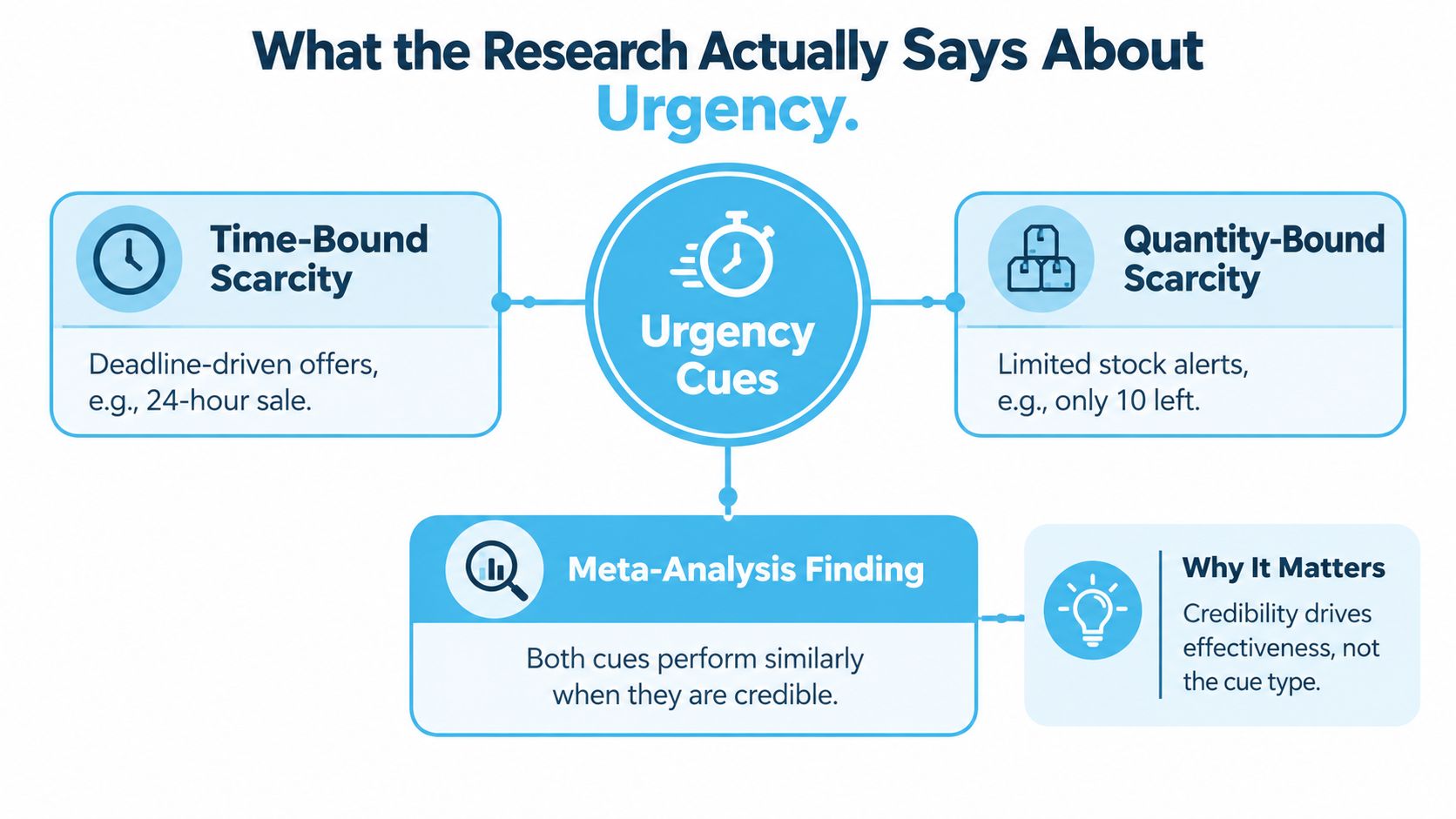
More urgency isn’t automatically more persuasive. Scarcity works when shoppers perceive a real constraint, and the type of constraint matters less than whether it holds up.
A meta-analysis of product-scarcity research distinguishes limited-time scarcity, such as an offer available for 24 hours, from limited-quantity scarcity, such as a reward capped by available claims. It found no statistically significant difference between the two cues in their effect on purchase decisions. That finding doesn’t establish that every deadline or stock limit works equally well. It suggests that a credible time limit can be a meaningful alternative to a genuine quantity limit, rather than a weaker form of urgency by definition. (Meta-analysis of product-scarcity effects)
A deadline needs a reason
A real product drop, seasonal cutoff, holiday, or recipient’s birthday gives the deadline a context customers can understand. Research summarized by Drexel University marketing scholars indicates that time-scarcity promotions can perform better when the reason for the deadline is outside the retailer’s control, and that a shorter remaining window can be more effective than a distant expiration. The same research warns that excessive or implausible scarcity can prompt skepticism. (Drexel University marketing research summary)
A peer-reviewed e-commerce study also found that displaying a limited-time availability notice increases perceived scarcity and, through that perception, purchase intention. The mechanism isn’t the countdown graphic itself. Shoppers have to believe the opportunity is constrained. (Peer-reviewed study of limited-time availability notices)
Time pressure can also backfire. Scarcity research indicates that consumers may look for the same product at alternative retailers when a promotion feels inconvenient or untrustworthy. That makes deadline clarity part of conversion strategy, not merely a detail for legal copy. (Research on scarcity and alternative-retailer seeking)
If the deadline cannot be verified on the store and at checkout, customers have reason to discount the urgency.
State the end time, time zone, eligible products, and any real claim or inventory limit. Don’t reset a countdown to create the appearance of a fresh opportunity. The useful question isn’t whether the email sounds urgent. It’s whether a customer can tell why the offer ends when it does.
Building the Campaign Before You Write a Single Word
Start with the business question, not the subject line. Do you want to know whether a deadline creates additional purchases, increases revenue per delivered email, or shifts orders earlier without damaging margin? Choose one primary outcome and set the guardrails before the campaign goes out.
A campaign is easier to evaluate when the deadline is the only meaningful difference between the treatment and control. Give both groups the same product, price, creative, and send time. The treatment receives a truthful deadline; the control sees the standard promotional framing. That comparison helps show whether the urgency itself contributed, rather than crediting the deadline for results caused by a different offer or audience.
Make the test interpretable
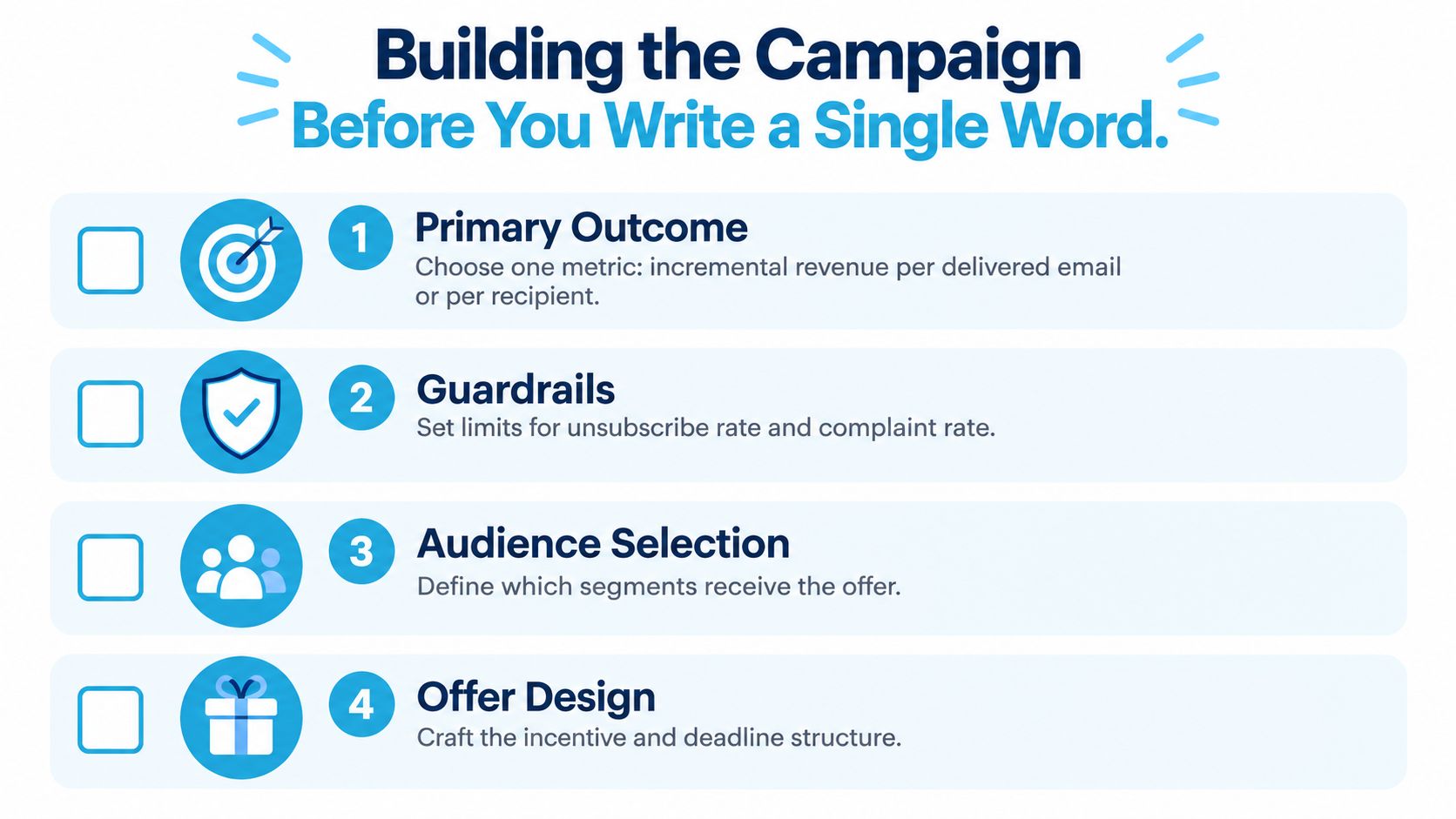
Before drafting, settle four decisions:
- Primary outcome: Choose one, such as completed purchases or revenue per delivered email. Use delivered email as the basis for comparison, not opens alone, because privacy features can distort open tracking.
- Guardrails: Monitor unsubscribe and complaint rates alongside margin per order and average order value. A lift in orders may not be worth buying with a deeper discount or a less responsive list.
- Audience: Define who is eligible and who belongs in the holdout. Consider whether new and repeat customers should be evaluated separately.
- Offer design: Record the genuine constraint, eligible products, exact expiration, and what happens when the window closes.
Predefine the minimum detectable effect, the smallest lift that would matter enough to change your decision. This protects you from declaring a weak or noisy result a win after looking at the numbers. Compare outcomes by delivered email, then check whether the added urgency produced incremental profit after discount and fulfillment costs.
Keep the setup clean. Changing the subject line and discount at once won’t tell you which change drove the result. Neither will a fake countdown, or a deadline that gets extended after it has passed.
For seasonal campaigns and larger-ticket purchases, compare the offer mechanics with the actual shopping context. A merchant planning an event or category promotion can check local furniture specials to see how a retailer presents offers to shoppers. The useful lesson for your own campaign is to make the product scope and terms plain before you ask for a decision.
Subject Lines That Earn the Open Without Burning Trust
A subject line should make a promise the email can keep. For a limited time offer email, that promise can focus on the benefit, the verifiable deadline, or the scarcity cue. Choose the approach that matches the customer’s reason to care, then make the opening line confirm it.
| Approach | When it fits | Primary risk |
|---|---|---|
| Benefit-led | The customer’s outcome is stronger than the discount itself | The deadline can feel hidden if it’s not stated promptly |
| Deadline-led | The closing time is real, clear, and relevant | A bare timestamp can lack a compelling reason to open |
| Urgency-led | A genuine constraint makes early action useful | Repeated urgency language can feel routine or manipulative |
Test the framing, not everything at once
A benefit-led subject line puts the customer’s result first. A deadline-led line makes the timing explicit. An urgency-led line uses scarcity language, which may catch attention but can also heighten skepticism if the message doesn’t substantiate it.
Test one difference at a time. Compare a benefit-led subject with a deadline-led one while keeping the offer and send time fixed. Don’t rewrite both the subject and preview text, change the discount, and then attribute the result to a countdown phrase.
Available benchmark material reports urgency-oriented subject lines at roughly 31.4% opens and 6.8% click-through, alongside a 0.21% unsubscribe rate. Treat those figures as directional, not a promise of what your list will do. A separate compilation claims a 33% click-through improvement for deadline-oriented subject lines, but its methodology is less transparent. (Urgency subject-line benchmark material)
A separate compilation reports a 28% higher unsubscribe rate for urgency-word emails and a 0.42% unsubscribe rate when multiple urgency words appeared, compared with 0.21% without urgency. These aren’t universal causal estimates, but they’re a reminder to look beyond opens and clicks when judging aggressive phrasing. (Urgency and unsubscribe benchmark compilation)
Keep the inbox preview aligned. If the subject promises a reward ending tonight, the first line shouldn’t bury the terms under a brand story. Use enough preview text to clarify the benefit or deadline, then make sure the landing page continues the same promise.
One clear urgency cue can be enough. Stacking “last chance,” “ending soon,” and “act now” doesn’t make an uncertain deadline more believable.
Body Copy and Design That Make the Offer Verifiable
The email body has a simple job: explain the value, prove the conditions, and make the next step obvious. Put the offer and deadline in the opening, not several scrolls below a campaign manifesto. Then give customers enough context to decide without forcing them to decode the terms.
Use a clear message hierarchy
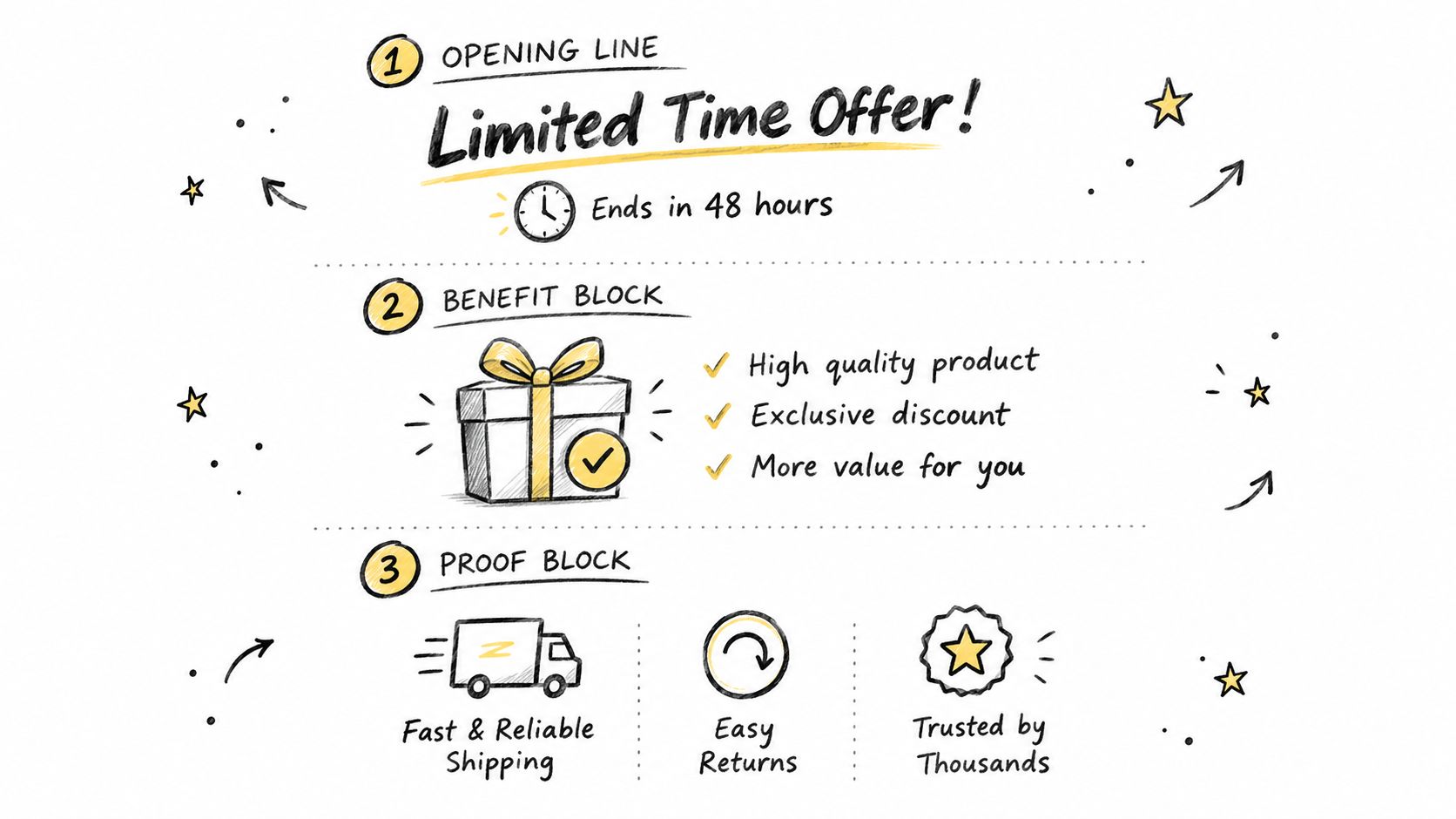
Opening: State the offer and the actual end condition in the first sentence. “Take the seasonal set for the sale price through Friday at 11:59 p.m. Pacific Time” is more useful than “Don’t miss out.”
Benefit block: Explain what the customer gets and which products, variants, or rewards qualify. If the offer is a reward rather than an automatic markdown, tell the reader what action makes them eligible.
Proof block: Include relevant, truthful reassurance, such as a shipping cutoff or returns information. Social proof can help when it’s genuine and directly relevant, not pasted in as decoration.
Deadline and CTA: Repeat the exact expiration timestamp and time zone in accessible text, then use one primary button with a direct action. Keep the call to action close to the offer, where a shopper can act without searching.
A countdown timer can reinforce a real deadline, but it can’t substitute for readable terms. The time should agree across the email, landing page, cart, and checkout, including for customers in different time zones. If the offer uses a timer, make sure the essential information still appears as text and isn’t dependent on an image or JavaScript rendering correctly. For a practical look at the role of timers in email, see how email countdown timers work.
Remove friction from the click
The easy-to-miss failures are usually practical. An image-only offer can disappear in dark mode or when images are blocked. A button that leads to a landing page with a different expiration creates doubt. And a CTA placed after several screens of brand storytelling asks the customer to do extra work just to reach the deal.
Keep the headline, stated terms, and button consistent from inbox to checkout. If you’re browsing how a retailer organizes discounted products, California Cowboy’s clearance picks offer an example of a direct route from promotion language to an eligible collection.
The timer supports the deadline. Plain text proves what the deadline is.
Segmentation That Prevents Urgency Fatigue
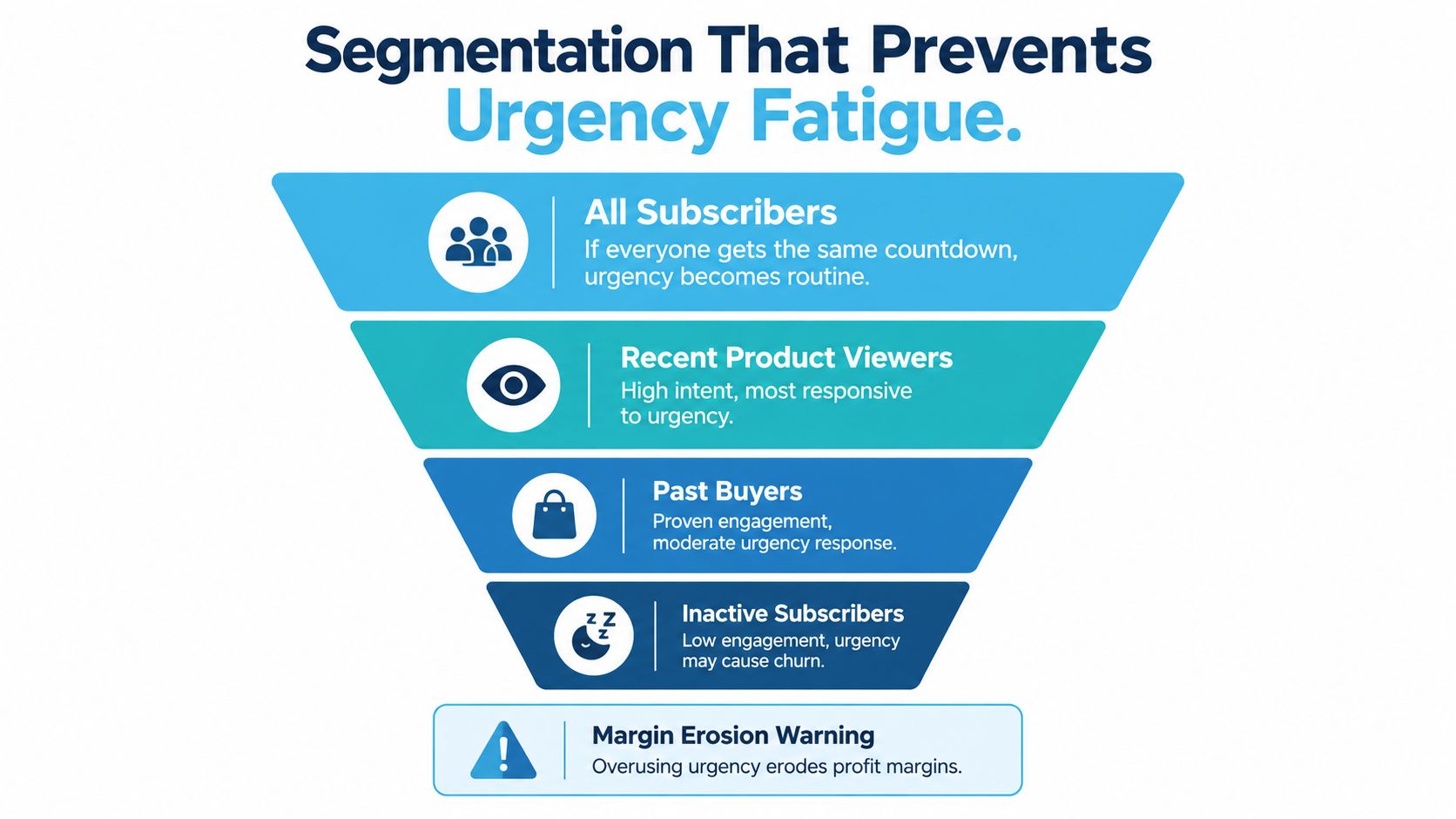
If every subscriber gets the same countdown, the countdown stops distinguishing anything. It also spends discount budget on people who might have bought without an incentive, while subjecting disengaged subscribers to another demand for attention.
Match urgency to observed intent
Recent product viewers and cart abandoners have shown specific interest. They may be reasonable candidates for a deadline if the offer addresses the item they considered and the expiry is real. Engaged repeat buyers can receive an offer shaped around their purchase history or a relevant reward, rather than an untargeted storewide markdown.
Subscribers who haven’t interacted recently need a different decision. A repeated “ends tonight” email may earn an unsubscribe rather than a purchase. Try relevance, recognition, or early access instead, then reserve stronger urgency for a campaign whose terms and audience fit.
A useful segment plan connects each message to behavior:
- Recent viewers: Reference the product or category they browsed, and make the expiration concrete.
- Cart abandoners: Confirm eligible items and terms, and suppress the message if the order completes.
- Repeat buyers: Consider a relevant reward or early access that acknowledges their history.
- Inactive subscribers: Lead with a clear benefit or access, rather than assuming another countdown will restore interest.
Behavioral research on promotions and email supports treating relevance and recognition as alternatives to raw time pressure. Holiday research reported that 55% of consumers considered email the most overwhelming channel during major sales, while 56% said message overload bothered them when offers were irrelevant. The same research found stronger engagement with loyalty or VIP-only campaigns than limited-time deals, and a separate survey reported that relevance was a more common reason to open brand emails than special offers or discounts. (Holiday marketing fatigue research)
Those findings don’t mean urgency has no place. They point to a more useful operating question: who has a reason to respond to this deadline, and who needs a different value proposition? For practical guidance on shaping audience rules, see email marketing targeting.
Use Klaviyo or your email platform’s event data to suppress buyers as soon as they purchase. That prevents a customer from receiving a reminder to claim an offer they’ve already used, and it keeps the campaign focused on people who can still act.
Sending Cadence, Measurement, and When to Send the Next One
A restrained reminder sequence is easier to manage and easier for customers to understand: send an announcement, a midpoint reminder, and a final notice close to expiry. Send follow-ups only to non-purchasers, and suppress buyers immediately after an order. The best send time depends on the audience and offer, so test it against your own purchase behavior rather than assuming one schedule fits every store. This guide to choosing when to send promotional emails can help frame that decision.
Measure the campaign as a connected set of outcomes: delivered-email-to-order rate, click-to-order rate, revenue per recipient, gross margin per recipient, unsubscribe and complaint rates, and post-campaign repeat purchase. Opens can help diagnose delivery or subject-line issues, but they don’t prove purchase intent. Judge the result by whether the deadline created profitable incremental orders, not by which version got the loudest inbox response.
A retailer may be tempted to repeat a discount as soon as its effect fades. That teaches customers to wait and can push margin lower. Rotate time-bound offers with access-based mechanics, relevant rewards, or participation-based incentives, so customers don’t learn that every purchase can safely wait for the next sale.
Email has a strong commercial history, but broad channel performance doesn’t guarantee that any single urgency campaign will pay off. The Direct Marketing Association’s 2019 UK Marketer Email Tracker reported that email generated just over £42 for every £1 spent, while roughly two-thirds of marketers said they measured email return on investment. Those figures describe email overall, not limited-time promotions, and the report’s practical lesson is to track revenue rather than rely on engagement alone. (DMA 2019 UK Marketer Email Tracker)
For your next campaign, write down the exact deadline, the audience who can benefit, and the margin outcome that would make the test worth repeating. Then give customers a reason to act that remains true after the countdown ends.
Quikly helps Shopify brands run on-brand promotions with rewards capped by time, quantity, or both, including campaigns coordinated across storefront, email, and SMS. If you want to test a participation-based offer instead of making every promotion a deeper discount, visit Quikly to see how it works.
Topics: limited time offer email, email urgency, email marketing, ecommerce promotions, scarcity