
You’re probably in a familiar spot. Traffic isn’t the only problem. Plenty of Shopify brands can get people to the site, but average order value stays stuck, conversion only moves when a discount gets louder, and every promo chips away at margin a little more.
That’s why the Good Better Best bundle strategy still matters. Not because tiered pricing is new, but because it gives you a better way to shape buyer choice than another flat code in the header bar. Done well, it helps customers self-select into a package that feels right for them while protecting profit better than blanket discounting.
Most advice on bundles stops at “offer three tiers.” That’s not enough. The work is in two places operators usually skip: the math that tells you whether the bundle can carry its discount, and the behavioral design that keeps the Good tier from stealing demand from the Better tier.
From Flat Discounts to Smart Tiers
A weak bundle is just a discount wearing a nicer outfit.
The merchant adds a few products together, trims the price, puts “save more” on the PDP, and hopes average order value rises enough to cover the margin hit. Sometimes revenue goes up. Profit doesn’t always follow. Worse, customers learn the pattern and wait for the next packaged markdown.
A stronger approach uses three deliberate tiers. The classic Good Better Best model, also called Goldilocks pricing, offers a basic option, a middle option, and a premium option. In the standard structure, the Good price is typically set about 25% lower than the average sales price, and the Best price is set no more than 50% higher. The Better package is positioned to attract most buyers, with companies often expecting 50% or more of sales volume in that middle tier, according to the overview of Good Better Best pricing on Wikipedia.
That changes the job of the bundle.
Instead of asking, “How much should we discount?” the better question is, “How do we guide the customer toward a higher-value purchase that still feels like the smartest choice?” That’s a pricing question, a UX question, and a psychology question.
Practical rule: If your bundle only lowers price and doesn’t improve choice architecture, you’re not running a Good Better Best strategy. You’re running a sale.
For Shopify brands, that distinction matters because the platform makes discounting easy. It also makes over-discounting easy. You can stack an app, a code, a banner, and an email flow in an afternoon. Undoing the brand damage from repetitive markdowns takes longer.
The upside of a smart tiered bundle is that it can raise perceived value without forcing every shopper into the same incentive. The Good tier gives budget-conscious buyers a path in. The Best tier creates aspiration and price context. The Better tier does the commercial heavy lifting.
The Psychology of a High-Performing Bundle
Simple bundles often fail because they treat the customer like a calculator. Real shoppers don’t buy that way. They compare, infer, hesitate, and look for the option that feels safest, smartest, and easiest to justify.
Why the middle tier usually wins
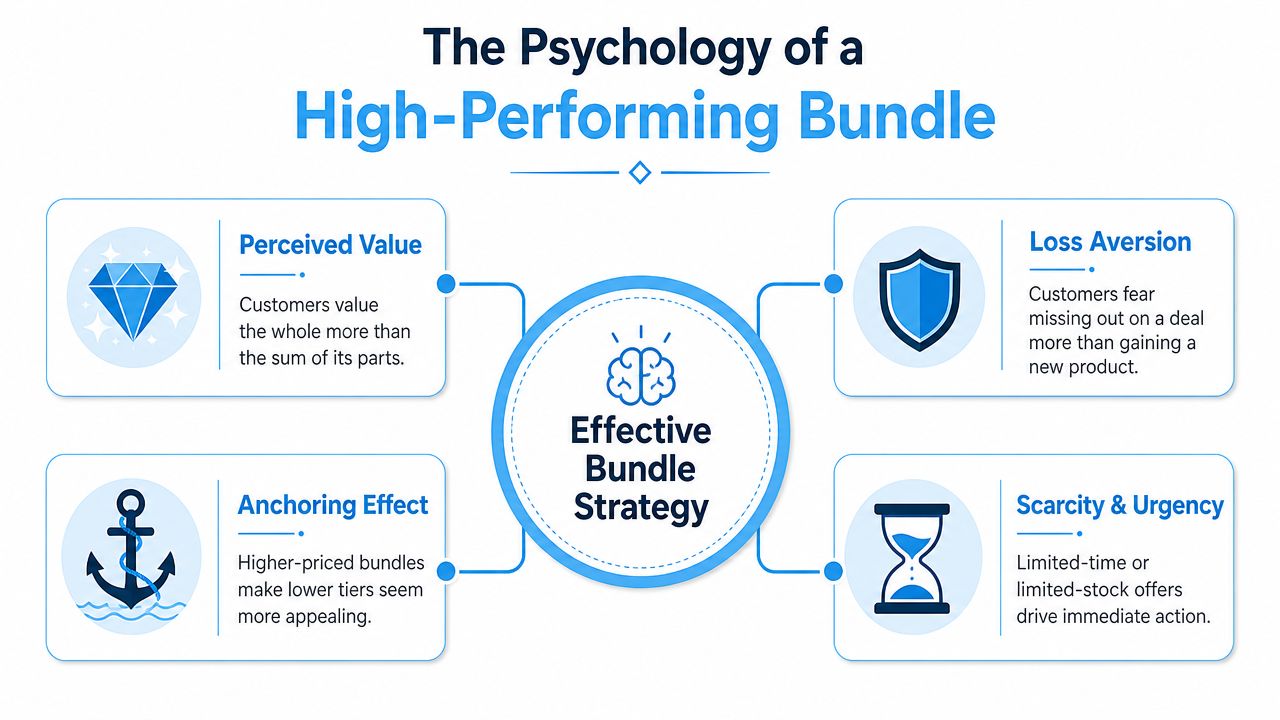
The engine behind this strategy is behavioral economics. A high-priced Best option sets the anchor. That anchor changes how the middle option feels. Instead of looking expensive, Better starts to look sensible.
One useful benchmark comes from the Digital Marketing Institute’s discussion of behavioral psychology. It notes that presenting a high-priced Best option first can make the middle tier feel like the optimal compromise for 70-80% of shoppers who avoid the cheapest and most expensive extremes, in a structure guided by the anchoring effect and compromise behavior in this behavioral pricing overview.
That doesn’t mean every store will see the same mix. It does mean the mechanism is predictable enough to design around.
Here’s what’s happening under the surface:
- Anchoring effect: The Best tier sets the reference point for value.
- Compromise effect: Many shoppers prefer the middle option because it feels balanced.
- Perceived completeness: The Better tier often feels like the “real” solution, while Good feels basic and Best feels indulgent.
- Loss aversion: Buyers react strongly when they feel they might miss out on meaningful value by choosing too low.
If you want a deeper look at how these price signals work on ecommerce storefronts, Quikly’s piece on psychological pricing strategies is a useful companion read.
Build tiers around outcomes, not SKU count
A lot of brands make the same mistake. They create tiers by adding more units, not by increasing usefulness.
That can work for commodity products. It’s weaker for brands trying to improve margin and brand perception at the same time.
Take a skincare example:
| Tier | Example bundle | Customer interpretation |
|---|---|---|
| Good | Cleanser + moisturizer | “I can start here” |
| Better | Cleanser + moisturizer + serum | “This is the real routine” |
| Best | Cleanser + moisturizer + serum + mask + tool | “This is the full experience” |
The Better tier wins when it feels complete, not merely larger.
The same logic applies to coffee:
- Good: one bag of house blend and paper filters
- Better: two bags, filters, and a grinder
- Best: two bags, grinder, scale, dripper, and premium roast
The Better option works because it solves the core job more fully. It helps the customer get a better result at home. That’s more persuasive than a generic “save on a bundle” label.
Shoppers don’t upgrade because you added items. They upgrade because the middle tier reduces the chance of making the wrong purchase.
What psychology does not fix
Psychology can improve presentation. It can’t rescue a lazy offer.
If the products don’t belong together, if the gap between tiers feels arbitrary, or if the Good option already satisfies the main use case too well, the strategy stalls. In those cases, all you’ve done is introduce more decisions without improving the offer.
Designing Your Good Better Best Product Tiers
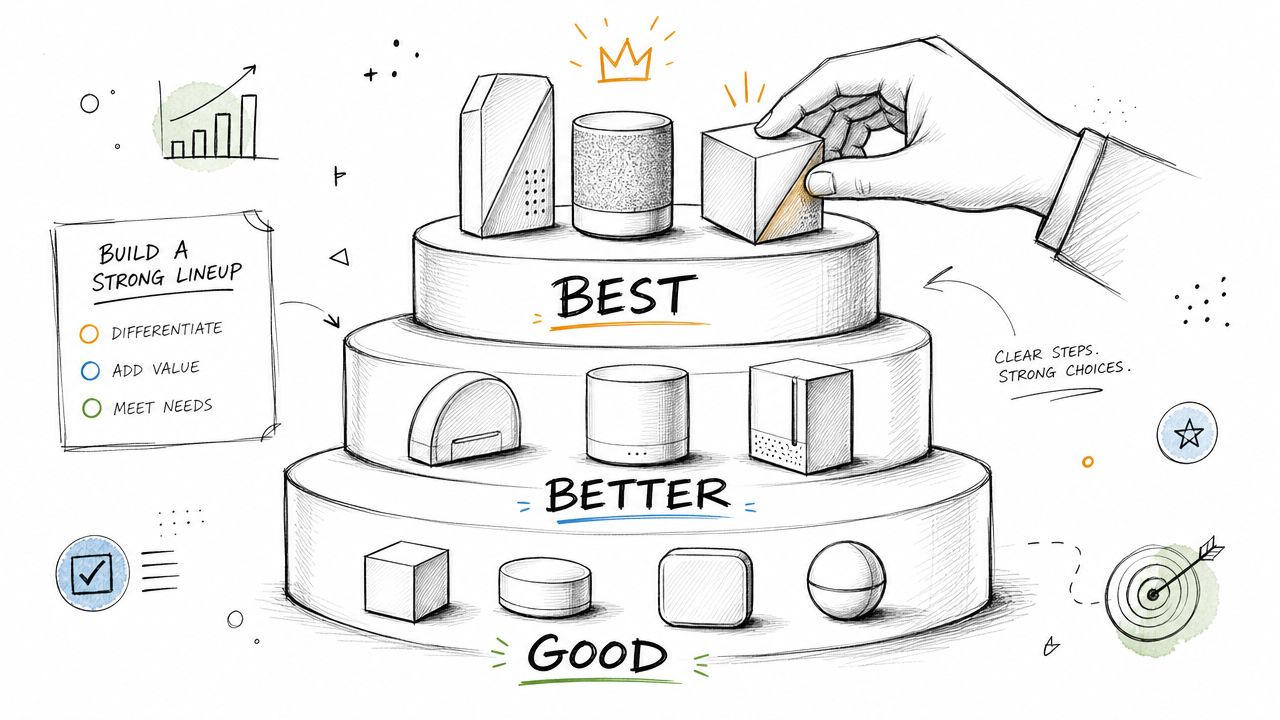
The hardest part of the Good Better Best bundle strategy isn’t naming the tiers. It’s deciding what each tier should do.
Start with the Better tier
Most operators build from the bottom up. That’s backwards.
The Better tier should come first because it’s the commercial center of the model. In a strong setup, the target is 50% or more of total revenue from the Better tier, and its price should sit approximately halfway between the Good and Best prices, with “fence” features that clearly separate the tiers without weakening the middle offer, as described in Impact Pricing’s guide to the strategy.
That means Better needs to represent the most common customer need.
For a coffee brand, Better might be the “Home Barista” bundle:
- core beans
- grinder
- brewer
- a small convenience or quality upgrade
That customer can make good coffee immediately. No missing piece. No hidden follow-up purchase.
Define fence features clearly
Fence features are the differences that make each tier feel logical.
Good fences are easy to understand:
- a premium roast instead of a house blend
- a ceramic dripper instead of a basic brewer
- a storage canister or scale included only in higher tiers
- priority access to a limited seasonal item in the top package
Bad fences feel arbitrary:
- random accessories no one asked for
- duplicate items that inflate quantity but not usefulness
- exclusions that make Good feel intentionally crippled
A clean way to pressure-test your fence features is to ask one question: does this difference map to a real use case?
If not, the tier line won’t hold.
What each tier should accomplish
A practical structure looks like this:
| Tier | Role in the lineup | What to avoid |
|---|---|---|
| Good | Entry point for price-sensitive shoppers | Making it so complete that upgrades feel unnecessary |
| Better | Default recommendation for most buyers | Pricing it too close to Good or stuffing it with weak extras |
| Best | Aspirational anchor and premium margin play | Underpricing it so it fails to create contrast |
Many Shopify stores miss the mark in this area. The Good tier often gets too much value because the team worries a lean entry option won’t convert. But when Good is too strong, Better loses its job.
Operator note: The Good tier should solve the basic problem. It should not remove the reason to move up.
Keep product logic tighter than promotion logic
The products in each tier need internal coherence before you think about discount depth.
For example, a beauty brand might build:
- Good as “Daily Essentials”
- Better as “Complete Routine”
- Best as “Studio Set”
Those names work only if the products match the promise. “Complete Routine” should feel complete. “Studio Set” should feel premium, not padded.
You also need operational discipline:
- Check inventory fit: Bundles can help move slower stock, but don’t let aged inventory dictate the whole tier strategy.
- Review fulfillment friction: If Best creates picking complexity or frequent substitutions, the premium perception falls apart.
- Protect merchandising clarity: Shoppers should understand the difference at a glance, especially on mobile Shopify PDPs.
When the assortment is right, pricing and presentation become multipliers. When the assortment is wrong, they become camouflage.
Pricing Bundles for Profit Not Just Revenue
A store launches a three-tier bundle, average order value jumps, and the team calls it a win. Thirty days later, gross margin is down because the discount was richer than the conversion lift.
That pattern shows up constantly in bundle tests. Operators track revenue lift, but the core question is simpler: how much extra bundle adoption do you need to earn back the margin you gave away?
Andreessen Horowitz makes this point clearly in its piece on when and how to bundle products. As discounts get deeper, the adoption lift required to break even rises fast. That is the math many Good Better Best setups skip.
Start with break-even math, not discount depth
Before setting prices, calculate the minimum lift required for the bundle to make sense.
Use a worksheet that answers five questions:
- What would the customer pay buying these items separately?
- What is your gross profit on that standalone mix?
- What is your gross profit at the proposed bundle price?
- How much profit do you give up per bundled order?
- How many more bundle orders do you need to offset that profit loss?
The model does not need to be fancy. It needs to be honest.
If a bundle cuts $8 of gross profit per order and your current product mix would have generated that margin anyway, the offer needs to drive enough extra conversion, attach rate, or units per session to recover the gap. If you cannot state that target upfront, the discount is guesswork.
For a more practical breakdown of how to set those thresholds, Quikly’s guide to bundle pricing strategy is a useful reference.
Price for contribution margin
Bundle pricing should protect contribution margin after fulfillment, payment fees, and channel costs, not just gross revenue on the PDP.
That matters most in categories with thin margins, heavy products, or high pick-and-pack complexity. A 15% bundle discount can look harmless in a spreadsheet built on product margin alone. Add shipping subsidies, bundle inserts, and warehouse labor, and the economics change quickly.
Simon-Kucher lays out the logic well in its analysis of good-better-best packaging and bundling. The practical takeaway is straightforward. Higher-margin categories can usually support more visible bundle savings. Lower-margin categories need tighter pricing, clearer tier separation, and stronger reasons to trade up that do not rely on a big markdown.
For a useful example of clear tier separation outside ecommerce, see RenderIO’s pricing structure. The category is different, but the discipline is the same. Each tier has a job, and the price gaps support that job.
Use pricing psychology to protect the Better tier
The pricing math sets the floor. Behavioral design shapes where customers land.
A common failure point is treating the Good tier as a cheaper version of Better with only one or two missing items. That structure invites downtrading. Better needs a stronger reason to exist, and price alone usually is not enough.
Use spacing with intent. Good should feel accessible, Better should feel like the rational choice, and Best should create contrast without looking fake. If Better is too close to Good, price-sensitive shoppers move down. If Best is too close to Better, it stops anchoring.
Scarcity also helps prevent Good from cannibalizing Better. Keep the entry tier permanently available if you want volume, but test limited-time bonuses, exclusive variants, or capped availability on Better or Best. That changes the decision from “cheapest acceptable option” to “best value before it goes away.” In my experience, that shift often does more than adding another low-cost product to the box.
Sanity-check the offer before launch
Run through these checks before publishing the bundle page:
- Margin survives after all variable costs.
- Better delivers a visible value jump without giving away too much profit.
- Best anchors the set with a believable premium.
- Good solves the entry need without making Better optional for your core buyer.
- Any scarcity mechanic is real and operationally supportable.
Bundle pricing fails in predictable ways. The discount is too deep. The price gaps are too narrow. The team uses feature gating but ignores urgency. Or the bundle looks profitable on paper because no one modeled what customers would have bought anyway.
The stores that get this right treat pricing as a conversion tool and a margin control system at the same time.
Presenting Bundles to Drive Action
A shopper lands on your bundle page, scans for five seconds, and picks the cheapest option. That usually is not a pricing problem. It is a presentation problem.
Good Better Best works when the page tells the shopper what to buy, why it is the smart choice, and why waiting has a cost. If all three bundles get equal visual weight and generic copy, shoppers default to the lowest-friction decision. On most stores, that means Good.
Merchandise the Better tier like the default choice
The Better tier should read like the recommended purchase, not just the middle card.
On Shopify, that usually means a three-card layout on desktop and stacked cards on mobile, with Better carrying the strongest visual priority. Use a stronger border, a clear “Most Popular” label, tighter copy, and the most obvious add-to-cart button. The goal is simple. Reduce comparison fatigue and make the middle option feel pre-vetted.
Copy matters just as much as design. Product counts and savings badges help, but outcome-led language closes the gap faster.
- Weak: “Includes 3 products, save on bundle”
- Better: “The complete routine for most customers”
- Best: “Everything in Better, plus premium extras and limited access”
The strongest tier names also do a lot of quiet work. They orient the shopper before the shopper reads a line of detail.
- Essential / Complete / Premium
- Starter / Most Popular / Collector
- Daily / Full Routine / Pro Set
Use urgency to protect Better from Good
Feature differences alone do not always keep shoppers out of the entry tier. In physical product bundles, Good can feel “good enough” faster than operators expect, especially when the products are familiar and the use case is straightforward.
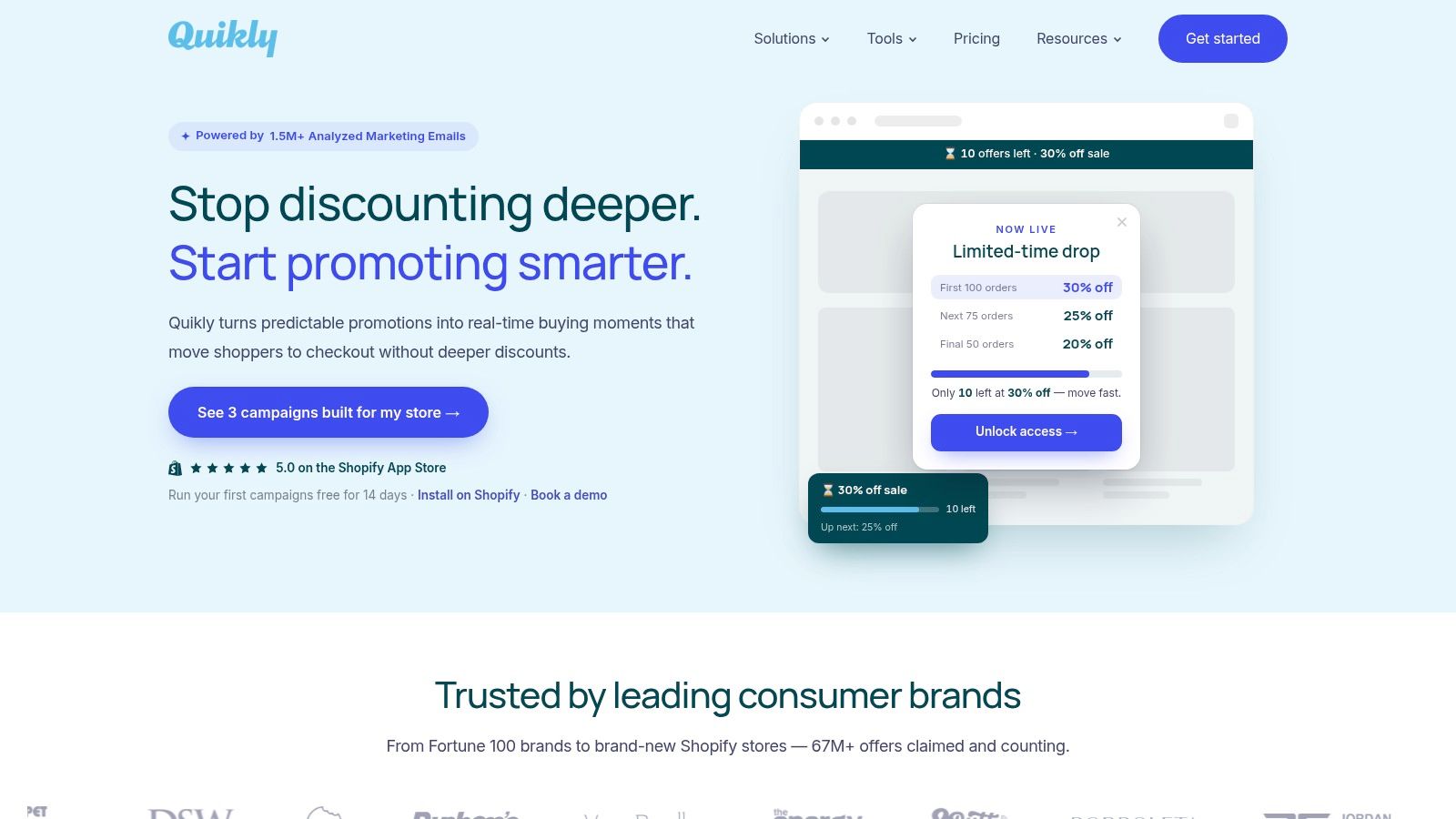
Real urgency helps. Quikly explains the mechanics well in its piece on promotional marketing and urgency mechanics. Time limits, capped rewards, and quantity-based offers change the decision frame. The shopper is no longer asking only which tier is cheapest. The shopper is deciding which option gives the best payoff before the window closes.
That is the practical use of scarcity here. It is not decoration. It is a control mechanism for tier mix.
A few tactics work well:
- Add a limited bonus item to Better for the first set of buyers.
- Give Better a time-bound reward that expires before the sitewide sale ends.
- Release Better first to email or SMS traffic, then open Good later.
- Reserve a variant, scent, colorway, or gift-with-purchase for Better or Best.
The trade-off is operational. Scarcity only works if inventory, fulfillment, and customer support can back it up. If the cap is fake or the timing slips, trust drops and the bundle loses force.
Test the presentation, not just the discount
Teams often change price first because it feels measurable. In practice, layout, copy, and offer framing can move more demand than another 5 percent off.
Start with a short test list:
- Visual emphasis: Better highlighted vs equal treatment
- Copy framing: outcome-led messaging vs item-count messaging
- Urgency mechanic: static bundle vs limited reward on Better
- Tier naming: plain labels vs buyer-oriented labels
- Savings display: total bundle savings vs per-item value
Watch what happens to click-through, add-to-cart rate, and tier selection. If you need a benchmark for the order-value side of the equation, Average Order Value explained is a useful primer, and this guide on improving average order value in Shopify shows how promotional structure affects basket size.
Measure whether the page is steering the mix you want
The page is doing its job if Better gets a healthy share of bundle orders without forcing margin down.
Track these numbers first:
- Bundle attach rate: how often shoppers choose any bundle
- Tier mix: whether Good is taking too much share from Better
- AOV by tier: how each bundle changes order value
- Gross profit by tier: whether Better is still the best economic outcome
- Conversion by channel: paid, email, and SMS traffic often behave differently
If Better underperforms, check the page before you cut price. The usual failure points are obvious once you look for them. Good is too complete. Better does not look recommended. Best is not creating enough contrast. Or the urgency mechanic is weak, unclear, or missing altogether.
How to Measure and Test Your Bundle Strategy
A bundle can raise revenue and still make the business worse.
That usually shows up in a familiar pattern. Good takes too many orders, Better gets ignored, AOV ticks up a little, and gross profit slips because the discount on the wrong tier is doing all the work. That is why bundle testing has to answer two questions at the same time: are shoppers taking the path you intended, and does that path still clear your break-even margin?
Track the metrics that expose weak tiers
AOV gets attention because it is easy to spot. It is not enough on its own. If you want a quick refresher on the definition itself, Average Order Value explained gives a straightforward overview.
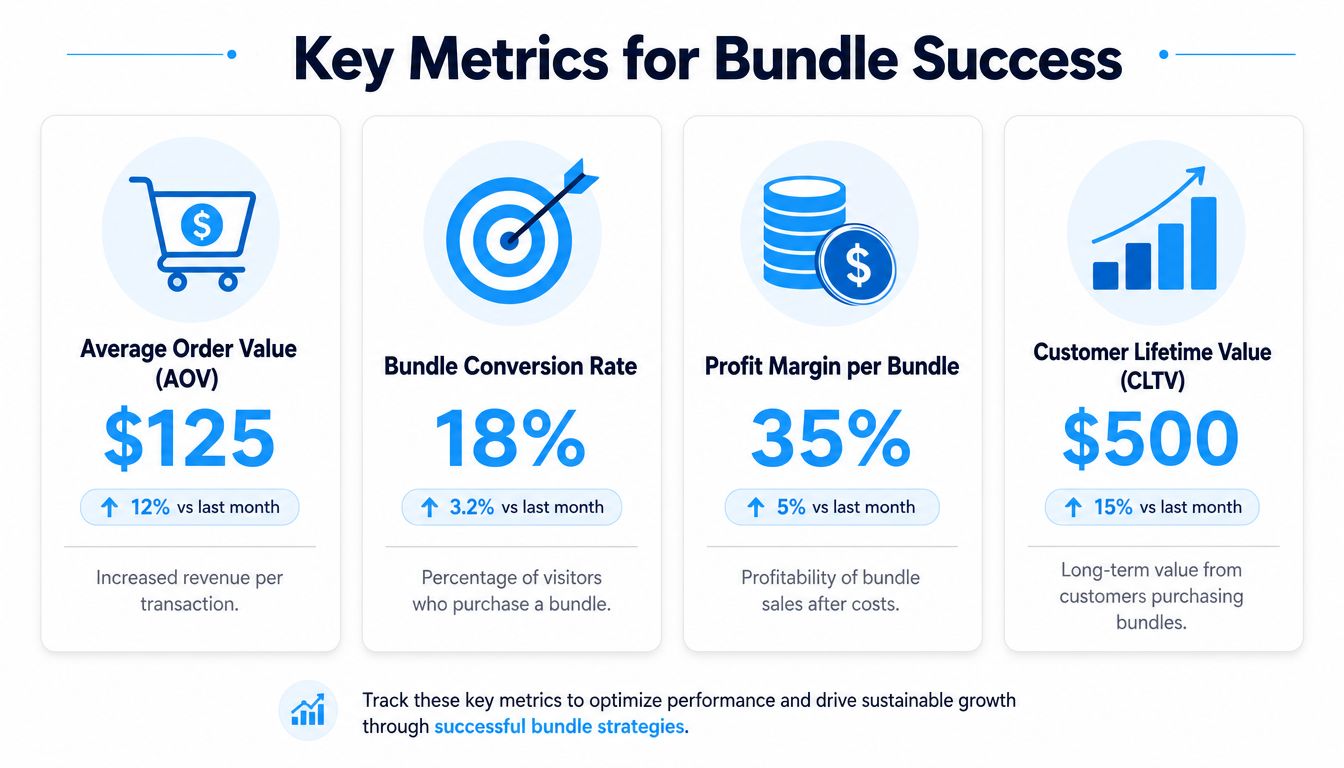
The working dashboard is small:
| Metric | Why it matters |
|---|---|
| AOV | Shows whether the bundle is lifting order value |
| Bundle attach rate | Shows whether shoppers are choosing bundles at all |
| Tier mix | Shows whether Good is cannibalizing Better |
| Gross profit per bundle | Catches margin erosion that revenue can hide |
Add one more layer that operators often miss. Track contribution margin by tier after product cost, pick-and-pack, platform fees, and promo cost. If Better is supposed to be your profit engine, set a floor for acceptable margin before you test anything. That one guardrail keeps a “winning” experiment from training your team to celebrate unprofitable growth.
If you are already working on basket economics, this guide to improving average order value in Shopify is a useful reference for how promotional structure changes order behavior.
Use testing to find the actual bottleneck
Do not test five variables at once. You will get noise, not direction.
Run tests in a sequence that protects margin and tells you what changed buyer behavior:
- Composition first. Check whether each tier has a clear job. Good should open the door. Better should feel complete. Best should make Better look sensible, not dominate volume.
- Then price spacing. Small gaps rarely move buyers up. Large gaps can stall conversion. The jump from Good to Better has to feel justified in one glance.
- Then behavioral pressure. If Good is cannibalizing Better, do not assume the answer is a deeper Better discount. Add a reason to act on Better now, such as limited-time bonus value, limited inventory, or a time-bound gift. Scarcity is often what shifts the mix without cutting margin further.
- Then presentation. Recommendation badge, visual weight, mobile order, and value callouts matter once the offer itself is sound.
- Discount depth comes last. It is the easiest lever to pull and the hardest one to roll back.
This order reflects how bundle failures usually happen in practice. The Good tier includes too much. Better is priced correctly but framed weakly. Best fails to create contrast. Or the page gives shoppers no reason to choose Better today instead of settling for Good.
A bundle page is not successful just because it converts. It has to push orders into the tier mix that keeps the model healthy.
The first move to make this week
Pull one high-volume collection and review the current bundle against three questions.
First, where is the break-even line for each tier after all costs? Second, which tier do you want to win most often? Third, what stops Good from becoming the comfortable default?
Audit the page with those questions in mind:
- Is Good missing a meaningful reason to stay there, or is it too complete?
- Does Better solve the full use case?
- Does Best create contrast without requiring a heavy discount?
- Is there a time or quantity-bound reason to pick Better now?
- Can a shopper understand the upgrade path in a few seconds on mobile?
If those answers are weak, leave the discount alone for now. Fix the tier roles, the spacing, and the urgency mechanic first. That is where most margin leaks start.
Topics: good better best bundle strategy, bundle pricing, average order value, shopify pricing strategy, profit margin