You can see the problem in most Shopify stores by looking at the promo calendar.
A sitewide sale goes out. Revenue jumps. The team breathes for a day. Then the postmortem starts. Margin took a hit, full-price demand got pulled forward, and a chunk of customers just learned to wait for the next code. The campaign “worked,” but it didn’t make the business healthier.
That’s why trigger based marketing matters. Done well, it doesn’t start with “what promo do we need to send this week?” It starts with “what did the customer just do, and what response would move them forward without giving away more than we need to?” That shift sounds small. Operationally, it changes everything.
The Promotion Paradox Why More Sales Can Mean Less Profit
Most merchants don’t have a traffic problem. They have a conversion economics problem.
You pay to acquire the visit, then rely on broad discounts to close the sale. That can lift orders in the short term, but it also conditions buyers. If every meaningful moment gets solved with 15% off, people stop responding to the brand and start responding to the discount. That’s not retention. That’s dependency.
The pressure is worse when your store has a mixed audience. Some shoppers need a nudge. Others were already close to buying. Traditional promotions treat both groups the same, which means you often give margin away to customers who didn’t need the incentive in the first place.
Why the old promo calendar breaks down
Calendar-based campaigns assume intent is evenly distributed. It isn’t. One visitor just added a hero SKU to cart. Another viewed a category page for ten seconds. Another bought last week and shouldn’t see a win-back offer for months. Sending the same promotion to all three is lazy targeting dressed up as efficiency.
Modern shoppers also expect relevance. A reported 72% of consumers say they only engage with personalized marketing messaging according to Cordial’s trigger messaging benchmark. That doesn’t mean every message needs to feel hyper-custom. It means the timing and context have to make sense.
Trigger based marketing works because it follows intent instead of interrupting it.
For Shopify merchants, that’s the practical appeal. You stop using promotions as a blunt instrument and start using them as responses to behavior. A cart abandonment reminder is different from a first-purchase welcome offer. A post-purchase replenishment message is different from a browse abandonment prompt. Each one solves a distinct moment in the buying journey.
That’s the path out of the promotion hamster wheel. Not fewer promotions for the sake of restraint. Smarter ones, tied to actual signals.
What Is Trigger Based Marketing And Why It Beats Mass Emails
Trigger based marketing is event-driven automation. A customer does something measurable, and your system responds with a pre-defined action. That action might be an email, SMS, push notification, onsite message, or offer logic. The core mechanic is simple: behavior comes first, messaging follows.
HubSpot describes triggered marketing as event-driven automation where measurable signals such as cart abandonment or page views can fire a defined action, and results depend on building the right if/then logic for each trigger in your stack, as explained in HubSpot’s guide to triggered emails.
A useful way to think about it is this. Mass email is a loudspeaker. Trigger based marketing is a concierge. The loudspeaker announces the same thing to everyone in the room. The concierge responds to what one person just asked for.
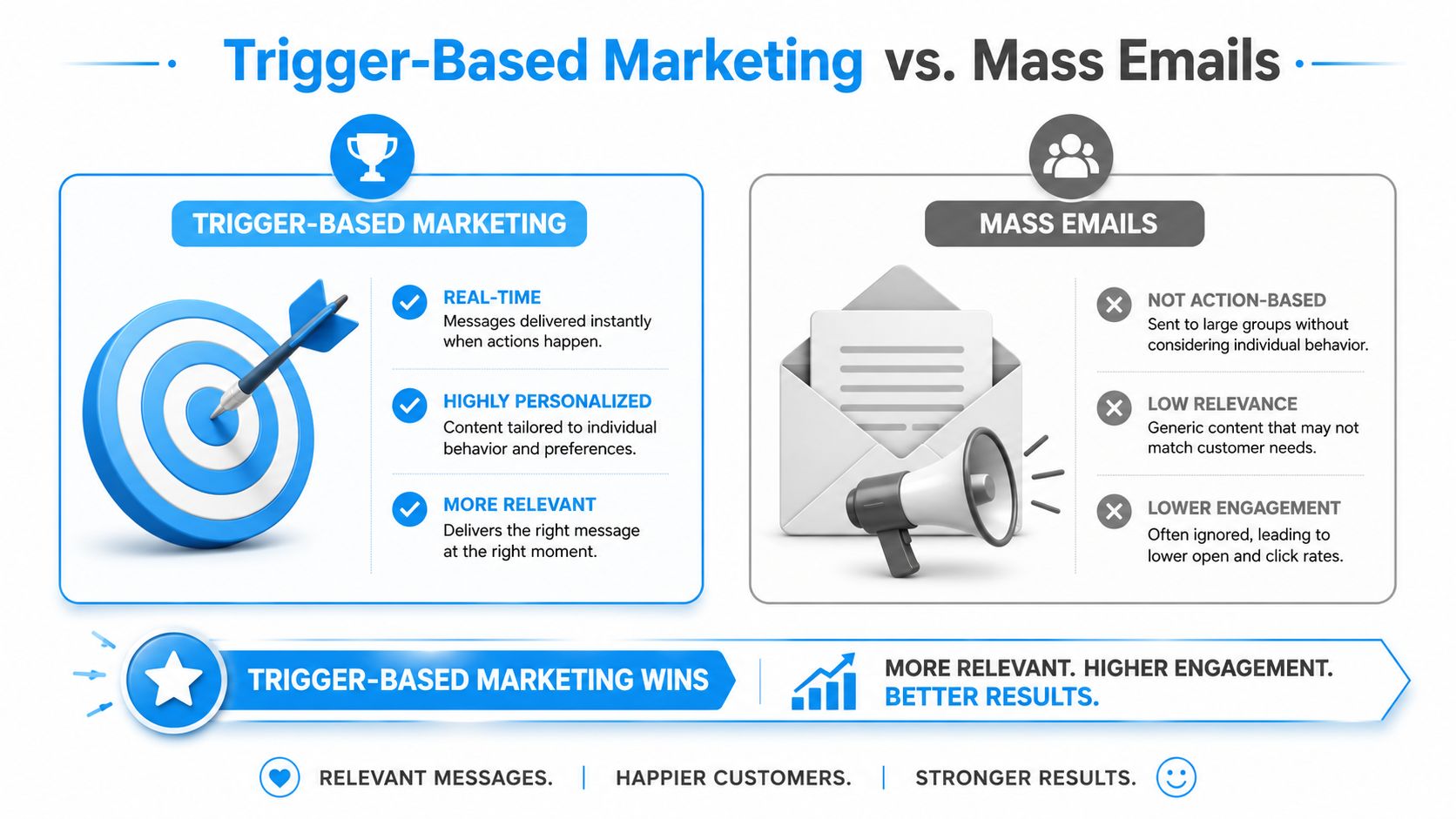
What the if then logic looks like
On Shopify, the trigger itself is usually straightforward. The hard part is mapping the right response.
- If a shopper abandons checkout, send a reminder with the product image, cart contents, and a clear route back.
- If a shopper views the same product multiple times, send a follow-up that reduces decision friction instead of jumping straight to a discount.
- If a first-time subscriber hasn’t purchased, move them into a welcome sequence that introduces category value, proof, and purchase motivation.
- If a payment fails or an order stalls, operational triggers matter too. This is where payment-event triggered email campaigns are useful to study because they sit at the intersection of customer experience and recovered revenue.
The biggest mistake teams make is treating triggers as “set it and forget it” flows. They aren’t. They’re decision trees. Delay windows, suppression rules, channel selection, and offer logic all matter.
Trigger based marketing versus traditional promotions
| Attribute | Traditional Promotions | Trigger-Based Marketing |
|---|---|---|
| Timing | Fixed to a calendar | Activated by customer behavior |
| Relevance | Broad segment assumption | Tied to a specific action or intent signal |
| Messaging | Same offer to many people | Contextual response based on what happened |
| Margin impact | Often relies on blanket discounting | Can reserve incentives for moments that need them |
| Customer experience | Repetitive and easy to ignore | More timely and harder to dismiss |
| Optimization | Campaign-level readout | Trigger-by-trigger refinement |
A lot of Shopify brands already have the plumbing for this through Shopify Email, Klaviyo, Attentive, Postscript, or their CRM. The gap usually isn’t tooling. It’s strategy. Teams know how to send flows, but not always how to decide which behavior deserves a message, which deserves an incentive, and which deserves silence.
If you want a useful companion read on deciding who should receive what, Quikly’s post on email marketing targeting is worth reviewing because targeting quality determines whether a trigger feels timely or just automated.
Key Triggers Every Shopify Store Should Use
A Shopify store does not need more automations. It needs the right triggers tied to the right margin decision.
That is the difference between trigger based marketing that recovers profitable demand and trigger based marketing that trains shoppers to wait for the next code. Each trigger reflects a different buying state, and each one should map to a specific behavioral principle, a clear customer obstacle, and a measured profit outcome.
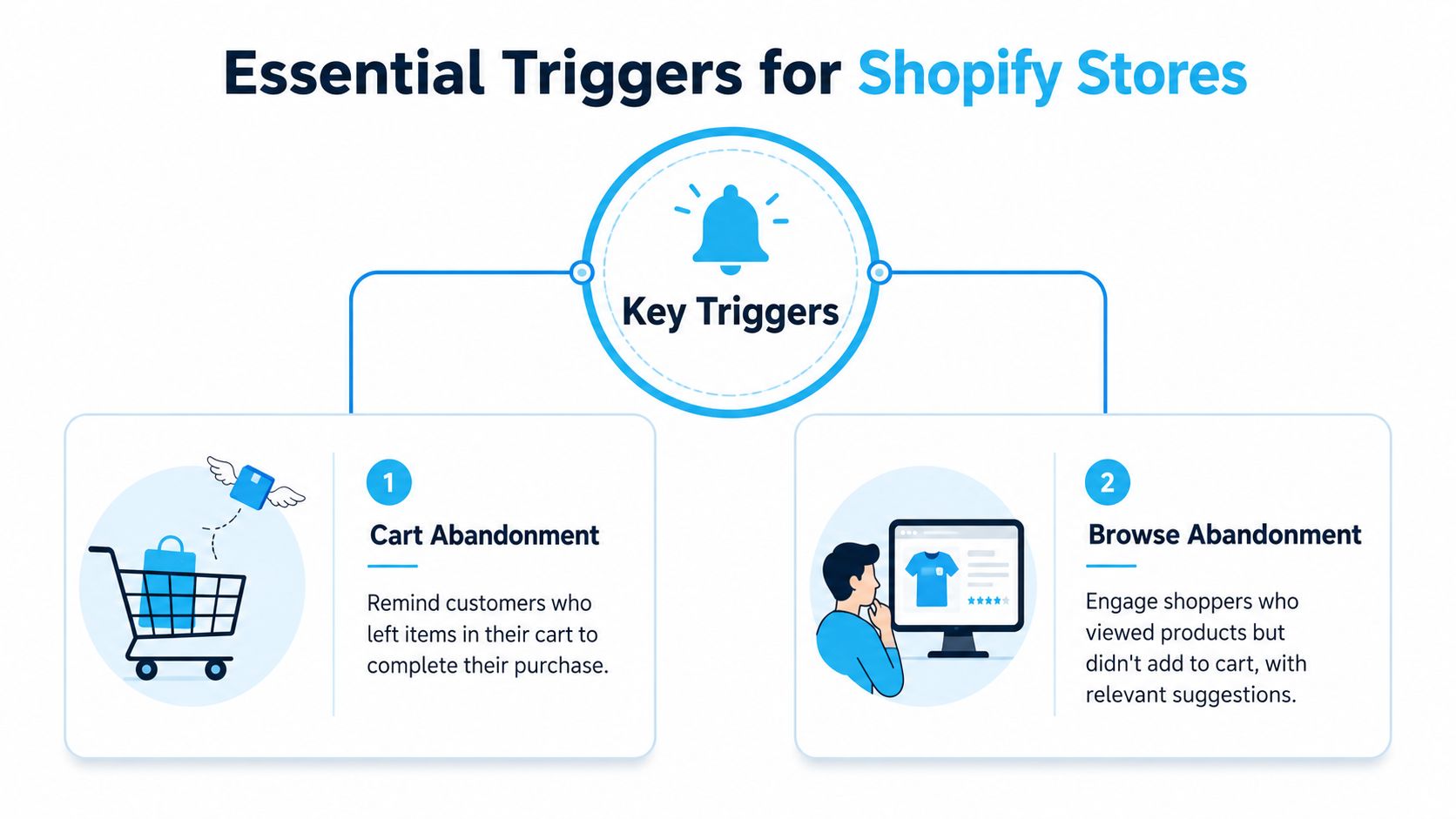
Cart abandonment and loss aversion
Cart abandonment usually sits closest to revenue. The shopper already chose a product, selected a variant, and started to picture ownership. The missed conversion often comes from friction, second thoughts, or interruption, not lack of interest.
Loss aversion matters here. Once an item feels mentally claimed, leaving it behind creates tension. A good cart recovery flow brings the shopper back to the decision with as little friction as possible.
For Shopify brands, the first message should protect margin before it offers an incentive. In practice, that means:
- Restoring context: Show the exact product, size, color, and cart contents.
- Reducing hesitation: Answer the likely objection with shipping timing, returns, reviews, or stock status.
- Shortening the path: Send traffic back to checkout or the saved cart, not the homepage.
Discounts still have a role. They just belong later in the sequence, after the store has tried to recover the order on relevance and convenience alone.
Browse abandonment and uncertainty reduction
Browse abandonment is a different problem. Interest exists, but conviction does not.
Shoppers in this stage are often comparing options, checking fit, or deciding whether the product solves the job they have in mind. A message that jumps straight to urgency can feel premature. A message that reduces uncertainty can move the sale without touching margin.
That might mean sending product education, social proof, category guidance, or a comparison between viewed items. If someone looked at the same product twice, the trigger should help them decide. It should not act like they are one reminder away from checkout.
For brands with replenishing or fast-selling inventory, browse intent also connects well to availability signals. Back-in-stock messaging for Shopify stores works because it reconnects existing product interest to a moment when the barrier has changed.
Welcome series and commitment consistency
A welcome trigger should do more than deliver a discount.
The signup itself is a small act of commitment. Commitment and consistency theory matters because people are more likely to keep moving in a direction they already started, especially when the next step feels coherent. The job of the welcome flow is to turn anonymous interest into a first order with a credible product path.
Strong welcome sequences usually do three things well. They confirm why joining was worthwhile, narrow the catalog to the few products most likely to fit, and remove uncertainty around the first purchase. That structure protects conversion and margin at the same time, because it relies less on blanket offers and more on guided discovery.
A skincare brand might sort by concern and routine. A fashion brand might sort by fit, bestseller status, and occasion. The point is the same. Give new subscribers a reason to choose, not just a reason to redeem.
Post-purchase follow-up and the endowment effect
Post-purchase triggers are one of the cleanest ways to improve customer economics because the hard part, trust, is already established.
The endowment effect explains why this moment matters. Once people feel ownership, they place more value on what they bought. Good follow-up messaging reinforces that choice, helps them get better use from the product, and introduces the next purchase only when it fits naturally.
For Shopify merchants, repeat rate is built here. Send care instructions, usage tips, setup guidance, replenishment reminders, or complementary product recommendations based on what was truly purchased. A post-purchase flow that feels useful increases the odds of a second order without relying on another broad promotion.
Win-back campaigns and salience decay
Win-back flows should react to fading relevance, not just a date threshold in the CRM.
As time passes, the memory of the product benefit weakens, inbox competition rises, and the customer has more chances to buy somewhere else. The core function of a win-back trigger is to restore salience. Bring the brand, category, or use case back into view before reaching for a discount.
That changes the economics of the campaign. Stores that lead with product newness, replenishment logic, seasonal relevance, or behavior-based recommendations often preserve more margin than stores that open every win-back with a coupon. Incentives still make sense for some lapsed segments, especially price-sensitive or one-time buyers. They should be used selectively, not automatically.
The operating principle is simple. High-intent triggers deserve friction removal first. Mid-funnel triggers need clarity. Retention triggers need usefulness. Lapsed-customer triggers need relevance. That is how trigger based marketing solves the conversion versus margin problem instead of making it worse.
Beyond Open Rates Measuring Triggers for Profitability
Email teams love opens, clicks, and conversion rates because they’re visible. Finance teams care whether the campaign created profitable demand. Those aren’t the same thing.
A trigger can generate a strong click rate and still be a bad campaign if it relies on unnecessary discounting, cannibalizes future full-price orders, or pulls purchases forward without creating incremental value. For Shopify brands, the useful question isn’t “did it convert?” It’s “did it improve the economics of this customer action?”
The metrics that matter more
Industry data says triggered emails can be 497% more effective than non-triggered emails, and some trigger-based campaigns have shown 775% higher conversion rates, according to Blueshift’s analysis of trigger campaign impact. Those gains are real, but they still don’t answer the full business question.
A better scorecard includes:
- Incrementality: Did the trigger capture orders that wouldn’t have happened anyway?
- Contribution margin: What did the campaign leave behind after discount cost and channel expense?
- Offer dependency: Did customers need the incentive, or were you subsidizing likely buyers?
- Retention effect: Did the triggered experience increase the chance of a second order?
A lower conversion rate can still be the better campaign
Many brands encounter a common pitfall. They compare two campaigns and choose the one with the higher conversion rate, even if it used more discounting and worse audience discipline.
A trigger that converts fewer people at healthier margins can outperform a broader campaign that wins more orders but weakens the business.
For example, a mass blast with a broad offer may drive more top-line revenue than a narrower behavior-based flow. But if the blast catches a large group of shoppers who were already close to purchasing, the “lift” is overstated. You paid for revenue you might have gotten anyway.
That’s why trigger based marketing works best when merchants think like operators, not just channel managers. The campaign report shouldn’t end at attributed revenue. It should ask whether the message was necessary, whether the incentive was justified, and whether the result was durable.
How to Implement Triggers on Shopify The Quikly Advantage
Most Shopify stores can launch basic triggers quickly. Shopify Email can handle simple automations. Klaviyo, Attentive, Postscript, and customer data tools can expand the logic. The stack isn’t the bottleneck anymore.
The bigger challenge is execution quality. Many triggered flows still look and feel like delayed batch campaigns. They’re technically automated, but strategically generic. Same design language. Same discount reflex. Same weak sense of urgency.
The standard implementation path
For most merchants, implementation starts with a handful of event types:
| Trigger | Typical Shopify setup | Common mistake |
|---|---|---|
| Cart abandonment | Klaviyo or Shopify flow tied to checkout/cart events | Sending a discount too early |
| Browse abandonment | Product-view event captured in email/SMS platform | Messaging without enough product context |
| Welcome series | Signup form to email flow | Treating the whole series like coupon delivery |
| Post-purchase | Order event into follow-up sequence | Jumping to upsell before product adoption |
| Win-back | Time-since-last-order logic | Re-engaging recent purchasers by mistake |
That setup is functional. It’s also where a lot of brands plateau. Once every trigger becomes another reminder email, response starts to compress.
Where a behavior-driven promotion changes the math
This is the difference between “automated marketing” and a real trigger strategy.
A standard cart abandonment flow says, “You left something behind.” A better one says, “There’s a reason to act now, and not everyone gets the same reward.” That changes shopper behavior because it introduces earned urgency instead of predictable discounting.
One way to approach that on Shopify is through marketing automation workflows that combine event data with controlled promotional logic. Instead of dropping a blanket code into every triggered message, the offer can depend on action, timing, audience, or inventory conditions.
Quikly finds its place. On Shopify, it can turn a standard trigger into a participation-based promotion built around real scarcity, engagement-driven rewards, and controlled exposure instead of sitewide discounting. That matters because urgency works best when it feels earned and specific, not broadcast to everyone at once.
What works better in practice
A few operating rules tend to separate healthy trigger programs from margin leaks:
- Use incentives last, not first: Recover intent before introducing a discount.
- Control audience exposure: Not every shopper needs to see the same reward.
- Match urgency to behavior: High-intent triggers can support stronger action cues than early-funnel ones.
- Build for brand fit: Trigger messages should look like your store, not your vendor’s default template.
Quikly’s broader model is built on psychology-backed mechanics refined across 60M+ consumer interactions, and the company cites examples such as about a 20% lift in profit for Jordan Craig along with incremental lift visible upon activation. The important takeaway isn’t the case study headline. It’s the operating principle. Trigger based marketing performs differently when the promotion itself is designed to shape behavior, not just distribute discounts.
For Shopify Plus teams, this often means tighter coordination between lifecycle marketing, merchandising, and promo strategy. For smaller teams, it means resisting the temptation to solve every conversion problem with another coupon flow.
Best Practices Avoiding Promo Fatigue and the Creepy Factor
The hardest part of trigger based marketing isn’t launching flows. It’s knowing when not to send them.
Cognism’s guidance on marketing triggers highlights a real risk: without frequency caps, audience exclusions, and channel-specific delays, trigger programs can become intrusive or overly personal, as noted in Cognism’s overview of trigger marketing best practices. That’s usually not a copy problem. It’s a governance problem.
Rules that protect both performance and trust
- Set cross-channel frequency caps: Email and SMS teams often optimize inside their own lanes. The customer experiences the combined volume.
- Use suppression aggressively: Recent purchasers, active subscribers in another flow, and customer service cases should all affect eligibility.
- Delay by trigger sensitivity: Cart reminders can be fast. Browse reminders usually need more breathing room.
- Avoid hyper-personal phrasing: Just because you can reference a detailed behavior doesn’t mean you should. Relevance should feel useful, not surveillance-based.
- Vary the incentive structure: If every trigger ends in a code, shoppers learn to wait for one.
- Audit overlapping automations: Shopify merchants often layer apps over time. That creates duplicate prompts and contradictory offers.
The best trigger programs feel attentive. The worst ones feel like the brand is hovering over the customer’s shoulder.
That line matters more for premium brands, but it applies everywhere. Relevance drives action. Overfamiliarity drives unsubscribes, opt-outs, and quiet brand damage.
Trigger based marketing works when the message fits the moment, the incentive fits the economics, and the experience still feels like your brand. That’s the standard. Not automation for its own sake.
If your store is relying on broad promotions to do the work that behavior-based messaging should be doing, it’s worth looking at Quikly. The practical value isn’t “more urgency.” It’s creating trigger-driven promotional experiences that can move shoppers to act without defaulting to blanket discounting.
Topics: conversion optimization, shopify marketing, trigger based marketing, ecommerce automation