You’ve probably seen the same pattern in your Shopify dashboard: email flows are doing dependable work, paid acquisition is getting more expensive, and someone suggests adding SMS because “everyone reads texts.” The suggestion isn’t wrong, but it leaves out the expensive part. A text message competes for a customer’s most immediate attention, and a careless send can trade short-term clicks for margin pressure, unsubscribes, and a smaller audience you can’t easily rebuild.
Text message marketing for Shopify works best when it earns a specific role that email, onsite conversion, and existing retention flows aren’t already handling. The right setup starts with a readiness decision, then moves through consent, app selection, lifecycle mapping, list hygiene, cadence, and measurement.
Whether SMS Earns a Place on Your Store
SMS shouldn’t be treated as a free extension of email. It has direct costs, including carrier and platform charges, compliance work, and the opportunity cost of using a high-attention channel for messages that could have gone through email. A weak campaign also burns trust faster because customers see texts almost immediately. EZ Texting’s consumer texting report says 25% of consumers check messages immediately, 84% read new texts within 15 minutes, and close to 70% receive two or more business texts per day.
That immediacy is useful for launches, inventory alerts, and time-sensitive offers. It’s wasteful for a generic discount that repeats the same message your email program already sent.
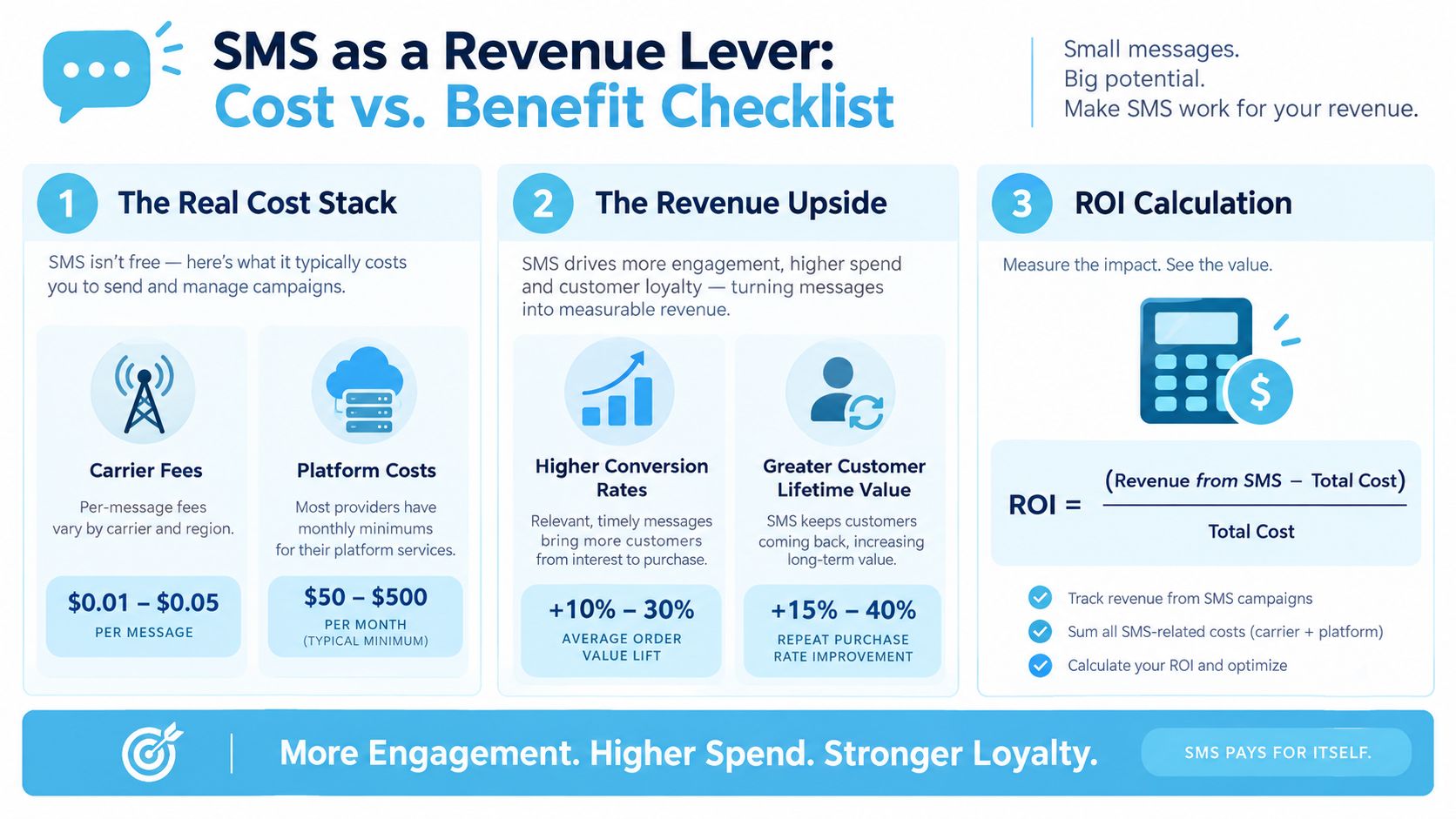
A practical readiness threshold
Before activating SMS, I’d want three conditions in place:
- Email flows produce predictable revenue. Welcome, abandoned cart, and post-purchase sequences should be live, tested, and connected to the right Shopify events.
- Inactive automation has been removed. Suppressed and sunset profiles shouldn’t remain in active campaigns just because the app still stores them.
- The product economics can support a controlled test. A small, well-timed conversion lift needs to improve net profit after message, platform, discount, and operational costs. A percentage lift without a margin calculation can make a campaign look successful while weakening the business.
If those conditions aren’t true, improve email and onsite conversion first. A better welcome sequence can reach more people without adding another consent system. A clearer product page can convert existing traffic without paying to interrupt a customer in a private channel.
SMS has earned a place when it adds incremental revenue, not when it merely takes credit for a purchase that email or the storefront would have generated anyway. That distinction matters even more as promotions become more aggressive. Constant discounts can train shoppers to wait, reduce perceived value, and force the brand toward deeper offers. A behavior-driven promotion, such as one where access or reward depends on acting within a real limit, gives urgency a defined job without making every customer wait for a markdown.
Choosing the Right Shopify SMS App
The best Shopify SMS app depends less on the longest feature list than on where your customer data already lives and who will operate the program. If Klaviyo is your email and customer-data backbone, keeping email and SMS profiles together may reduce audience and attribution friction. If SMS is the core retention channel, an SMS-first platform with dedicated compliance and deliverability support may justify a higher operating cost. Lighter tools can suit smaller lists, but lower pricing often comes with trade-offs in support, replies, or message billing.
Start with six checks:
- Consent controls: Can the app manage Shopify checkout opt-ins without treating email consent as SMS consent?
- Checkout compatibility: Does it support both Shopify Customer Accounts and Checkout Extensibility where your store uses them?
- MMS economics: Are image and media messages priced clearly, including incoming messages?
- Consent records: Does each subscriber record include the timestamp, source, and language presented at opt-in?
- List growth: Can you collect permission through checkout, keywords, onsite forms, and POS without scraping email addresses?
- Scaling cost: Does the pricing model remain understandable as your list and reply volume grow?
Shopify’s own SMS deliverability guidance emphasizes that email consent doesn’t transfer to SMS and that number hygiene, filtering, and explicit opt-in affect deliverability. That makes compliance support an operating requirement, not an optional add-on. Merchants comparing the wider app ecosystem can also review this guide to best Shopify marketing apps, then narrow the shortlist based on SMS-specific consent and reporting needs. For stores assessing broader channel connections, SMS integrations for Shopify is a useful reference point.
| App | Best Fit | Pricing Model | Consent Logging | MMS Support | Email Integration |
|---|---|---|---|---|---|
| Klaviyo SMS | Stores already using Klaviyo for email and customer data | Combined platform and usage pricing | Confirm timestamp and source fields before launch | Confirm media fees and limits | Native email and profile integration |
| Postscript | SMS-first Shopify teams | Platform plus message usage | Review compliance records and export options | Available, with cost review required | Usually paired with a separate email platform |
| Attentive | Larger teams needing dedicated SMS operations | Custom or enterprise pricing | Strong compliance tooling, verify implementation details | Available, with contract review | Integrates with existing marketing systems |
| SMSBump | Smaller or growing Shopify programs | Usage or tier-based pricing | Validate source and consent-history access | Available, check incoming-message billing | Connects with email tools |
| Omnisend | Teams wanting email, SMS, and push in one workflow | Platform tiers plus channel usage | Confirm channel-specific records | Available, review country coverage | Native multi-channel workflows |
Cheap per-message pricing can become expensive when incoming replies, MMS, international delivery, or carrier filtering require manual work. Pick the system your team can audit and improve, not the one that looks cheapest before the first customer responds.
Setting Up Compliant Consent Capture
Consent is infrastructure. Build it as a record of what a person agreed to, where they agreed to it, and when they agreed, rather than as a checkbox that only increases the subscriber count.
Shopify recommends collecting explicit SMS permission through supported opt-in surfaces and warns that an email address or prior purchase doesn’t authorize marketing texts. Shopify also added SMS marketing opt-ins to POS in 2026, which means retail teams need the same discipline as ecommerce teams.
Use clear language at every surface
At checkout, place the SMS option near the relevant marketing preference and state the program plainly:
Example checkout disclosure: “I agree to receive recurring marketing text messages from [Brand] at the number provided. Consent isn’t required to purchase. Message frequency varies. Message and data rates may apply. Reply STOP to opt out. View Terms and Privacy Policy.”
For a keyword form, show the keyword, the expected message type, the frequency disclosure, carrier language, and STOP instructions before submission. A POS associate should read the same disclosure aloud, then record the customer’s number and the source as POS, rather than adding the number later from a receipt or customer profile.
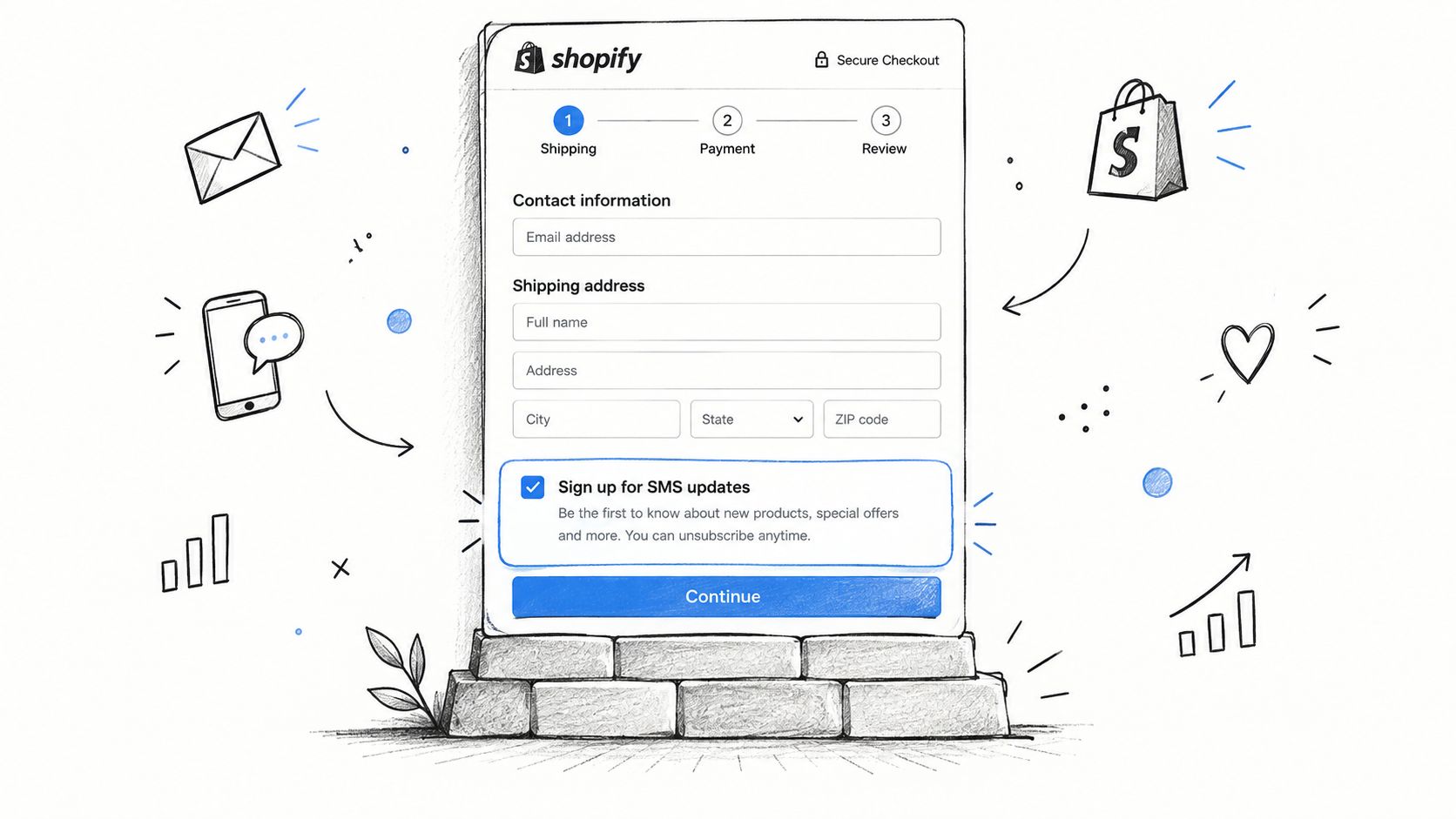
Popup and exit-intent forms need the disclosure above the submit button or directly beside it. Hiding terms in a footer link makes the record harder to defend and the customer less likely to understand what they’re joining. The same principle applies to lead capture forms, where the form’s conversion goal can’t come at the expense of clear permission.
The shortcut to avoid is importing an email list or assuming a past purchaser wants marketing texts. Email consent doesn’t become SMS consent, and a list built that way creates both deliverability and legal exposure. Keep the source, timestamp, form version, and consent language available for every subscriber.
Mapping Message Types to the Customer Lifecycle
A Shopify operator should earn the right to send the first marketing text. SMS carries a higher attention cost than email, so launch only after email automation, product pages, and checkout recovery are doing their basic jobs. Each SMS flow must fill a lifecycle gap, reflect a clear customer intent, and have a reason to exist beside email rather than repeat it.
| Message Type | Funnel Stage | Typical Revenue per Recipient | Watch Out For |
|---|---|---|---|
| Welcome | New subscriber | Plan around $0.66 to $2.41 revenue per recipient as a starting envelope, then refine against your own first 30 days of sends. ClickMinded | Sending the same discount immediately to every new subscriber |
| Browse abandonment | Product consideration | Use the welcome-flow range as an initial planning envelope, then measure this flow separately from cart recovery | Texting a low-intent visitor before the product has earned attention |
| Cart abandonment | High purchase intent | Track placed orders and revenue per recipient. Ecommerce placed-order benchmarks have ranged from 1.0% to 2.0% | Repeating an email reminder with a deeper discount |
| Shipping or delivery update | Post-purchase trust | Judge support deflection and customer experience, not promotional revenue | Adding sales language to a message opened for order information |
| Back in stock | Purchase intent | Compare revenue per recipient with the product’s prior demand and the size of the request list | Alerting a broad audience instead of people who requested availability |
| Win-back | Retention | Calculate revenue separately for recent buyers and genuinely lapsed customers before choosing an offer | Discounting for customers who would have purchased without one |
| Broadcast sale | Active promotion | Broad ecommerce SMS click rates have been benchmarked between 8.9% and 14.5%. Revenue still depends heavily on audience and offer. | Sending to a cold or unfiltered list and treating clicks as success |
The ClickMinded figures are planning references, not targets. Your product margin, average order value, offer strength, and audience quality can move results substantially, so set internal thresholds after the first clean measurement period.
Prioritize intent-led messages, then retention, then broad promotion. Cart recovery, back-in-stock alerts, and selected welcome messages have a defensible role because the customer has already signaled interest. Shipping updates belong for a different reason: they reduce uncertainty and support trust. They should not become disguised sales messages.
Automated flows deserve separate measurement. Omnisend’s SMS benchmark coverage reports automated messages generating 5x more revenue per send than broadcast campaigns across 150,000 brands, while its reported average campaign conversion rate was 0.12%. Omnisend’s SMS benchmark coverage supports a practical rule: evaluate completed purchases and revenue per recipient, not an attractive click rate alone. SMS earns its place when it adds timely attention that email cannot provide without duplicating the same message.
Segmenting and Maintaining a Healthy List
A healthy SMS list is smaller than an email database and more deliberately organized. Start with two major groups, subscribers with no purchase and customers who have bought. Their next message shouldn’t have the same job. A nonbuyer may need product education or a carefully bounded first offer, while a recent buyer may need replenishment guidance, complementary products, or no promotional message at all.
Suppress recent converters from a promotion when the offer doesn’t add value for them. Split by region when local time, shipping availability, or product eligibility changes the message. Keep VIP or loyalty tags synchronized between Shopify, your email platform, and the SMS app so a customer’s value tier doesn’t disappear when the channel changes.
Run a repeatable hygiene loop
- Remove opt-outs quickly: Process STOP responses and suppression events promptly, then keep them excluded from future sends.
- Watch silent disengagement: Falling clicks, fewer replies, and repeated non-engagement are warning signs before a visible unsubscribe.
- Separate recent activity: Don’t invite a customer who just ordered to buy the same product again unless the message has a clear replenishment reason.
- Review regional rules: Filter by country, state, timezone, inventory, and shipping promise before scheduling.
- Reconcile records: Check Shopify tags, customer status, and SMS attributes on a regular operating schedule.
The full-email-list import is the fastest way to make a new SMS program look large and perform poorly. List size matters less than permission, recent intent, and message relevance. SMS marketing best practices for Shopify can help teams turn those principles into an operating checklist, but the core rule is simple: send fewer messages to people with a reason to care.
Sending Frequency and Timing That Respects
Cadence is a behavioral contract. Every message teaches subscribers what the next message will feel like, and their tolerance depends on the value of the previous send. A useful product alert or a limited offer can preserve attention. A repetitive discount can make the next text feel like an interruption before the customer reads it.
For a new program, start with one or two sends per month as an operating baseline, then increase frequency only for segments that demonstrate purchase intent. Don’t treat that cadence as a universal rule. A replenishment brand, a seasonal retailer, and a luxury product have different natural communication rhythms.
Practical rule: Earn the second text before you plan the third.
Timing needs testing rather than superstition. 6 p.m. local time is a default, not a best practice. A Tuesday morning can outperform a Friday afternoon if the audience shops during work breaks, if the offer supports weekday purchasing, or if Friday messages compete with other commercial noise. Test local time, message purpose, and audience state together instead of declaring one winning send hour for the entire list.
Read early warning signals before opt-outs become the headline. CTR decay suggests the audience is tiring or the offer is losing relevance. Reply spikes can indicate confusion, missing product information, or an operational problem. Quiet unsubscribes, including declining engagement without an immediate STOP response, often tell you that the perceived value of the channel is falling.
The right question isn’t how many texts you can send. It’s whether the next text deserves the attention you’re asking for.
Launch Checklist and What to Measure First
A quiet launch is safer than a list-wide blast. Verify the consent record, test the opt-in keyword, confirm the abandoned-cart flow, seed a clearly defined segment, import the suppression list, and check the Shopify order event before sending to a limited audience.
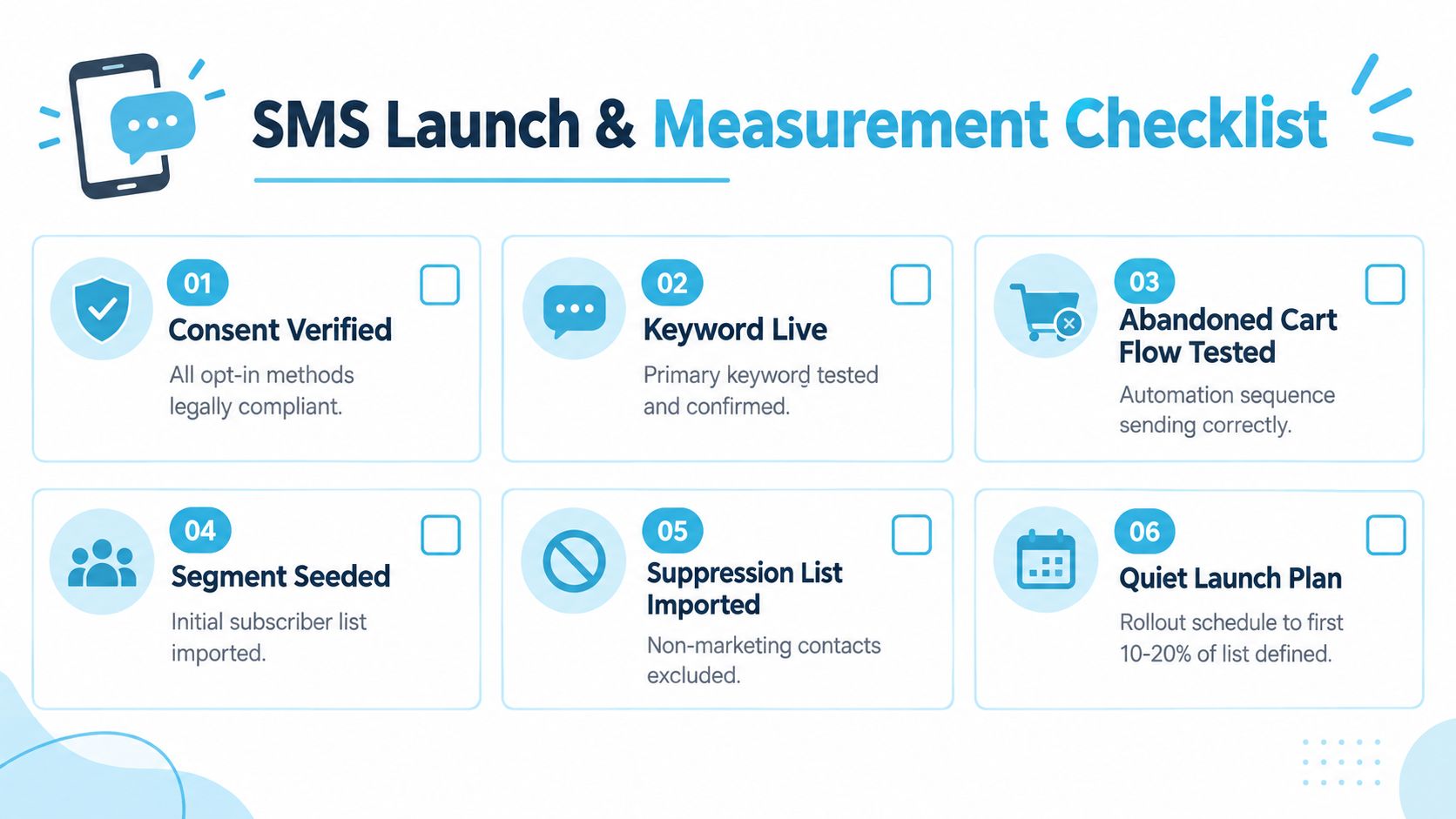
The first measurement window
Don’t make click-through rate the headline metric. One benchmark reported a 12.39% average click-through rate across more than 246 million sends and 96.6% deliverability, while another benchmark reported a 98% SMS open rate versus 30.7% for email. AudienceTap’s benchmark summary and Digital Applied’s 2026 benchmark report show why attention can look excellent while purchase impact still needs careful validation.
Track these four measures during the first 14 days:
- Opt-in rate during the first 30 days: Is the store attracting permission from qualified shoppers, or just adding volume through an aggressive form?
- First-message purchase conversion within 48 hours: Did the initial message create incremental orders, or only clicks?
- Revenue per recipient compared with email: Use the same audience and funnel context where possible, rather than comparing a high-intent SMS flow with a broad email send.
- Unsubscribe rate per send: A campaign that generates revenue while damaging the list may be borrowing from future performance.
Also compare results by send type. A broad ecommerce program has reported median click-through rates of 11.4%, while flash-sale apparel campaigns have reported 14.6%, yet those figures don’t establish profitability by themselves. Digital Applied’s benchmark data supports using placed orders and revenue per recipient as the decision metrics.
SMS should earn expansion through incremental revenue and healthy list growth, not through attention metrics in isolation. For merchants testing urgency without defaulting to deeper discounts, Quikly creates time- and quantity-bound promotional experiences that can run across storefront, email, social, and SMS, with on-brand presentation and rewards tied to acting early.
If SMS is earning consideration but your promotions still depend on blanket discounts, visit Quikly to see how Shopify brands can turn an offer into a controlled urgency experience. Start by evaluating one campaign where faster action could improve conversion without training customers to wait for the next markdown.
Topics: text message marketing shopify, shopify sms, sms marketing, klaviyo sms, shopify apps